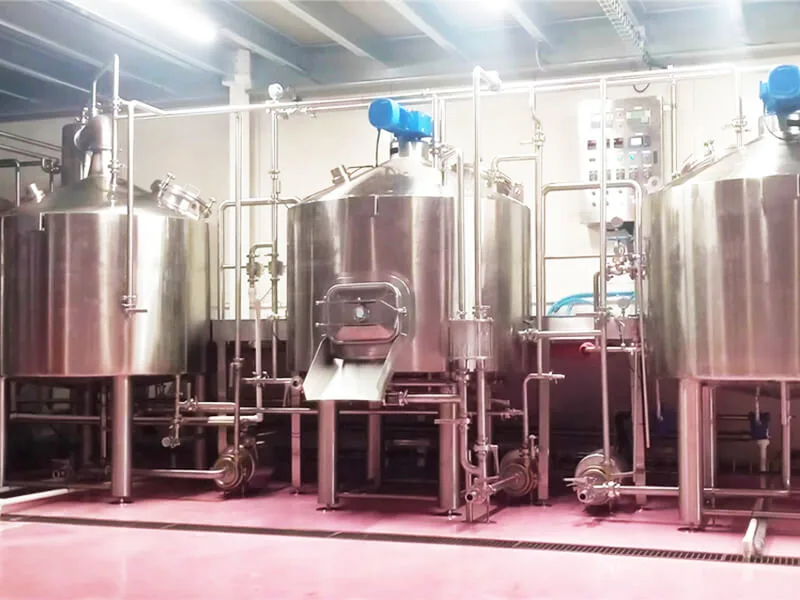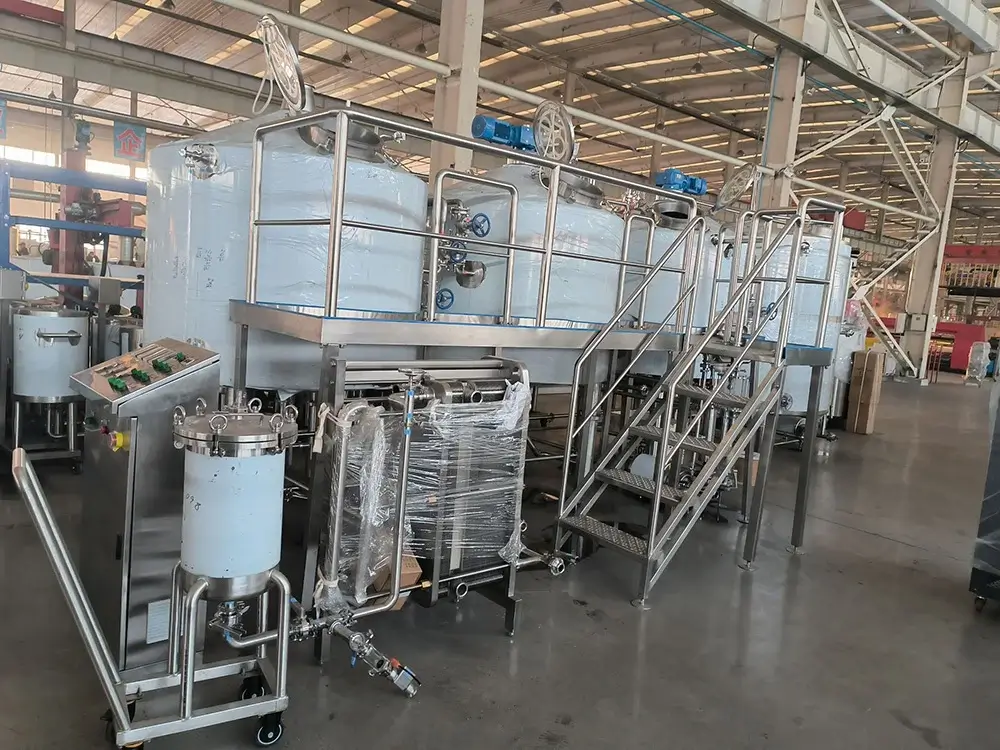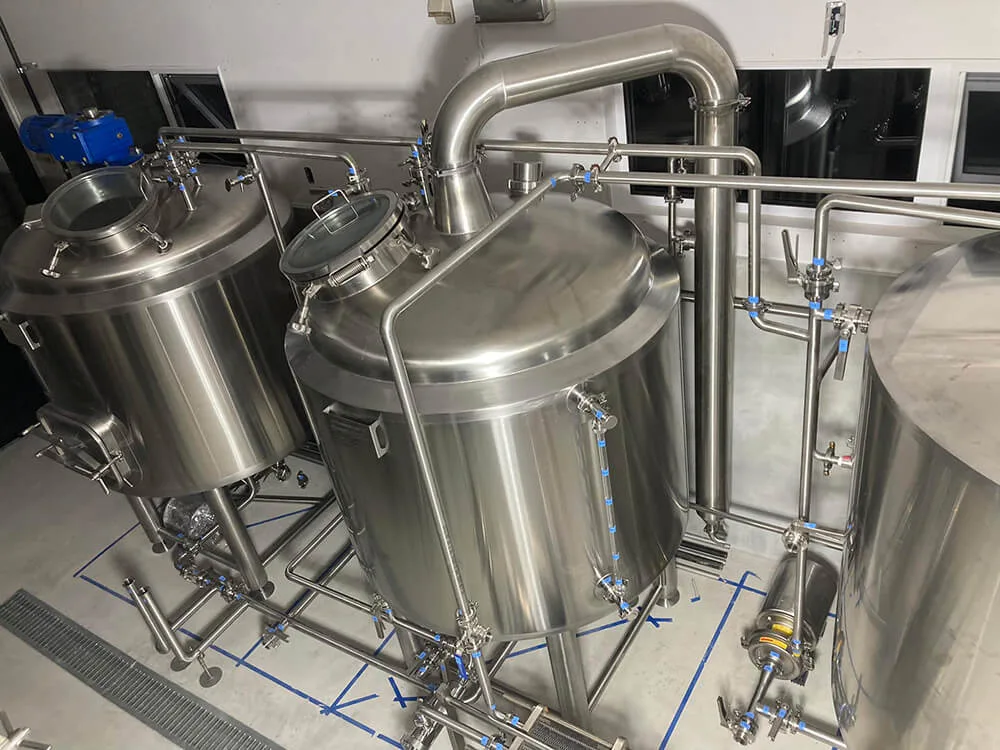
La conception d'une petite cave commerciale ne se résume pas au simple choix de quelques cuves de fermentation. La capacité de production, le mode de traitement du raisin, le processus de fermentation, le vieillissement, l'assemblage, la filtration, le refroidissement, le nettoyage et le conditionnement doivent être considérés comme un système intégré.
Pour un petit domaine viticole, l'objectif est généralement de mettre en place un système compact, pratique, facile à utiliser et suffisamment modulable pour s'adapter à une croissance future.
La configuration adéquate dépend des types de vins, de l'objectif de production annuel, de la taille des lots, de l'espace disponible dans les locaux, des services publics, de la main-d'œuvre et du processus de production.
1. Définissez l'objectif de production de votre domaine viticole
La première étape consiste à déterminer la quantité de vin que vous comptez produire.
Votre objectif de production a une incidence sur :
- Capacité de traitement du raisin
- Capacité des cuves de fermentation
- Vieillissement et capacité de stockage
- Exigences en matière de refroidissement
- Capacité de filtration
- Capacité d'emballage
- Dimensions du système CIP
Il est important de faire la distinction entre la capacité des réservoirs et la production annuelle.
Par exemple, le fait qu'une cave dispose d'une cuve de fermentation de 1 000 litres ne signifie pas qu'elle ne peut produire que 1 000 litres de vin par an. La présence de plusieurs cuves et la mise en place de cycles de production multiples peuvent augmenter considérablement la production annuelle.
Pour les petits domaines viticoles, disposer de plusieurs cuves de plus petite taille peut également offrir une plus grande flexibilité en fonction des cépages, des recettes et des lots de fermentation.
2. Présenter le processus complet de production du vin
Avant de choisir le matériel, définissez l'ensemble du processus de production.
Voici un exemple de processus typique dans un petit domaine viticole commercial :
Réception des raisins → Foulage/égrappage → Dépépignage ou pressurage → Stockage intermédiaire → Fermentation → Élevage → Assemblage → Filtration → Stockage → Conditionnement
Toutes les caves n'ont pas nécessairement besoin de tous les procédés ou de toutes les machines. La configuration doit être adaptée aux styles de vin et aux méthodes de production réels.
La disposition des équipements doit suivre autant que possible le déroulement du processus. Cela permet de réduire les manutentions inutiles et facilite le nettoyage et l'entretien.
3. Choisir les cuves de fermentation adaptées
Les cuves de fermentation sont au cœur de la production viticole.
Les cuves en acier inoxydable sont largement utilisées car elles offrent :
- Surfaces hygiéniques
- Résistance à la corrosion
- Nettoyage facile
- Contrôle de la température
- Longue durée de vie
- Options de capacité flexibles
Pour un petit domaine viticole, l'utilisation de plusieurs cuves plutôt que d'une seule grande cuve peut permettre une plus grande flexibilité dans la production.
Par exemple, on peut affecter des cuves distinctes à différents cépages, lots ou styles de vin.
Les cuves de fermentation à double enveloppe permettent également de réguler la température pendant la fermentation, ce qui est important lorsqu'il est nécessaire de maintenir des conditions de fermentation constantes.
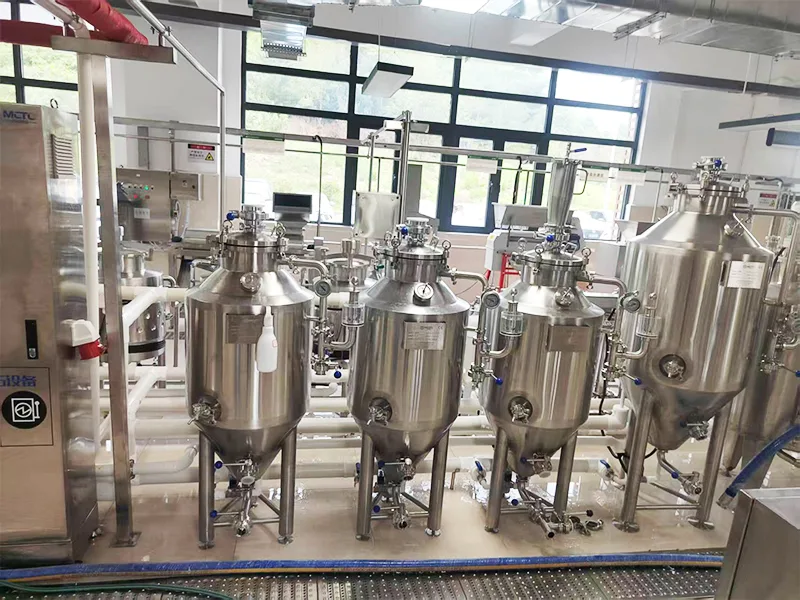
4. Planifier conjointement les capacités de fermentation et de vieillissement
La capacité de fermentation ne doit pas être considérée indépendamment de la capacité de vieillissement et de stockage.
Après la fermentation, le vin peut rester dans des cuves à des fins de clarification, de maturation, d'assemblage ou de stockage temporaire avant d'être filtré et conditionné.
Un système concret peut donc comprendre :
Cuves de fermentation → Cuves d'élevage → Cuve d'assemblage → Filtration → Stockage du vin fini
Le nombre de réservoirs nécessaires dépend :
- Production annuelle
- La saison des récoltes
- Durée de fermentation
- Durée de vieillissement
- Rotation des réservoirs
- Nombre de cépages
Si un domaine viticole vinifie plusieurs cépages, l'utilisation de plusieurs cuves plus petites peut offrir une plus grande souplesse de production.
5. Conception du système de prétraitement
La partie amont de la cave doit être adaptée à la capacité de fermentation en aval.
En fonction des matières premières et du style de vin, le prétraitement peut comprendre :
- Égrappage
- Broyage
- Dénoyautage
- Dépulpage
- Pressage
- Mise en mémoire tampon
- Transfert de jus
Par exemple, un système de production de vin de fruits peut nécessiter un traitement supplémentaire des fruits par rapport à une cave à vin traditionnelle.
Le choix des équipements de transformation doit être effectué en fonction du volume prévu de matières premières et de la taille des lots.
Des équipements de prétraitement surdimensionnés peuvent entraîner une augmentation des coûts d'investissement et des besoins en espace, tandis que des équipements sous-dimensionnés risquent de constituer un goulot d'étranglement dans la production.
6. Utiliser des réservoirs tampons pour relier les différentes étapes du processus
Les cuves tampons peuvent offrir une flexibilité utile entre le traitement des matières premières et la fermentation.
Ils permettent de stocker temporairement du jus ou des matières transformées avant leur transfert vers les cuves de fermentation.
Dans le cas des petits systèmes de production, un réservoir tampon correctement dimensionné peut permettre de coordonner des équipements ayant des capacités de traitement différentes.
Le matériau de la cuve, le volume utile, le système de régulation de la température, les raccords et les connexions de transfert doivent être choisis en fonction du produit et du procédé.
7. Contrôler la température de fermentation
Le contrôle de la température est l'un des éléments clés à prendre en compte dans la conception d'une cave à vin.
Selon le vin et le procédé de fermentation, il peut être nécessaire de refroidir les cuves de fermentation.
Un système de refroidissement classique peut comprendre :
- Refroidisseur à glycol
- Réservoir de refroidissement ou réservoir tampon
- Pompes de circulation
- Cuves de fermentation à double enveloppe
- Capteurs de température
- Système de contrôle
La capacité de refroidissement doit être calculée en fonction du nombre et de la taille des cuves, des conditions de fermentation, de la température ambiante et du calendrier de production.
Pour les petits domaines viticoles commerciaux, un système de refroidissement centralisé permet de réguler la température de plusieurs cuves tout en conservant un système relativement compact.
8. Planification des cuves de vieillissement et de stockage
Une fois la fermentation terminée, le vin peut nécessiter un temps supplémentaire pour le vieillissement, la clarification ou la stabilisation.
Les cuves de vieillissement peuvent être équipées d'un système de régulation de la température si nécessaire.
La capacité doit être déterminée en fonction du volume de vin prévu et du temps de séjour.
Par exemple, si le vin reste en stockage pendant plusieurs semaines ou plusieurs mois, la capacité de stockage devra peut-être être nettement supérieure au volume traité lors d'un seul cycle de fermentation.
C'est l'une des raisons pour lesquelles la conception des équipements viticoles doit prendre en compte l'ensemble du cycle de production, et non pas uniquement la capacité de fermentation.
9. Intégrer les étapes de mélange et de filtration
Le mélange et la filtration peuvent constituer des étapes importantes avant le stockage ou le conditionnement final.
Une cuve de mélange permet de mélanger de manière contrôlée différents lots de vin ou différents ingrédients.
En fonction des exigences liées au produit, la filtration peut inclure :
- Filtration par cartouche ou en duplex
- Filtration sur membrane
- Autres systèmes de filtration sanitaire adaptés
Le système de filtration doit être choisi en fonction du débit requis, des caractéristiques du vin et des spécifications du produit final.
Pour les petits domaines viticoles, les équipements de filtration modulaires offrent une grande souplesse sans occuper beaucoup d'espace.
10. Concevoir le système de nettoyage CIP
Le nettoyage doit être pris en compte dès la conception de la cave.
Les cuves, les pompes, les conduites de transfert, les équipements de filtration et les autres composants du processus doivent être nettoyés et désinfectés régulièrement.
Un système CIP peut comprendre :
- Cuve CIP
- Pompe de nettoyage
- Dispositifs de pulvérisation
- Tuyauterie
- Vannes
- Contrôle de la température
- Système de contrôle
La taille et la configuration dépendent du nombre de cuves et d'équipements à nettoyer.
Pour une cave de petite taille, un système CIP bien conçu peut améliorer la régularité du nettoyage tout en réduisant les interventions manuelles.
11. Envisager l'automatisation pour un meilleur contrôle des processus
Même un petit domaine viticole peut tirer profit de l'automatisation.
Un système de contrôle permet de surveiller et de contrôler :
- Température de fermentation
- Refroidissement
- Fonctionnement de la pompe
- Température du réservoir
- Opérations de transfert
- Procédures CIP
Par exemple, un système de commande basé sur un automate programmable (PLC) et doté d'un écran tactile IHM permet aux opérateurs de surveiller plusieurs cuves de fermentation à partir d'une interface centrale.
Le niveau d'automatisation approprié dépend de l'échelle de production, de la disponibilité de la main-d'œuvre, de la complexité des processus et du budget.
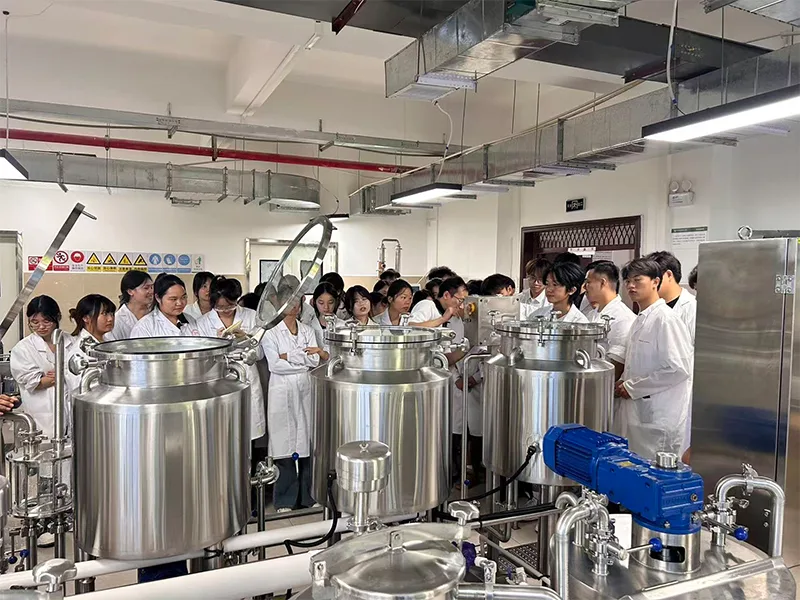
12. Exemple concret de projet : un système de production d'apprentissage pour la fabrication de vin de fruits d'une capacité de 50 litres
Un exemple concret de conception d'un système de vinification à petite échelle est illustré par un projet METO récent mené pour l'École professionnelle d'ingénierie alimentaire du Guizhou, en Chine.
Ce projet a été développé dans le cadre d'un centre de formation complet dédié à la biotechnologie alimentaire et comprenait un système de formation spécialisé de 50 litres destiné à la fabrication de vin de fruits.
Bien que ce projet ait été conçu à des fins pédagogiques et de formation aux procédés plutôt que pour une production commerciale, sa configuration montre comment un cycle complet de vinification à petite échelle peut être organisé autour d'une capacité de production compacte.
Le système des vins de fruits comprend :
Prétraitement → Fermentation → Vieillissement → Assemblage → Filtration → Nettoyage CIP
Sa configuration de base comprend :
- Égrappoir-fouloir
- Dépierreur-décortiqueur
- Réservoirs tampons de 50 litres
- Presse hermétique de 50 litres avec protection à l'azote
- Quatre cuves de fermentation de 50 litres
- Deux cuves de vieillissement de 50 litres
- Cuve de mélange de 50 litres
- Filtration en double étage
- Filtration sur membrane
- Pompes de transfert de produits
- Système CIP de 100 litres
- Automate programmable Siemens et commande par écran tactile
Les cuves de fermentation sont en acier inoxydable et équipées d'une double paroi permettant le refroidissement et le contrôle de la température. Les cuves de vieillissement sont également dotées d'un système de contrôle de la température, tandis que la conception hermétique des systèmes de pressage et de transfert permet de réduire l'exposition à l'oxygène pendant la transformation.
Ce projet illustre un principe important dans la conception des petits domaines viticoles : la capacité des équipements doit être adaptée au flux de production plutôt que choisie en fonction de machines prises isolément.
Ce même principe de conception peut être appliqué lors de la mise en place d'une cave commerciale de plus grande envergure. Il est possible d'augmenter les capacités des équipements tout en conservant la même logique de processus de base.
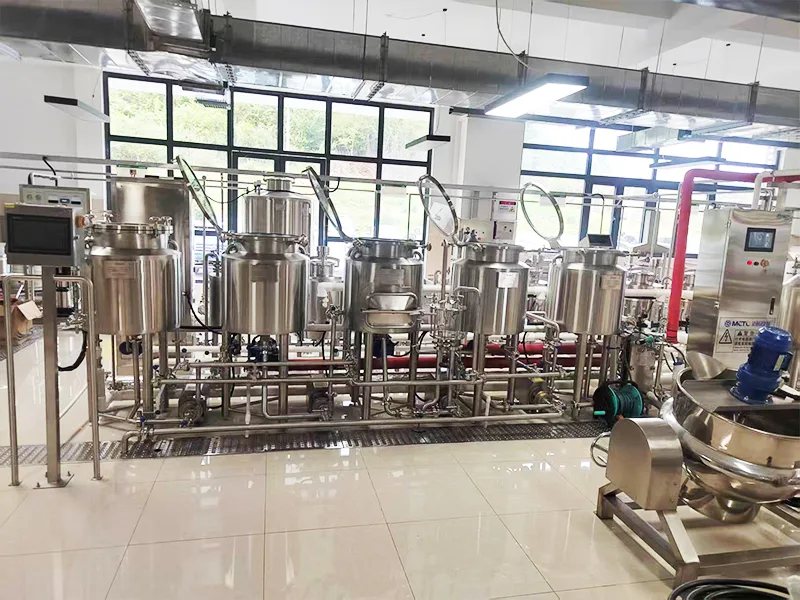
13. Concevoir l'agencement de la cave en fonction du processus
Une petite exploitation viticole commerciale doit exploiter au mieux l'espace dont elle dispose.
Une configuration type peut comprendre :
Zone des matières premières
Réception, foulage, égrappage et transformation du raisin ou des fruits.
Zone de fermentation
Cuves de fermentation et équipements de régulation de la température.
Zone de vieillissement et de stockage
Cuves de vieillissement, cuves de stockage et cuves de conservation du vin fini.
Zone de filtration et de mélange
Équipements de mélange, de filtration et de transfert.
Zone d'emballage
Mise en bouteille, étiquetage et manutention des produits finis.
Espace de rangement
Refroidissement, nettoyage en place (CIP), traitement de l'eau, équipements électriques et autres services techniques.
Il convient de prévoir un espace de travail suffisant autour des réservoirs pour permettre leur exploitation, leur inspection, leur nettoyage et leur entretien.
Avant de commander du matériel, vérifiez également :
- Dimensions de la porte
- Hauteur sous plafond
- Charge au sol
- Drainage
- Accès au matériel
- Emplacements des raccordements aux réseaux publics
14. Prévoir les raccordements aux réseaux avant l'installation des équipements
Le chantier doit être préparé avant l'arrivée du matériel.
En fonction de la configuration de la cave, les équipements peuvent inclure :
- Eau de process
- Énergie électrique
- Refroidissement
- Air comprimé
- Drainage
- Ventilation
- Produits d'entretien
Les exigences précises dépendent de la configuration de l'équipement et des conditions locales.
L'eau et l'évacuation des eaux usées revêtent une importance particulière, car les activités d'une cave nécessitent des opérations fréquentes de nettoyage et de transfert de liquides.
Les besoins en électricité doivent inclure les pompes, les systèmes de refroidissement, les armoires de commande, les équipements de filtration et les machines d'emballage.
15. Prévoir une expansion future
Un petit domaine viticole pourrait, à terme, augmenter sa production.
Lors de la conception initiale du système, vérifiez si le site peut accueillir :
- Cuves de fermentation supplémentaires
- Cuves de vieillissement plus grandes
- Augmentation de la puissance frigorifique
- Espace de stockage supplémentaire
- Systèmes CIP de plus grande taille
- Filtration à plus grande capacité
- Améliorations apportées aux emballages
Une conception modulaire peut faciliter les extensions futures.
Par exemple, une cave à vin peut commencer par plusieurs cuves de fermentation de 500 L ou 1 000 L, puis ajouter par la suite des cuves de 2 000 L, 5 000 L ou de plus grande capacité.
Prévoir suffisamment d'espace et de capacité des réseaux dès la phase initiale du projet permet de réduire les coûts et les perturbations liés à une extension future.
16. Travailler avec un fabricant d'équipements pour caves à vin
Une petite exploitation viticole commerciale constitue un système de production intégré plutôt qu'un simple ensemble de cuves individuelles.
La fermentation, le vieillissement, l'assemblage, la filtration, le refroidissement, le nettoyage en place (CIP), le transfert et le conditionnement doivent être conçus de manière intégrée.
Travailler directement avec un fabricant d'équipements pour les caves peut faciliter la coordination des éléments suivants :
- Capacité des équipements
- Configuration du réservoir
- Schéma du processus
- Exigences en matière de services publics
- Raccords de tuyauterie
- Puissance frigorifique
- Conception CIP
- Automatisation
- Conditions d'installation
METO conçoit et fabrique des cuves en acier inoxydable ainsi que des équipements sur mesure destinés à la transformation des boissons, notamment pour le vin, le vin de fruits, la bière, le kombucha et d'autres applications liées à la fermentation.
Sa gamme d'équipements comprend notamment des cuves de fermentation, des cuves de vieillissement, des cuves de stockage, des cuves de mélange, des systèmes de filtration, des systèmes CIP, des systèmes de refroidissement, des pompes et des systèmes de contrôle.
Le projet de formation sur la fabrication de vin de fruits d'une capacité de 50 litres mené au Collège professionnel d'ingénierie alimentaire du Guizhou illustre bien comment METO peut intégrer plusieurs étapes de processus au sein d'un système complet et compact.
Pour les projets de caves à vin à vocation commerciale, cette même approche technique peut être adaptée à des capacités plus importantes, en fonction des objectifs de production du client et des conditions du site.
Liste de contrôle pour le matériel d'une petite cave à vin commerciale
Avant de demander un devis, veuillez vous munir des informations suivantes :
| Article | Éléments à vérifier |
|---|---|
| Production annuelle | Objectif de production viticole |
| Matières premières | Raisins, fruits ou autres matières |
| Styles de vins | Rouge, blanc, rosé, vin de fruits, etc. |
| Taille du lot | Volume cible par cycle de production |
| Fermentation | Capacité et nombre de réservoirs |
| Le vieillissement | Capacité de stockage et de vieillissement requise |
| Refroidissement | Exigences en matière de contrôle de la température |
| Filtration | Méthode de filtration et débit requis |
| Nettoyage | Manuellement ou par CIP |
| Emballage | Exigences en matière de mise en bouteille |
| Bâtiment | Surface au sol et hauteur sous plafond |
| Services publics | Eau, électricité, climatisation et assainissement |
| Expansion | Objectif de production futur |
Considérations finales
La conception d'une petite cave commerciale commence par le processus de production et le volume de production visé, et non pas simplement par la taille des cuves de fermentation.
Un système pratique devrait regrouper le traitement des matières premières, la fermentation, le vieillissement, l'assemblage, la filtration, le nettoyage, le refroidissement et le conditionnement au sein d'un processus coordonné.
Le système de formation à la vinification de fruits de 50 litres fourni par METO montre comment même une plateforme de production compacte peut couvrir l'ensemble du processus, depuis le prétraitement des matières premières jusqu'à la fermentation, le vieillissement, l'assemblage, la filtration et le nettoyage CIP.
Pour les projets commerciaux, cette même approche axée sur les processus peut être adaptée à des capacités de réservoirs plus importantes et à des objectifs de production plus élevés.
Si vous envisagez de créer un petit domaine viticole ou de vous lancer dans la production de vins de fruits, veuillez indiquer votre capacité de production visée, les matières premières, les types de vins, l'espace disponible et vos projets de production futurs. METO peut mettre au point une configuration sur mesure d'équipements de vinification adaptée à votre processus.