Scaling up from homebrewing to a 100L brewhouse system? That’s where serious brewing begins — and where your equipment choices start having measurable consequences for extract efficiency, dissolved oxygen pickup, and batch-to-batch deviation.
Scan a few spec sheets, and everything sounds the same. SUS304. Pumps. “Professional-grade.” But the gap between a brewhouse that introduces process variability and one that delivers reproducible results? It lives in the engineering details most buyers overlook.
Whether you’re specifying equipment for a nano brewery, a pilot system, or a compact mini brewery, here are six features worth scrutinizing before you commit.
1. Modular Layout: Footprint Efficiency and Process Flexibility
The space-saving argument is obvious for any nano brewery working within 20–30 m². But modularity extends well beyond squeezing into a tight footprint.
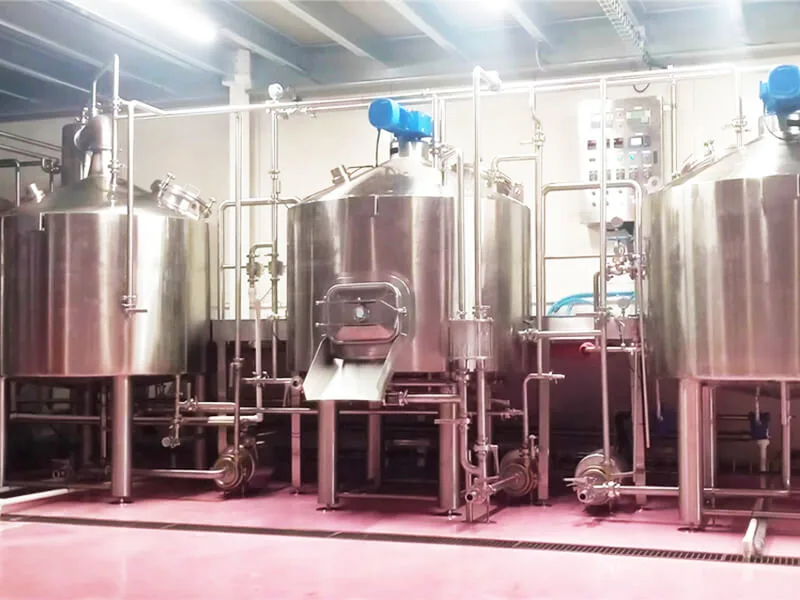
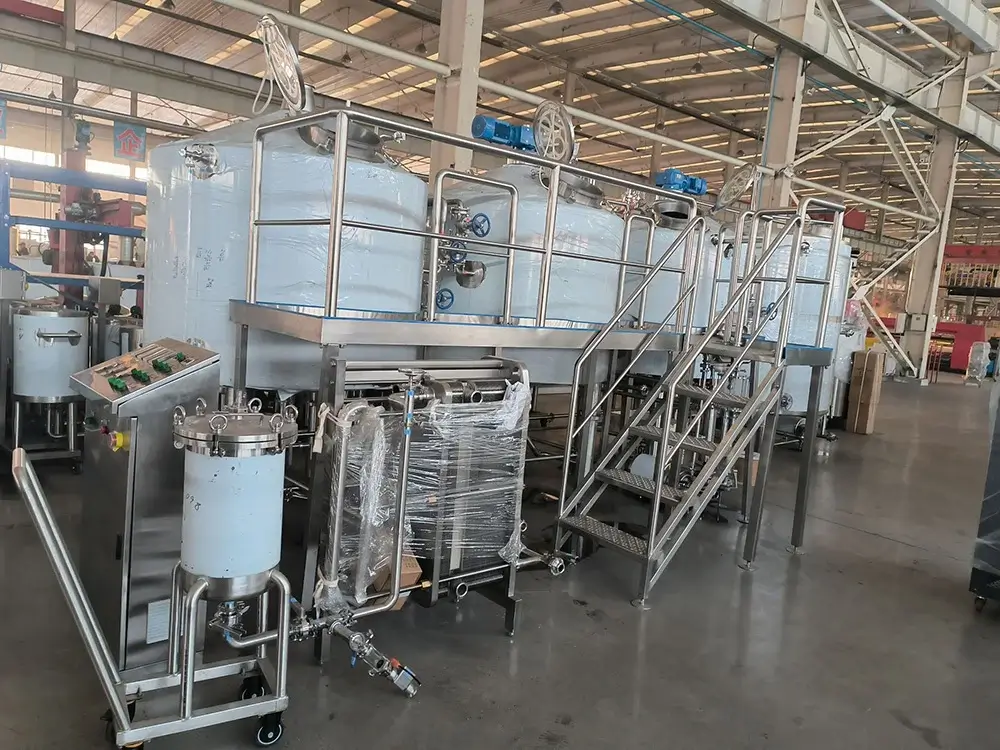
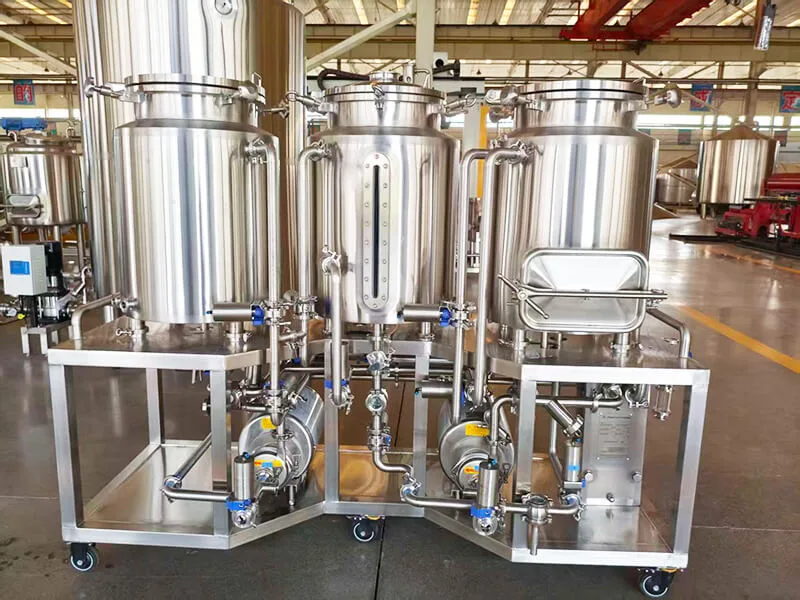
A well-designed modular brewhouse decouples the mash tun, lauter tun, kettle/whirlpool, and hot liquor tank into independent vessels. This configuration allows parallel operations: you can begin heating strike water in the HLT while simultaneously mashing in, or run CIP on one vessel while another is in active production. In a compact 100L system, this parallelism can reduce total brew-day duration by an estimated 30–45 minutes.
From an installation standpoint, individual modules weighing 50–80 kg are far easier to rig into position than a welded monoblock frame exceeding 300 kg — particularly relevant for nano breweries operating in locations with limited access, such as basements, mezzanines, or converted retail spaces with standard door widths.
Engineering consideration: When evaluating modular systems, confirm that interconnecting hard piping uses tri-clamp connections rather than threaded fittings. Tri-clamps allow for repeated disassembly and reconfiguration without galling or leakage — a non-trivial detail if you anticipate layout changes.
Key takeaway: Modularity is operational flexibility and installation pragmatism rolled into one. It’s not just a floor-plan perk; it’s an uptime strategy.
2. Brushed Stainless Steel Finish: Surface Roughness and Cleanability
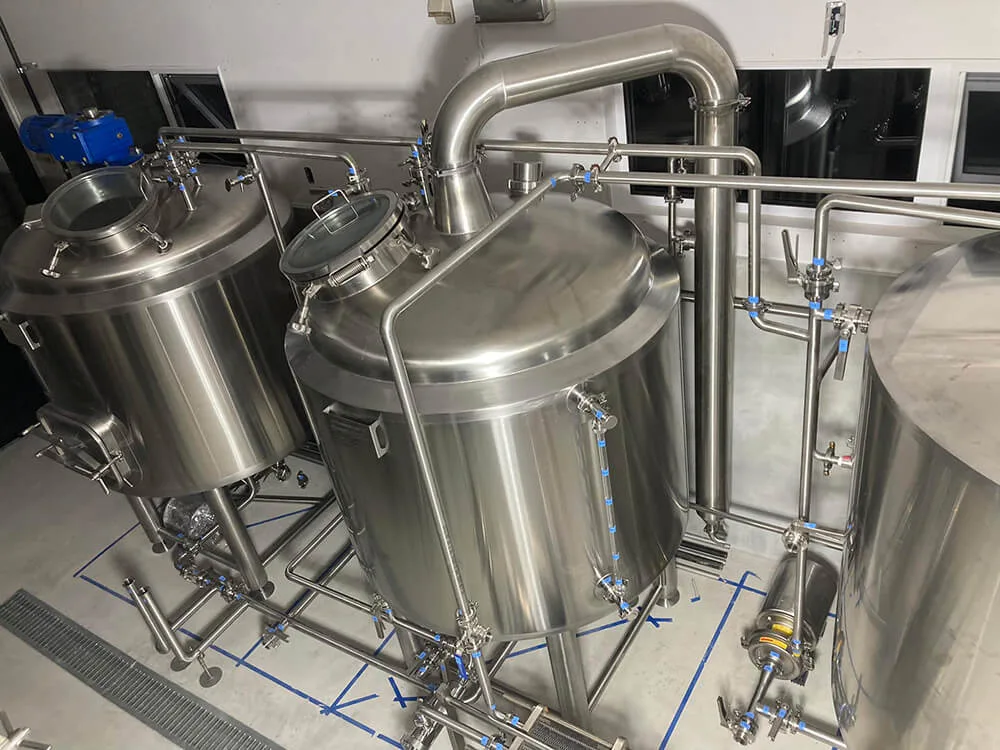
Walk into any production brewery and you’ll notice a consistent aesthetic: a uniform #4 brushed finish (sometimes specified as 180–240 grit) on all exposed stainless surfaces. This isn’t decorative.
Surface roughness (Ra) directly correlates with microbial adhesion. A brushed finish typically achieves an Ra of 0.5–1.0 μm, compared to 0.1–0.2 μm for an electropolished surface or 2.0+ μm for an unpolished mill finish. While electropolishing offers marginally better cleanability, a properly executed brushed finish provides 90% of the hygienic benefit at a fraction of the cost — making it the pragmatic choice for a brewhouse in the 100L class.
Additionally, brushed surfaces resist visible fingerprinting and minor abrasion. In a nano brewery where the brewhouse is often customer-facing, this aesthetic durability translates to a consistently professional appearance across hundreds of brew cycles with minimal maintenance.
Practical consideration: Post-brew CIP with a 2% caustic solution at 60–70°C, followed by a phosphoric/nitric acid passivation rinse every 6–12 months, will maintain the passive chromium oxide layer and preserve the finish’s cleanability.
Key takeaway: Surface finish is a hygiene variable. Choose a finish that balances cleanability, durability, and cost for your operating environment.
3. SUS304 Stainless Steel: Alloy Composition and Corrosion Resistance
SUS304 (JIS standard) is the Japanese designation for what ASTM/ASME classifies as UNS S30400 — an austenitic stainless steel containing 18–20% chromium and 8–10.5% nickel, with a maximum carbon content of 0.08%.
The relevant metallurgy for brewers: chromium, when exposed to atmospheric oxygen, forms a passive chromium oxide (Cr₂O₃) layer approximately 2–4 nanometers thick. This layer is self-healing — if mechanically scratched, it re-forms spontaneously in the presence of oxygen. The nickel content stabilizes the austenitic crystal structure, improving ductility, weldability, and resistance to reducing acids like phosphoric acid commonly used in brewery passivation protocols.
Why SUS304 over 200-series alternatives (e.g., SUS201)? 200-series steels substitute manganese for a portion of the nickel content. While cheaper, they exhibit reduced resistance to chloride-induced pitting and stress corrosion cracking — both relevant failure modes in a brewhouse exposed to hot, acidic wort (pH 5.0–5.5 at mash temperatures, dropping to pH 3.5–4.5 in fermenting beer), chlorinated tap water, and aggressive cleaning chemistry.
Specification alert: For the hot-side vessels in a 100L brewhouse (HLT, mash tun, kettle), SUS304 is entirely adequate. For cold-side vessels (fermenters, brite tanks) where prolonged low-pH contact occurs, consider upgrading to SUS316L for its molybdenum-enhanced pitting resistance — particularly if your water source has elevated chloride levels (>150 mg/L).
Key takeaway: SUS304 remains the cost-performance sweet spot for hot-side brewery equipment. Understand your water chemistry and process exposure before accepting it as the default for every vessel.
4. Pneumatic Butterfly Valves with PLC Control: Actuation and Process Repeatability
Manual ball valves dominate homebrew rigs because they’re inexpensive and intuitive. At the 100L scale, the process logic changes significantly: each brew day involves 15–25 valve state changes across mashing, lautering, sparging, whirlpool, knockout, and CIP cycles. Manual actuation introduces two problems — operator fatigue and timing variability.
Pneumatic butterfly valves solve both. A double-acting or spring-return pneumatic actuator, supplied by a compressed air line at 6–8 bar, delivers consistent open/close times independent of operator technique. When integrated with a PLC, valve sequencing becomes programmable: a single “Start Lauter” command can simultaneously open the mash tun outlet, close the grant bypass, and ramp the VFD pump — eliminating the 10–20 seconds of variability that manual sequencing introduces into each transition.
Valve selection notes for nano breweries:
- Seat material: Specify EPDM seats for hot-side applications (rated to 130–150°C). Avoid PTFE seats on butterfly valves used in trub-laden applications; they lack the compliance needed for reliable sealing around particulate.
- Port size: For a 100L brewhouse, DN25–DN40 (1″–1.5″) valves are typical for product lines; DN15–DN25 for CIP and sampling ports.
- Position feedback: Specify valves with integrated limit switches if your PLC supports feedback loops — useful for building interlocks that prevent pump operation against a closed valve.
주요 요점: Pneumatic actuation with PLC control reduces process variability and operator exposure to hot surfaces. In a nano brewery producing 3–5 batches per week, the ROI in consistency alone justifies the added complexity.
5. Sanitary Centrifugal Pump with VFD: Fluid Dynamics and Gentle Product Handling
The pump selection for a 100L brewhouse has downstream consequences for extract yield, trub formation, and hot-side aeration. A sanitary centrifugal pump paired with a Variable Frequency Drive (VFD) gives you control over what hydraulic engineers call the pump’s operating point.
The physics: A centrifugal pump’s flow rate is approximately linear with impeller speed, while head pressure scales with the square of speed. A VFD allows you to operate the pump at partial speed — say 35–50 Hz instead of a fixed 50/60 Hz — dramatically reducing both flow velocity and discharge pressure.
Why this matters in your brewhouse:
- Vorlauf and lautering: Excessive suction pressure compacts the grain bed. A VFD-controlled soft start lets the grain bed set naturally before ramping to the target recirculation rate of roughly 0.1–0.15 L/min per kg of grain. The pump curve shifts downward, and you avoid the pressure spikes that collapse filter channels and reduce lauter efficiency.
- Hot-side aeration : Turbulent flow and splashing at transfer points introduce dissolved oxygen into hot wort. While the industry debate on HSA’s sensory impact continues, best practice minimizes it. A VFD running a controlled-speed whirlpool transfer eliminates the surge that occurs when a fixed-speed pump deadheads against a throttled valve.
- Energy consumption: Pump affinity laws dictate that at 80% speed, power consumption drops to approximately 51% of full-speed operation. Over a 5-hour brew day, the energy savings are modest; over a 10-year equipment lifecycle, they’re meaningful.
Specification recommendations for a 100L system:
- 0.5–1.5 HP motor with a frequency range of 10–60 Hz
- 316L stainless impeller and volute for corrosion resistance
- Single mechanical seal with EPDM or FKM elastomers
- Tri-clamp connections for quick disassembly during CIP
Key takeaway: The pump is your brewhouse’s circulatory system. A VFD gives you hemodynamic control — protect your grain bed, minimize oxygen pickup, and put energy where it’s needed.
6. Illuminated Sight Glasses & Sampling Valves: Process Visibility and Analytical Access
Temperature probes and flow meters give you numbers; sight glasses give you context. Brewing remains a sensory craft at its core, and several critical process transitions in a 100L brewhouse benefit from direct visual observation.
Illuminated sight glasses — typically borosilicate glass tubes or discs rated to 150°C, housed in 304 stainless bodies with an integrated LED backlight — provide real-time visual data on:
- Lauter clarity: You’re targeting a progressive transition from turbid to brilliant within the first 15–20 minutes of recirculation. A sight glass on the grant or lauter outlet lets you confirm this visually before diverting flow to the kettle.
- Trub cone formation: During whirlpool, an in-line sight glass on the tangential inlet confirms rotational velocity. Post-rest, a sight glass at the kettle outlet allows you to spot trub carryover before it fouls your heat exchanger.
- Knockout clarity: A sight glass immediately upstream of the plate chiller gives you one last visual check before cold-side transfer. Cloudy knockout = clogged HX plates on brew day #4.
Sampling valves complement sight glasses by providing aseptic analytical access. A sanitary sample valve with a steamable port and silicone septum allows you to pull wort or beer samples for:
- pH verification (mash pH should stabilize at 5.2–5.6 within 10 minutes of dough-in)
- Iodine test for starch conversion
- Pre-boil and post-boil gravity readings
- Microbiological sampling if you’re plating for QA
Key takeaway: Instrumentation is probabilistic — a sensor tells you what it measures. Sight glasses and sampling valves let you verify what’s actually there. Both belong in a well-instrumented brewhouse.
Bonus: The Mobile Stainless Workbench — Ergonomic Rationalization
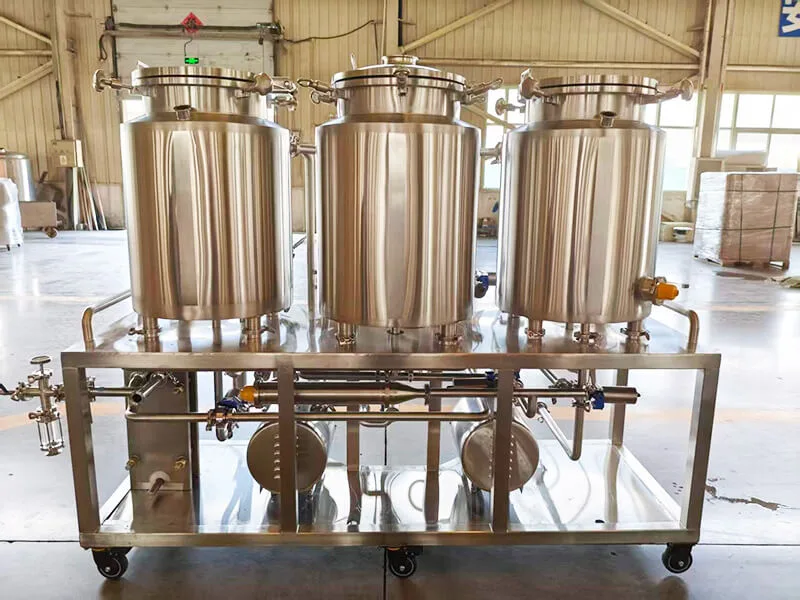
A 100L brewhouse on a mobile stainless workbench with integrated push/pull handles and locking casters solves an underappreciated problem: access for cleaning and maintenance.
In fixed installations, the 30 cm gap between the brewhouse and the wall becomes a hygiene blind spot. A mobile platform lets you roll the entire system forward for full 360° access — especially important for CIP of hard-to-reach undersides and rear plumbing.
Load rating note: Confirm casters are rated for the full wet weight of your system. A 100L brewhouse with 3 vessels at capacity, plus plumbing and frame weight, can easily exceed 400 kg. That’s 100 kg per caster on a 4-wheel platform — specify accordingly.
Key takeaway: Mobility isn’t a convenience feature. It’s a cleaning-access and workflow solution hiding in plain sight.
The Bottom Line
A great 100L brewhouse isn’t sold on buzzwords. It’s sold on material specs, valve selection rationale, surface finish details, and pump sizing — the engineering decisions that determine whether your brewhouse is a source of process capability or process noise.
Every feature we’ve dissected here contributes to a measurable outcome: higher extract efficiency, lower dissolved oxygen pickup, tighter batch-to-batch consistency, and longer equipment service life. If you’re specifying a nano brewery or mini brewery system, interrogate these details. Your 200th batch will reflect the decisions you make today.
Frequently Asked Questions
What size brewhouse do I need for a nano brewery?
A nano brewery typically operates a brewhouse in the 50L–250L range, with 100L being the most common entry point for commercial production. A 100L brewhouse yields roughly 80–85L of finished wort per batch (accounting for trub loss, hop absorption, and system losses), which translates to 3–4 kegs or approximately 200–250 bottles per brew. At 3 batches per week, that’s a theoretical annual output of 120–150 hL — viable for a taproom-focused business model. Choose based on your target annual volume, available fermentation capacity, and taproom throughput projections.
What’s the difference between a nano brewery and a microbrewery?
The distinction is primarily one of scale. In the US, the Brewers Association defines a nano brewery as producing fewer than 2,000 barrels per year, though the term is unofficially applied to operations under a few hundred barrels annually. A nano brewery typically uses a 50L–250L brewhouse, while a microbrewery generally starts at 3.5–7 BBL (roughly 400–800L) brewhouse size. The equipment considerations differ significantly: a nano brewery prioritizes compact footprint and plug-and-play installation; a microbrewery adds requirements for grain handling systems, larger glycol loops, and more sophisticated CIP infrastructure.
Why is SUS304 stainless steel important for brewery equipment?
SUS304 (UNS S30400) is an austenitic stainless steel with 18–20% chromium and 8–10.5% nickel. The chromium forms a passive, self-healing oxide layer that resists corrosion from acidic wort (pH 3.5–5.5), cleaning chemicals, and ambient humidity. The nickel improves formability and weldability during fabrication. Without SUS304 or equivalent 304-grade stainless, brewery tanks would rapidly pit, corrode, and potentially leach metallic ions into the product — compromising both equipment longevity and beer quality.
Do I need a VFD pump for a 100L brewhouse?
Technically no — you can operate a 100L brewhouse with a fixed-speed pump and a throttling valve. However, a VFD (Variable Frequency Drive) provides soft starts that protect grain bed structure during vorlauf, eliminates pressure spikes that cause hot-side aeration, reduces shear on wort during transfers, and cuts energy consumption by approximately 50% at 80% speed operation. For the incremental cost (typically $200–400 at this scale), a VFD is one of the highest-ROI upgrades you can specify. If your budget forces a trade-off, prioritize the VFD over cosmetic upgrades — your extract efficiency will thank you.
How many fermenters do I need with a 100L brewhouse?
A practical rule of thumb for nano breweries: maintain a fermenter-to-brewhouse ratio of at least 3:1 at the primary fermentation stage. With a 100L brewhouse and typical ale fermentation timelines (5–7 days primary, 3–5 days conditioning), 3–4 fermenters allow weekly brewing without scheduling conflicts. If you’re producing lagers with 2–4 week fermentation cycles, plan for 5–6 fermenters to avoid production gaps. Also account for one brite tank per 2–3 fermenters for carbonation and serving preparation. Your unitank fleet dictates your annual throughput far more than your brewhouse size alone.
Ready to Specify Your 100L Brewhouse System?
Whether you’re launching a new nano brewery, upgrading your pilot system, or building out a compact mini brewery, the equipment decisions you make now compound across every batch. Get the engineering right from day one.
Contact our team to discuss your process requirements, facility constraints, and equipment specifications. We’ll help you build a brewhouse system matched to your beer.
Explore our complete range of nano brewery equipment and commercial craft brewing solutions.