If you’re scaling up from a pilot system or launching a commercial craft brewery, 1000L brewery equipment hits a sweet spot. It’s big enough to drive real revenue but small enough to keep you connected to the craft.
In the industry, many call it the “golden capacity.” It bridges the gap between nano-breweries and full-scale industrial plants. Whether you’re a startup looking to land your first regional accounts or an established brewery expanding taproom production, a well-designed 1000L system gives you the flexibility and output you need to grow profitably.
What Makes 1000L Brewing Systems Stand Out
Let’s cut to the chase. The value of a 1000L brewhouse comes down to three things: balanced output, solid build, and smart automation. Here’s what that means in practice.
Real-World Production Capacity
Under a standard setup (one brew per day, a handful of fermenters), you’re looking at 300,000–500,000 liters annually. Run two brews a day or add more fermentation tanks, and you can push that closer to 800,000 liters.
That range works for:
- Brewpubs supplying multiple taps and local accounts
- Regional brands testing new markets
- Existing breweries replacing 3–5 small batches with one streamlined brew
Built for Hygiene and Longevity
Expect food-grade SUS304 or SUS316L stainless steel. Tank walls are typically 3mm thick, with interior welds ground and polished to a Ra ≤ 0.6µm finish. That smoothness means no hiding spots for bacteria—critical for consistent quality and easy cleaning.
If you brew sours, kombucha, or fruit beers, go with 316L. It resists pitting from acidic recipes much better than 304.
Precision Temperature Control
Nearly every fermenter comes with double-walled jackets or dimple cooling zones plus high-density polyurethane insulation. This lets you control fermentation temperature zone by zone.
Why it matters: keeping ales at 68°F or lagers at 50°F without drifting is what separates clean, repeatable beer from off-flavor surprises.
Automation That Makes Sense
A modern 1000L system uses a PLC with a touchscreen HMI (human-machine interface). You can:
- Save and recall mash schedules
- Automate step mashes and temperature ramps
- Monitor fermentation remotely
The result: fewer mistakes, consistent batches, and the ability to train new staff quickly.
Key Modules from Grain to Glass
A complete turnkey 1000L brewing system covers every step of the process. Here’s what you’re looking at, module by module.
1. Grain Handling & Milling
You’ll get a small malt silo (optional) and a roller mill. The mill should crush grain evenly without shredding the husks—good husk integrity makes lautering easier. Look for integrated dust collection and a vibration screen to remove fines.
2. Brewhouse (Hot Side)
The heart of the operation. You can choose between:
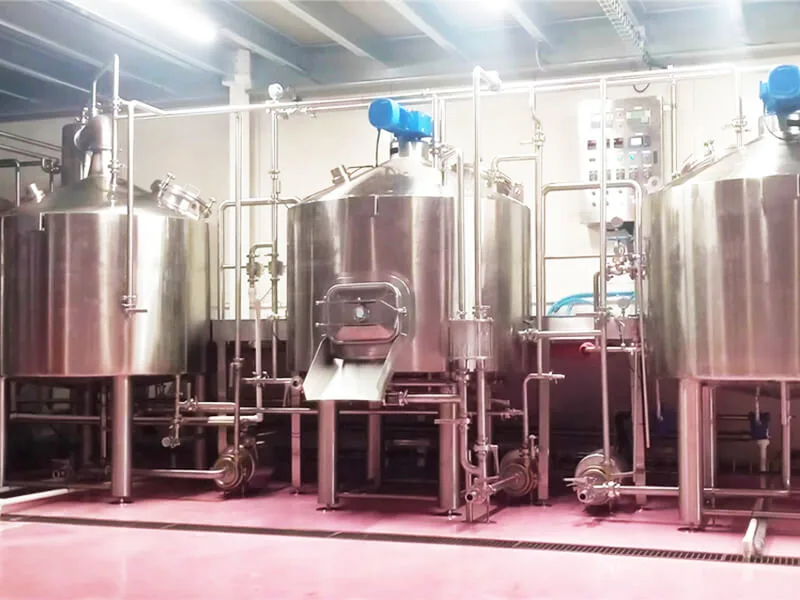
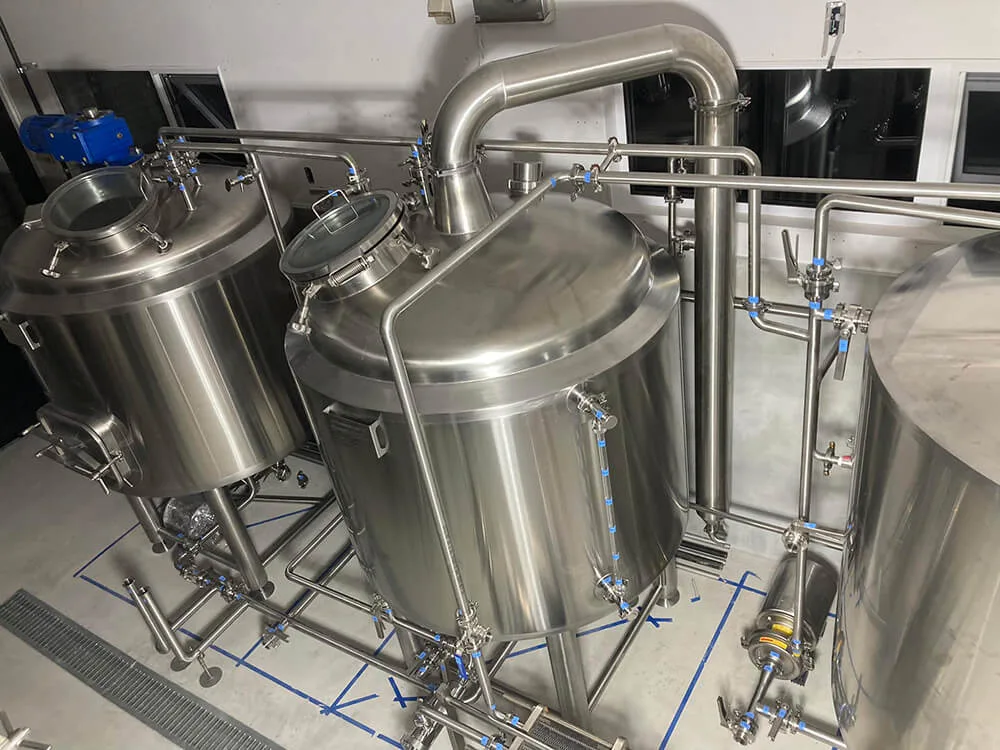
- 2-vessel (mash/lauter tun + kettle/whirlpool)
- 3-vessel (separate mash, lauter, and kettle/whirlpool)
- 4-vessel (all four stations independent)
Heating options: steam (most efficient), electric (precise), or direct-fire (traditional). All systems include a false bottom, rakes or agitators, and a whirlpool port for trub separation.
3. Wort Cooling & Aeration
A plate or tubular heat exchanger drops wort from boiling to yeast-pitching temperature (50–72°F) in one pass. After cooling, a venturi or sintered stone injects sterile oxygen—essential for healthy yeast starts.
4. Fermentation & Bright Beer Storage
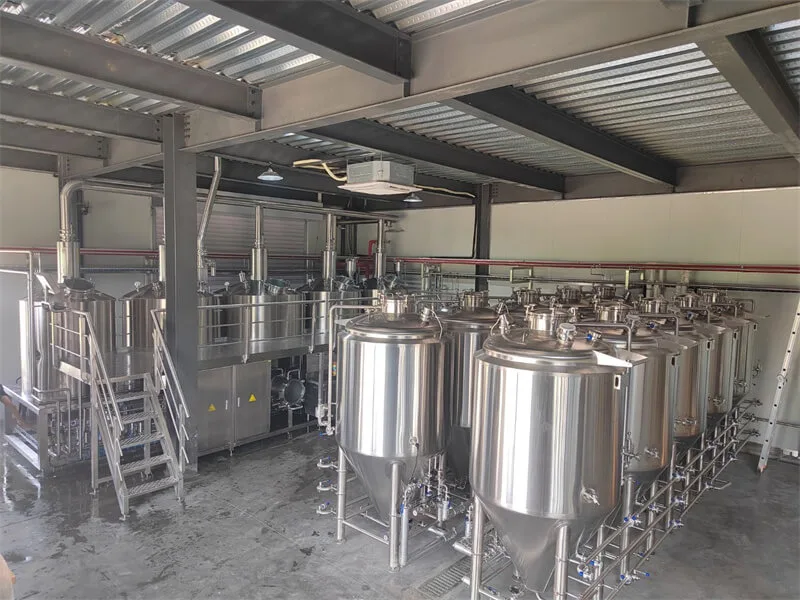
Most breweries start with 4 to 6 jacketed conical fermenters (1000L or 2000L each). Cones should have a 60° angle for good yeast harvesting. Add 1–2 bright beer tanks for carbonation, clarification, and serving.
5. Utilities That Keep You Running
- Refroidisseur à glycol: Industrial-grade, sized for your total fermenter volume
- Système CIP: Portable or built-in, with acid/alkali tanks and spray balls
- Tuyauterie industrielle: Sloped for drainage, with sanitary fittings throughout
2-Vessel vs. 3-Vessel: Which One Is Right for You?
This is the single biggest decision you’ll make. Let’s break it down without the marketing fluff.
2-Vessel System (Compact & Cost-Effective)
Meilleur pour : Tight spaces, smaller budgets, and teams focused on a few core styles.
Typical layout: Mash/Lauter Tun + Kettle/Whirlpool.
| Pros | Cons |
|---|---|
| Lower upfront cost (20–30% less than 3-vessel) | Can’t mash and lauter simultaneously → longer brew days |
| Smaller footprint—fits in a garage or small bay | Limited step mashing capability |
| Simpler operation, easier to learn | Lower extract efficiency (more grain per batch) |
3-Vessel System (Flexible & High-Throughput)
Meilleur pour : Breweries making multiple styles, high gravity beers, or planning to scale.
Typical layout: Mash Tun → Lauter Tun → Kettle/Whirlpool (or separate whirlpool).
| Pros | Cons |
|---|---|
| Parallel processing: lauter while you mash the next batch | More floor space and higher install cost |
| 3–4 brews per day possible | More vessels to clean and maintain |
| Better efficiency (85–90% vs. 75–80% on 2-vessel) | Steeper learning curve |
| Real step mashing and decoction capability |
Quick take: If you have the space and budget, a 3-vessel system pays for itself in time saved and grain savings over a few years. But many great breweries start with a 2-vessel and upgrade later.
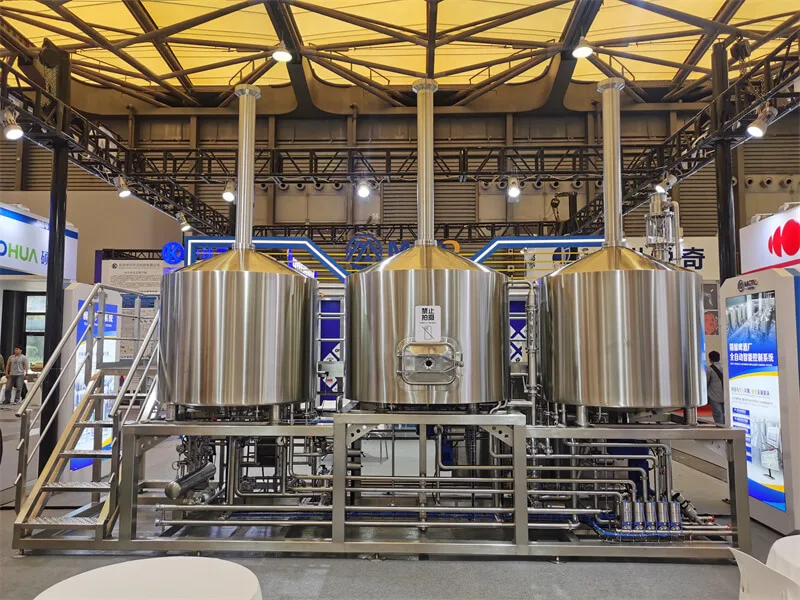
Real-World Configuration: A Compact 1000L Brewhouse in Action
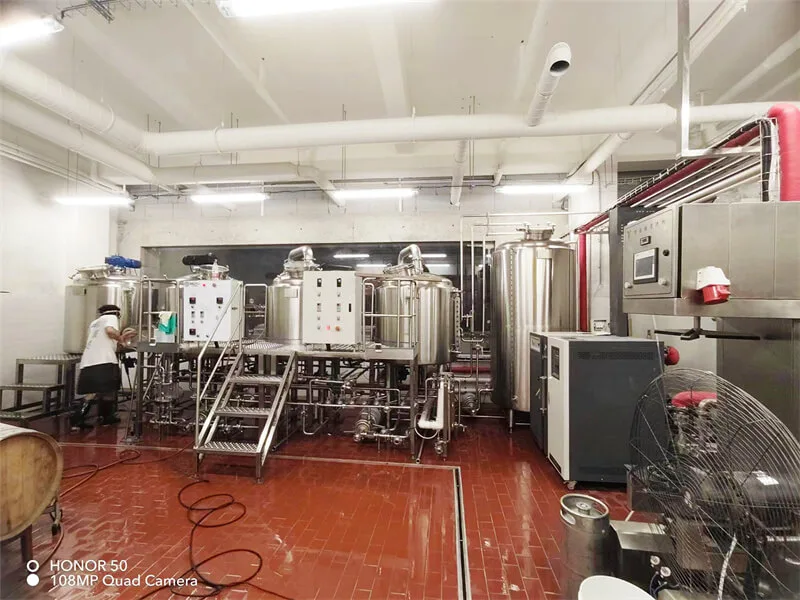
Let’s walk through a typical compact craft production setup—the kind you’d see in a 5,000–10,000 sq ft brewery.
Mill
- Specification: 500–800 kg/hr
- Why It Works: Matches mash tun throughput, minimizes oxidation from prolonged crushing.
Salle de brassage
- Specification: 2-vessel combo (Mash/Lauter Tun + Kettle/Whirlpool)
- Why It Works: Saves floor space while still producing high-quality wort for a range of styles.
Hot Liquor Tank (HLT)
- Specification: 1500L
- Why It Works: Covers both sparge water and CIP rinsing needs from a single, efficiently sized tank.
Fermenters / Unitanks
- Specification: 2 x 1000L with side manway
- Why It Works: Side manway allows easy dry-hopping and deep cleaning without climbing inside. (Game-changer: your back will thank you.)
Glycol System
- Specification: 3000L buffer tank + dual 5HP chillers
- Why It Works: The buffer tank smooths out thermal load spikes, and dual chillers provide redundancy—one can fail or defrost while the other maintains fermentation temps.
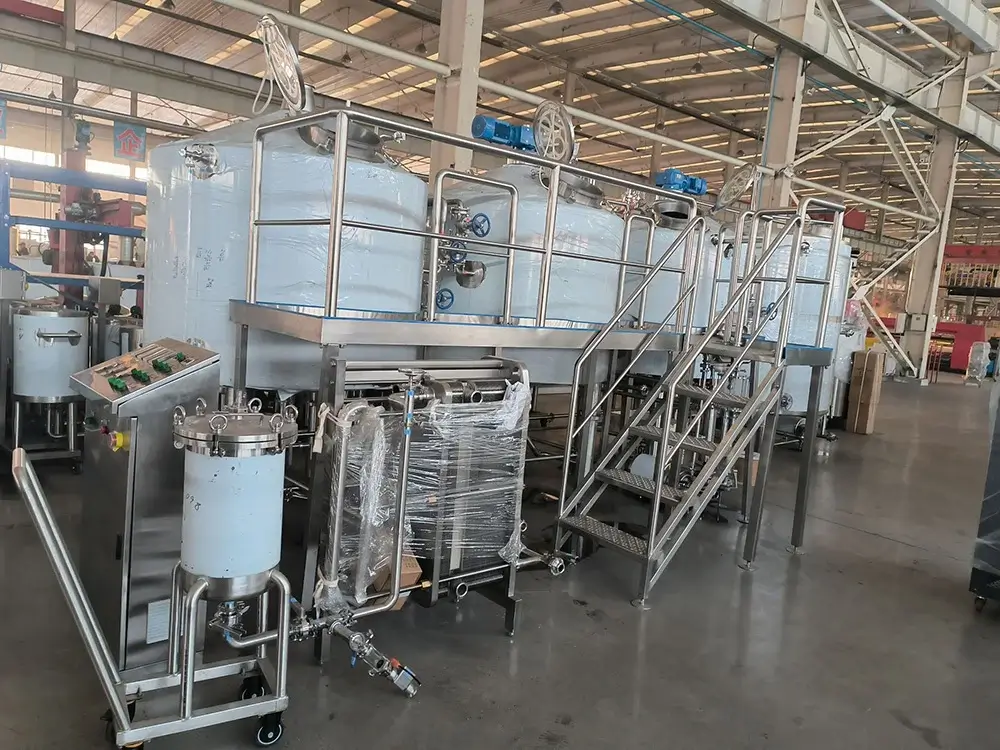
Système CIP
- Specification: 100L portable skid
- Why It Works: Compact footprint, perfectly sized for 2–3 fermenters, and minimizes sanitary risks from long pipe runs.
Contrôles
- Specification: PLC + touchscreen HMI
- Why It Works: Full recipe management, automated temperature ramps, and batch logging for consistency.
Where 1000L Systems Make Business Sense
This capacity fits several commercial models. Here’s where it shines.
Urban Brewpub or Taproom + Distribution
One 1000L brewhouse can supply 10–20 tap handles and still have enough to keg for local bars and restaurants. Many owners break through the “we’re always out of beer” ceiling by stepping up from 3–5 barrel systems to 1000L.
Growing Regional Brand
You started on a 300L or 500L system. Now you’re brewing back-to-back days just to keep up. Jumping to 1000L gives you 2–3x the output without doubling labor. It’s the natural next step before moving to a 20–30 barrel system.
Specialty Beverage & R&D
Beyond beer, those jacketed 1000L fermenters work great for:
- Hard seltzer
- Kombucha
- Cider
- Sparkling fruit wines
And because your control system logs every batch, you can dial in new recipes faster and repeat them reliably.
Final Tips for Buying 1000L Brewery Equipment
- Look for ASME certification if you need pressure-rated vessels.
- Ask for 3A sanitary standards—this matters for consistent CIP results.
- Get a glycol chiller rated for 1.5–2x your current fermenter volume. You’ll add tanks.
- Make sure the supplier provides P&IDs (piping and instrumentation diagrams). You’ll need them for install and troubleshooting.
- Visit a brewery running the same system before you sign.
Still Have Questions About 1000L Systems?
Every brewery’s floor plan, utility access, and production goals are different. Whether you need a 2-vessel starter system or a fully automated 4-vessel brewhouse, the right supplier will help you size it without overselling.
Talk to 2–3 manufacturers. Compare lead times, spare parts availability, and post-sale support. And if you want to see a 1000L system running in person, reach out—we can connect you with breweries using them every day.
Want a custom quote or layout? Tell us your target annual output and available space, and we’ll send a detailed equipment list within 24 hours.