Designing a brewery isn’t about sketching nice layouts.
It’s about coordinating grain, heat, time, and people — who will eventually do something dumb if you let them.
Whether you’re building a tiny nano brewery or turning an old warehouse into a 2,000-hectoliter-per-year operation, the real questions never change:
- How do you keep things clean, safe, and repeatable?
- And how do you make sure you can scale up later without ripping everything out?
This guide cuts the fluff. Here are 12 things that actually work — covering capacity planning, brewhouse layout, equipment selection, automation, CIP sanitation, utilities, packaging, and how to avoid the usual nightmares.
1. Capacity Planning: Match Brewhouse, Fermenters, and Chiller First
Don’t start with the kettle size.
Start with: how much beer you want to sell per year, and how many batches you can realistically brew per week.
Brewhouse example — 10 hL system
- One brew cycle (mash → lauter → boil → whirlpool → knockout) takes 5–6 hours.
- Two shifts = three batches per day → 30 hL daily.
- 220 brew days per year (allow cleaning, changeovers, breakdowns) → roughly 6,600 hL/year.
Fermenter sizing
- Lager: 14–21 days (pitch to crash)
- Ale: 7–14 days
If you mostly brew lager, you need enough tank space to hold 14 days of production.
Rough formula:Total fermenter volume (hL) = daily output × fermentation days × 1.1 (safety factor)
Our example:
30 hL/day × 14 days × 1.1 = 462 hL → install around 500 hL of fermenter capacity.
That could be six 80 hL tanks.
Chiller (glycol) sizing — don’t skip this
You have two main cooling loads:
- Refroidissement du moût — 95°C down to 12°C (lager) right after boil.
Use a two-stage plate heat exchanger: city/well water or cooling tower first, then chilled water (1–2°C), then glycol at –4°C. - Fermentation cooling — a lager at peak fermentation releases about 2.5–3.5 kW per 100 hL.
With good tank insulation, you can size the chiller pack at 60–80% of theoretical peak — not all tanks peak at once.
Hard rule: Size the chiller for the single biggest instantaneous load (wort cooling) plus the peak fermentation load at that same moment — then add 25% margin. You’ll thank yourself on a hot July day.
Also: install a glycol buffer tank at least 1.5× your total system volume. Use variable-speed pumps and zone control valves. Otherwise one tank can starve another.
2. Layout: Sloped Floors and Drains Matter More Than You Think
Three principles: separate zones, one-way material flow, and slope every floor toward a drain.
- Matières premières — separate room with dust control, near the mill. Pneumatic conveyor or short auger. Keep dust out of the brewhouse.
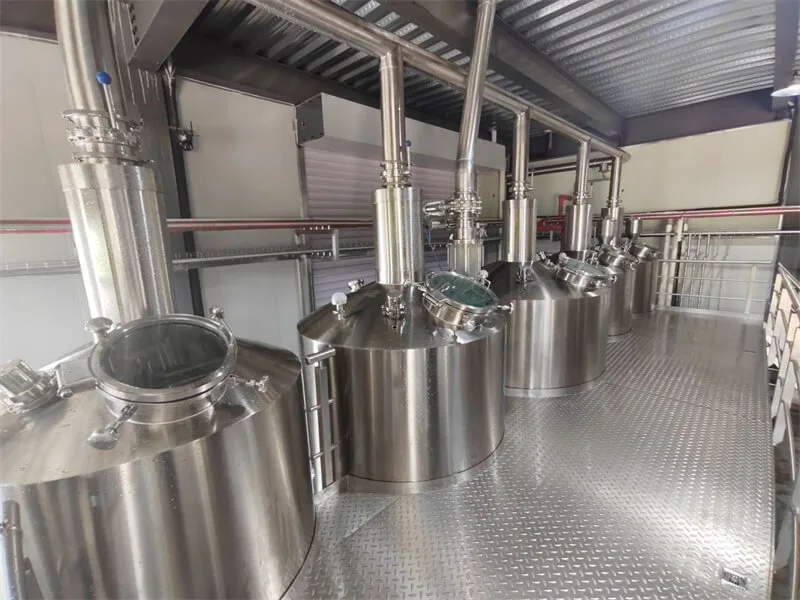
- Hot side (brewhouse) — heat-resistant, non-slip floors. Big exhaust hoods over kettles. Leave at least 1.2 m (4 ft) working space around lauter tun and kettle.
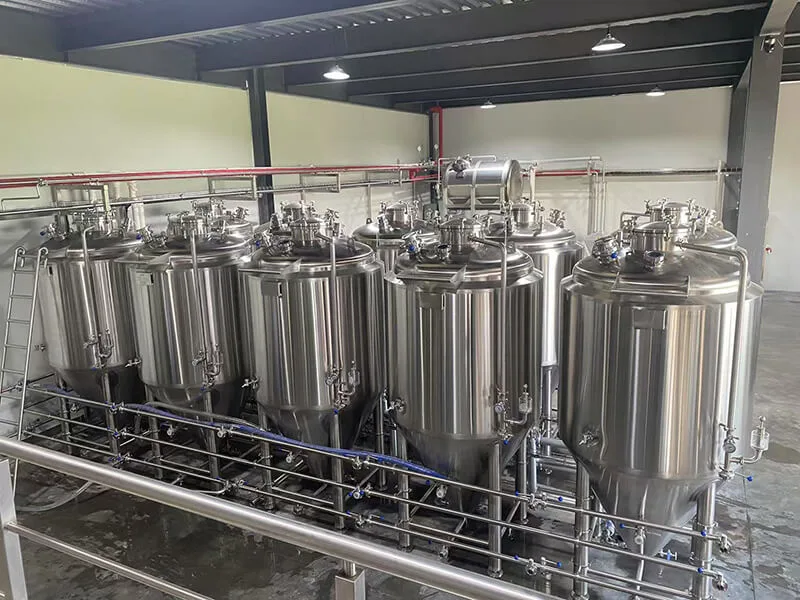
- Cold side (fermenters, bright beer tanks) — separate from hot side with a solid wall or buffer room. Run overhead pipes in insulated bundles, with drip trays at low points.
- Emballage — at one end of the building or its own room. Floor slope at least 2% toward channel drains.
Sanitary details that actually work
- Every floor drain needs a water seal and a removable strainer basket.
- Never let a drain line cross from a dirty area into a clean area. Use thresholds or ramps.
- Walls? Tile or stainless steel sheeting with coved corners — no right angles where crud hides.
Small breweries: line tanks along a wall, pipes overhead.
Large breweries: go vertical — hot side on lower floors, cold side above. Gravity does the work, fewer pumps.
3. Choosing a Brewhouse for Scalability
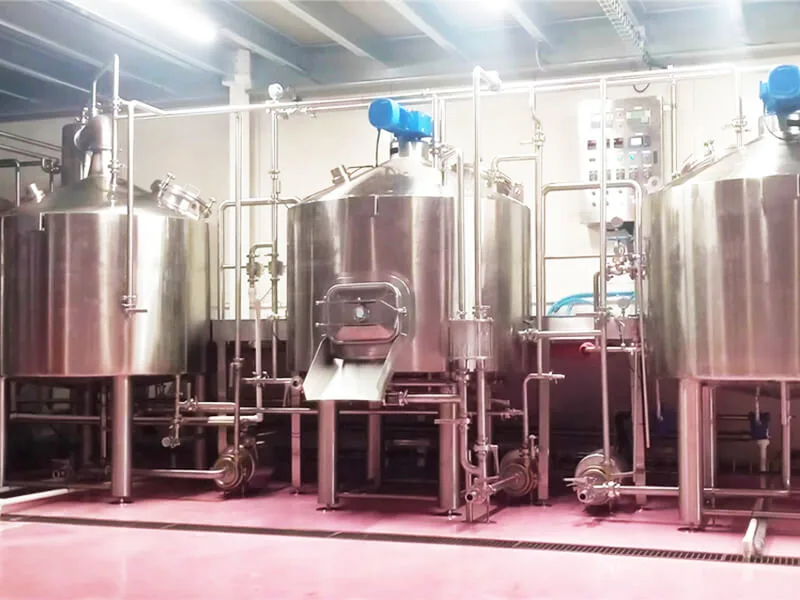
A full brewhouse has: mash mixer, lauter tun, kettle, whirlpool. But some people combine functions to save space and money.
The trade-offs:
- 2-vessel (mash/lauter + kettle/whirlpool) — small footprint, lower cost. Good for pubs and <500 hL/year.
- 3-vessel (mash, lauter, kettle/whirlpool) — flexible, parallel steps. Works for 1,000–5,000 hL/year.
- 4-vessel (add cereal cooker) — for adjuncts like rice or corn. Large industrial or specialty breweries.
For the lauter tun, traditional slotted plates work fine for most craft breweries. If you use a lot of wheat or oats, a mash filter gives better efficiency — but you’ll need a spent grain handling system.
Smart sizing rule: Design for 30% more capacity than you think you need today. That could mean a kettle with extra ports, or a plate heat exchanger sized for a bigger batch later.
4. Automation and Controls for Consistent Quality
Manual brewing works fine — until you try to scale. Then repeatability becomes everything.
A typical control system has three layers:
- Field devices — PT100 temperature sensors, pressure/level transmitters, conductivity probes (CIP), flow meters (magnetic or Coriolis).
- Control layer — PLC (Siemens S7-1200 or 1500). Redundant power supplies for critical loops are nice.
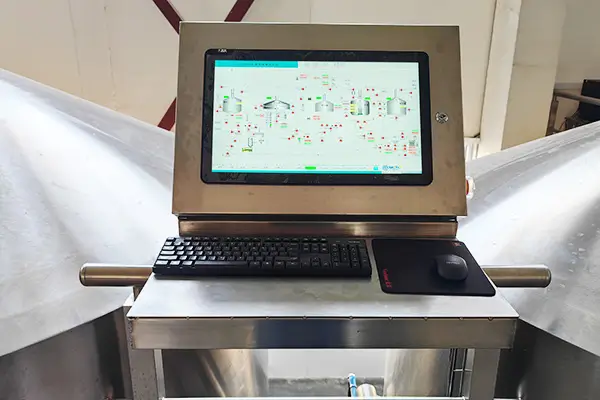
- Operator layer — SCADA. You need recipe management, batch traceability, alarms, and trend logs.
What you really need to automate
- Mash temperature steps (dough-in, protein rest, saccharification, mash-out, sparge)
- Boil intensity — steam valve position linked to pressure
- Knockout temperature and oxygenation — closed-loop control
- Fermenter temperature staging — main ferment, diacetyl rest, crash cooling — with automated valve switching
Worth spending extra on
- A dedicated glycol control valve for each fermenter, and three temperature probes per tank (top, middle, bottom).
- Bright beer tank pressure control (0.8–1.2 bar) with CO₂ backpressure.
If money’s tight, skip full batch automation for now. But leave 20% spare I/O on the PLC and open network ports for future upgrades. You’ll want them later.
5. Sanitary Piping, Valves, and CIP — The Hidden Defense
Beer isn’t a great place for bacteria — but they’ll find a way if you give them a dead leg.
Conception des canalisations
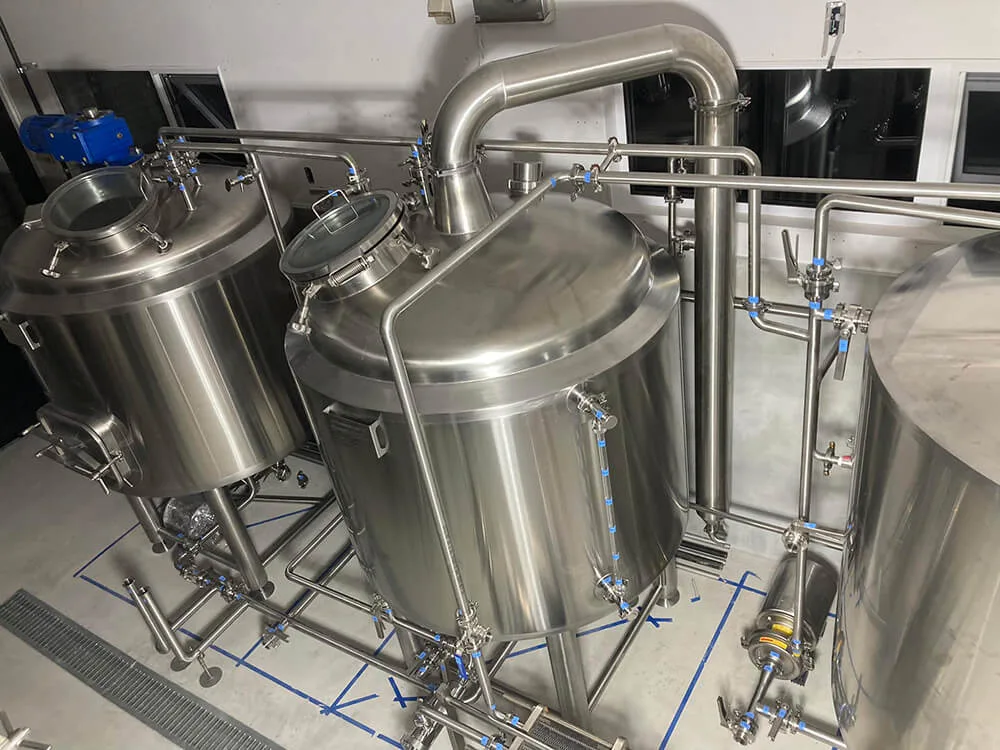
- Inside surface finish: Ra ≤ 0.8 μm (about 32 microinches). Use autogenous orbital welding. Never threaded fittings.
- Slope every line at least 1% toward a low-point drain.
- Long-radius bends (R=1.5D). For tees, use sweep tees or Y-branches. Right-angle tees are traps.
Vannes
- Tank bottom valves — aseptic diaphragm or sanitary angle-seat valves. Flow straight down.
- Transfer panels — mix-proof butterfly or double-seat valves (separate seals for product and CIP).
- Sample valves — miniature diaphragm type. Steam-sterilize before and after sampling.
CIP design principles
- Two CIP return pumps — one duty, one standby.
- Separate tanks for caustic, acid, hot water, and sanitizer (PAA is common).
- Every process line must form a closed cleaning loop: supply → sprayball → return.
- Fermenter CIP sequence: pre-rinse → caustic → intermediate rinse → acid → final rinse → sanitize (hot water or PAA). Use rotating sprayballs.
- The CIP return line needs conductivity and pH sensors — so you know when rinsing is done and can recover chemicals.
6. Glycol, Temperature Control, and Utilities Integration
Utilities aren’t just “plug in electricity and steam.” You have to handle peak loads without crashing the whole system.
Système au glycol
- 25–35% glycol by volume. Setpoint at –4°C.
- Pressure stabilizer tank at the circulation pump discharge. Balance valves on every branch.
- Insulate all cold pipes — fully. Then cover with stainless or aluminum cladding so condensation doesn’t drip everywhere.
Cooling water system
- Primary side of your plate heat exchanger: cooling tower water. (Know your local wet-bulb temperature in summer — it matters.)
- Secondary side: a chilled water tank at 2°C or below.
- Small breweries sometimes combine chilled water and glycol into one skid. Fine — but keep piping separate. Never let glycol get into your wort.
Steam and compressed air
- Size your steam generator for peak brewhouse demand +30%. Install steam traps at every drip leg and heat exchanger outlet.
- Compressed air: refrigerated dryer + three stages of filtration — particulate, oil, sterile. And put a sterile filter just before any air point that touches beer or yeast.
7. Packaging System Choice and Material Flow
Your packaging setup decides how materials move through the building. Most craft breweries end up with kegs, cans, or both.
Keg line
Keg washer (2–3 stations) → counter-pressure filler → labeler/coder. Works fine up to 300–500 kegs/day. Low investment, flexible.
Can line
Depalletizer → rinser → filler/seamer (counter-pressure or flow-meter) → tunnel pasteurizer → labeler/sleever → packer. Minimum economic scale: roughly 3,000–5,000 cans per hour.
Material flow
- Run finished beer from bright beer tank to filler by the shortest route possible — fewest bends wins.
- Keep the washer/rinser area isolated. That drain water goes straight to floor drains, not through clean areas.
- Empty cans, cartons, and pallets come in one end. Finished pallets go out the other. No crossing.
8. Microbrewery vs. Large Scale — What Actually Changes?
| Area | Micro / Pub Brewery | Large Brewery |
|---|---|---|
| Layout | Compact, multi-use spaces | Separate buildings or floors, automated material handling |
| Contrôles | Semi-auto + handwritten logs | Full BATCH control with MES |
| CIP | Portable CIP cart, manual hoses | Fixed piping, automatic valve groups |
| Emballage | Manual keg washer, single-head filler | High-speed line with online inspection (fill level, seam, label) |
| Staffing | Everyone wears multiple hats — brew, pack, fix | Dedicated engineers, operators, QC |
But — and this is important — sanitary standards don’t shrink. Microbreweries often have higher infection rates because people overlook dead legs, leave hoses on the floor, and get sloppy with sampling.
9. Building Around an Existing Facility — Floor, Drains, Ventilation
So you’ve got an old warehouse. 4-meter ceilings, no drains, stale air. Here’s what you do, in order:
- Floor and drains — Break out the old slab. Pour a new one sloped at least 2% toward a new main channel drain. Make the drain about 30 cm wide and 15–20 cm deep. Cover with stainless steel grating. Add secondary drains at the base of each tank.
- Ventilation — Stainless exhaust hoods over the brewhouse with axial fans. Aim for 20 air changes per hour minimum. On the cold side, keep slight positive pressure with filtered supply air — G4 + F7 filters.
- Equipment placement — Rig the fermenters in first. Then run pipework. Then add insulation and stainless cladding. Leave a 60 cm wide pipe alley so someone can actually get in there to fix things.
- Power and controls — Main electrical panel somewhere dry, away from wash-down areas. Local control stations need at least IP65 rating.
Most common mistake: Installing tanks before cutting drains. Then the low point ends up in the wrong place, water pools, and it stinks.
10. Commissioning, Ramping Up, and Minimizing Downtime
From mechanical completion to full production, you’ll go through four phases:
- Single-component testing — motor rotations, pump seals, valve positions.
- Cold integrated testing — run with water. Check for leaks, verify sensor signals, run CIP cycles.
- Hot/process testing — simulate brewing with water. Measure evaporation rate, cooling time, glycol load.
- Trial batches — first 3–5 full batches. Lab analysis and microbiology. This is when downtime is most likely — so have spare parts, pump rebuild kits, and a backup generator ready.
Ways to reduce downtime
- Dual water and steam feeds — or at least quick-change bypasses.
- One extra fermenter and one extra bright beer tank for maintenance rotation.
- A CIP system that can switch automatically — one line cleans while another runs.
11. Staffing, Training, and Supply Management
Equipment doesn’t brew beer. People do.
Roles — for a 500–2,000 hL/year brewery
- At least one brewer (understands both process and micro)
- One maintenance and controls tech
- Production operators — every operator must be able to run a CIP cycle and recognize an alarm
Training topics
Must-have:
Valve identification (manual vs. actuated, diaphragm vs. butterfly), the four steps of CIP, proper sampling technique, fermentation temperature logging.
Next level:
Navigating the PLC interface, replacing gaskets and repair kits, sensory off-flavor detection (diacetyl, acetaldehyde, DMS).
Supply management
- Critical spares: seals, diaphragms, probes, heating elements. Keep two weeks’ worth on hand.
- Malt, hops, yeast: monthly orders with safety stock — enough for at least two brew days.
- Track yeast generations. When you hit the supplier’s limit, discard it or relegate it to your cheapest product.
12. From Design Consultation to Turnkey Handover — A Practical Roadmap
Most brewery projects break down into six milestones:
- Requirements (1–2 weeks) — annual output, beer styles, packaging mix, site constraints, budget, timeline.
- Concept design (2–4 weeks) — general arrangement, process flow diagram, equipment list, rough utility estimates (water, power, steam, cooling).
- Detailed design (4–8 weeks) — P&IDs, electrical and controls drawings, platform and structural requirements, CIP calculations, 3D pipe routing.
- Fabrication and procurement (8–20 weeks) — long-lead items first (brewhouse, fermenters, heat exchanger, chiller). Order specialty valves and instruments early.
- Installation and commissioning (4–10 weeks) — consider successful cold commissioning (CIP loops verified) as the internal handoff point.
- Trial and acceptance (2–4 weeks) — three consecutive batches that meet spec (chemistry and micro). Signed training records. As-built drawings and spare parts list delivered.
A note on turnkey: “Turnkey” doesn’t mean you walk away. Assign one in-house engineer to be present during installation and commissioning. Because one mis-labeled valve can shut you down for half a day.
Final Word
A brewery comes together in the details. The right tank volumes. The slope of a floor drain. The polish inside a weld. And the brewer who instinctively tightens the sample valve cap before walking away.
The more you plan upfront, the fewer midnight emergencies you’ll have later.
Vous avez des questions concernant votre projet d'équipement de brasserie ?
Faites-nous part de vos besoins — annual output, beer styles, site conditions — and we’ll provide a turnkey solution within 24 hours.