Whether producing a limited vintage from a family vineyard or operating a high-volume commercial winery, every winemaker shares the same objective: preserving grape quality while achieving consistent, reliable production.
The vessel used for fermentation and storage plays a decisive role in this process. It influences temperature stability, oxygen exposure, sanitation, production efficiency, and ultimately the character of the finished wine.
For decades, stainless steel has become the preferred material for modern wineries around the world. Unlike traditional wooden barrels or concrete tanks, stainless steel offers exceptional process control without introducing unwanted flavors or contaminants. It supports both small-batch craftsmanship and large-scale commercial production while reducing maintenance costs over the long term.
Today, stainless steel wine tanks are more than storage vessels. They are precision-engineered equipment designed to improve wine quality, simplify cellar operations, and maximize return on investment.
This guide explores the different types of stainless steel wine tanks, their technical advantages, key specifications, manufacturing standards, and the factors wineries should consider when selecting a reliable equipment supplier.
Types of Stainless Steel Wine Tanks
Modern wineries use different tank configurations depending on the production stage, wine style, and available cellar space.
Vertical Wine Tanks
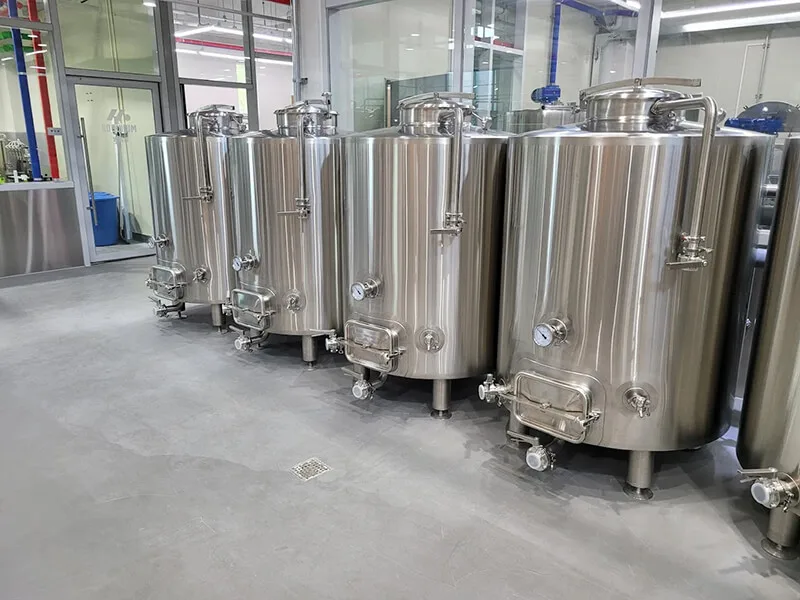
Vertical tanks are the most common choice for commercial wineries because they make efficient use of floor space while providing large storage capacity.
These tanks are suitable for:
- Alcoholic fermentation
- Cold stabilization
- Wine clarification
- Bulk storage
- Blending
- Temporary holding before bottling
Depending on the application, vertical tanks may feature flat bottoms, sloped bottoms, or conical bottoms to facilitate complete drainage and yeast removal.
Their modular design also makes future production expansion easier, as additional tanks can be integrated into the existing process without major modifications.
Horizontal Wine Tanks
Horizontal tanks are commonly installed in wineries with restricted ceiling height or in older cellar buildings where vertical installations are impractical.
Their lower center of gravity simplifies transportation and maintenance while allowing operators easier access to valves and fittings.
Although less common than vertical designs, horizontal tanks remain an effective solution for wine storage and maturation.
Wine Fermentation Tanks
Fermentation tanks are specifically designed to support active yeast fermentation.
Compared with storage tanks, they include features that improve fermentation management and temperature control.
典型的配置包括
- Open-top design for red wine fermentation
- Large sanitary top manway
- Glycol cooling jacket
- Temperature sensor port
- Carbon dioxide vent
- 取样阀
- Racking outlet
- CIP spray ball
Open-top fermentation tanks are especially suitable for premium red wine production, allowing easy punch-down or pump-over operations during maceration.
Wine Storage Tanks
After fermentation, wine requires stable storage conditions to preserve freshness and allow clarification before bottling.
Storage tanks are designed to minimize oxygen exposure while maintaining sanitary conditions throughout the aging process.
Common features include:
- Airtight construction
- Floating or fixed lids
- 泄压阀
- Mirror-polished interior
- Inert gas compatibility
- Bottom discharge valve
- CIP 清洁系统
These tanks are widely used for finished wine storage, blending, filtration, and bottling preparation.
Variable Capacity Wine Tanks
Variable capacity tanks, also known as floating lid tanks, offer maximum flexibility for wineries producing multiple wine varieties or seasonal batches.
The floating lid rests directly on the wine surface and is sealed with an inflatable gasket, significantly reducing oxygen exposure regardless of the remaining wine volume.
This design provides several advantages:
- Suitable for partial batches
- Reduced oxidation risk
- Flexible production scheduling
- Lower inventory losses
- Ideal for white wines, rosé wines, and experimental vintages
For boutique wineries with fluctuating production volumes, variable capacity tanks provide an economical and practical solution.
Why Stainless Steel Is the Preferred Material for Winemaking
Preserving Grape Character and Terroir
One of the defining characteristics of stainless steel is its neutrality.
Unlike oak barrels, stainless steel does not contribute tannins, vanilla notes, toasted aromas, or other secondary flavors. Instead, it allows the natural characteristics of the grapes to remain the focal point.
This is particularly important for wines where freshness and varietal expression are highly valued.
Winemakers producing Sauvignon Blanc, Riesling, Pinot Grigio, Chardonnay, sparkling wines, or fruit-driven reds often choose stainless steel because it preserves delicate aromatics and maintains the wine’s original identity.
Rather than influencing flavor, stainless steel provides complete control over the winemaking process.
Accurate Temperature Control
Temperature management is one of the most critical factors during alcoholic fermentation.
Yeast performance, aroma retention, color extraction, and fermentation efficiency are all closely linked to temperature stability.
Commercial stainless steel wine tanks are typically equipped with glycol cooling jackets that provide rapid and uniform heat transfer.
Depending on production requirements, wineries may choose between:
Dimple Cooling Jackets
Dimple jackets feature embossed channels that maximize heat exchange while minimizing glycol consumption.
Advantages include:
- High cooling efficiency
- Energy savings
- Excellent structural strength
- 降低运营成本
Full Cooling Jackets
Full jackets surround a larger portion of the tank wall, providing highly uniform temperature distribution.
They are commonly specified for larger fermentation vessels where precise thermal control is essential.
Combined with automated temperature controllers, modern glycol systems enable wineries to maintain fermentation within a narrow temperature range, improving product consistency from one vintage to the next.
Superior Hygiene and Easy Cleaning
Sanitation directly affects wine quality and production safety.
Food-grade stainless steel features a smooth, non-porous surface that prevents microorganisms from penetrating the material.
Unlike wood, stainless steel neither absorbs moisture nor harbors bacteria, mold, or residual organic matter.
High-quality wine tanks are typically polished to a surface roughness of Ra ≤ 0.8 μm or finer, reducing product residue and simplifying cleaning procedures.
Most commercial tanks are equipped with CIP (Clean-In-Place) spray balls, allowing automated cleaning without disassembly.
The result is shorter cleaning cycles, reduced labor requirements, lower water consumption, and improved hygiene across the winery.
Long Service Life and Sustainability
Stainless steel is widely recognized for its exceptional durability.
When properly maintained, a professionally manufactured wine tank can remain in service for several decades while requiring minimal maintenance.
Unlike oak barrels, which gradually lose performance and require replacement, stainless steel maintains its structural integrity and sanitary properties throughout its lifespan.
From an environmental perspective, stainless steel is also a sustainable choice.
Its long service life, recyclability, and compatibility with water-saving CIP systems contribute to lower environmental impact and reduced operating costs.
For wineries pursuing sustainable production practices, stainless steel supports both economic and environmental objectives.
Technical Specifications and Customization Options
Every winery operates differently, making customization an essential part of equipment selection.
Material Selection
Two stainless steel grades are commonly used in winery equipment.
SUS 304 Stainless Steel
SUS 304 is the industry standard for food and beverage processing.
It offers:
- Excellent corrosion resistance
- 高机械强度
- Easy fabrication
- Cost-effective performance
For most winery applications, SUS 304 provides an ideal balance between durability and investment cost.
SUS 316 Stainless Steel
SUS 316 contains molybdenum, improving resistance to acidic environments and chloride corrosion.
It is recommended for:
- High-acid wine production
- Coastal wineries
- Aggressive cleaning chemicals
- Long-term storage applications
Capacity Range
Wine tanks can be manufactured in virtually any capacity.
Typical production sizes include:
- 50 L laboratory tanks
- 100–500 L pilot systems
- 1,000 L
- 2,000 L
- 3,000 L
- 5,000 L
- 10,000 L
- 20,000 L
- 30,000 L and above
Custom dimensions are available to match existing winery layouts and production capacity.
Cooling System Options
Cooling performance depends on fermentation volume, ambient conditions, and production schedule.
Manufacturers typically offer:
- Dimple glycol jackets
- Full cooling jackets
- Dual-zone cooling
- Insulated tank walls
- Digital temperature control integration
Proper cooling system design ensures stable fermentation while reducing overall energy consumption.
Interior Finish and Sanitary Design
Surface finishing is an important indicator of manufacturing quality.
Premium tanks feature:
- Mirror-polished interior
- Smooth welded seams
- Hygienic corners
- Dead-leg-free piping
- Food-grade gaskets
- Sanitary valves
These details reduce contamination risk while simplifying routine cleaning.
Standard Accessories
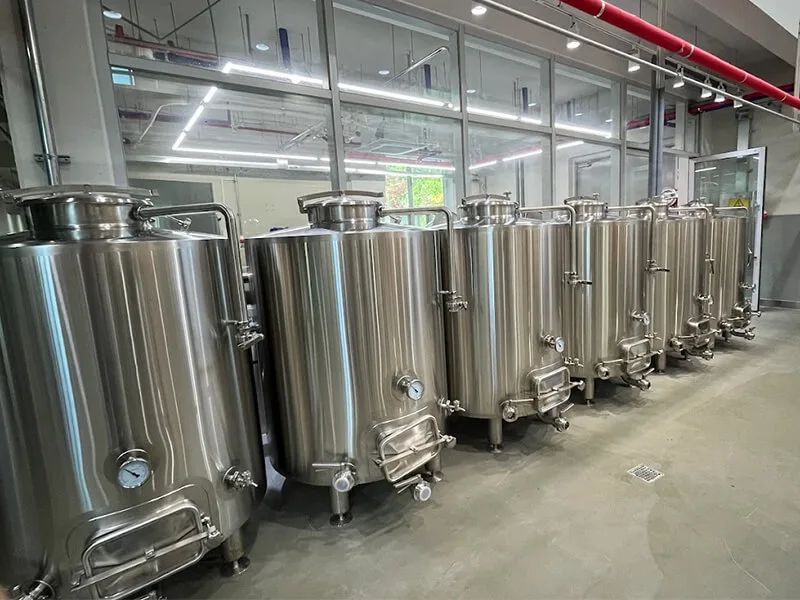
Commercial winery tanks may include:
- Top manway
- Side manway
- Rotary sampling valve
- 视镜
- Level indicator
- 泄压阀
- Thermometer port
- Adjustable support legs
- CIP spray ball
- Bottom drain valve
- Butterfly valves
- Tri-clamp sanitary connections
Each configuration can be customized according to winery workflow and production requirements.
Manufacturing Standards and Quality Assurance
A well-designed wine tank should meet internationally recognized manufacturing standards while delivering long-term operational reliability.
International Certifications
Professional manufacturers typically comply with:
- ISO 9001 Quality Management System
- CE Certification
- TÜV inspection requirements
- Food-grade material certifications
These standards help ensure product quality while facilitating export to Europe, North America, Australia, and other international markets.
Precision TIG Welding
Automatic TIG welding is widely used in premium stainless steel fabrication.
Compared with manual welding, automated TIG welding produces:
- Uniform weld penetration
- Smooth internal seams
- Minimal oxidation
- Excellent corrosion resistance
- Consistent structural strength
After welding, seams are ground and polished to sanitary standards to eliminate crevices where residues or microorganisms could accumulate.
Pressure and Leak Testing
Before shipment, every tank should undergo comprehensive quality inspection, including:
- 压力测试
- Leak detection
- 焊缝检查
- Surface finish verification
- Dimensional measurement
- Functional testing of valves and accessories
A documented inspection process reduces installation risks and ensures reliable performance throughout the equipment’s service life.
How to Choose the Right Stainless Steel Wine Tank Supplier
Selecting the right manufacturing partner is just as important as selecting the equipment itself.
Strong OEM and Engineering Capability
No two wineries are identical.
A capable supplier should provide customized engineering services based on production capacity, building dimensions, process flow, and future expansion plans.
Look for manufacturers that offer:
- 3D layout design
- Process engineering
- Custom fabrication
- Complete turnkey winery solutions
Engineering support during the planning stage often prevents costly modifications after installation.
Proven International Export Experience
Experienced exporters understand the technical and logistical requirements of overseas projects.
They should be familiar with:
- International standards
- Export packaging
- Sea freight protection
- Customs documentation
- 设备安装
- Remote commissioning
A supplier with successful installations in Europe, North America, Australia, South America, and emerging wine-producing regions is generally better equipped to support international customers.
Reliable After-Sales Support
Long-term service is an important part of equipment ownership.
Professional suppliers typically provide:
- 安装指南
- Online technical support
- Maintenance documentation
- Spare parts supply
- Operator training
- Lifetime technical consultation
Comprehensive after-sales support minimizes production downtime and protects your investment over many years.
常见问题解答
What size stainless steel wine tank should I choose?
Tank size depends on annual production volume, harvest schedule, grape varieties, and fermentation strategy. Many wineries use a combination of different tank capacities to improve production flexibility.
Is SUS 304 suitable for wine production?
Yes. SUS 304 is the standard material for most commercial wineries. SUS 316 is generally recommended only when higher corrosion resistance is required.
Do all fermentation tanks need cooling jackets?
For commercial wine production, cooling jackets are highly recommended. Stable fermentation temperatures improve aroma retention, fermentation consistency, and overall wine quality.
How long can stainless steel wine tanks last?
With proper maintenance, high-quality stainless steel wine tanks can remain in operation for more than 30 years while maintaining excellent sanitary performance.
Can wine tanks be customized?
Yes. Professional manufacturers can customize tank capacity, dimensions, cooling systems, insulation, fittings, polishing level, and control systems to match specific winery requirements.
结论
Stainless steel wine tanks have become an indispensable part of modern winemaking because they combine precision, hygiene, durability, and operational efficiency in a single solution.
From fermentation to long-term storage, they provide the stable environment necessary to protect wine quality while reducing maintenance costs and improving production consistency.
For wineries planning new facilities or upgrading existing operations, investing in professionally manufactured stainless steel tanks is a long-term decision that supports both product quality and business growth.
When selecting a supplier, look beyond the purchase price. Manufacturing quality, engineering expertise, international certifications, customization capability, and after-sales support all contribute to the long-term value of your investment.
If you are planning a winery project or expanding production capacity, choosing the right stainless steel wine tank today will help establish a more efficient, reliable, and sustainable winemaking operation for years to come.
Request a Customized Winery Solution
Looking for a reliable stainless steel wine tank manufacturer?
Our engineering team provides customized winery equipment, including fermentation tanks, storage vessels, variable capacity tanks, glycol cooling systems, and complete turnkey winery solutions. 立即联系我们 to discuss your production requirements, request technical drawings, or receive a detailed quotation tailored to your winery project.