Producing quality whisky is not simply a matter of putting fermented wash into a still and collecting alcohol. The character of the final spirit is influenced by every stage of the process—from raw material preparation and mashing to fermentation, distillation, spirit collection, and maturation.
For a commercial distillery, the right whisky distillation equipment must therefore do more than separate alcohol from water. It should provide precise process control, sufficient copper contact, reliable heating and condensation, hygienic operation, efficient cleaning, and the flexibility to produce different spirit styles.
A well-designed whisky production line typically combines a brewing or mashing system, fermentation tanks, wash still, spirit still, condenser, spirit receiver, control system, CIP system, and maturation equipment.
This article explains how these systems work together and what distilleries should consider when selecting whisky distillation equipment.
1. Whisky Production Starts Before Distillation
The distillation process begins long before the wash enters the still.
During mashing and fermentation, starch from grains such as malted barley, corn, rye, or wheat is converted into fermentable sugars and then transformed by yeast into alcohol and a wide range of flavor compounds.
These compounds become important precursors for the final spirit.
Esters, higher alcohols, organic acids, aldehydes, and other fermentation-derived compounds can contribute fruity, floral, cereal, spicy, or heavier notes. Distillation then separates and concentrates these compounds according to their volatility and their interaction with the still.
This is why a professional whisky distillery should consider the entire production line rather than selecting a still in isolation.
A typical production flow is:
Raw Material → Milling → Mashing → Wort Separation → Fermentation → Wash → First Distillation → Low Wines → Second Distillation → Heads/Hearts/Tails Separation → Spirit Collection → Maturation
The equipment used at each stage directly affects process consistency and final spirit quality.
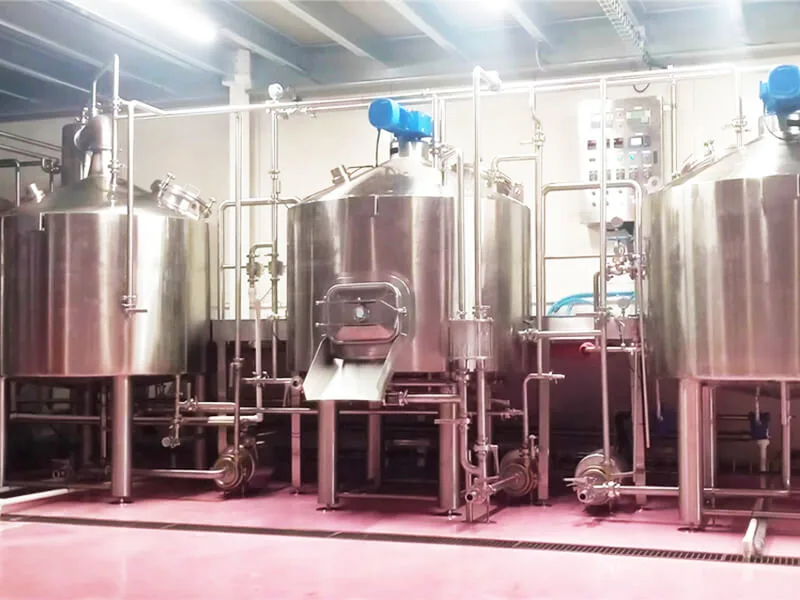
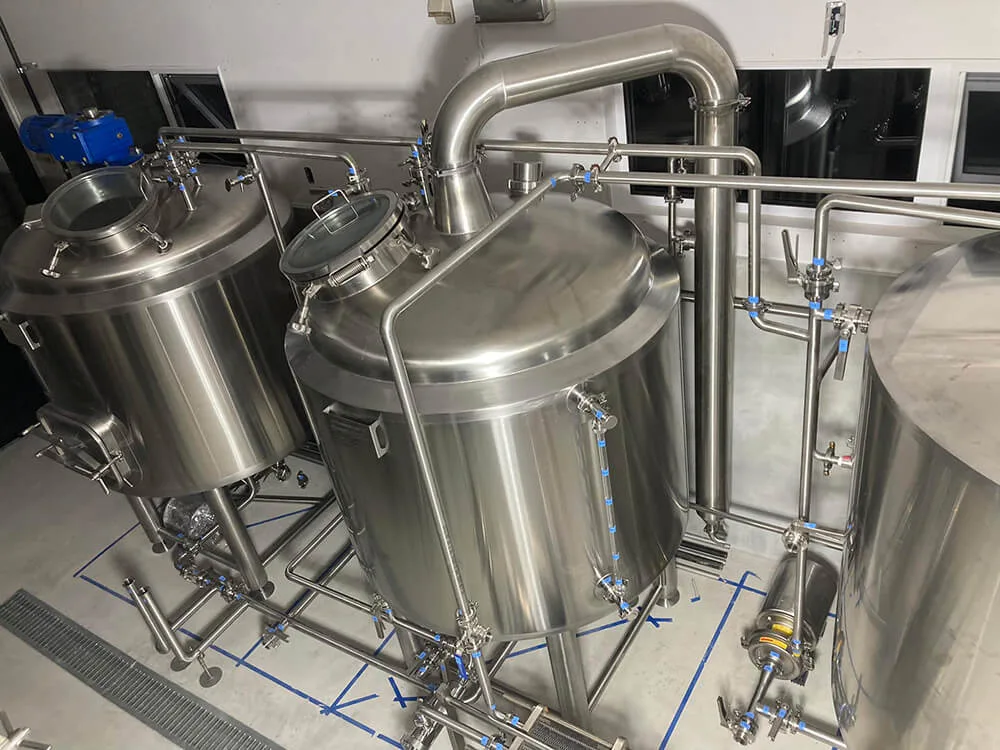
2. Brewing and Mashing System
The brewing or mashing system prepares the raw material for fermentation.
For malt whisky, malted barley is commonly milled before being mixed with hot water. The objective is to release starch while maintaining an appropriate particle size for efficient extraction and filtration.
Malt Milling
A roller mill is commonly used for malt processing.
The objective is not simply to grind the grain as finely as possible. Excessive milling can create filtration problems, while insufficient milling may reduce starch conversion efficiency.
A properly configured milling system should provide:
- Consistent particle size
- Efficient starch release
- Controlled husk preservation
- Stable throughput
- Low dust generation
- Easy cleaning and maintenance
For larger distilleries, automated conveying and milling systems can be integrated with the brewhouse to reduce manual handling.
Mashing
During mashing, hot water is mixed with the milled grain to convert starch into fermentable sugars.
Mashing temperature and process time depend on the recipe, raw materials, enzyme activity, and desired spirit style. A temperature range around 65–68°C can be used in some whisky processes, but it should not be treated as a universal specification for every distillery.
A professional mash tun or mash kettle can be equipped with:
- Temperature sensors
- Agitation system
- Insulation
- Wort outlet
- CIP spray device
- Sight glass
- Flow control
- Automated temperature control
The resulting wort is then transferred to fermentation.
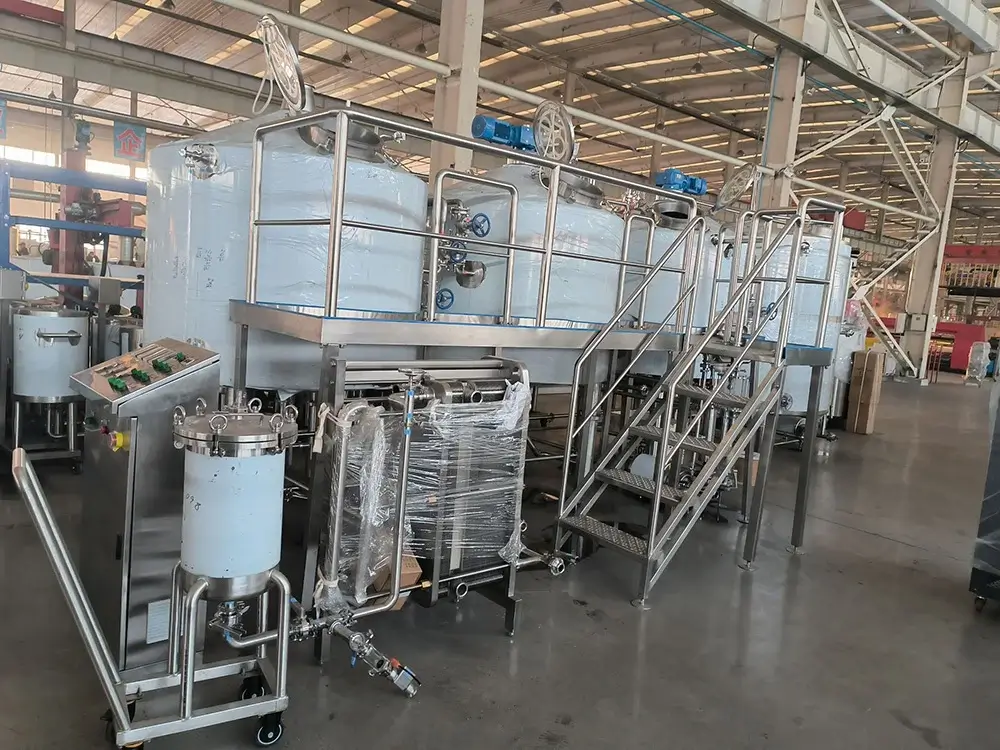
3. Fermentation Tanks: Building the Spirit’s Flavor Foundation
Fermentation is one of the most important stages in whisky production because yeast creates many of the flavor compounds that later influence the distilled spirit.
The wort is transferred into fermentation vessels where yeast converts sugars into ethanol, carbon dioxide, and numerous secondary metabolites.
Depending on the production philosophy, fermentation may last from approximately 48 hours to several days, with longer fermentation generally providing more time for yeast and other microorganisms to develop additional flavor complexity.
For commercial distilleries, fermentation tanks should provide stable and repeatable operating conditions.
Important features may include:
- SUS304 or SUS316L stainless steel construction
- Cooling jackets
- Temperature sensors
- Sanitary fittings
- CIP spray balls
- Sampling ports
- Pressure-rated design where required
- Insulation
- Automated temperature control
Temperature management is particularly important. Excessive fermentation temperatures can affect yeast performance and flavor development, while inadequate temperature control can create batch-to-batch variation.
The final fermented wash is then transferred to the wash still.
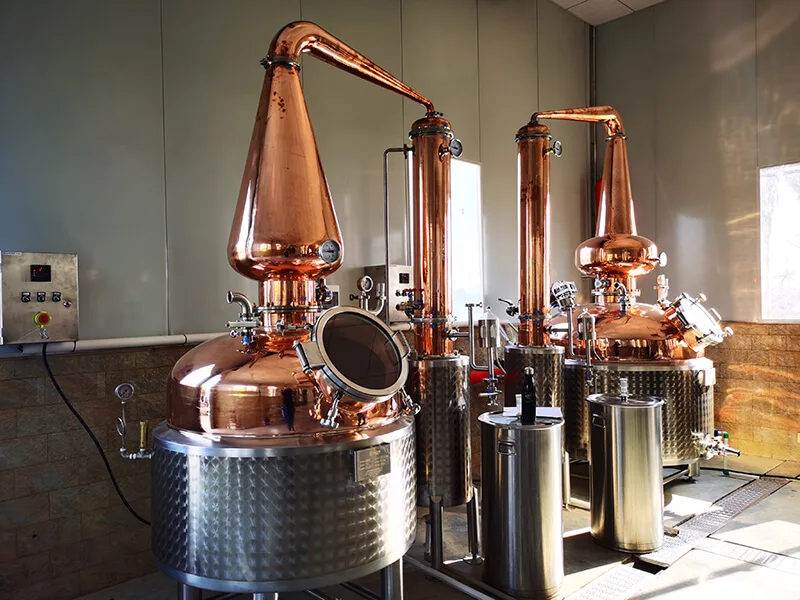
4. What Is a Whisky Pot Still?
A traditional whisky pot still is a batch distillation vessel designed to concentrate alcohol while shaping the character of the spirit.
Unlike a simple alcohol separation system, a pot still is also a flavor-development tool.
Its geometry, copper surface area, heating method, vapor path, reflux characteristics, distillation rate, and condenser configuration can all influence the resulting spirit.
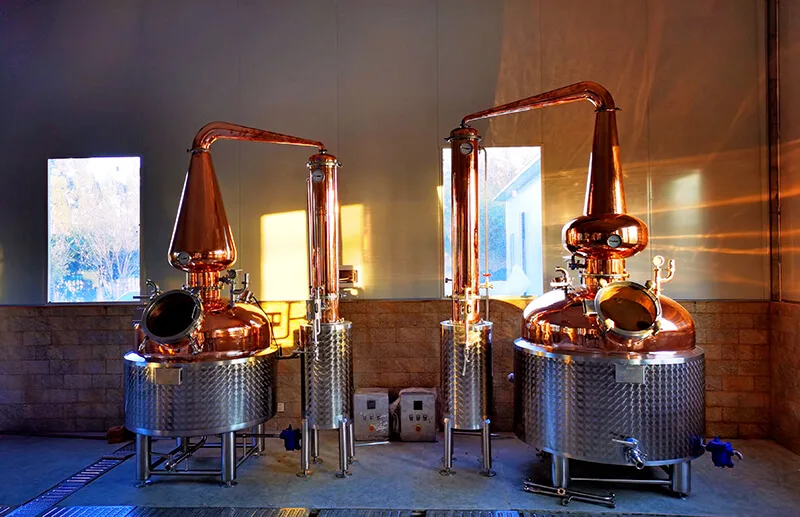
A typical whisky pot still system includes:
- Wash still
- Spirit still
- Copper pot
- Onion head or comparable vapor chamber
- Swan neck
- Lyne arm
- Condenser
- Spirit receiver
- Heating system
- Control system
- CIP system
The exact configuration can be customized according to the desired spirit style and production capacity.
5. Wash Still: The First Distillation
The fermented wash first enters the wash still.
The wash still is designed to separate alcohol and volatile compounds from the fermented liquid and concentrate them into a distillate commonly known as low wines.
The still is heated indirectly, typically using steam or another controlled heating method.
During heating, alcohol and other volatile components vaporize. The vapor travels through the still head and vapor path before entering the condenser, where it is cooled and converted back into liquid.
A first distillation may produce low wines in the approximate range of 20–30% ABV, depending on the original wash strength, still design, distillation strategy, and operating conditions.
The first distillation is primarily focused on concentration and separation rather than producing the final drinking spirit.
Why Copper Matters
Copper is traditionally used in whisky stills because it can interact with certain sulfur-containing compounds and other undesirable components in the vapor stream.
Adequate copper contact can contribute to a cleaner and more refined spirit.
Common copper components include:
- Still body
- Still head
- Onion head
- Swan neck
- Lyne arm
- Condenser components
The amount and location of copper contact are important design considerations.
A longer or more interactive vapor path can increase copper interaction and potentially encourage a lighter spirit character, while still geometry and reflux behavior can also influence the final profile.
For this reason, still design should be based on the intended spirit style rather than simply maximizing copper surface area.
6. Spirit Still: The Second Distillation
After the first distillation, the low wines are transferred to the spirit still for the second distillation.
The second distillation allows the distiller to make more precise separations between different fractions of the distillate.
This is where the distiller’s process expertise becomes particularly important.
The distillate is generally divided into three broad fractions:
Heads
The heads are the early fraction containing a higher concentration of the most volatile compounds.
The heads are separated according to the distillery’s process parameters, sensory evaluation, analytical data, and legal and safety requirements.
It is not technically accurate to define the heads simply as “the methanol fraction.” Methanol behavior depends on the composition of the wash and distillation process, and proper spirit production relies on controlled fraction management rather than assuming one compound exists entirely in one fraction.
Hearts
The hearts are the principal spirit fraction selected for maturation.
This fraction contains the desired balance of ethanol and congeners that define the intended spirit character.
The quality of the hearts depends on:
- Still design
- Heating rate
- Reflux
- Copper contact
- Distillation speed
- Cut strategy
- Fermentation profile
- Raw material
- Distiller expertise
Tails
The tails are the later fraction and generally contain a greater proportion of less volatile compounds and heavier flavor components.
Some distilleries recycle selected portions of the tails into future distillation runs, depending on their production philosophy.
The exact cut points are not universal. Experienced distillers often combine analytical measurements with sensory evaluation to determine where the heads transition into hearts and where the hearts transition into tails.
7. The Importance of Still Design
When purchasing whisky distillation equipment, the still’s capacity is only one part of the equation.
Its geometry can have a significant influence on spirit character.
Important design parameters include:
Still Shape
Traditional pot stills may use different body and head geometries depending on the desired spirit profile.
A larger vapor chamber or particular head shape can influence reflux and vapor-liquid interaction.
Swan Neck and Lyne Arm
The vapor path between the still head and condenser affects reflux and copper interaction.
A rising vapor path may encourage reflux and produce a lighter spirit, while other configurations can contribute to a heavier character.
Condenser
The condenser must efficiently convert alcohol vapor back into liquid while maintaining stable operating conditions.
Common configurations include shell-and-tube condensers and other sanitary heat-exchange designs.
Cooling water flow, temperature, heat-transfer area, and material selection should be matched to the still capacity.
8. Heating System for Whisky Stills
The heating system has a direct influence on distillation stability.
For commercial whisky production, indirect heating is commonly preferred because it provides better control and reduces the risk of localized overheating.
Typical heating options include:
Steam Heating
Steam heating provides controlled and uniform heat transfer and is particularly suitable for medium and large distilleries.
A steam system can be connected to:
- Wash still
- Spirit still
- Mash system
- Hot water system
- CIP system
Centralized steam generation can therefore support multiple parts of the production line.
Electric Heating
Electric heating can be suitable for smaller distilleries and pilot systems where steam infrastructure is unnecessary.
It provides relatively straightforward installation and independent process control.
Direct Fire
Direct-fired systems are traditionally associated with certain whisky production methods and can contribute to specific production characteristics.
However, direct fire requires careful engineering, safety control, and vessel design.
The appropriate heating method should be selected based on production capacity, local energy costs, facility infrastructure, safety requirements, and the desired process.
9. Condensation and Cooling System
After vapor leaves the still, it must be condensed back into liquid.
The condenser is therefore a critical part of the distillation system.
A properly designed condenser should provide:
- Stable cooling performance
- Sufficient heat-transfer area
- Food-grade or sanitary construction
- Reliable water circulation
- Easy cleaning
- Consistent outlet temperature
The cooling system may include a cooling water tank, pump, heat exchanger, cooling tower, chiller, or other supporting equipment depending on plant size.
For larger distilleries, the condenser and cooling-water system should be designed together with the still capacity rather than treated as independent components.
10. Spirit Receiver and Collection System
After condensation, the distillate is transferred to a spirit receiver or collection tank.
A well-designed collection system allows the distiller to monitor and manage the different fractions during the run.
Depending on the production scale, the system may include:
- Spirit receiver
- Intermediate tanks
- Flow meters
- Alcohol meters
- Sampling ports
- Sight glasses
- Transfer pumps
- Valves
- Load cells
- PLC monitoring
For commercial production, accurate measurement is important for batch traceability and process consistency.
The selected heart fraction can then be transferred to storage or maturation vessels.
11. New Make Spirit and Maturation
Freshly distilled whisky spirit is not yet the finished product.
The new make spirit is usually reduced to an appropriate filling strength before being transferred into oak casks, depending on the distillery’s maturation strategy and applicable regulations.
During maturation, the spirit interacts with the oak over an extended period.
Several processes occur simultaneously:
- Extraction of wood compounds
- Color development
- Oxidation
- Esterification
- Reduction of harsh notes
- Integration of alcohol and flavor compounds
Oak contributes compounds associated with vanilla, caramel, spice, tannin, dried fruit, toast, and other flavor characteristics.
The maturation environment also matters.
Temperature, humidity, warehouse conditions, cask type, previous cask contents, fill strength, and maturation time can all affect the final whisky.
This is why the distillation equipment should be designed to produce a stable and repeatable new make spirit—the quality of the spirit entering the barrel directly affects the maturation result.
12. Stainless Steel vs. Copper in Distillation Equipment
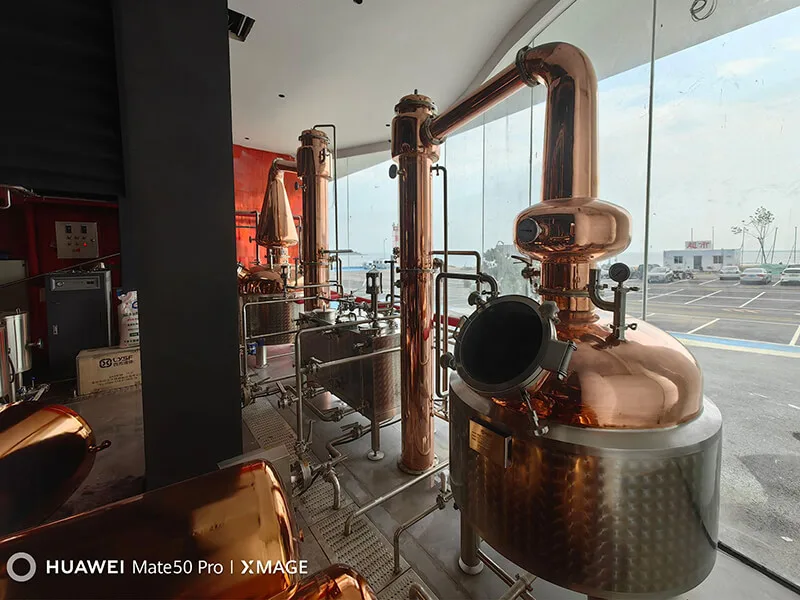
Modern distilleries often combine stainless steel and copper rather than using copper for every component.
Stainless Steel
SUS304 stainless steel is widely used for tanks, piping, frames, and supporting equipment because it provides:
- Good corrosion resistance
- Easy cleaning
- Long service life
- High mechanical strength
- Hygienic surfaces
- Lower maintenance requirements
SUS316L may be selected for applications requiring higher corrosion resistance or specific sanitary requirements.
Copper
Copper is especially important in the vapor path of traditional whisky stills.
Depending on the design, copper may be used for:
- Still body
- Still head
- Swan neck
- Lyne arm
- Condenser
- Other vapor-contact components
Combining stainless steel and copper allows manufacturers to balance hygiene, durability, process performance, appearance, and cost.
13. CIP System: An Essential Part of a Commercial Distillery
Cleaning should be considered during equipment design rather than added later.
Fermentation tanks, mash systems, piping, receivers, and other process equipment require regular cleaning to maintain hygienic conditions and consistent production.
A CIP system can typically include:
- CIP tank
- Cleaning pump
- Spray balls
- Return piping
- Valves
- Heating system
- Temperature monitoring
- Chemical dosing
- Control system
For larger installations, automated CIP sequences can reduce labor requirements and improve repeatability.
CIP design should also consider dead legs, drainage, pipe slope, internal surface finish, valve arrangement, and accessibility.
A well-designed hygienic system makes cleaning faster and reduces the risk of contamination between batches.
14. Automation and Process Control
Modern distilleries increasingly use PLC-based automation to improve consistency and reduce manual operation.
A control system can monitor and manage:
- Mash temperature
- Fermentation temperature
- Heating rate
- Steam pressure
- Cooling-water temperature
- Flow rate
- Tank level
- Pump operation
- Valve positions
- Distillation parameters
- CIP sequences
Depending on the project, control levels can range from manual operation to semi-automatic or fully automated systems.
For smaller craft distilleries, a manual or semi-automatic system may provide the flexibility preferred by experienced distillers.
For larger commercial facilities, PLC and HMI systems can provide centralized monitoring and production records.
15. How to Choose the Right Whisky Distillation Equipment Capacity
Capacity should be determined according to the entire production plan rather than the still volume alone.
For example, a distillery may consider:
- Target annual spirit production
- Fermentation batch size
- Number of fermentation tanks
- Distillation frequency
- Available working hours
- Wash strength
- Expected spirit yield
- Maturation inventory
- Available building space
- Energy supply
- Future expansion plans
A typical project may include capacities ranging from small 100–500L pilot distillation systems to 1,000L, 2,000L, 3,000L, 5,000L and larger commercial distillation systems.
The correct configuration depends on the distillery’s business model.
A small craft producer may prioritize flexibility and small-batch experimentation, while a commercial whisky producer may prioritize throughput, automation, energy efficiency, and repeatability.
16. Pot Still vs. Column Still
Not every distillery needs the same type of distillation system.
Pot Still
Pot stills are widely associated with whisky, rum, brandy, and other spirits where flavor retention is important.
They generally provide:
- Strong spirit character
- Batch production
- High control over distillation cuts
- Significant influence from still geometry
- Traditional production characteristics
Column Still
Column stills are designed for continuous or highly efficient distillation.
They can provide:
- Higher throughput
- Greater rectification
- More efficient alcohol separation
- Continuous operation
- Flexible production for certain spirit styles
Hybrid Still
A hybrid system combines characteristics of pot and column distillation.
It can be a useful choice for distilleries producing multiple spirit categories and looking for greater production flexibility.
The best choice depends on the product portfolio rather than simply the equipment price.
17. Custom Whisky Distillation Equipment for Different Markets
An overseas distillery may have very different requirements depending on its location and target market.
A professional equipment manufacturer should consider:
- Local electrical standards
- Steam and gas requirements
- Pressure vessel regulations
- Food-contact requirements
- CE or other applicable certifications
- Local installation codes
- Safety systems
- Control components
- Factory layout
- Shipping dimensions
- Future expansion
For international projects, electrical components, control systems, pressure-rated equipment, documentation, and certification packages can be customized according to the destination market.
This is particularly important for customers importing complete distillery systems rather than individual pieces of equipment.
18. Turnkey Whisky Distillery Solutions
For a new distillery, purchasing individual machines from different suppliers can create challenges in installation, piping, control integration, and after-sales service.
A turnkey distillery solution can integrate the entire production process into one coordinated system.
A complete whisky production line may include:
Milling System
→ Malt mill and grain conveying
Mashing System
→ Mash tun, hot liquor tank, pumps and wort handling
Fermentation System
→ Fermentation tanks, cooling system and temperature control
Distillation System
→ Wash still, spirit still, copper vapor path and condenser
Spirit Collection
→ Spirit receiver, measuring and transfer equipment
CIP System
→ Cleaning tanks, pumps, piping and spray devices
Control System
→ PLC, HMI, sensors, valves and electrical cabinet
Maturation System
→ Spirit storage and oak cask management
The advantage of an integrated system is that the equipment, piping, utilities, automation, and process flow can be engineered as one complete project.
19. What Should Buyers Ask a Distillery Equipment Manufacturer?
Before purchasing whisky distillation equipment, overseas buyers should ask manufacturers several practical questions.
What material is used?
Confirm the grade of stainless steel and copper used in product-contact areas.
How is the still heated?
Ask whether the system uses steam, electric heating, or direct fire and what utility infrastructure is required.
What is the working capacity?
Do not evaluate the system based only on nominal volume. Confirm working volume, headspace, distillation batch size, and expected throughput.
How much copper contact is provided?
Copper contact is an important part of traditional whisky still design and should be discussed together with still geometry and vapor-path configuration.
What level of automation is available?
Determine whether the project requires manual, semi-automatic, or PLC-based control.
How is the equipment cleaned?
Confirm CIP configuration, drainage, internal surface finish, spray devices, and cleaning procedures.
Can the equipment be customized?
A commercial distillery may require customized dimensions, heating systems, tank configurations, piping, electrical components, or control functions.
What after-sales support is provided?
For overseas projects, installation guidance, commissioning support, spare parts, technical documentation, and remote service can be just as important as the equipment itself.
20. Building a Whisky Distillery Around the Final Spirit Style
The most important principle in whisky equipment selection is that equipment should follow the spirit concept—not the other way around.
A light and delicate whisky may require a different still geometry, vapor path, reflux behavior, and fermentation strategy from a rich and heavy spirit.
Likewise, a small craft distillery producing multiple spirits may value flexibility more than maximum throughput.
Before finalizing the equipment specification, distillers should define:
- Target spirit style
- Raw materials
- Fermentation philosophy
- Desired production capacity
- Distillation method
- Heating method
- Copper contact requirements
- Automation level
- Maturation plan
- Expansion requirements
The equipment manufacturer can then translate these requirements into a practical engineering solution.
Conclusion
For overseas distilleries planning a new project or upgrading an existing production line, a customized turnkey solution can help integrate equipment capacity, process flow, utilities, automation, and installation requirements into one complete distillery system.
Planning to Build a Whisky Distillery?
If you are planning to build a new whisky distillery, expand your existing production capacity, or develop a customized distillation project, METO can provide professional equipment solutions based on your production goals, site conditions, and target spirit style.
From mashing and fermentation to pot still distillation, spirit collection, CIP, cooling, automation, and supporting systems, we can help you develop a complete production solution tailored to your requirements.
Contact METO today to discuss your distillery project, equipment requirements, capacity, and production plans. Our technical team will help you find the right whisky distillation equipment and build a practical solution for your market.