1. Introduction: Why Fermentation System Design Matters
In an industrial brewery, fermentation is more than the stage where yeast converts wort into beer. It is a critical production process that directly affects brewery capacity, product consistency, production scheduling, and operating efficiency.
A well-designed industrial beer fermentation system must coordinate several factors: brewhouse output, fermentation time, tank capacity, cooling requirements, cleaning cycles, process pipelines, and packaging schedules.
If fermentation capacity is insufficient, freshly brewed wort may have to wait before entering a fermenter. If too many tanks are installed without considering the production plan, the brewery may face unnecessary investment and underutilized equipment. Poorly arranged pipelines or cooling systems can also create operational difficulties as production volume increases.
For this reason, industrial fermentation system design should begin with the overall brewery production plan rather than simply selecting tanks by volume.
This article explains the main engineering considerations for designing an industrial beer fermentation system for continuous and organized production.
2. Start with the Brewery’s Production Capacity
Before selecting fermentation tanks, the first step is to define the brewery’s production targets.
A commercial brewery typically needs to consider three different capacity figures:
- Brewhouse capacity: The volume of wort produced per batch.
- Fermentation capacity: The total working volume available in fermentation tanks.
- Finished beer capacity: The actual volume of beer available after fermentation, maturation, processing, and packaging losses.
These figures are related, but they are not interchangeable.
For example, a brewery equipped with a 5,000L brewhouse and a planned production rate of four to six batches per day has a theoretical daily wort output of approximately 20,000–30,000L.
However, this does not mean that the brewery can package the same volume of finished beer every day. Actual production depends on fermentation duration, tank turnover, beer styles, downstream processing, and packaging capacity.
Calculate Daily Wort Output
A basic calculation is:
Daily Wort Output = Wort Volume per Batch × Number of Brewhouse Batches per Day
For a 5,000L brewhouse:
- 4 batches/day = 20,000L wort/day
- 5 batches/day = 25,000L wort/day
- 6 batches/day = 30,000L wort/day
These figures provide an initial reference for fermentation system planning.
The next step is to determine how much fermentation capacity is needed to accommodate this wort output over the full fermentation and maturation cycle.
3. Calculate the Number and Size of Fermentation Tanks
Fermentation tank configuration is one of the most important decisions in industrial brewery design.
The number of tanks should be determined by the relationship between batch volume, fermentation duration, maturation time, cleaning turnaround, and production frequency.
A simplified planning formula is:
Required Fermentation Capacity = Daily Wort Input × Total Tank Occupancy Days
Tank occupancy includes the time required for fermentation, maturation or conditioning when performed in the same vessel, emptying, and cleaning before the next production cycle.
The calculation provides a preliminary capacity estimate. The final tank arrangement must also consider working volume, headspace, tank geometry, beer style, and actual operating procedures.
Choose the Right Tank Working Volume
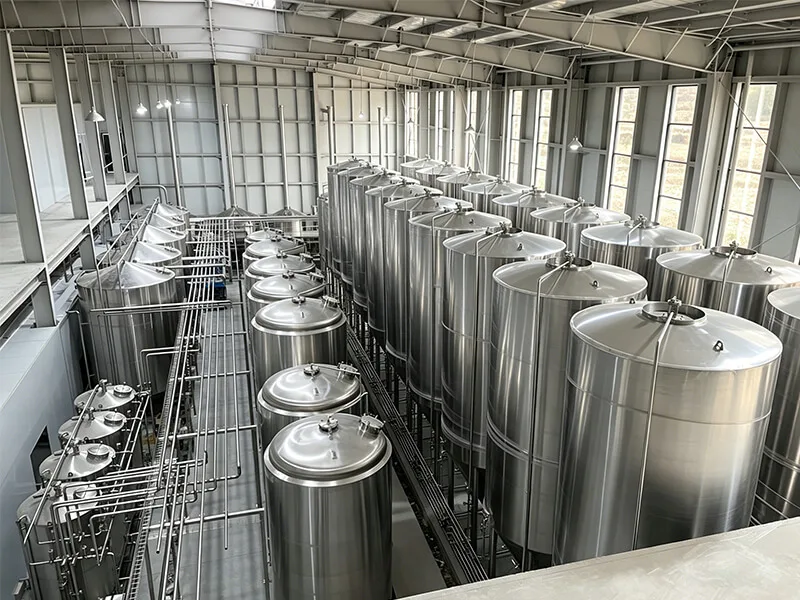
Industrial breweries commonly use conical fermentation tanks with different capacities to match production requirements.
For example, a project may include:
- 5-ton fermentation tanks for smaller production batches or more flexible scheduling.
- 10-ton fermentation tanks for larger production batches.
- 15-ton fermentation tanks for a later production expansion phase.
The actual usable volume of each tank should be confirmed according to the wort volume, fermentation characteristics, required headspace, and tank design.
It is important not to select tanks based only on nominal volume. Active fermentation produces foam and CO2, so sufficient headspace must be reserved. The required allowance varies with the beer recipe, yeast strain, fermentation conditions, and tank geometry.
Consider Multiple Tank Sizes
Using different tank sizes can make a fermentation system more flexible.
Smaller tanks can support pilot production, seasonal beers, special recipes, and smaller batches. Larger tanks are more suitable for standardized high-volume products.
For a brewery with several beer styles and changing production schedules, a combination of tank sizes may provide better operational flexibility than installing identical tanks throughout the facility.
4. Design Fermentation Scheduling for Continuous Production
Continuous production does not necessarily mean that every fermentation tank is filled and emptied simultaneously. Instead, it means organizing brewing, fermentation, maturation, cleaning, and transfer operations into a coordinated production schedule.
A brewery should plan tank availability according to the actual fermentation cycle of each beer style.
A simplified production sequence is:
- The brewhouse produces and cools wort.
- Wort is transferred into an available fermentation tank.
- Yeast is added under controlled process conditions.
- Primary fermentation takes place under the required temperature and pressure conditions.
- The beer proceeds to conditioning or maturation, depending on the production process.
- Finished beer is transferred for filtration, carbonation, storage, or packaging.
- The empty tank enters the CIP cleaning cycle.
- The cleaned tank becomes available for the next batch.
The time required for each stage varies according to beer style, yeast strain, original gravity, fermentation temperature, and the brewery’s quality requirements.
Avoid Fermentation Bottlenecks
A common mistake in brewery planning is to calculate the brewhouse capacity carefully while underestimating the time tanks remain occupied.
For example, a brewhouse may produce several batches per day, but fermentation tanks may remain occupied for considerably longer than one brewing shift.
If the total available tank volume is insufficient, the brewery cannot maintain the planned brewing schedule.
To avoid this problem, engineers should evaluate:
- Daily wort production.
- Average fermentation and conditioning duration.
- Tank filling and emptying time.
- CIP turnaround time.
- Production variation between different beer styles.
- Planned maintenance and occasional tank downtime.
A tank scheduling chart is useful during the design stage. It helps determine when each tank will be filled, fermented, emptied, cleaned, and returned to service.
5. Select the Right Industrial Fermentation Tank Design
The fermentation tank is the central piece of equipment in the fermentation system. Its structure and configuration should match the brewery’s process requirements.
Conical Fermentation Tank
Conical fermentation tanks are widely used in commercial breweries because their bottom geometry supports yeast collection and removal.
A typical industrial conical fermentation tank may include:
- Stainless steel inner shell.
- Conical bottom.
- Cooling jacket.
- Insulation layer.
- Top manway or access opening.
- CIP spray ball.
- Sampling valve.
- Temperature sensor.
- Pressure gauge and pressure protection components, where required by the design.
- Beer outlet and yeast discharge connections.
- Carbonation stone, if required by the process.
The final configuration depends on the beer production process and the required operating pressure.
Stainless Steel Material
SUS304 stainless steel is commonly used for beer-contact surfaces. SUS316L may be selected when the process, cleaning chemicals, or project specifications require its additional corrosion resistance.
Material selection should consider product contact, cleaning conditions, chloride exposure, and the intended service environment.
Surface Finish and Hygienic Design
The internal surface of a fermentation tank should be smooth and suitable for cleaning.
Weld quality, internal polishing, drainage, dead-leg control, and the arrangement of valves and connections all affect cleaning performance.
For commercial breweries, hygienic design should be considered throughout the tank and pipeline system, not only on the tank’s internal surface.
6. Design an Independent Cooling System for Fermentation
Temperature control is essential for maintaining fermentation consistency.
During fermentation, yeast generates heat. Without adequate cooling, the temperature inside the tank may rise beyond the intended process range, affecting yeast activity and the final beer profile.
Industrial fermentation tanks therefore commonly use glycol cooling jackets.
Glycol Jacket Configuration
Depending on tank size and cooling requirements, cooling jackets may be arranged in different sections of the tank.
A typical design may include:
- Lower cooling zones.
- Upper or side cooling zones.
- Insulated tank body.
- Glycol supply and return connections.
- Temperature sensors.
- Automated or manual control valves.
Independent cooling zones can help regulate temperature more effectively under different operating conditions.
Glycol Chiller and Storage Tank
The refrigeration system generally includes a glycol chiller, glycol storage tank, circulation pumps, supply and return pipelines, and control components.
The glycol system should be sized according to the total cooling load rather than the number or nominal volume of fermentation tanks alone.
Engineers need to consider:
- Total fermentation tank volume.
- Number of tanks operating simultaneously.
- Heat generated during fermentation.
- Required cooling rate.
- Incoming wort temperature.
- Ambient temperature.
- Insulation performance.
- Other cooling loads, such as cold storage or wort cooling.
A properly designed refrigeration system helps maintain stable fermentation temperatures while avoiding unnecessary equipment oversizing.
7. Plan the Fermentation Pipeline System
In a large commercial brewery, pipeline design has a direct impact on production efficiency, hygiene, and maintenance.
The fermentation area usually requires several independent or properly separated pipeline systems.
Main Process Pipelines
A typical industrial fermentation system may include:
Wort Pipeline: Transfers cooled wort from the brewhouse or heat exchanger to the fermentation tanks.
Beer Transfer Pipeline: Moves fermented or conditioned beer to filtration, bright beer tanks, or the packaging area.
Yeast Pipeline: Supports yeast addition, collection, discharge, and transfer where required.
CIP Pipeline: Delivers cleaning solutions and rinsing water to tanks and associated process lines.
Glycol Pipeline: Circulates cooling medium between the refrigeration system and tank jackets.
CO2 Pipeline: Supplies carbon dioxide for applicable process operations, such as tank purging or beer transfer.
Compressed Air Pipeline: Supplies instrument or process air where required by pneumatic valves and other equipment.
Drainage Pipeline: Collects wastewater and cleaning discharge from the production area.
Separate Process and Utility Lines
A practical fermentation system should make process connections easy to identify, operate, and maintain.
Pipeline routing should consider:
- Product flow direction.
- Cleaning flow direction.
- Pipe slope and drainage.
- Isolation between tanks.
- Valve accessibility.
- Prevention of cross-contamination.
- Maintenance space.
- Future tank expansion.
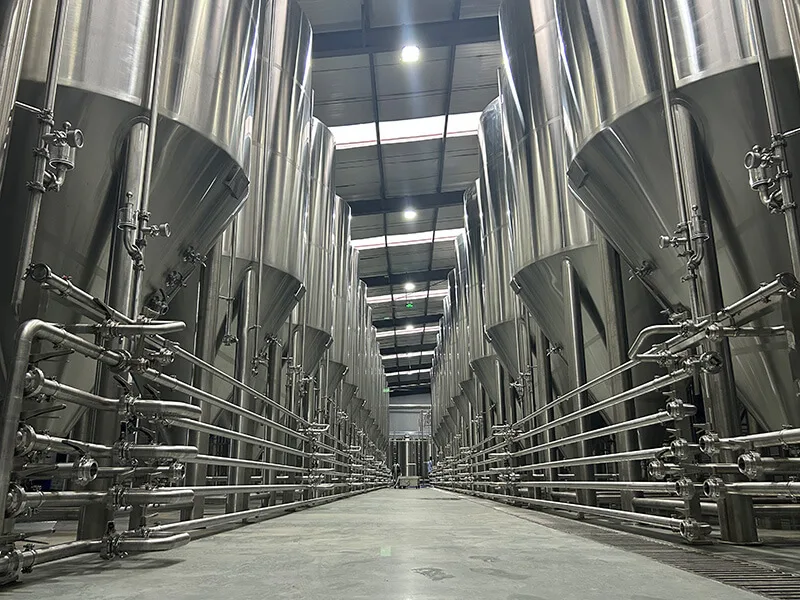
For larger breweries, a dedicated pipeline gallery or utility corridor in front of the fermentation tanks can make the system easier to manage.
This arrangement allows operators to access wort, beer, CIP, glycol, CO2, compressed air, and drainage connections without unnecessarily interfering with tank operations.
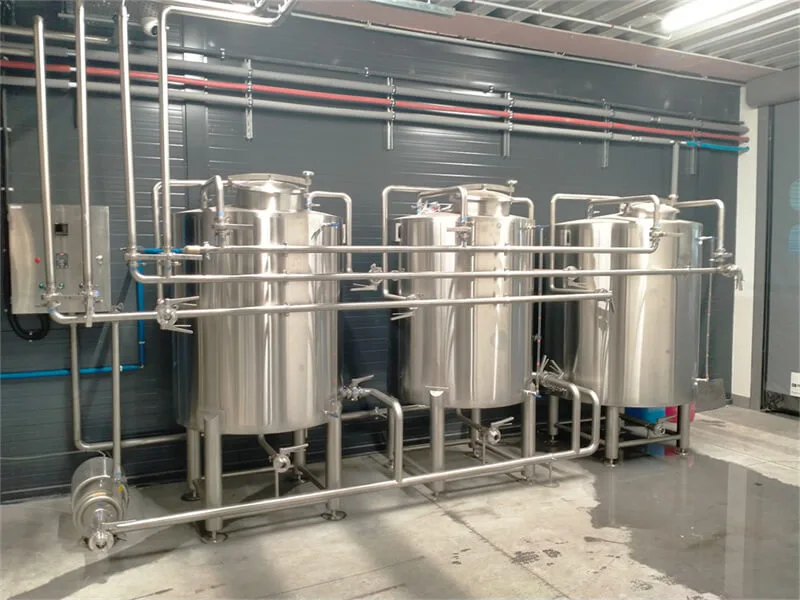
8. Integrate the CIP Cleaning System
Cleaning is an essential part of fermentation tank turnover.
After beer is transferred out, the tank and connected process lines must be cleaned according to the brewery’s validated cleaning procedure.
A centralized CIP system can reduce manual cleaning work and help standardize cleaning operations across multiple tanks.
Typical CIP Tank Configuration
An industrial brewery CIP station may include:
- Caustic solution tank.
- Acid solution tank.
- Sanitizer tank.
- Hot water tank.
- CIP pumps.
- Supply and return pipelines.
- Valves and control components.
The actual tank arrangement depends on the cleaning procedure, chemical selection, production scale, and the number of tanks cleaned simultaneously.
CIP Process Considerations
A typical cleaning sequence may include pre-rinsing, alkaline cleaning, intermediate rinsing, acid cleaning when required, final rinsing, and sanitization.
The exact sequence and chemical concentration should be determined by the brewery’s cleaning procedure and chemical supplier recommendations.
Cleaning performance depends on four key factors:
- Time: Sufficient contact time for each cleaning stage.
- Temperature: Appropriate cleaning temperature.
- Chemical concentration: Correct chemical strength.
- Mechanical action: Adequate flow and spray coverage.
The CIP system should be designed together with the tank spray devices, valve arrangement, and pipeline routing. Installing a CIP station without considering the actual cleaning circuit may result in incomplete coverage or inefficient operation.
9. Apply PLC Automation to Fermentation Management
As brewery production increases, manual control of every tank becomes more difficult.
A PLC-based control system can coordinate fermentation temperature, cooling valves, pump operation, and selected process parameters.
A typical industrial brewery automation system may include a Siemens PLC and an HMI touchscreen.
Depending on the project scope, the control system can support:
- Real-time tank temperature monitoring.
- Temperature setpoint management.
- Cooling valve control.
- Pump start and stop.
- Tank status monitoring.
- Process alarm management.
- Production data recording.
- Selected CIP operation control.
A Wi-Fi connection may also allow supported monitoring through mobile devices or tablets.
However, the actual level of remote operation depends on the control architecture, network configuration, access permissions, and project requirements.
Why Automation Matters
Automation helps operators manage multiple fermentation tanks according to defined process parameters.
For example, different tanks can follow different temperature profiles depending on their beer styles and fermentation stages.
Alarm functions can also help operators identify abnormal temperature conditions or equipment status changes in a timely manner.
For industrial breweries, automation should be designed around the production process. The objective is not simply to install a touchscreen, but to make tank operation more consistent, traceable, and manageable.
10. Plan for Future Fermentation Capacity Expansion
Industrial breweries often expand in phases as market demand increases.
A fermentation system designed only for the first production stage may become difficult or expensive to expand if there is insufficient space or utility capacity.
A better approach is to consider the future layout during the initial engineering stage.
For example, a brewery project may adopt the following expansion plan:
Phase I: Initial Production
Install 5-ton and 10-ton fermentation tanks to support the first production target of approximately 3,000 tons per year.
Phase II: Capacity Expansion
Add 15-ton fermentation tanks to increase the planned annual production capacity to approximately 5,000 tons.
These figures represent project planning targets. Actual production depends on the number of installed tanks, operating cycles, beer styles, fermentation duration, and downstream capacity.
Reserve Space and Utility Connections
When planning future expansion, engineers should evaluate:
- Reserved floor space for additional tanks.
- Building height and installation access.
- Floor loading and foundation requirements.
- Glycol cooling capacity.
- CIP station capacity.
- Pipeline connection points.
- Electrical and control system capacity.
- Drainage and wastewater treatment capacity.
Planning these interfaces early can reduce the need for major modifications during the next expansion phase.
11. Common Mistakes in Industrial Fermentation System Design
Even when individual tanks are properly manufactured, the overall fermentation system may encounter operational problems if the engineering design is incomplete.
Some common mistakes include:
1. Selecting tanks based only on brewhouse volume.
Fermentation capacity must account for tank occupancy time, not just daily wort production.
2. Ignoring headspace requirements.
The nominal tank volume should not automatically be treated as the available working volume.
3. Underestimating cooling demand.
The refrigeration system must be calculated based on simultaneous operating conditions and the required cooling duty.
4. Treating CIP as a separate accessory.
CIP equipment, tank spray devices, valves, and pipelines must work as one integrated cleaning system.
5. Overlooking pipeline accessibility.
Poorly arranged pipelines can make tank isolation, cleaning, maintenance, and future expansion more difficult.
6. Planning no room for expansion.
A growing brewery may need additional tanks, cooling capacity, and utility connections. These requirements should be considered before construction begins.
12. Why Choose METO for Industrial Beer Fermentation Systems?
METO is a brewery and fermentation equipment manufacturer integrating engineering design, equipment production, system integration, installation, and after-sales support.
For industrial brewery projects, METO can provide coordinated solutions covering fermentation tanks, brewhouse systems, glycol cooling, CIP stations, process pipelines, and automated control systems.
Our manufacturing capabilities include stainless steel vessel fabrication, laser cutting, automatic welding, manual argon arc welding, and equipment inspection processes.
For each project, the fermentation system configuration can be developed according to the customer’s production target, beer styles, factory layout, utility conditions, and expansion plan.
Rather than selecting tanks independently, METO focuses on coordinating the fermentation area with the brewhouse, refrigeration system, CIP station, and downstream beer processing equipment.
This integrated approach helps customers build a fermentation system that is practical for current production and prepared for future development.
13. Frequently Asked Questions
How do I calculate the required fermentation tank capacity for a commercial brewery?
Start with daily wort production and the total number of days each tank remains occupied. Include fermentation, conditioning when performed in the same tank, emptying, and cleaning turnaround. Then account for working volume, headspace, beer styles, and production scheduling.
How many fermentation tanks does an industrial brewery need?
There is no fixed number. The required quantity depends on brewhouse output, fermentation duration, tank size, production frequency, beer styles, and cleaning time. A tank scheduling calculation should be completed before finalizing the configuration.
What is the difference between a fermentation tank and a bright beer tank?
A fermentation tank is used for yeast fermentation and may also support conditioning, depending on the process. A bright beer tank is generally used to hold finished beer after fermentation, often for carbonation, clarification, or packaging preparation.
Is a glycol cooling system necessary for industrial fermentation tanks?
Glycol cooling is widely used in commercial breweries because it provides controlled cooling through tank jackets. The refrigeration system should be sized according to the actual cooling load and operating conditions.
Can fermentation tanks be controlled through a PLC system?
Yes. A PLC system can monitor tank temperature, manage cooling valves, record process data, and provide alarms. Remote monitoring or operation can also be included when supported by the control system design.
Can an industrial fermentation system be expanded later?
Yes, provided that future tank space, cooling capacity, CIP capacity, pipeline connections, electrical infrastructure, and building conditions are considered during the initial design.
14. Build a Fermentation System Around Your Production Plan
An industrial beer fermentation system should be designed as part of the complete brewery process.
The right solution depends on more than tank capacity. Fermentation scheduling, cooling performance, CIP configuration, pipeline arrangement, automation, and future expansion all influence the long-term operation of a brewery.
METO provides customized brewery fermentation solutions for different production scales, from small commercial breweries to large industrial brewing facilities.
Contact METO to discuss your brewery project. Share your target annual production, brewhouse batch capacity, beer styles, factory layout, and planned fermentation cycle. Our engineering team can help evaluate the required tank configuration and supporting systems.