Le choix d'un système de distillation est l'une des décisions les plus importantes à prendre lors de la création ou de l'agrandissement d'une distillerie. Le système idéal doit être adapté au spiritueux que vous souhaitez produire, à la capacité de production, aux matières premières, au mode de chauffage, au niveau de contrôle souhaité du processus et aux projets d'expansion futurs.
Il n'existe pas de système de distillation unique adapté à toutes les distilleries. Le whisky, le rhum, le gin, la vodka, les eaux-de-vie de fruits et autres boissons distillées peuvent nécessiter des configurations d'équipement et des conditions d'exploitation différentes.
Ce guide présente les principaux critères à prendre en compte lors du choix d'un système de distillation à usage professionnel.
1. Commencez par l'esprit que vous souhaitez insuffler
La première question n'est pas de savoir quelle taille doit avoir l'alambic, mais quel type d'alcool vous comptez produire.
Selon les spiritueux, les méthodes de distillation peuvent varier.
Whisky utilise souvent des alambics à repasse ou des systèmes hybrides, pour lesquels la distillation par lots et le contrôle des composés aromatiques jouent un rôle important.
Rhum peut être produit à l'aide d'alambics à cuve, d'alambics à colonne ou de systèmes hybrides, selon le style souhaité et le procédé de fabrication.
Gin peut utiliser un alambic à repasse ou un alambic hybride associé à un panier à gin ou à un système d'infusion de plantes aromatiques.
Vodka nécessite généralement un degré de purification plus élevé et peut tirer parti d'une distillation en colonne ou d'une combinaison d'appareils de distillation en alambic et en colonne.
La fabrication d'eaux-de-vie de fruits peut également faire appel à des alambics à repasse ou à des systèmes hybrides, en fonction de la matière première utilisée et du profil aromatique recherché.
Le système de distillation doit donc être conçu en fonction du processus de production plutôt que d'être choisi uniquement en fonction de la capacité des cuves.
2. Choisir le bon type d'alambic
Les principales configurations d'alambics comprennent les alambics à cuve, les alambics à colonne et les systèmes hybrides.
Pot Still
Un alambic à cuve est un système de distillation discontinue. Le moût fermenté est versé dans la cuve, chauffé, distillé, puis recueilli.
Les alambics à cuve sont couramment utilisés lorsqu'il est important de préserver les caractéristiques propres aux matières premières et de contrôler le profil aromatique.
On y pense souvent pour :
- Whisky
- Rhum
- Brandy
- Eaux-de-vie de fruits
- Spiritueux artisanaux
Colonne Toujours
Un alambic à colonne permet une distillation continue ou semi-continue et peut atteindre des niveaux de séparation plus élevés grâce à plusieurs étages.
Les systèmes à colonnes peuvent s'avérer adaptés lorsqu'une distillerie a besoin :
- Débit plus élevé
- Concentration en alcool plus élevée
- Une séparation plus homogène
- Fonctionnement continu ou semi-continu
Le nombre et la configuration des colonnes, des plateaux, des plaques ou des garnissages dépendent du procédé requis.
Hybride Still
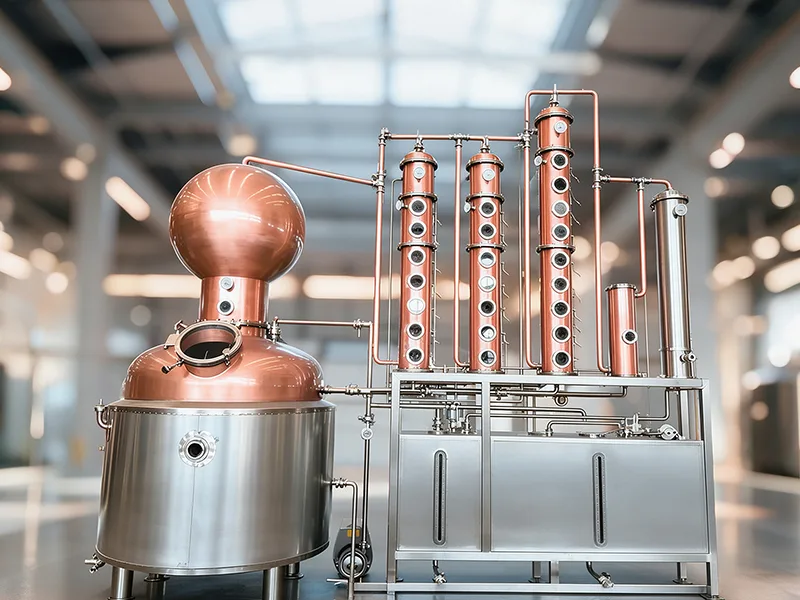
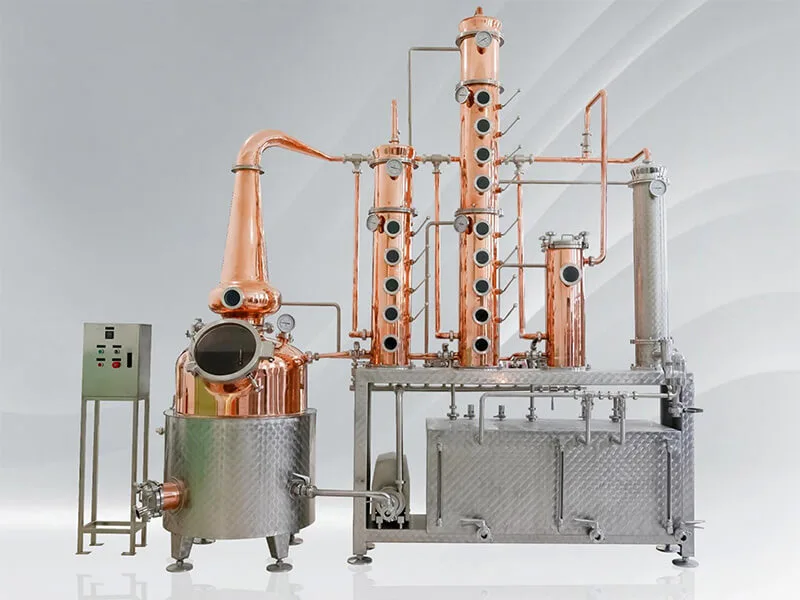
Un système hybride associe un alambic à cuve et une colonne de rectification.
Cela offre une plus grande souplesse dans les processus et peut s'avérer utile pour les distilleries produisant plusieurs catégories de spiritueux.
Par exemple, une distillerie peut utiliser la partie « alambic » pour la distillation par lots, tout en recourant à la partie « colonne » pour améliorer la rectification lorsque cela s'avère nécessaire.
Pour une distillerie multiproduits, une configuration hybride peut offrir davantage de flexibilité qu'un système monofonctionnel.
3. Déterminer la capacité de production nécessaire
La capacité doit être déterminée en fonction de votre objectif de production plutôt qu'en se basant uniquement sur le volume de distillat.
Par exemple, un alambic de 500 litres ne signifie pas nécessairement que la distillerie ne produit que 500 litres d'alcool fini par lot. Le rendement réel dépend :
- Volume de fermentation
- Teneur en alcool
- Fractions de distillation
- Nombre de distillations
- Durée du cycle de distillation
- Jours d'ouverture
- Nombre de lots par jour
- Pertes de produits
- Épreuve finale souhaitée
Une distillerie doit d'abord estimer son objectif de production annuel, puis procéder par rétroactivité pour déterminer la capacité des alambics et la fréquence des cuvées.
Pour une petite distillerie artisanale, un système d'une capacité de 100 à 500 litres peut convenir à une production pilote ou à petite échelle. Les activités commerciales en pleine expansion peuvent nécessiter des systèmes d'une capacité de 500 à 2 000 litres, voire plus, tandis que les usines de plus grande envergure peuvent recourir à plusieurs alambics ou à des systèmes en continu de plus grande capacité.
4. Comparer la distillation discontinue et la distillation en continu
Le mode de production influe également sur le choix des équipements.
La distillation par lots offre une grande souplesse, car elle permet de traiter différents produits dans des lots distincts.
Cela peut s'avérer utile pour les distilleries artisanales qui produisent plusieurs spiritueux ou modifient fréquemment leurs recettes.
La distillation en continu permet d'obtenir un débit plus élevé et une production plus régulière pour les opérations à grande échelle.
Pour faire votre choix entre les deux, tenez compte des éléments suivants :
- Production annuelle
- Nombre de produits
- Flexibilité de production
- Besoins en main-d'œuvre
- Niveau d'automatisation
- Consommation d'énergie
- Teneur en alcool requise
- Développement futur
Un fabricant peut aider à déterminer si une configuration par lots, en continu ou hybride correspond au modèle de production envisagé.
5. Choisir le bon matériau
L'acier inoxydable et le cuivre sont tous deux utilisés dans les équipements de distillation, en fonction du procédé et des exigences liées au produit.
acier inoxydable 304 est largement utilisé dans de nombreuses applications du secteur agroalimentaire en raison de sa résistance à la corrosion, de sa durabilité et de sa facilité de nettoyage.
Acier inoxydable 316L peut être choisie lorsque cela se justifie par une résistance accrue à la corrosion ou par des exigences spécifiques du procédé.
Cuivre Il est traditionnellement utilisé dans de nombreux systèmes de distillation de whisky, de brandy et d'autres spiritueux. Des éléments en cuivre ou des composants en cuivre peuvent également être intégrés dans des systèmes hybrides.
Le choix des matériaux doit tenir compte de la matière première, de la concentration en alcool, de la méthode de nettoyage, de la température, des exigences du procédé et de la réglementation locale.
6. Choisissez le mode de chauffage
Le système de chauffage a une incidence directe sur les performances de distillation et les exigences du site.
Les options les plus courantes sont les suivantes :
- Chauffage à la vapeur
- Chauffage électrique
- Chauffage à l'huile thermique
- Tir direct
Le chauffage à la vapeur est largement utilisé dans les installations professionnelles, car il permet d'obtenir un chauffage régulable et relativement homogène.
Le chauffage électrique peut s'avérer pratique pour les petites installations disposant d'une infrastructure électrique.
Le chauffage direct peut être choisi pour certains procédés de distillation traditionnels, mais ce système nécessite de prendre en compte certaines mesures de sécurité et de ventilation.
Le mode de chauffage doit être évalué en tenant compte de la taille de l'alambic, des services publics disponibles, des coûts énergétiques locaux et du calendrier de production.
7. Examiner le condenseur et le système de refroidissement
La distillation nécessite une condensation efficace de la vapeur.
Le dimensionnement du condenseur doit tenir compte des éléments suivants :
- Capacité résiduelle
- Puissance de chauffage
- Débit de production de vapeur
- Température de l'eau de refroidissement
- Conditions de fonctionnement souhaitées
Une distillerie industrielle peut utiliser des échangeurs de chaleur à calandre et tubes ou d'autres configurations d'échangeurs de chaleur hygiéniques, en fonction de la conception du système.
Le système de refroidissement doit également disposer d'un débit d'eau et d'une capacité d'évacuation de la chaleur suffisants.
Pour un projet complet, le condenseur et le système de refroidissement doivent être conçus conjointement plutôt que définis séparément.
8. Déterminez le niveau d'automatisation dont vous avez besoin
Les systèmes de distillation peuvent aller d'équipements à commande manuelle à des systèmes hautement automatisés.
Un système de base peut faire appel à des vannes et des instruments manuels, tandis qu'un système plus sophistiqué peut comprendre :
- Commande par automate programmable
- Écran tactile IHM
- Contrôle automatique de la température
- Surveillance de la pression
- Surveillance du débit
- Vannes automatisées
- Régulation du chauffage
- Enregistrement des données
- Gestion des recettes
L'automatisation permet d'améliorer la reproductibilité des processus et de réduire la charge de travail des opérateurs.
Toutefois, le niveau d'automatisation approprié dépend de l'échelle de production, de l'expérience des opérateurs, de la gamme de produits et du budget.
Pour une petite distillerie artisanale, un système semi-automatique peut suffire à assurer le contrôle des processus. Les projets commerciaux de plus grande envergure peuvent quant à eux tirer parti d'une automatisation plus poussée via un automate programmable (PLC).
9. Envisager le système de fermentation en même temps que l'alambic
L'alambic ne doit pas être choisi indépendamment du système de fermentation.
La capacité du fermenteur influe sur la quantité de moût disponible pour chaque cycle de distillation.
Par exemple, une distillerie peut utiliser plusieurs cuves de fermentation alimentant un seul alambic. Le cycle de fermentation, le cycle de distillation et le temps de nettoyage doivent être coordonnés afin d'éviter les goulots d'étranglement.
Un calcul complet des coûts de production doit tenir compte des éléments suivants :
Capacité de fermentation → Capacité de cuve de repos → Cycle de distillation → Stockage des spiritueux → Conditionnement
Cette approche permet de s'assurer qu'aucune partie de la chaîne de production ne freine le rendement global.
10. Prévoir une expansion future
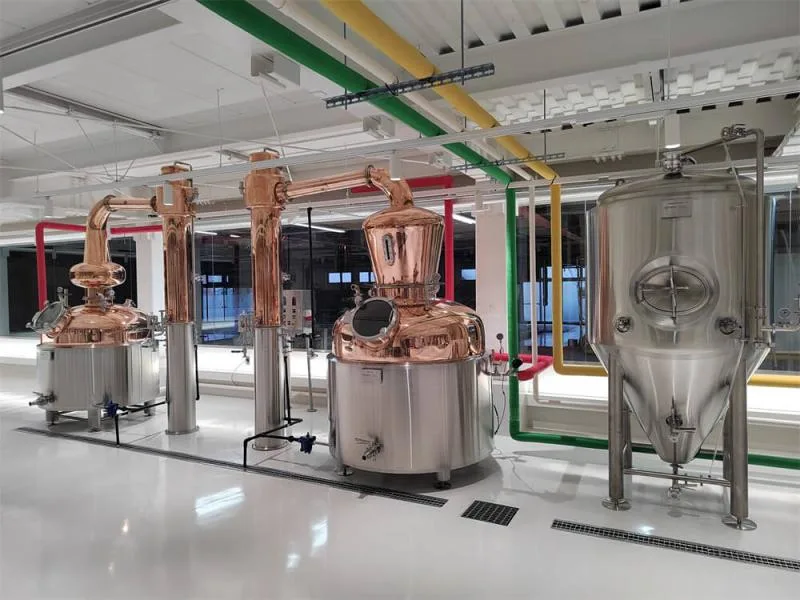
Une distillerie peut démarrer avec une installation relativement modeste, puis augmenter sa production à mesure que le marché se développe.
Lors du choix du système initial, vérifiez si la configuration des lieux et les infrastructures techniques permettent de prendre en charge :
- Fermenteurs supplémentaires
- Encore plus grand
- Colonnes supplémentaires
- Davantage de réservoirs de stockage
- Une plus grande capacité de refroidissement
- Équipements CIP supplémentaires
- Matériel d'emballage
Par exemple, une distillerie d'une capacité de 500 litres pourrait à terme étendre sa production à 1 000 ou 2 000 litres.
En planifiant dès le départ l'aménagement du site et les infrastructures de services publics en tenant compte des extensions futures, on peut réduire les coûts de modification ultérieurs.
11. Pensez au nettoyage et à l'entretien
Les équipements de distillation doivent être nettoyés et inspectés régulièrement.
Le système doit permettre d'accéder facilement à :
- Traversées d'homme
- Vannes
- Condenseurs
- Gammes de produits
- Composants internes
- Raccordements de chauffage
- Instrumentation
Selon le système, le nettoyage peut être effectué manuellement ou à l'aide d'un système CIP.
Une conception hygiénique, avec des raccords adaptés, des surfaces internes lisses et des composants facilement accessibles, peut faciliter le nettoyage et l'entretien.
12. Vérifier les conditions d'installation et les exigences en matière de services publics
Avant de commander un système de distillation, assurez-vous que le site de production dispose de l'espace nécessaire pour accueillir l'équipement.
Parmi les éléments importants à prendre en compte, on peut citer :
- Dimensions de l'équipement
- Charge au sol
- Hauteur sous plafond
- Dimensions des portes et des accès
- Alimentation électrique
- Système de chauffage à vapeur ou de chauffage
- Eau de refroidissement
- Drainage
- Ventilation
- Air comprimé, si nécessaire
- Tuyauteries de produits et de services publics
La réglementation locale peut également avoir une incidence sur la conception des récipients sous pression, les installations électriques, la mise en place, la sécurité incendie et d'autres aspects du projet.
Il convient de vérifier ces exigences auprès du fabricant de l'équipement et des professionnels locaux compétents avant l'installation.
13. Travailler avec un fabricant capable de concevoir le système dans son intégralité
Un système de distillation, c'est bien plus qu'un simple alambic.
Un projet complet peut comprendre :
- Cuves de fermentation
- Alambic à repasse
- Colonne de rectification
- Panier à gin
- Condenseur
- Réservoirs de réception de spiritueux
- Réservoirs de stockage
- Système CIP
- Système de refroidissement
- Système de contrôle
- Tuyauterie
- Installation et mise en service
Travailler avec un fabricant capable d'intégrer ces composants permet de s'assurer que l'équipement fonctionne comme un système de production homogène.
METO conçoit et fabrique des équipements de distillation destinés au whisky, au gin, à la vodka, au rhum, aux eaux-de-vie de fruits et à d'autres applications. En fonction du projet, METO peut fournir des alambics à repasse, des systèmes à colonne, des configurations hybrides, des équipements en cuivre ou en acier inoxydable, des cuves de fermentation, des systèmes de refroidissement, des systèmes CIP ainsi que des solutions de contrôle sur mesure.
Considérations finales
Le choix d'un système de distillation doit d'abord tenir compte du produit et de l'objectif de production, et non pas uniquement de la taille de l'alambic.
Avant de demander un devis, veuillez vous munir des informations suivantes :
- Type Esprit
- Matière première
- Production annuelle visée
- Taille du lot
- Teneur en alcool souhaitée
- Nombre de distillations
- Méthode de chauffage
- Préférence en matière de matériaux
- Exigences en matière d'automatisation
- Services disponibles sur le site
- Projets d'expansion futurs
Grâce à ces informations, un fabricant d'équipements de distillation peut mettre au point un système adapté au processus de production réel et aux conditions du site.
Si vous envisagez de créer une nouvelle distillerie ou d'agrandir une distillerie existante, Contacter METO en fonction de votre objectif de production et du type de spiritueux. Notre équipe d'ingénieurs peut vous aider à mettre au point un système de distillation et une configuration d'équipements adaptés à votre projet.