When a brewery reaches its production limit, building a larger brewhouse is not always the best solution.
In many cases, the real production bottleneck is not the brewhouse itself. Fermentation capacity, tank turnover, cooling capacity, CIP time, packaging efficiency, labor, or inefficient brewing schedules may be limiting total output.
Before investing in a completely new brewhouse, breweries can often increase production by optimizing the existing system and expanding the equipment around it.
This guide explains practical ways to increase brewery production without replacing your current brewhouse.
Find the Real Production Bottleneck First
The first step is to determine what is actually limiting production.
A brewery may have a 1,000L brewhouse capable of producing several batches per day, but its annual output can still be limited by fermentation capacity.
For example, if the brewhouse can complete four batches per day but there are not enough fermentation vessels available, increasing brewing frequency will not significantly increase finished beer production.
Common bottlenecks include:
- Brewhouse operating hours
- Mash and lautering cycle time
- Fermentation tank capacity
- Fermentation time
- Glycol cooling capacity
- Hot and cold water capacity
- CIP cycle time
- Packaging capacity
- Labor availability
- Storage and logistics
The goal is to identify the equipment or process that has the lowest practical capacity in the entire production chain.
Increase the Number of Brews Per Day
One of the simplest ways to increase production is to make better use of the existing brewhouse.
If a brewery currently runs two batches per day, it may be possible to increase production to three or four batches by improving scheduling and reducing unnecessary downtime.
Potential improvements include:
Optimize the Brewing Schedule
Brewing activities can be organized so that different vessels operate simultaneously.
For example, while one vessel is completing lautering, another stage of the previous batch can be transferring or cleaning. A well-designed multi-vessel brewhouse can reduce waiting time between processes.
Reduce Unnecessary Downtime
Review the time spent on:
- Vessel preparation
- Water filling
- Mash-in
- Lautering
- Wort transfer
- Cleaning
- Changeover
- Waiting for operators or equipment
Even small reductions in each cycle can create additional brewing capacity over a full production year.
Improve Milling and Mashing
A properly sized mill and efficient grain handling system can reduce preparation time and improve consistency.
For larger breweries, automated grain conveying and controlled mash-water mixing can further reduce manual operations and improve batch-to-batch repeatability.
Add More Fermentation Capacity
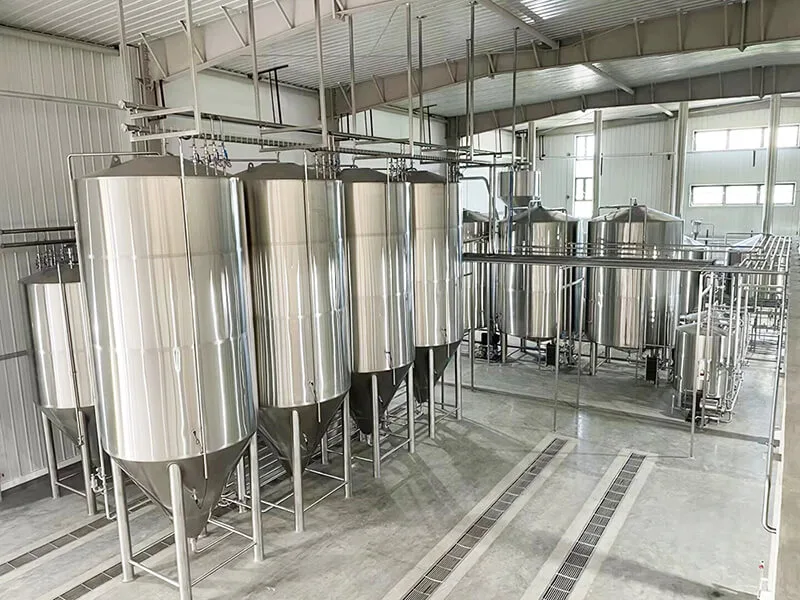
For many breweries, adding fermentation tanks is one of the most effective ways to increase production without replacing the brewhouse.
Suppose a brewery already has a 1,000L brewhouse but does not have enough fermentation vessels. Adding additional 1,000L or 2,000L fermenters may allow the brewery to fully utilize its existing brewing capacity.
The key is to calculate fermentation capacity based on:
- Brewhouse batch size
- Brews per day
- Fermentation time
- Beer styles
- Tank utilization
- Target annual production
For example, increasing from six fermenters to twelve may have a much greater effect on annual production than replacing a 1,000L brewhouse with a larger system.
However, additional tanks also require sufficient glycol cooling, CIP capacity, floor space, utilities, and piping.
Shorten Fermentation Tank Turnaround Time
Increasing the number of tanks is not the only way to increase cellar capacity.
Reducing the time each tank remains occupied can also improve production.
This does not mean artificially shortening fermentation. Instead, breweries should examine the complete tank cycle:
Filling → Fermentation → Conditioning → Cooling → Transfer → CIP → Ready for Next Batch
If a tank remains occupied for several days after the beer is ready because transfer or packaging is not available, the brewery is losing production capacity.
Better production scheduling, reliable cooling, efficient CIP, and sufficient packaging capacity can improve tank utilization without adding a large number of new vessels.
Upgrade the Glycol Cooling System
Cooling can become a major bottleneck when production increases.
More brewing batches and more fermentation tanks mean a greater cooling load.
A brewery planning to add fermenters should evaluate:
- Chiller capacity
- Glycol tank volume
- Glycol pump capacity
- Cooling piping
- Heat exchanger capacity
- Fermenter jacket capacity
- Ambient operating conditions
Adding fermentation tanks without upgrading the cooling system can result in slow temperature reduction and unstable fermentation control.
For breweries operating in hot climates, cooling capacity becomes even more important.
The cooling system should therefore be designed around the brewery’s actual production schedule rather than simply the total nominal tank volume.
Improve CIP Efficiency
Cleaning can consume a significant amount of production time.
If operators spend too much time cleaning tanks, pipes, and brewing vessels manually, the brewery may lose valuable production hours.
A properly designed CIP system can help reduce cleaning time and improve consistency.
Depending on brewery size and process requirements, improvements may include:
- Dedicated CIP tanks
- Automated cleaning sequences
- Spray balls or rotary spray devices
- Dedicated CIP pumps
- Separate cleaning circuits
- Automatisierte Ventilsteuerung
- Temperature and chemical concentration monitoring
The objective is not simply to make CIP automatic. It is to make the entire cleaning process repeatable and efficient.
Upgrade Pumps, Piping and Process Flow
Sometimes the equipment has enough nominal capacity, but the process flow between equipment is inefficient.
Undersized pumps, long transfer routes, excessive pipe bends, manual valve operation, or poorly arranged equipment can increase transfer time and create unnecessary labor.
A brewery expansion should therefore review:
- Wort transfer
- Beer transfer
- CIP circulation
- Glycol circulation
- Hot-water distribution
- Cold-water distribution
- Entwässerung
- Piping diameter
- Valve arrangement
Improving the process layout can increase throughput without increasing brewhouse volume.
Add Hot and Cold Water Capacity
Water systems are often overlooked when breweries expand production.
More batches require more process water for mashing, sparging, cleaning, cooling, and other operations.
A brewery may therefore benefit from additional:
- Hot liquor tank capacity
- Cold liquor tank capacity
- Water treatment capacity
- Heat exchanger capacity
- Water pumps
Increasing available process-water capacity can help the existing brewhouse operate more continuously.
Improve Automation and Process Control
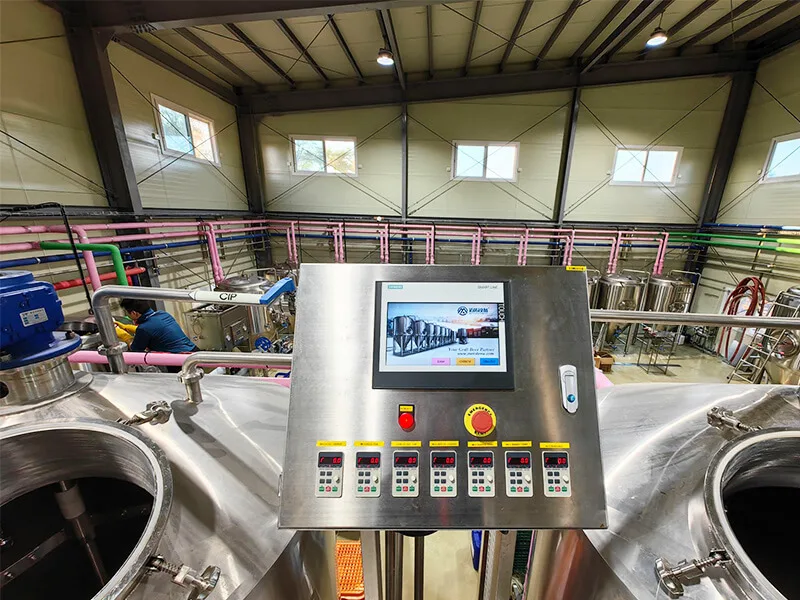
Automation does not necessarily mean replacing the entire brewery control system.
Existing equipment can often be upgraded with better instrumentation and controls.
Depending on the brewery’s needs, improvements may include:
- PLC control
- HMI touchscreen operation
- Temperatursensoren
- Durchflussmesser
- Automated valves
- Pump frequency control
- Automatic CIP sequences
- Fermentation temperature monitoring
- Alarm systems
- Fernüberwachung
The purpose is to reduce operator workload and improve process consistency while allowing the brewery to run more production with the same core equipment.
Optimize Packaging Capacity
A brewery can brew more beer without being able to sell more beer.
If the packaging line becomes the bottleneck, increasing brewhouse utilization will simply increase the amount of beer waiting in tanks.
Packaging capacity should therefore be evaluated alongside brewing and fermentation.
Depending on the brewery’s business model, improvements may involve:
- Faster keg filling
- Can or bottle filling upgrades
- Larger packaging equipment
- Better labeling and packing systems
- Reduced changeover time
- Improved packaging scheduling
The best expansion strategy considers the complete production chain from raw materials to finished packaged beer.
Consider Double-Batch or Multiple-Batch Brewing
Some breweries can increase output by optimizing their existing brewhouse for multiple batches per day.
For example, instead of brewing one large batch, a brewery may schedule several smaller batches when the brewhouse and cellar configuration allow it.
This approach can be particularly useful when:
- The brewhouse is reliable
- Fermentation capacity is available
- Utilities have sufficient capacity
- Operators can support additional shifts
- Cooling capacity is adequate
- CIP cycles are optimized
The brewhouse does not necessarily need to become larger. It may simply need to operate more efficiently.
Expand the Cellar Before the Brewhouse
For many growing breweries, cellar expansion is a more practical first investment than brewhouse replacement.
A brewery can potentially keep the existing brewhouse while adding:
- Fermentation tanks
- Tanks für helles Bier
- Horizontal lagering tanks
- Glycol systems
- CIP equipment
- Service tanks
- Additional pumps and piping
This approach allows production capacity to grow in stages.
It also gives the brewery time to confirm market demand before committing to a major brewhouse investment.
When Should You Actually Build a New Brewhouse?
Expanding the existing system has limits.
A new brewhouse may eventually become necessary when the current system is consistently operating at its practical maximum and further optimization cannot provide enough capacity.
Signs include:
- The brewhouse runs at maximum utilization
- Additional brewing shifts are no longer practical
- Fermentation capacity is already sufficient
- Cooling and utilities have sufficient capacity
- Packaging can handle higher output
- Production demand continues to exceed available brewing capacity
At this point, a larger brewhouse or a second brewhouse may provide a better long-term solution.
The decision should be based on the complete production model rather than brewhouse size alone.
A Practical Expansion Strategy
For an existing brewery, a staged approach is usually more effective than immediately replacing major equipment.
A typical expansion sequence can be:
Step 1: Identify the actual production bottleneck.
Step 2: Optimize the existing brewing schedule.
Step 3: Improve tank turnaround and CIP efficiency.
Step 4: Add fermentation or bright beer tanks if cellar capacity is limiting production.
Step 5: Upgrade glycol, water, pumps and piping as required.
Step 6: Improve automation and process monitoring.
Step 7: Increase packaging capacity if necessary.
Step 8: Recalculate annual production capacity.
Step 9: Consider a new brewhouse only when the existing system has become the true bottleneck.
This approach can reduce unnecessary capital investment while allowing production capacity to grow with market demand.
Why Work With a Brewery Equipment Manufacturer?
Expanding an existing brewery requires more than adding individual tanks.
The new equipment needs to work with the existing brewhouse, utilities, piping, controls, cooling system, and production schedule.
A manufacturer with experience in complete brewery systems can evaluate the existing configuration and determine where additional capacity will have the greatest impact.
At METO, brewery expansion projects can include fermentation tanks, bright beer tanks, glycol cooling systems, CIP systems, hot and cold water systems, pumps, piping, automation, and other supporting equipment.
The goal is to increase practical production capacity while keeping the existing brewery infrastructure as fully utilized as possible.
FAQ
Can I increase brewery production without changing my brewhouse?
Yes. If the brewhouse is not the main bottleneck, adding fermentation capacity, improving cooling, optimizing CIP, increasing brewing frequency, or upgrading packaging can significantly increase overall production.
Should I add fermenters or buy a larger brewhouse?
It depends on where the bottleneck is. If fermentation capacity is limiting production, additional fermenters may provide a better return than replacing the brewhouse.
Can automation increase brewery production?
Automation can improve production efficiency by reducing manual operations, improving process consistency, and reducing downtime. However, automation cannot compensate for insufficient physical capacity elsewhere in the system.
How do I calculate whether my brewery needs more fermenters?
Consider brewhouse batch size, batches per day, fermentation time, tank utilization, beer styles, and target annual production. The required number of fermenters should be calculated from the complete production schedule.
When should I replace my brewhouse?
A new brewhouse is generally worth considering when the existing brewhouse itself has become the limiting factor and the surrounding systems already have sufficient fermentation, cooling, water, CIP, packaging, and utility capacity.
Schlussfolgerung
Increasing brewery production does not always require a new brewhouse.
In many cases, the better solution is to identify the real bottleneck and expand the system around the existing brewhouse. Additional fermentation tanks, better cooling, faster CIP, optimized scheduling, improved automation, and higher packaging capacity can all contribute to higher overall output.
For growing breweries, a staged expansion strategy can provide additional production capacity while avoiding unnecessary investment in a completely new brewing system.
If you are planning to expand an existing brewery, start by evaluating your current brewhouse, fermentation capacity, cooling system, CIP, utilities, and production schedule as a whole. Feel free to contact us.