For a new brewery, choosing brewery equipment is often approached from the equipment side first: How large should the brewhouse be? Should the project use a 4-vessel, 5-vessel, or 6-vessel system? How many fermentation tanks are required?
These are important questions, but they should come after one more fundamental calculation:
How much saleable beer does the brewery need to produce, and how often will the brewhouse need to operate to achieve it?
A brewhouse that looks adequate by nominal tank volume may still become a bottleneck once actual mash times, lautering, boiling, transfers, CIP, fermentation residence time, and working hours are included.
For a brewery equipment manufacturer, brewhouse selection is therefore a production engineering problem rather than a simple equipment comparison.
The objective is to build a brewhouse system that matches:
- Target annual and daily production
- Required brews per day
- Recipe and brewing process
- Fermentation capacity
- Steam and cooling capacity
- Available operating hours
- Automation requirements
- Future expansion plans
The correct configuration may be a 4-vessel system for one brewery and a 5- or 6-vessel system for another brewery with similar tank volumes.
What Does a 4-Vessel, 5-Vessel or 6-Vessel Brewhouse Actually Mean?
The term “4-vessel” or “6-vessel” describes the number of dedicated process vessels in the brewhouse, but it does not by itself define production capacity.
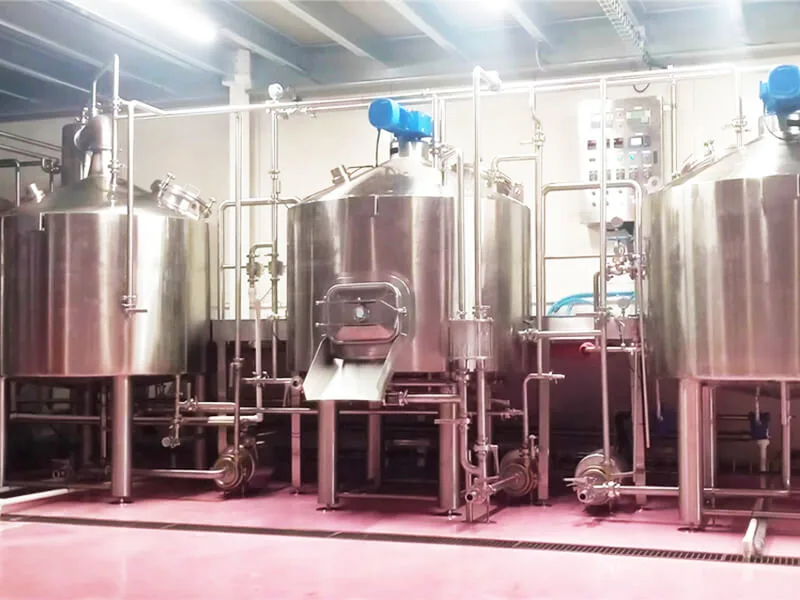
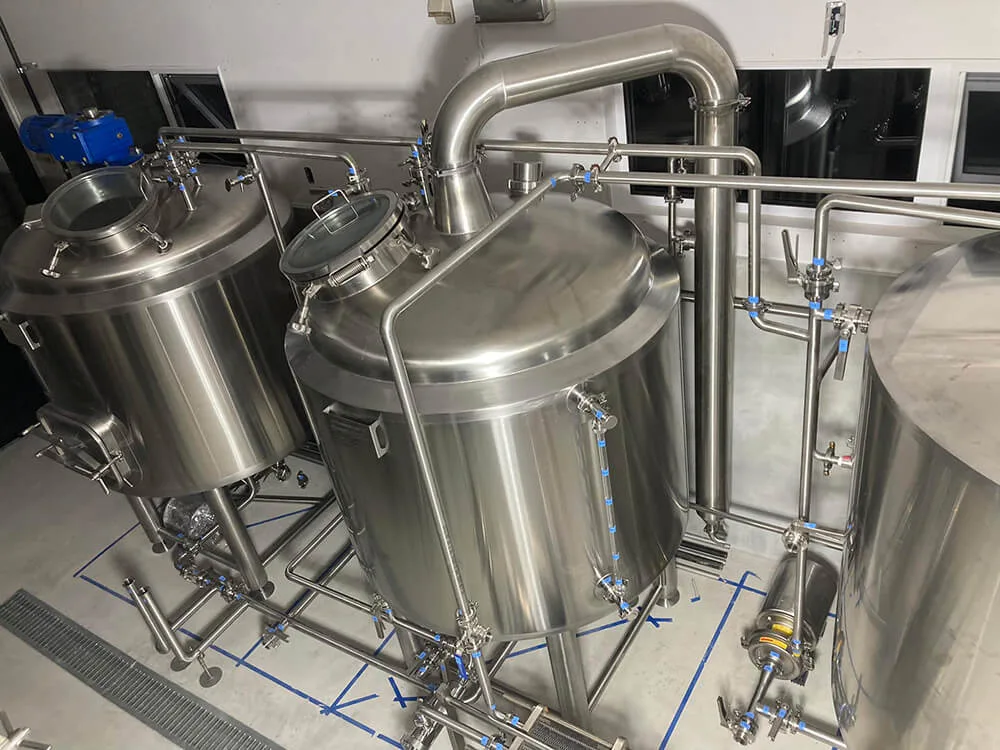
A conventional 4-vessel brewhouse typically includes:
- Mash/mash conversion vessel
- Lauter tun
- Boiling kettle
- Whirlpool tank
Depending on the recipe and project requirements, additional equipment may include a cereal cooker, hot liquor tank, wort holding vessel, CIP system, heat exchanger, pumps, and other auxiliary equipment.
The important point is that adding vessels is not simply about increasing the amount of stainless steel.
Additional vessels are normally introduced to separate processes, reduce waiting time, and increase equipment utilization.
This distinction becomes critical when comparing commercial brewery equipment from different manufacturers. Two brewhouses may both be advertised as “20 HL” systems, but their actual daily output can differ substantially because of vessel configuration and process timing.
4-Vessel Brewhouse: A Practical Choice for Moderate Production
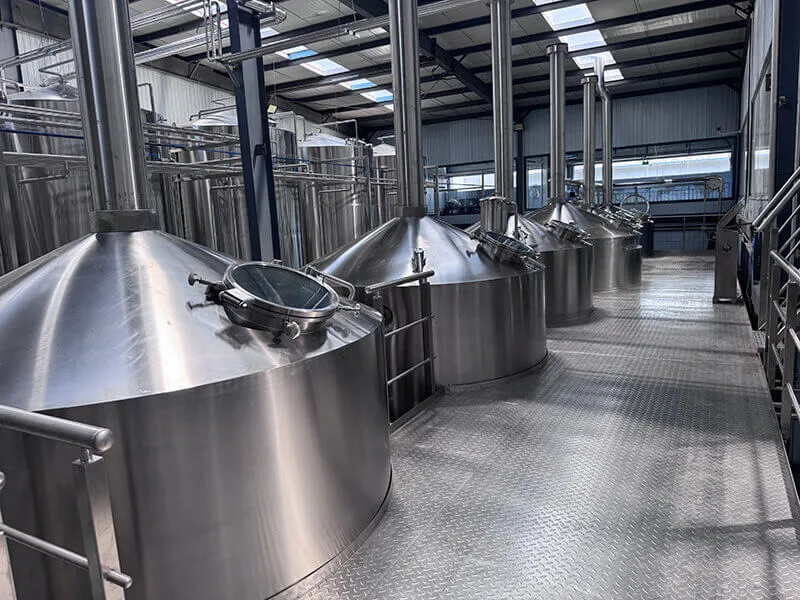
A 4-vessel brewhouse remains one of the most widely used configurations for commercial brewing.
The basic arrangement gives each major process its own vessel:
Mash → Lauter → Boil → Whirlpool
This layout is relatively simple to understand and operate. It also provides clear process separation, which makes it suitable for breweries that do not need extremely aggressive production cycles.
Where a 4-Vessel System Fits
A well-designed 4-vessel system can commonly support approximately four brews per day, although the actual brewery equipment capacity depends on recipe, batch size, heating method, transfer time, operator schedule, and cleaning requirements.
It can be a good option for:
- New commercial breweries
- Regional craft breweries
- Brewpub production facilities
- Breweries with moderate daily demand
- Projects where capital expenditure must be controlled
For a brewery producing several different beer styles, a 4-vessel system can also provide useful process flexibility without introducing unnecessary mechanical complexity.
The Limitation Is Usually Cycle Time
The main limitation of a 4-vessel system is not necessarily the tank volume.
It is the time relationship between processes.
If lautering takes longer than the kettle is available, wort transfer may have to wait. If the kettle remains occupied while the next batch is ready, the lauter tun cannot immediately release another batch.
The result is idle time.
Once this happens repeatedly during a production shift, nominal brewery equipment capacity becomes less important than actual brewhouse utilization.
5-Vessel Brewhouse: Increasing Utilization Without Overbuilding
A 5-vessel brewhouse is often selected when a brewery wants to move beyond the production limitations of a conventional 4-vessel layout.
The fifth vessel may be used as a wort holding or buffer vessel, or the overall configuration may be arranged differently according to the production schedule.
The engineering objective is the same:
Separate processes that would otherwise compete for the same vessel.
Why a Wort Buffer Can Improve Brewhouse Capacity
Consider a simplified production sequence.
If the lauter tun finishes collecting wort while the boiling kettle is still occupied, the next batch cannot proceed efficiently unless there is somewhere to hold the wort.
A dedicated holding vessel creates a buffer:
Lauter → Wort Holding → Kettle
This allows lautering and boiling to operate with less dependence on exact cycle synchronization.
For a brewery targeting approximately five to six brews per day, this additional flexibility can have a significant effect on brewery equipment capacity.
Is a 5-Vessel System Always Better Than a 4-Vessel System?
No.
The fifth vessel only adds value when it addresses a real production constraint.
If the brewery operates a single shift with long intervals between brews, the additional vessel may provide little financial benefit.
If the brewery plans multiple brewing cycles per day, however, reducing vessel waiting time can produce considerably more wort without proportionally increasing brewhouse size.
This is why METO evaluates the brewing schedule before recommending a specific brewhouse configuration.
6-Vessel Brewhouse: For High-Utilization Production
A 6-vessel brewhouse is generally considered for projects where high production throughput is a priority.
Unlike a conventional 4-vessel system, a 6-vessel configuration can use additional or duplicated process vessels to allow more operations to occur simultaneously.
Depending on the brewery’s requirements, the system may incorporate combinations such as:
- Dual lauter vessels
- Dual boiling vessels
- Additional wort holding capacity
- Separate mash and conversion vessels
- Additional process vessels for recipe flexibility
The exact configuration should be determined by process timing rather than by the number “six.”
Parallel Processing Is the Real Advantage
The purpose of a high-capacity brewhouse is to keep several batches moving through different process stages.
At the same time:
- One batch can be mashing
- Another can be lautering
- A third can be boiling
- A fourth can be transferred to the whirlpool
This parallel operation can allow a large brewery to achieve eight or more brews per day when the rest of the plant is designed to support the output.
However, a 6-vessel brewhouse is not automatically a high-capacity brewery.
If the steam boiler, wort cooling system, fermentation tanks, CIP system, or transfer piping cannot handle the production rate, the additional brewhouse vessels will simply move the bottleneck somewhere else.
4-Vessel vs. 5-Vessel vs. 6-Vessel: Engineering Comparison
| Konfiguration | Typical Production Position | Main Advantage | Main Limitation |
|---|---|---|---|
| 4-vessel | Moderate commercial production | Simpler layout and lower investment | More sensitive to process waiting time |
| 5-vessel | Higher utilization | Better separation of process bottlenecks | Higher investment and control complexity |
| 6-vessel | High-throughput production | Parallel operation and maximum utilization | Higher CAPEX, utilities and automation requirements |
The production figures commonly associated with these systems—such as four, six, or eight brews per day—should be treated as engineering reference points rather than guaranteed outputs.
Actual brewery equipment capacity must be calculated from the complete process cycle.
Brewery Equipment Capacity: Calculate the Process Before the Tank
A brewery investor may begin with an annual target such as 5,000, 10,000, or 30,000 hectoliters.
That figure needs to be converted into daily wort production.
Zum Beispiel:
Annual beer production ÷ operating days = required daily production
Then:
Daily wort production ÷ usable wort volume per brew = required brews per day
The calculation should also account for brewhouse losses, evaporation, trub losses, transfer losses, and other process factors.
A 20 HL brewhouse does not necessarily produce 20 HL of finished packaged beer per brew.
This distinction is particularly important when comparing brewery equipment suppliers.
Working Volume Is Not the Same as Nominal Volume
A vessel advertised as 2,000 L may not provide 2,000 L of usable working volume for every process.
Brewhouse vessels require appropriate headspace, heating surface, process allowance, and operating volume.
For fermenters, the distinction is equally important.
A fermentation tank may have a nominal volume of 2,000 L but a working volume that is intentionally lower to provide adequate headspace during fermentation.
Therefore, capacity calculations should always distinguish between:
- Gross vessel volume
- Working volume
- Transfer volume
- Finished beer volume
Fermentation Tanks Must Match the Brewhouse
A high-output brewhouse is only useful if the fermentation cellar can absorb its production.
This is one of the most common areas where brewery projects become unbalanced.
Suppose a brewhouse can produce wort at a rate that requires several fermentation vessels to be filled every day. If there are not enough fermentation tanks, the brewhouse will eventually have to slow down.
Fermentation capacity should therefore be calculated using:
Daily wort production × average fermentation/conditioning residence time
The calculation should then be adjusted for:
- Beer styles
- Gärtemperatur
- Yeast characteristics
- Dry hopping
- Maturation requirements
- Tank cleaning time
- Tank turnover
- Production peaks
For breweries with seasonal demand, additional fermentation capacity may be more valuable than increasing brewhouse capacity.
.webp)
Recipe Requirements Can Change the Brewhouse Design
Brewhouse selection should never be based solely on annual production.
The beer portfolio also matters.
High-Adjunct Recipes
Breweries producing beers with substantial quantities of rice, corn, or other adjuncts may need a dedicated cereal cooker or additional mash-processing equipment.
In these cases, a conventional 4-vessel system may need to be modified to support the required process.
Decoction and Multi-Step Mashing
Traditional lager production or specialty recipes may require multiple temperature rests or decoction.
The brewhouse should provide sufficient heating capacity, transfer flexibility, and vessel availability to execute these programs without creating unnecessary downtime.
Recipe Diversity
A brewery producing ten different beer styles may have very different equipment requirements from a brewery producing only one flagship lager.
More vessels can provide greater process flexibility, but they also increase capital cost, cleaning requirements, automation points, and maintenance.
The objective is not to maximize the number of vessels.
It is to provide the right process capability for the brewery’s product portfolio.
Steam Capacity Can Become the Real Bottleneck
When increasing brewery equipment capacity, steam demand should be calculated at the same time.
A larger brewhouse may require steam for:
- Wort boiling
- Mash heating
- Hot liquor preparation
- CIP
- Other steam-consuming processes
If several kettles operate simultaneously, peak steam demand can increase significantly.
This is particularly important for 5- and 6-vessel systems designed for parallel production.
The boiler should therefore be selected according to the actual operating sequence rather than simply adding together the nominal heating ratings of individual vessels.
For many projects, maintaining approximately 15–20% utility reserve capacity is a reasonable starting point for planning, although the final margin should be determined from the project’s operating conditions and future expansion strategy.
Cooling Capacity Must Be Designed Around Peak Production
Wort cooling is another potential constraint.
A commercial brewhouse may transfer hot wort through a plate heat exchanger at a high flow rate. The cooling system must remove enough heat to bring the wort to the required pitching temperature without slowing production.
The cooling system should therefore be evaluated as a complete package:
- Glykolkühler
- Glycol storage tank
- Cold liquor tank
- Plate heat exchanger
- Wort flow rate
- Cooling water temperature
- Gärtemperatur
- Peak cooling demand
A brewery that increases brewhouse output without increasing refrigeration capacity may simply move the production bottleneck from the brewhouse to the cellar.
CIP Capacity Should Be Included in the Original Design
Higher brewhouse utilization means more frequent cleaning cycles.
CIP capacity becomes increasingly important as the number of tanks and production cycles increases.
A commercial brewery equipment package may include:
- CIP solution tank
- Caustic tank
- Acid tank
- Sanitizer system
- CIP pump
- Spray balls
- Return piping
- Temperaturüberwachung
- Automatisierte Ventilsteuerung
For larger systems, the CIP schedule should be integrated into the production schedule.
A brewhouse capable of eight brews per day is not genuinely capable of eight brews per day if cleaning the associated equipment repeatedly stops production.
Automation Becomes More Valuable as Capacity Increases
Manual operation can be practical for a small brewery, but process coordination becomes significantly more difficult as brewhouse capacity increases.
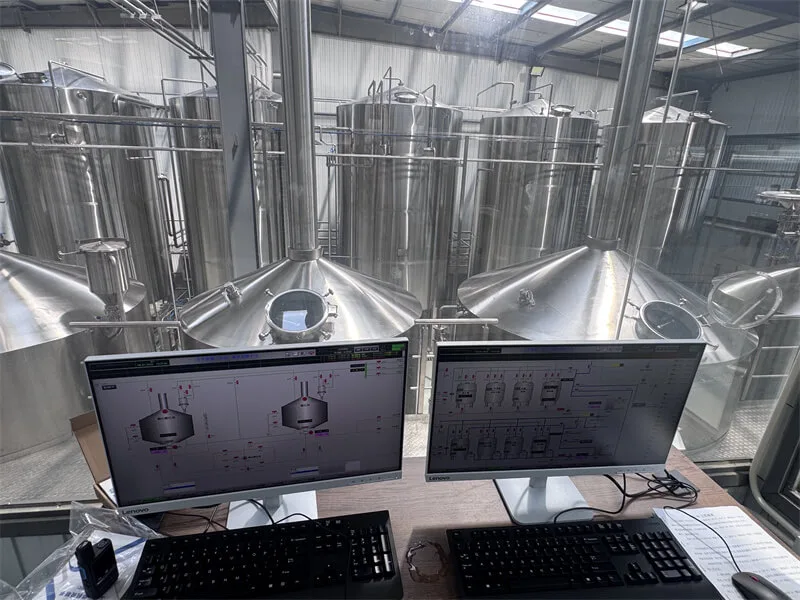
A modern commercial brewhouse may use PLC-based control for:
- Vessel temperature
- Pumpenbetrieb
- Valve sequencing
- Wort transfer
- Flow measurement
- Heizungsregelung
- Füllstandsüberwachung
- CIP-Sequenzen
- Rezeptverwaltung
For high-throughput systems, automation also helps prevent process conflicts.
For example, the control system can prevent a transfer valve from opening when another process is using the same line or prevent a pump from operating when the associated vessel conditions are incorrect.
This is where automation becomes an engineering tool rather than simply a convenience feature.
The Brewhouse Layout Matters as Much as the Vessel Count
A brewery equipment project must also consider physical layout.
A larger brewhouse may require:
- More floor space
- Larger service platforms
- More piping
- Larger pumps
- Additional electrical capacity
- Expanded maintenance access
- More complex CIP routing
Equipment should be positioned so operators can safely access valves, manways, instruments, and service points.
Pipe routing should also minimize unnecessary bends and dead legs while maintaining drainability and sanitary design.
For a new brewery, these considerations should be resolved before fabrication begins.
Changing the equipment layout after installation is considerably more expensive than correcting it during the engineering stage.
A Practical Brewhouse Selection Framework
For a new brewery project, the following sequence provides a more reliable equipment selection process.
Step 1: Define the Annual Production Target
Start with the intended annual finished beer volume.
Then determine:
- Operating days per year
- Peak-season demand
- Expected growth
- Packaging losses
- Product mix
Step 2: Convert Annual Volume Into Daily Wort Demand
Calculate realistic daily production rather than relying on nominal brewhouse size.
Include process losses and the actual working volume of the brewhouse.
Step 3: Determine Required Brews Per Day
Once the daily wort requirement is known, calculate how many brews are needed.
As a preliminary guide:
- Around 4 brews/day → 4-vessel system
- Around 5–6 brews/day → 5-vessel system
- Around 8+ brews/day → 6-vessel or parallel configuration
The actual result should then be validated against the brewing schedule.
Step 4: Identify the Bottleneck
Map the time required for:
- Maischen
- Lautering
- Kochend
- Whirlpool
- Transfers
- Kühlung
- Cleaning
Find the stage that limits the next batch.
This is often more valuable than simply increasing vessel size.
Step 5: Match the Cellar
Calculate the required number and size of fermentation tanks based on daily wort production and residence time.
Step 6: Verify Utilities
Check:
- Dampf
- Electricity
- Water
- Glycol
- Kühlwasser
- Entwässerung
- Compressed air
Allow reasonable reserve capacity for future growth.
Step 7: Design Automation Around the Process
Decide which operations should be manual, semi-automatic, or fully automatic based on labor availability, production volume, and operator requirements.
When Should a Brewery Choose 4, 5, or 6 Vessels?
There is no universal answer.
A 4-vessel brewhouse is usually appropriate when the brewery prioritizes a straightforward process, moderate production, and controlled capital investment.
A 5-vessel brewhouse becomes attractive when the brewery needs higher utilization and a specific process bottleneck can be removed through additional vessel capacity.
A 6-vessel brewhouse is justified when the production schedule requires extensive parallel processing and the brewery has sufficient fermentation, utility, CIP, and packaging capacity to absorb the additional output.
For investors and project managers, the key question is therefore not:
“Which brewhouse has more vessels?”
It is:
“Which configuration produces the required volume at the lowest practical lifecycle cost?”
That includes not only the purchase price, but also energy consumption, labor, maintenance, cleaning time, floor space, automation, and future expansion.
Why Work With a Brewery Equipment Manufacturer From the Planning Stage?
A brewery project involves multiple systems that must operate as one production chain.
The brewhouse, fermentation tanks, glycol system, CIP, hot liquor system, piping, controls, and packaging equipment cannot be sized independently.
This is where working directly with a brewery equipment manufacturer can simplify the engineering process.
METO provides brewery equipment ranging from microbrewery equipment and pilot systems to commercial brewery equipment and larger industrial brewing installations.
For new brewery projects, the engineering scope can include:
- Brewhouse system design
- Fermentation tank configuration
- Hot liquor and glycol systems
- CIP systems
- Piping and process connections
- PLC and HMI control
- Utility calculations
- Equipment layout
- Installation support
- Commissioning and technical support
The equipment can be configured according to production volume, brewing process, local regulations, available utilities, and future expansion requirements.
For projects that require multiple production systems to be coordinated from the beginning, a turnkey brewery solution can reduce interface problems between individual equipment packages.
Final Considerations Before Ordering Brewery Equipment
Choosing between a 4-vessel, 5-vessel, and 6-vessel brewhouse should be the result of a production calculation, not a catalog comparison.
Before approving the final equipment specification, a brewery project should have clear answers to the following:
Production
- What is the annual production target?
- What is the required daily wort volume?
- How many brews are required per day?
- How many operating hours are available?
Process
- What beer styles will be produced?
- Are high levels of adjuncts used?
- Are multi-step mashes or decoction required?
- How much recipe flexibility is needed?
Cellar
- How many fermentation tanks are required?
- What fermentation residence time is expected?
- Can the cellar absorb peak brewhouse production?
Utilities
- Is steam capacity sufficient?
- Is refrigeration sized for peak demand?
- Is the water supply adequate?
- Is CIP capacity sufficient?
- Is 15–20% expansion reserve appropriate for the project?
Future Growth
- Can additional fermentation tanks be added?
- Can the brewhouse operate longer shifts?
- Can utilities support expansion?
- Can automation be upgraded later?
The best brewhouse system is not necessarily the largest one.
It is the configuration that removes the brewery’s actual bottlenecks, supports the intended brewing process, and leaves enough flexibility for the business to grow.
If you are planning a new brewery setup, equipment upgrade or capacity expansion, feel free to contact our professional team.We provide tailored brewery solutions, detailed equipment parameters, customized layout designs and exclusive project quotations to meet your unique brewing production needs.