In the craft beer brewing process, the fermentation tank plays a critical role in transforming wort into finished beer. It is where yeast consumes sugars, develops flavor compounds, and creates alcohol and carbonation. Selecting the right type of fermentation tank directly affects workflow efficiency, beer clarity, flavor consistency, and long-term production cost.
Among the various styles available, conical fermenters and cylindrical (or flat-bottom) fermenters are the two most frequently used in breweries. Each design has its own advantages depending on production scale and brewing goals. This article compares their key differences to help brewers choose the best option.
What Is a Conical Fermentation Tank?
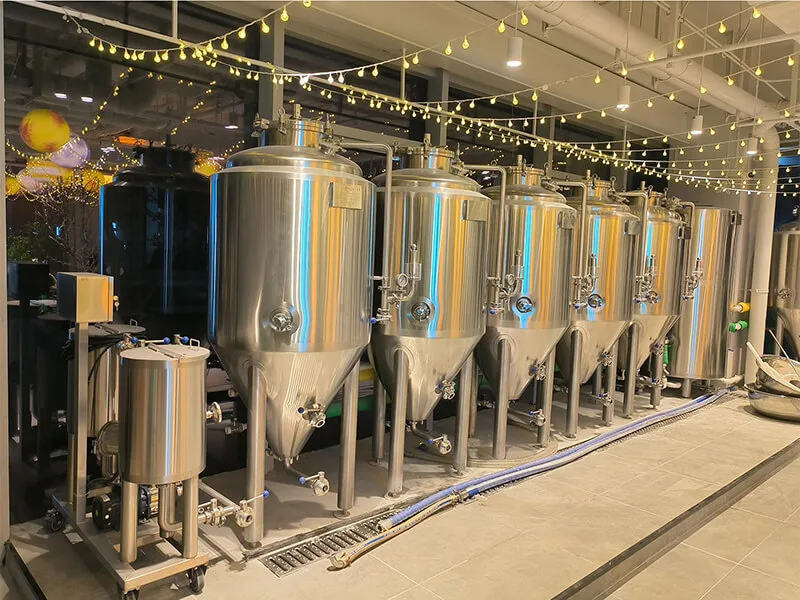
A conical fermentation tank features a cylindrical top section paired with a cone-shaped bottom, typically angled around 60–70 degrees. This structure allows yeast, hops, and sediment to settle naturally at the bottom of the cone. Brewers can easily discharge these solids through the bottom valve, improving beer clarity and simplifying yeast harvesting.
Most conical tanks are built from stainless steel (such as SS304 or SS316), equipped with cooling jackets, temperature sensors, CIP spray balls, sample valves, and pressure-rated lids. Because they can handle pressure, they can be used for primary fermentation, conditioning, dry hopping, cold-crashing, yeast collection, and carbonation in one vessel. For this reason, conical tanks are often called unitanks, capable of replacing multiple pieces of equipment.

What Is a Cylindrical or Flat-Bottom Fermentation Tank?
A cylindrical or flat-bottom fermentation tank is more traditional in design, featuring a simpler cylindrical body with a shallow or flat base. These tanks are generally not pressure-rated, making them more affordable and easier to operate for small-batch or experimental brewing.
Cylindrical tanks are often used in homebrewing and microbreweries that rely on manual methods or produce special styles such as wheat beers or open-fermented ales. They allow easy access from the top for monitoring, mixing, or adding ingredients.
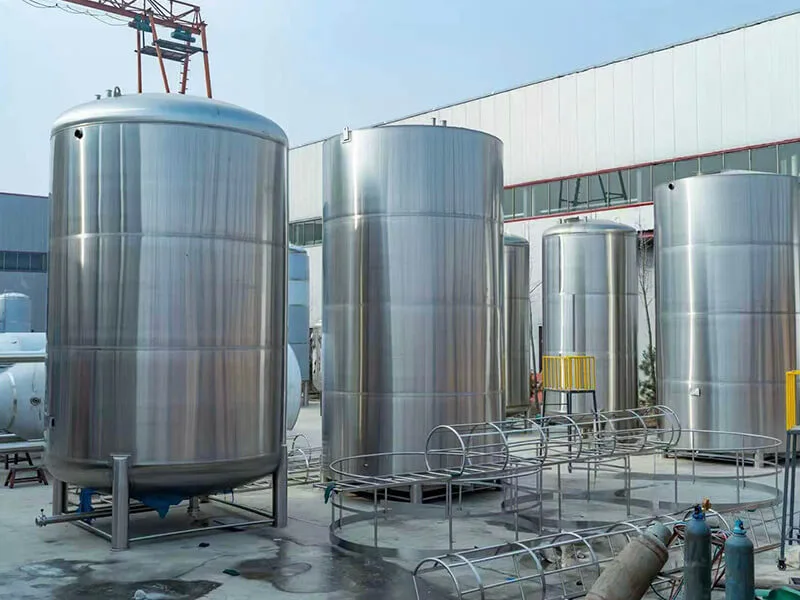
Key Differences Between Conical and Cylindrical Fermentation Tanks
| Feature | Conical Fermenter | Cylindrical / Flat-Bottom Fermenter |
|---|---|---|
| Sediment & Yeast Handling | Solids settle into cone; easily removed | Sediment spreads across bottom; harder to separate |
| Yeast Harvesting | Very efficient and ideal for reuse | Difficult due to mixed trub and yeast |
| Workflow Efficiency | One tank for fermentation, conditioning, carbonation | Often requires transferring to multiple tanks |
| Beer Quality & Clarity | Improved clarity with less oxygen exposure | More prone to oxidation or contamination during transfers |
| CIP Cleaning | Efficient and automated | May require more manual cleaning |
| Pressure Control | Supports forced carbonation and pressure fermentation | Usually non-pressurized |
| Cost | Higher initial investment | Low cost and accessible for beginners |
| Ideal User | Professional and growing craft breweries | Homebrewers and small experimental brewers |
Why Many Craft Breweries Prefer Conical Fermentation Tanks
- Reduced contamination and oxygen exposure by minimizing transfers
- Superior clarity and stability due to easier sediment removal
- Suitable for a wide range of beer styles including lagers and hazy/hoppy IPAs
- Higher productivity and scalability for expanding breweries
- Easy yeast reuse, lowering operational cost
For commercial or semi-commercial brewing, the conical fermentation tank is often considered the best long-term investment.
When a Cylindrical Fermentation Tank Is Still a Good Choice
Despite the advantages of conical designs, cylindrical tanks are still useful in many scenarios:
- Small-batch brewing with limited budget
- Traditional styles that benefit from open fermentation
- Experimentation with many small recipe variations
- Simple manual processes without pressure needs
For new brewers or hobbyists, a cylindrical fermentation tank provides a low-risk way to learn.
Conclusion: Which Fermentation Tank Is Right for You?
There is no universal “best” fermentation tank—only the best match for your goals. Consider the following:
- Brewing scale and production volume
- Required beer quality and consistency
- Budget and long-term equipment plans
- Yeast reuse and sanitation expectations
- Preference for automation or hands-on brewing
Choose a conical fermenter if you prioritize professional efficiency, cleanliness, scalability, and consistent quality.
Choose a cylindrical fermenter if you value simplicity, lower cost, and experimental flexibility.
Selecting the right fermentation tank can greatly enhance your brewing experience and the quality of your craft beer.
If you have any question about brewing, please feel free to contact us Meto Equipment.