Choosing the right commercial brewery equipment is critical for quality, efficiency, and long-term profitability. This guide breaks down everything from material selection and core systems to automation levels—helping you avoid costly mistakes and scale with confidence.
For entrepreneurs, head brewers, and industry veterans alike, your brewing equipment isn’t just hardware—it’s the foundation of your brand’s quality and operational efficiency. Unlike homebrewing, commercial systems are built around scale, standardization, and stability. They govern the entire journey from raw grain to finished beer, directly influencing flavor consistency, throughput, and your total cost of ownership.
Below, we answer the 5 most critical questions to help you select the perfect setup, avoid common pitfalls, and future-proof your brewery.
1. What Defines Commercial Brewing Equipment?
Commercial craft beer brewing equipment is a complete, professional-grade system designed for consistent, large-scale production. It serves nano breweries, microbreweries, and large regional production facilities alike.
| Homebrewing | Commercial Brewing |
|---|---|
| Manual, small-batch (pots & buckets) | Automated/semi-automated production lines |
| Inconsistent, variable results | Precision-controlled, batch-to-batch uniformity |
| Not built for regulatory compliance | Meets food safety standards (e.g., FDA, GB 14881) |
A commercial setup is not just a bigger pot—it’s a synchronized “production line” covering raw material handling, mashing, fermentation, maturation, and CIP cleaning, enabling outputs from dozens of liters to dozens of tons daily.
Production Scale Reference
- Nano Brewery: ≤3 barrels per batch
- Microbrewery: 3–15 barrels per batch
- Production Brewery: ≥15 barrels per batch
Choose your scale based on your business plan, physical footprint, and target market.
2. Why 304/316 Stainless Steel is the Industry Gold Standard
Any surface touching your beer must be 304 or 316 stainless steel. This isn’t a recommendation—it’s a non-negotiable requirement. The reasons boil down to three pillars: safety, durability, and cleanability.
Food Safety First
Beer is acidic and chemically complex. Ordinary metals can react, leaching heavy metals or creating “metallic” off-flavors. Both 304 and 316 are food-grade, chemically inert, and preserve your beer’s true flavor profile without contamination.
Superior Corrosion Resistance
Brewing involves aggressive chemical cleaning (caustic, acid, chlorine-based sanitizers) that would rapidly corrode standard steel.
| Feature | 304 Stainless Steel | 316 Stainless Steel |
|---|---|---|
| Composition | 18% Chromium, 8% Nickel | 2-3% Molybdenum added; low carbon |
| Best For | Standard ales, lagers, regular CIP | High-acidity sours, aggressive sanitizers |
| Lifespan | 5–10 years | 10–20 years |
| Cost Factor | Baseline | 30–50% higher upfront, but lower lifetime cost |
Key Takeaway: For premium craft brands or high-sour production, 316L’s pitting and crevice corrosion resistance offers dramatically better long-term ROI.
Hygienic & Easy to Maintain
Polished stainless steel (Ra ≤0.8μm) leaves no micro-crevices for bacteria, yeast, or biofilms. It allows true CIP without disassembly, slashing labor costs and batch-to-batch cross-contamination risks.
3. The 4 Core Production Systems (Your Brewery’s Backbone)
Each piece of core equipment directly shapes your beer’s character and output efficiency.
1) Raw Material Handling: The Malt Mill
The first step is precision crushing. The goal is to expose the starchy endosperm while keeping the husk intact for proper lautering.
- For <500L/day: Choose a 2-roller mill with adjustable gap settings.
- For >1 ton/day: Opt for a 4-roller or 6-roller mill to perfect the husk-grist balance.
- Avoid: Hammer mills for base malt (they destroy husks; keep them for rice/corn adjuncts only).
2) Mashing System: The Flavor Blueprint
Converting malt into fermentable wort requires exact temperature steps.
- Small/Startup (<300L/day): An integrated 2-vessel or 3-vessel combined system saves space and capital.
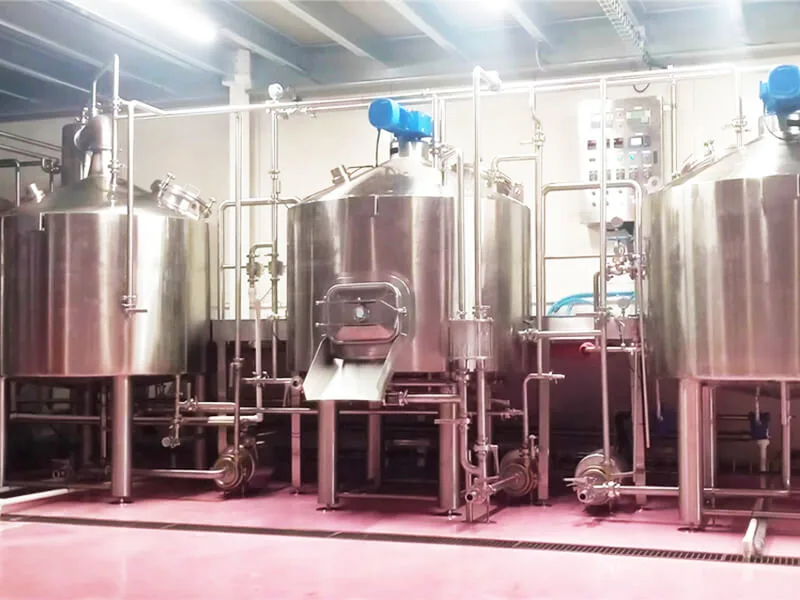
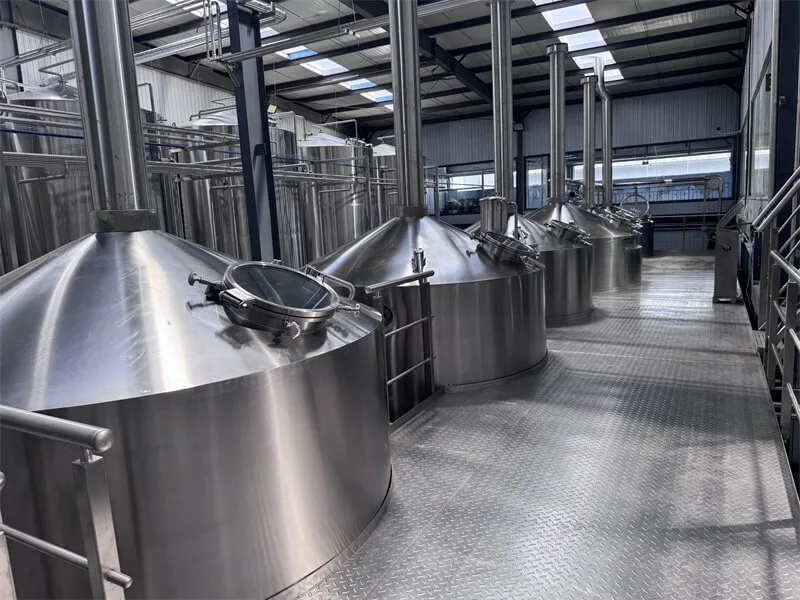
- Scaling & Professional (>500L/day): A modular 4-vessel system (Mash Tun, Lauter Tun, Kettle, Whirlpool) allows independent parameter control—mashing accuracy within ±0.5°C and 8-10% evaporation rates—vital for diverse recipes and high-repeatability.
3) Fermentation Tanks: Where the Magic Happens
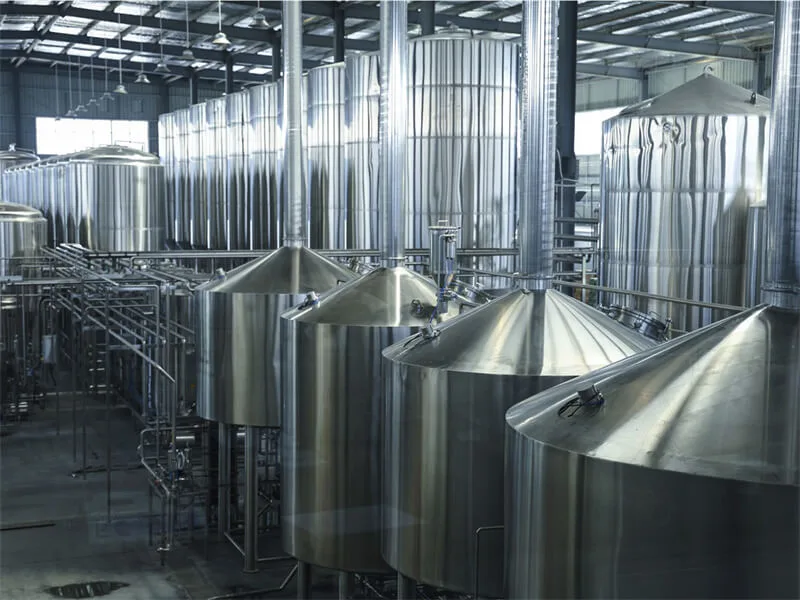
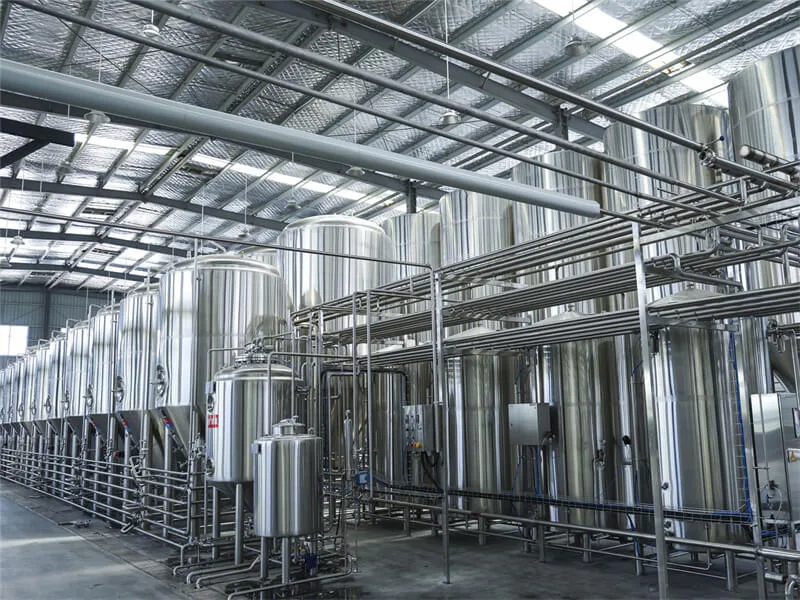
Conical fermenters (Cylindroconical) dominate the industry. Your tanks must provide strict thermal control and efficient yeast management.
- Sizing Rule: Tank capacity should be 1.5–2× your daily batch volume to accommodate foaming (kräusen).
- Temperature Control: Accuracy of ±0.3°C to flawlessly execute both warm ale (15-24°C) and cold lager (0-10°C) fermentations.
- Cone Angle: 60°–75° for optimal yeast collection and viability, reducing downstream yeast costs.
4) Yeast Propagation: Consistency Engine
Under-pitching or unhealthy yeast destroys batch consistency. A dedicated propagation plant lets you amplify pure lab cultures into pitchable volumes.
- For Microbreweries: Manual propagation tanks with rigorous SOPs.
- For Regional Brewers: Fully automated systems with precise DO, pH, and temperature control—delivering >95% viability, batch after batch.
4. Essential Support Equipment (Don’t Overlook These)
Ancillary systems don’t touch the beer directly but are mandatory for operational stability and legal compliance.
CIP (Clean-in-Place) System
Fully automatic systems save hours of manual scrubbing, guarantee repeatable sanitation cycles, and minimize water/chemical use.
Temperature Control Suite
- Heating: Steam (most efficient for multi-vessel plants), electric (clean, for small setups), or gas.
- Cooling: Scroll chillers for small breweries; screw chillers for larger loads. Always pair with a high-efficiency plate heat exchanger (>2000 W/m²·°C) to crash-cool wort quickly, sharply narrowing the infection window.
Bright Beer Tanks & Transfer Pumps
Food-grade transfer pumps and insulated, aseptic BBTs keep your finished product stable and oxidation-free.
Packaging (Optional but Critical for Retail)
Diatomaceous earth filters, automated canning lines (up to 4,000 cans/hour) and bottling lines (6,000 bottles/hour) if you’re distributing off-premise.
Quality Control Lab
Water hardness/pH kits, yeast cell counters, dissolved oxygen meters, and carbonation testers turn “artisan passion” into “repeatable science.”
5. Automation: How Much Do You Really Need?
Many founders agonize over the cost of automation. The right answer depends entirely on your scale and ambition.
Go Fully Automatic if:
- Your target is ≥500L per day with multi-batch production.
- You’re distributing to retailers and need absolute flavor consistency across thousands of units.
- You want to run a lean operation with only 1–2 operators monitoring PLC/HMI touchscreen interfaces.
- You plan to scale fast and want recipe management and data logging at your fingertips.
Consider it an investment that reduces labor costs and eliminates human-error losses.
Choose Semi-Automatic if:
- You’re a brewpub or microbrewery producing ≤500L/day.
- Your brand is built on a brewmaster’s intuition—frequent recipe tweaks, seasonal one-offs.
- You need a lower upfront investment and have a small, hands-on team.
This is the sweet spot for craft creativity, balancing control with cost.
Don’t Over-Invest if:
You’re a nano start-up (<100L/day) testing the market. Start manual, validate your brand, generate cash flow, and reinvest in automation step by step.
Final Checklist for Equipment Buyers
Before you contact a supplier, define these clearly:
- Target Volume: Daily/Annual production (hectoliters).
- Beer Portfolio: Will you brew mainly lagers, IPAs, or barrel-aged sours? (Influences material grade—304 vs 316, and vessel count.)
- Physical Space: Ceiling height, drainage, and floor loading capacity.
- Utility Infrastructure: Steam boiler capacity, electrical supply, and available chilled water.
The Golden Rule: Don’t just buy equipment—build a partnership. The right supplier offers more than stainless steel; they provide layout engineering, process consultation, and after-sales support that keeps your lines running.
Contact Meto today to learn more about our brewery solutions and find the brewery equipment for your brewery.