Brewery automation has become increasingly common in craft and commercial brewing. PLC control, automated valves, temperature monitoring and recipe management can improve process consistency and reduce manual work.
However, a fully automated brewery is not always the best solution for every brewery.
A 300L brewpub, a 1,000L craft brewery and a 5,000L commercial brewery have very different production requirements. The right level of automation should match the brewery’s production volume, labor availability, beer styles, budget and future growth plans.
The goal is not to automate everything. The goal is to automate the processes where automation provides measurable value.
What Does Brewery Automation Include?
Brewery automation can cover different levels of the brewing process, from individual sensors and temperature controllers to a centralized PLC system controlling the entire brewhouse.
Common automated functions include:
- Temperature control
- Pump operation
- Valve operation
- Wort transfer
- Mash temperature management
- Lautering
- Whirlpool operation
- Fermentation temperature control
- Glycol cooling
- CIP sequences
- Water and steam control
- Alarm monitoring
- Recipe management
- Production data recording
The automation system can be designed as a standalone control panel or integrated into a complete brewery control system.
Manual vs Semi-Automatic vs Fully Automatic Brewing
There are generally three approaches to brewery automation.
Manual Brewery
In a manual brewery, operators control most pumps, valves and process steps themselves.
This configuration can work well for:
- Small brewpubs
- Pilot breweries
- Breweries with experienced brewers
- Low production volumes
- Recipe development
The main advantage is flexibility and relatively low initial investment.
The disadvantage is that production depends heavily on operator experience and attention.
Semi-Automatic Brewery
Semi-automatic systems combine operator control with automated functions.
For example, the brewer may select a process step from the PLC touchscreen while the system automatically controls pumps, valves or temperature according to predefined parameters.
This is often a practical solution for growing craft breweries.
It provides better process consistency without requiring the complexity of a fully automated production system.
Fully Automatic Brewery
A fully automated brewery can coordinate multiple processes through a centralized PLC and control system.
Depending on the design, the system may manage:
- Water preparation
- Mashing
- Lautering
- Wort transfer
- Whirlpool
- Wort cooling
- Fermentation temperature
- CIP
- Glycol distribution
- Process alarms
- Recipe parameters
This type of system is more suitable for larger breweries or operations where production consistency and labor efficiency are major priorities.
How Much Automation Does a Small Brewery Need?
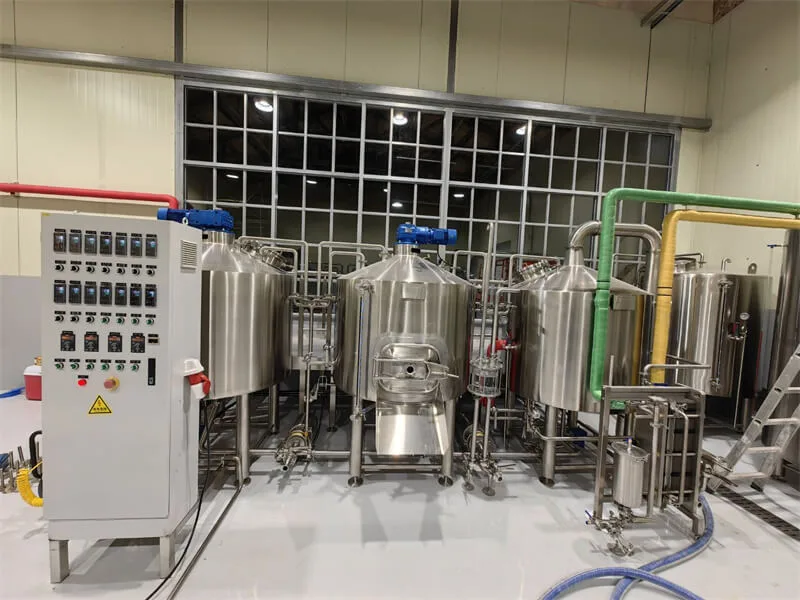
A small brewery does not necessarily need a fully automated brewhouse.
For a 300L–500L system, basic automation may be sufficient.
Useful functions include:
- Digital temperature control
- Pump control
- Tank temperature monitoring
- Basic PLC control
- Automatic glycol control
- High/low temperature alarms
The brewer can continue to manually manage many process decisions.
This approach keeps the system relatively simple while improving temperature stability and reducing operator error.
Automation for a 1000L Brewery
A 1000L brewery is often at the point where automation begins to provide significant operational benefits.
A semi-automatic or advanced semi-automatic system can control:
- Mash temperature
- Wort transfer
- Pump operation
- Valve switching
- Whirlpool
- Heat exchanger operation
- Fermentation temperature
- Glycol cooling
- CIP procedures
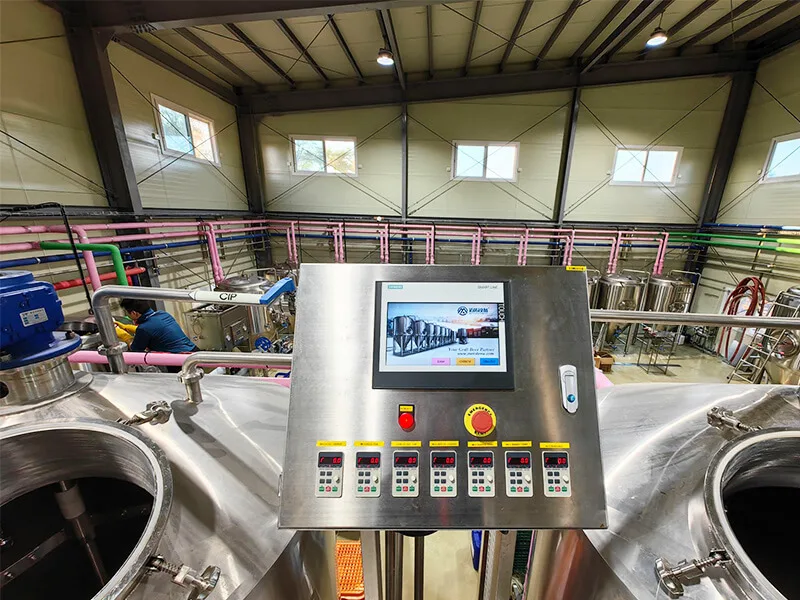
A PLC touchscreen can provide a centralized interface for monitoring the brewing process.
For breweries with multiple fermenters, independent temperature control becomes especially useful. Each tank can maintain its own fermentation temperature according to the beer recipe.
Automation for 2000L and Larger Breweries
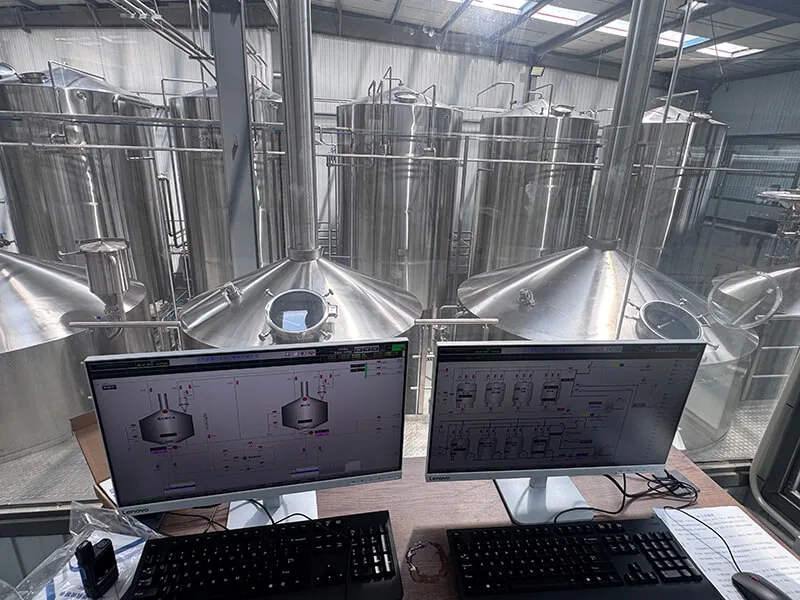
As brewery capacity increases, automation becomes more valuable because more equipment operates simultaneously.
A 2,000L or larger brewery may have:
- Multiple brewhouse vessels
- Several fermenters
- Bright beer tanks
- Multiple glycol circuits
- Larger CIP systems
- More pumps and valves
- More complex production schedules
Manual operation becomes increasingly difficult as the number of process points increases.
A centralized PLC system can help operators monitor the entire production system from one interface.
Which Brewery Processes Should Be Automated?
Not every process needs the same level of automation.
Temperature Control
Temperature is one of the best areas for automation.
Automated temperature control can be applied to:
- Mash vessels
- Hot liquor tanks
- Wort cooling
- Fermenters
- Bright beer tanks
- Glycol systems
Stable temperature control improves process repeatability and reduces the need for continuous manual adjustment.
Pump and Valve Control
As the number of tanks and pipelines increases, automated valves and pumps can significantly reduce operator workload.
A PLC can control the correct pump and valve combination according to the selected process step.
This can also reduce the risk of transferring product to the wrong tank.
CIP Automation
CIP is another area where automation can provide significant value.
An automated CIP system can control:
- Cleaning sequence
- Pump operation
- Valve switching
- Cleaning time
- Temperature
- Flow
- Rinse cycles
For larger breweries, automated CIP can improve repeatability and reduce operator involvement.
Fermentation Control
Fermentation temperature can be automatically monitored and adjusted through temperature sensors, solenoid valves and glycol control.
For breweries with many fermenters, this can save considerable manual work.
The brewer can monitor tank temperatures from the PLC interface instead of checking every tank individually.
Does Full Automation Improve Beer Quality?
Automation itself does not guarantee better beer.
Beer quality depends on many factors, including:
- Raw materials
- Recipe design
- Water quality
- Milling
- Mashing
- Yeast management
- Fermentation
- Sanitation
- Packaging
- Brewer expertise
The main contribution of automation is process consistency.
For example, an automated system can repeat a mash temperature profile more accurately, maintain fermentation temperatures more consistently and standardize CIP procedures.
This can reduce variation between batches.
When Is Brewery Automation Worth the Investment?
Automation usually becomes more valuable when one or more of the following conditions exist:
- Production volume is increasing
- The brewery has many fermenters
- Multiple batches are brewed every day
- Labor costs are significant
- Consistent production is important
- The brewery operates multiple shifts
- CIP takes substantial labor
- The brewery plans future expansion
For a small brewpub, full automation may not provide enough return on investment.
For a growing commercial brewery, however, automation can become an important part of production efficiency.
How to Avoid Over-Automating a Brewery
One common mistake is assuming that more automation is always better.
A brewery can become unnecessarily complicated if every valve, pump and process step is automated without considering how the brewery actually operates.
Over-automation can increase:
- Initial equipment cost
- Electrical complexity
- Maintenance requirements
- Training requirements
- Dependence on control components
The automation system should therefore be designed around the brewery’s actual process.
For example, a brewery may choose automated fermentation temperature control while keeping some brewhouse operations manual.
Another brewery may automate the entire brewhouse but use independent manual control for certain cellar operations.
There is no universal automation level for every brewery.
What Should You Consider Before Choosing Automation?
Before ordering an automated brewery system, buyers should define several key requirements.
Production Capacity
The number of batches per day and annual production target will influence the appropriate automation level.
Number of Tanks
A brewery with ten or twenty fermenters will benefit more from centralized monitoring than a small brewery with two or three tanks.
Beer Styles
Different beer styles may require different mash profiles, fermentation temperatures and process parameters.
Recipe-based control can be particularly useful when a brewery produces several beer styles.
Labor Availability
If skilled brewery operators are readily available, a semi-automatic system may be sufficient.
Where labor availability is limited, automation can reduce repetitive manual tasks.
Future Expansion
The control system should ideally allow additional tanks, pumps, valves and sensors to be integrated later.
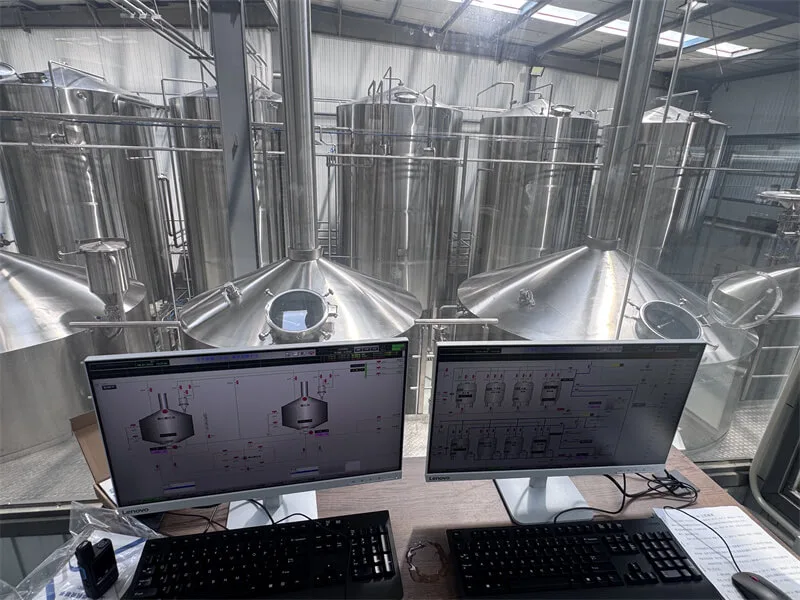
This is particularly important for breweries planning phased expansion.
PLC and HMI: The Core of a Modern Brewery Control System
A PLC is commonly used as the main controller of an automated brewery.
The PLC receives information from sensors and controls pumps, valves, heating systems and other equipment according to programmed logic.
The HMI touchscreen provides the operator interface.
A well-designed brewery HMI can display:
- Tank temperatures
- Process status
- Pump status
- Valve status
- Glycol temperature
- Alarm conditions
- Recipe parameters
- CIP progress
For larger systems, production data can also be recorded for process analysis and quality management.
How METO Approaches Brewery Automation
As a brewery equipment manufacturer, METO can integrate automation according to the brewery’s production requirements rather than applying the same control configuration to every project.
Depending on project requirements, the system can include:
- PLC control
- HMI touchscreen
- Automatic valves
- Temperature sensors
- Pump control
- Fermentation temperature management
- Glycol cooling control
- CIP automation
- Alarm functions
- Recipe management
- Remote monitoring options
For smaller breweries, a practical semi-automatic system can provide a balance between investment and operational efficiency.
For larger commercial breweries, centralized PLC control can coordinate more complex brewing, fermentation, cooling and CIP processes.
The objective is to create an automation system that is reliable, expandable and appropriate for the brewery’s actual production workflow.
FAQ
Is a fully automatic brewery better than a semi-automatic brewery?
Not necessarily. The best solution depends on production volume, labor, budget, process complexity and future expansion plans.
How much automation does a 1000L brewery need?
A 1000L brewery can operate effectively with semi-automatic control, including temperature monitoring, pump and valve control, fermentation temperature management and selected CIP functions.
Can brewery automation be upgraded later?
Yes. A properly designed PLC system can often be expanded with additional sensors, tanks, valves, pumps and control functions as production grows.
Does automation reduce brewery labor?
It can reduce repetitive manual operations, particularly for temperature control, pump and valve operation, CIP and monitoring. However, skilled brewery personnel are still important for production management and quality control.
Should fermentation tanks be automated?
Temperature-controlled fermentation is one of the most useful forms of brewery automation. It allows each fermenter to maintain a defined temperature profile and reduces the need for continuous manual adjustment.
Conclusion
Brewery automation should be selected according to production requirements, not simply based on how advanced the system appears.
Small breweries may benefit from basic temperature control and selected automated functions. Growing 1000L–2000L breweries can often achieve a good balance with semi-automatic PLC control. Larger commercial breweries may benefit from centralized automation covering brewing, fermentation, cooling and CIP.
The most effective approach is to automate the processes that improve consistency, reduce repetitive work and support future growth while keeping the system practical to operate and maintain.
For international brewery projects, working with a manufacturer that can integrate brewhouse equipment, fermentation, cooling, CIP and automation as one system can make the overall project easier to design, install and expand.If you are planning to build a brewery, feel free to contact us.