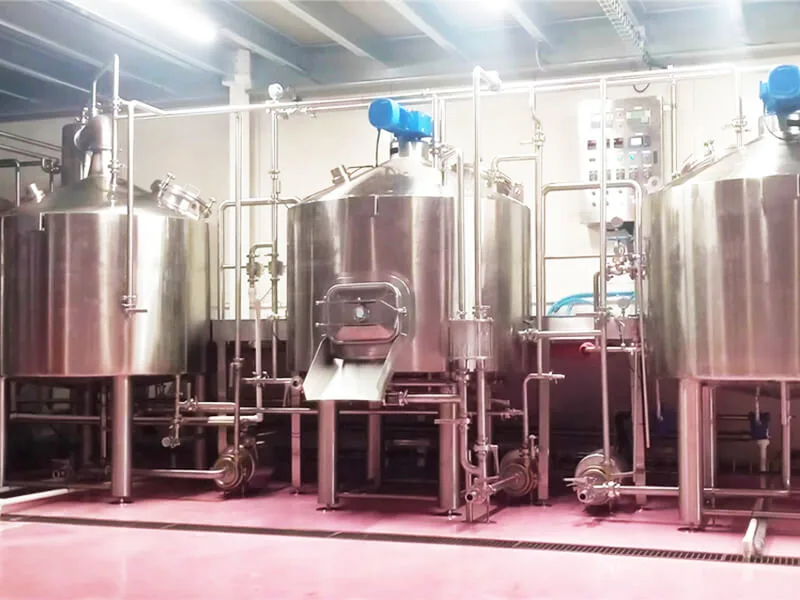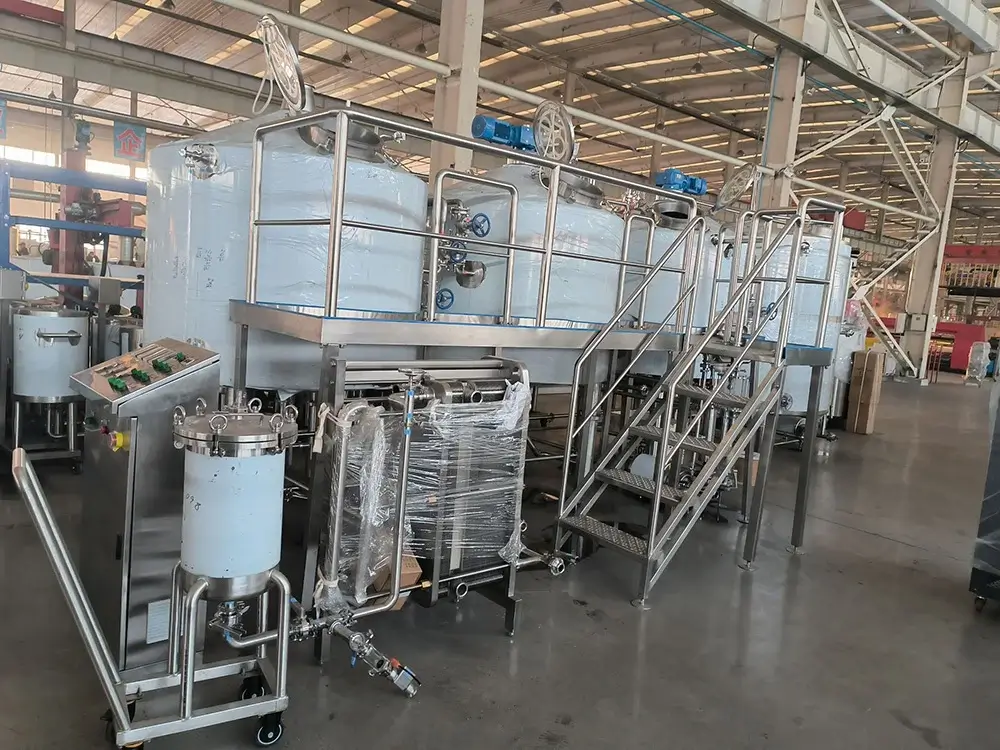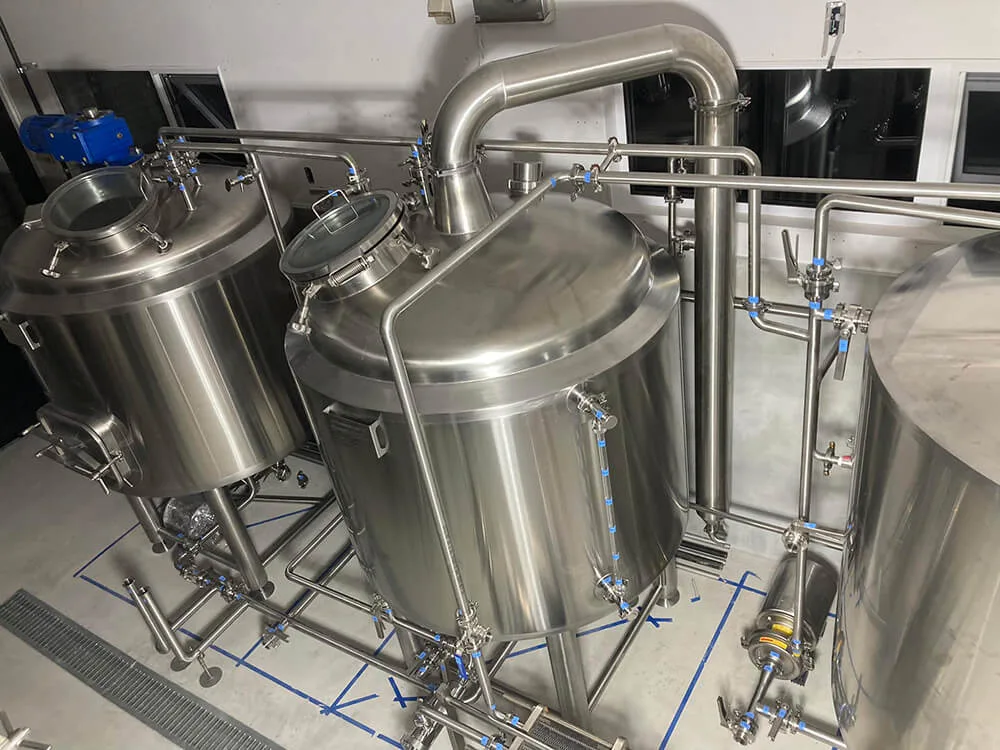
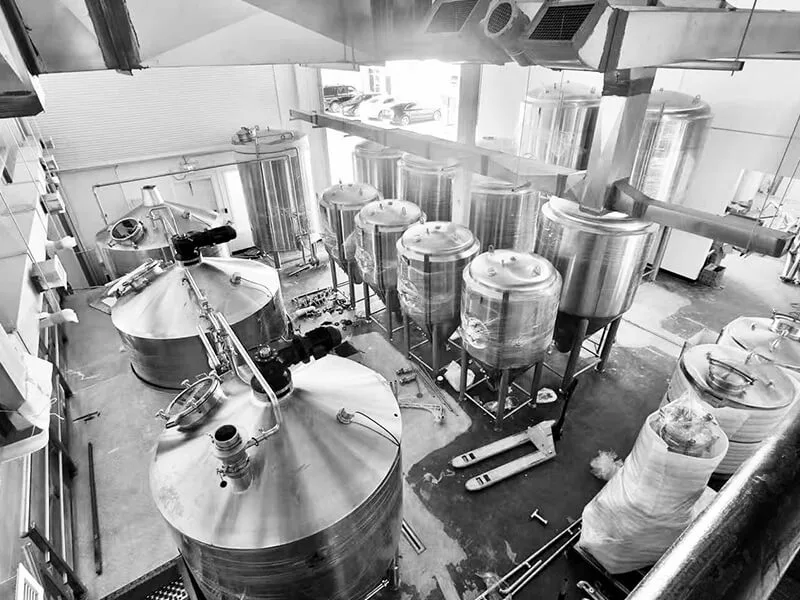
South Korea has developed a strong craft beer culture, with independent breweries, brewpubs, restaurants and specialty beer brands looking for greater control over production and product quality. For a brewery moving beyond pilot production, a 2000L brewing system offers a practical balance between production capacity, equipment investment and operational flexibility.
A 2000L brewhouse, also referred to as a 20HL brewery system, can support breweries that need commercial-scale production without immediately committing to a large industrial brewery. More importantly, the brewhouse should not be selected as an isolated piece of equipment. Fermentation capacity, cooling, CIP, hot water, utilities, packaging and process control all need to be calculated as one integrated system.
For Korean brewery projects, METO approaches 2000L brewery equipment from this engineering perspective. Rather than supplying a fixed package, we configure the brewing system around the customer’s production targets, available space, utility conditions and desired level of automation.
What Can a 2000L Brewery System Produce?
The nominal brewhouse volume does not directly determine annual beer production. Actual output depends on the number of brews per day, brewing days per year, fermentation time, beer losses and packaging efficiency.
For example, a brewery operating a 2000L brewhouse twice per day has a theoretical wort throughput of 4000L per brewing day. However, this should not be treated as the final packaged beer volume because losses occur during wort boiling, trub separation, fermentation, beer transfer and packaging.
A more useful capacity calculation considers the entire process:
Brewhouse capacity × brews/day × brewing days/year × process efficiency
Fermentation capacity is equally important. If fermentation takes 10–14 days, a brewery needs sufficient fermenters to prevent the brewhouse from producing wort faster than the cellar can process it.
This is why METO normally evaluates the brewhouse and fermentation cellar together when designing 2000L brewery equipment.
Typical Applications for a 2000L Brewery
A 2000L system can be suitable for several commercial applications:
- Craft breweries developing regional brands
- Brewpubs with substantial on-site production
- Restaurants producing proprietary beer
- Existing breweries expanding from smaller systems
- Contract brewing operations
- Specialty beer producers requiring multiple recipes
- Startups planning a scalable commercial brewery
The correct configuration depends less on the label “2000L” and more on how frequently the system will be operated.
How to Configure 2000L Brewery Equipment
A complete commercial brewing system normally includes more than the brewhouse itself. A typical project may include a 2000L brewhouse, fermentation tanks, bright beer tanks, glycol cooling equipment, hot and cold liquor tanks, wort cooling, pumps, piping, CIP equipment and a control system.
| System | Typical Configuration | Main Function |
|---|---|---|
| Brewhouse | 3-, 4- or 5-vessel | Mashing, lautering, boiling and whirlpooling |
| Fermenters | 2000L–4000L | Primary fermentation |
| Bright Beer Tanks | 2000L–4000L | Conditioning, carbonation and storage |
| Glycol System | Project calculated | Fermentation and beer cooling |
| CIP System | Mobile or fixed | Cleaning and sanitation |
| Hot Liquor Tank | Project dependent | Brewing and cleaning water |
| Cold Liquor Tank | Project dependent | Cooling and process water |
| Plate Heat Exchanger | Project calculated | Rapid wort cooling |
| Control System | Manual, semi-auto or PLC | Process monitoring and control |
The final equipment list should be calculated from the brewery’s recipe, production schedule and building conditions rather than copied from a standard quotation.
Choosing a 3-Vessel, 4-Vessel or 5-Vessel Brewhouse
The number of vessels in a brewhouse directly affects process separation, brewing efficiency, floor space and the level of flexibility available during production. For a 2,000L commercial brewery, choosing between a 3-vessel, 4-vessel or 5-vessel system should be based on the planned brewing frequency, production workflow and future capacity requirements.
For Korean breweries, METO designs 2000L brewery equipment according to the actual production process rather than treating vessel quantity as a simple upgrade from one configuration to another.
3-Vessel 2000L Brewhouse
A 3-vessel brewhouse provides a practical balance between process separation, equipment investment and floor space.
A typical configuration includes:
- Mash/Lauter Tun
- Kettle/Whirlpool Tank
- Hot Liquor or dedicated process vessel, depending on the system design
The exact arrangement can be customized according to the brewer’s process and recipe requirements.
A 3-vessel 2000L brewing system is suitable for breweries that require commercial production but do not need to maximize the number of brews per day.
It can be a good option for:
- Growing craft breweries
- Brewpubs with regular production
- Breweries producing several beer styles
- Projects with moderate daily brewing requirements
- Facilities where floor space needs to be controlled
The main advantage is a relatively straightforward process layout without adding unnecessary vessels. For breweries operating one or two brews per day, this configuration can provide sufficient production flexibility without significantly increasing equipment complexity.
4-Vessel 2000L Brewhouse
A 4-vessel brewhouse provides greater separation between the main brewing operations.
A typical configuration separates:
- Mash Tun
- Lauter Tun
- Boiling Kettle
- Whirlpool Tank
With dedicated vessels for these operations, the brewing team has greater flexibility when scheduling transfers and preparing the next stage of production.
A 2000L 4-vessel brewhouse is particularly suitable for commercial breweries that want to increase brewhouse utilization while maintaining good process control.
It can be considered when the brewery:
- Plans multiple brews per day
- Needs more efficient process sequencing
- Produces several recipes or beer styles
- Wants greater flexibility during lautering and boiling
- Expects production volume to increase in the future
The additional vessel requires more floor space, piping and controls, but it also allows brewing operations to be organized with less dependence on a single shared vessel.
For a Korean brewery with an established production plan and ambitions to expand distribution, a 4-vessel system can offer a strong balance between current production needs and future scalability.
5-Vessel 2000L Brewhouse
A 5-vessel brewhouse is designed for breweries that place a higher priority on process separation, brewing frequency and operational flexibility.
Depending on the process design, the system may include dedicated vessels for:
- Mash
- Lautering
- Boiling
- Whirlpooling
- Hot liquor or other dedicated brewing functions
The additional vessel does not automatically mean higher beer output. Its value comes from allowing more operations to be performed with greater independence and better coordination.
For breweries targeting multiple brews per day, this can reduce waiting periods between process stages and improve utilization of the brewhouse, pumps, heat source and operators.
A 5-vessel 2000L brewery system may be appropriate for:
- High-utilization commercial breweries
- Breweries producing multiple batches per day
- Facilities with a broad beer portfolio
- Breweries planning significant future expansion
- Projects where production efficiency is more important than minimizing initial equipment footprint
However, a 5-vessel system also requires additional space, piping, valves, instrumentation and investment. The brewery layout must therefore provide adequate access for operation, cleaning and maintenance.
For this reason, METO evaluates the complete production schedule before recommending a 5-vessel configuration.
3-Vessel vs. 4-Vessel vs. 5-Vessel: Which Is Right for a 2000L Brewery?
| Configuration | Main Advantage | Suitable For | Main Consideration |
|---|---|---|---|
| 3-Vessel | Balanced investment and process flexibility | Regular commercial production | Less process separation |
| 4-Vessel | Better process separation and workflow efficiency | Growing commercial breweries | Larger footprint and higher investment |
| 5-Vessel | Maximum process flexibility and high utilization | Multiple daily brews and expansion projects | More complex installation and operation |
The correct configuration depends on the brewery’s production schedule rather than the number of vessels alone.
A brewery producing one 2,000L batch per day may not gain enough operational value from a 5-vessel system to justify the additional investment. A brewery targeting several brews per day, however, may benefit from the greater process separation of a 4-vessel or 5-vessel brewhouse.
The fermentation cellar must also be considered. Increasing brewhouse capacity without sufficient fermenters, glycol cooling or CIP capacity can simply move the bottleneck to another part of the brewery.
How METO Selects the Brewhouse Configuration
As a brewery equipment manufacturer, METO evaluates the complete production process before finalizing the brewhouse design.
The main factors include:
- Target annual beer production
- Number of brews per day
- Brewing time per batch
- Beer styles and recipes
- Fermentation duration
- Fermenter quantity and volume
- Available floor space
- Heating method
- Cooling capacity
- CIP requirements
- Automation level
- Future expansion plans
This engineering approach allows the 2000L brewhouse to work as part of a complete production system rather than as an isolated piece of equipment.
For Korean breweries planning a new production facility or upgrading an existing one, METO can develop 3-vessel, 4-vessel or 5-vessel 2000L brewery equipment according to the brewery’s actual process requirements, site conditions and production goals.
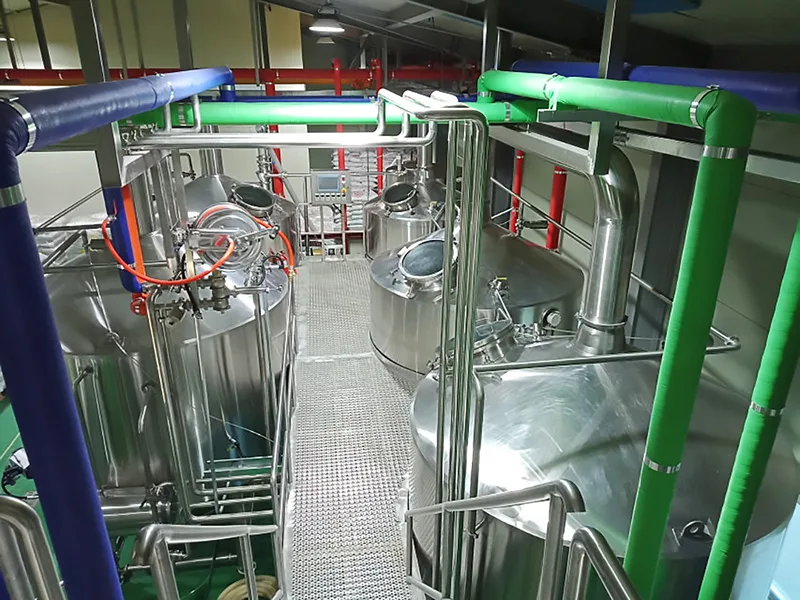
Heating Options for a Korean Brewery
Heating method affects installation requirements, energy consumption, operating procedures and brewhouse performance.
METO can configure 2000L brewery systems with different heating solutions depending on project requirements.
Electric Heating
Electric heating can be attractive for breweries that have suitable electrical capacity and want a relatively straightforward installation.
The project should consider:
- Available electrical supply
- Total installed power
- Local electrical requirements
- Peak load
- Heating time
- Operating cost
Electrical heating is not simply a matter of installing heating elements with sufficient wattage. The building’s electrical infrastructure must support the total brewery load, including pumps, refrigeration, controls and auxiliary equipment.
Steam Heating
Steam heating is often considered for breweries requiring frequent brewing or greater thermal flexibility.
A steam system introduces additional equipment, including a suitable steam generator or boiler, piping, valves and condensate management.
For a commercial brewery, steam capacity should be calculated from the brewhouse heating requirement rather than selected independently.
METO can design the heating configuration according to the brewery’s utilities and production schedule.
Fermentation Capacity Is the Real Production Bottleneck
One of the most common mistakes in brewery planning is focusing heavily on brewhouse volume while underestimating fermentation capacity.
A 2,000L brewhouse can produce wort quickly, but fermentation may take considerably longer.
For example, if the average fermentation and maturation cycle requires 10 days, the brewery needs enough tank capacity to accommodate the production generated during those 10 days.
Example Fermenter Configurations
A smaller operation might use:
2000L brewhouse + 4 × 2000L fermenters
A growing brewery might consider:
2000L brewhouse + 6 × 2000L fermenters + 2 × 2000L BBTs
A brewery with multiple beer styles and longer maturation requirements may require additional fermentation or conditioning capacity.
There is no universal ratio between brewhouse and fermenters. METO calculates the tank quantity according to:
- Brewing frequency
- Fermentation temperature
- Fermentation duration
- Beer styles
- Packaging schedule
- Seasonal production
- Expected future expansion
This approach prevents the brewhouse from becoming the only optimized part of the system.
Fermenter Design for Consistent Beer Production
The fermentation tank is where wort becomes beer, so tank design directly affects temperature control, cleaning and process consistency.
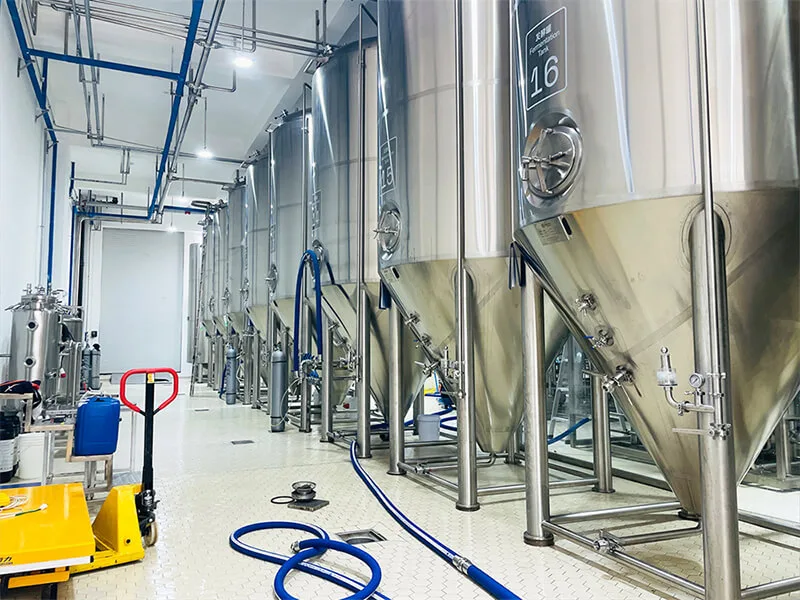
METO manufactures stainless steel conical fermenters using sanitary fabrication principles. Depending on the application, tanks can be configured with features such as cooling jackets, insulation, pressure-rated fittings, CIP spray devices, carbonation ports, sample valves, temperature sensors and dry-hopping ports.
A conical bottom supports yeast collection and makes it easier to separate yeast from finished beer.
Temperature Control
Fermentation temperature needs to be controlled according to the yeast strain and recipe.
A glycol cooling jacket provides indirect cooling while avoiding direct contact between refrigerant and product.
The cooling system should be sized according to:
- Number of tanks
- Tank volume
- Fermentation temperature
- Wort temperature entering the fermenter
- Ambient conditions
- Simultaneous cooling demand
This calculation becomes particularly important when several fermenters are operating at different stages of fermentation.
Sanitary Design and CIP for Korean Breweries
Cleaning is a production process, not an afterthought.
A properly designed CIP system for brewery equipment reduces manual cleaning work and provides a repeatable cleaning procedure for tanks, pipelines and process equipment.
A typical CIP sequence may include:
- Pre-rinse
- Caustic cleaning
- Intermediate rinse
- Acid cleaning when required
- Final rinse or sanitation
The exact sequence depends on the brewery’s cleaning chemicals, water quality and production process.
Stainless Steel Surface Finish
For brewery applications, stainless steel selection and surface finishing influence cleanability.
METO commonly uses SUS304 stainless steel for brewery vessels, while SUS316L can be specified for applications requiring additional corrosion resistance or specific process requirements.
Internal welding should be designed to minimize product-contact crevices. Appropriate TIG welding, polishing and passivation procedures help create a sanitary internal surface that is easier to clean.
A smooth internal surface is valuable not because it makes the tank look better, but because it reduces areas where product residue and microorganisms can accumulate.
PLC Control and Brewing Process Repeatability
Automation should solve a real operational problem.
For a growing Korean brewery, PLC-based control can reduce repetitive manual operations and improve consistency between batches.
A brewery control system may monitor or control:
- Mash temperature
- Wort transfer
- Valve sequences
- Boiling process
- Tank temperature
- Pump operation
- CIP sequences
- Glycol cooling
- Fermentation parameters
Depending on the project, METO can provide manual, semi-automatic or PLC-based control systems.
A fully automatic system is not automatically better for every brewery. The appropriate level of automation depends on production volume, staffing, process complexity and the brewery’s budget.
For breweries expecting multiple daily brews, however, automation can become increasingly valuable because operators spend less time repeating basic valve and temperature-control operations.
Designing a Space-Efficient Brewery in Korea
Urban brewery projects often need to work within an existing building rather than a purpose-built industrial facility.
The equipment layout therefore needs to consider more than the footprint of individual tanks.
Important factors include:
- Operator access
- Tank manway clearance
- Pump maintenance
- Pipe routing
- CIP connections
- Drainage
- Electrical cabinets
- Glycol piping
- Raw material handling
- Finished beer movement
- Future equipment expansion
A compact brewery should not mean that maintenance access is sacrificed.
METO can develop equipment layouts according to the available building dimensions, including the positioning of the brewhouse, fermenters, bright beer tanks, glycol system and CIP equipment.
Brewery Utilities and Engineering Calculations
A 2000L brewery requires sufficient utilities to operate reliably.
Before manufacturing begins, the project should evaluate:
Water
Water demand includes brewing liquor, cleaning, rinsing and other process requirements.
Electricity
The electrical load depends on heating method, pumps, refrigeration, controls, lighting and auxiliary equipment.
Cooling
The glycol system must handle the combined cooling load rather than being sized only for one fermenter.
Drainage
Floor drainage and wastewater handling should be considered during layout design, particularly around the brewhouse and CIP area.
Ventilation
Boiling wort generates steam and heat. Adequate ventilation and condensate management are therefore important in the brewhouse area.
These utility calculations should be completed before equipment fabrication. Changing utilities after installation is generally more expensive than designing them correctly at the beginning.
International Standards and Documentation
For Korean brewery projects, documentation should be discussed during the equipment design stage.
Depending on the project scope and equipment category, documentation may include:
- Material information
- Welding documentation
- Pressure testing records
- Electrical documentation
- Equipment drawings
- P&ID documentation
- Operation manuals
- CE-related documentation where applicable
- Pressure vessel documentation where applicable
The exact certification requirements depend on the equipment, installation location and Korean regulatory requirements.
For this reason, METO works with customers to identify applicable requirements before production rather than treating documentation as a final-stage issue.
Why Work with METO as a 2000L Brewery Equipment Manufacturer?
METO is not simply a reseller assembling standard brewery components. As a brewery equipment manufacturer, METO handles engineering, stainless steel fabrication, equipment integration and project support.
The manufacturing process includes laser cutting, TIG welding, polishing, passivation, pressure testing and assembly.
This manufacturing capability is important when a brewery requires modifications to:
- Tank dimensions
- Vessel configuration
- Pipe connections
- Manway positions
- Cooling jackets
- Control systems
- Heating methods
- Brewery layout
A standardized 2000L package may work for one brewery but create unnecessary compromises for another. Manufacturing directly around the customer’s process allows the system to be adapted before fabrication rather than modified after installation.
From 2000L Brewhouse to a Complete Brewery System
A successful brewery project requires more than purchasing a brewhouse.
The complete production chain may include:
Malt Handling → Brewhouse → Wort Cooling → Fermentation → Conditioning → Carbonation → Packaging → CIP
Each stage affects the others.
For example, increasing brewhouse production without increasing fermentation capacity creates a cellar bottleneck. Increasing fermenter capacity without upgrading glycol refrigeration can create cooling problems. Adding automation without considering the brewery’s actual workflow can add complexity without delivering meaningful operational benefits.
This is why METO evaluates the complete process when preparing a 2000L brewery equipment proposal.
Planning a 2,000L Brewery in South Korea?
A 2000L brewery system can provide a strong foundation for a Korean craft brewery, but the right configuration depends on your production schedule, building space, utilities and expansion plans.
METO can engineer a customized 20HL brewery system covering the brewhouse, fermenters, bright beer tanks, glycol cooling, CIP, piping and control system.
If you are planning a new brewery or upgrading an existing production line in South Korea, send METO your target annual production, available floor space, preferred heating method and expected number of brews per day. Our engineering team can develop a suitable 2000L brewery equipment configuration and brewery layout based on your actual production requirements.