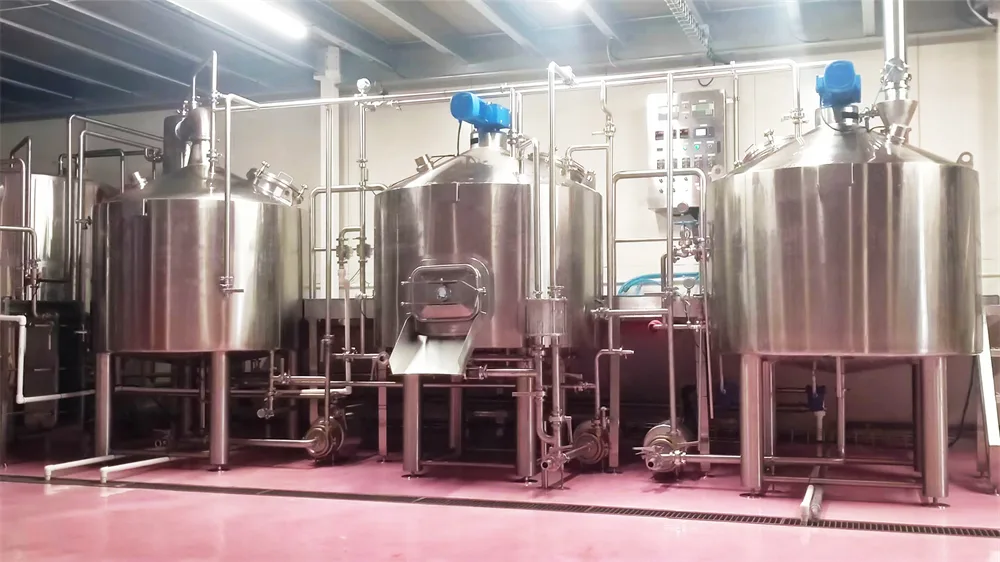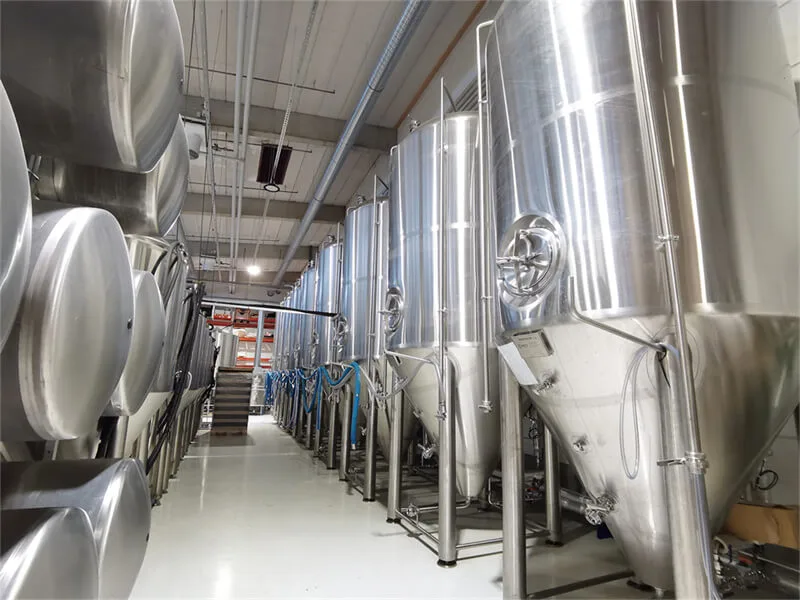
In the world of craft beer and fine wine, a fermenter is far more than just a container; it is a “reactor” that shapes flavor. While the core objective of both is to convert sugar into alcohol via yeast, the vast differences in raw materials, processes, and final product characteristics have led beer and wine fermenters down entirely divergent evolutionary paths in terms of design logic, functional configuration, and material selection. Understanding these differences is the first step in building an efficient and high-quality brewing system.
Core Difference 1: Tank Design and Geometry
This is the most intuitive distinction, directly serving different fermentation management needs.
Beer Fermenters: The Kings of Conical Bottoms
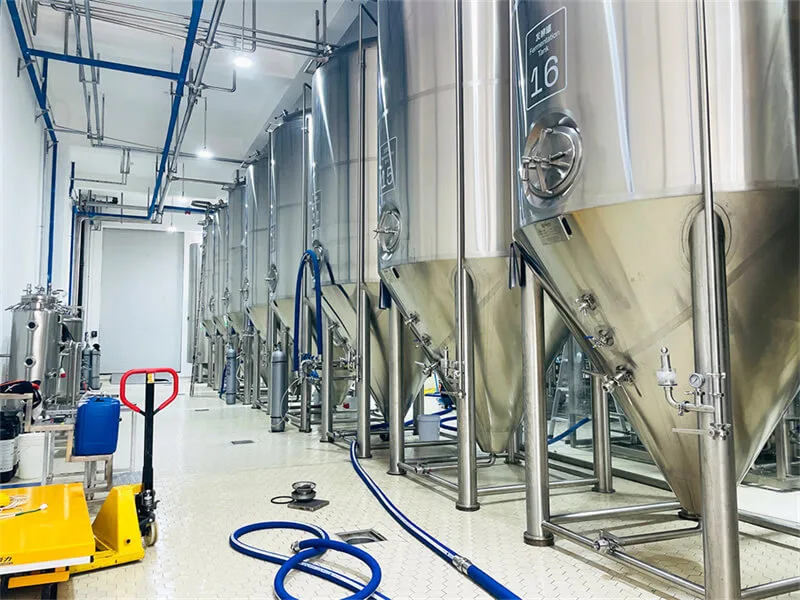
- Design: The absolute mainstream for modern beer fermentation is the conical fermenter. Its signature 60-70 degree conical bottom allows yeast and cold break material to naturally settle and accumulate at the cone tip via gravity after fermentation. By opening the bottom valve, yeast (for the next batch) or sediment can be collected easily and hygienically without transferring the beer.
- Purpose: This design perfectly meets beer’s high demands for yeast recovery and purity, facilitating subsequent cooling, storage, and even carbonation within the same vessel (“unitank”).
Wine Fermenters: The Trade-off Between Open and Closed
- Design: Wine tanks come in more varied shapes. For red wines, open-top or shallow wide fermenters are common. Their wide top openings facilitate “punching down” by winemakers—pushing the “cap” of grape skins floating on the surface back into the liquid to fully extract color, tannins, and flavor compounds. For white wines, tall, narrow closed tanks are preferred to minimize oxygen contact and facilitate solid-liquid separation after fermentation.
- Purpose: The design core revolves around how to handle and utilize grape pomace (solid residue).
Core Difference 2: Temperature Control Systems and Strategies
Temperature is the soul of fermentation, and the two have vastly different requirements.
Beer Fermenters: Precise Zoned Control
- System: Beer fermenters typically feature multiple independent cooling jackets located on the cylindrical section and the conical section respectively. This allows for independent and precise control of the main fermentation temperature and the yeast layer temperature at the bottom.
- Strategy: Beer fermentation pursues a strategy of “rapid start, stable finish.” Strong cooling is needed during the vigorous fermentation phase to prevent excessive ester formation, while low temperatures are required at the end to encourage yeast settling. Different beer styles (e.g., Ale vs. Lager) have distinct temperature curves, demanding a flexible and precise temperature control system.
Wine Fermenters: Gentle Management and Peak Control
- System: While cooling jackets are present, temperature control in wine fermenters focuses more on preventing overheating, which can stall fermentation or create off-flavors.
- Strategy: Red wine fermentation sometimes requires higher temperatures (up to 29°C) to promote the extraction of pigments and polyphenols. Conversely, white wines must be strictly controlled at low temperatures (10-15°C) for slow fermentation to preserve fresh fruit aromas. Therefore, the temperature control system must not only cool but also possess heating capabilities to address difficult fermentation starts or ensure the smooth progression of malolactic fermentation.
Core Difference 3: Material Selection and Flavor Interaction
Beer Fermenters: The Absolute Reign of Stainless Steel
- Selection: Almost exclusively made from high-quality stainless steel (such as 304 or 316L). The reason is that beer requires an absolutely pure flavor expression. Stainless steel has a smooth, non-porous surface that is easy to clean and sanitize, preventing any off-flavors, and unlike oak, it does not impart flavor compounds to the beer (except for specific barrel-aged varieties).
- Focus: Breweries focus heavily on the precision of the inner wall polishing to reduce bacterial attachment and the smoothness of welds.
Wine Fermenters: The Dance of Stainless Steel and Oak
- Selection: Stainless steel is the cornerstone of modern wineries due to its durability, ease of temperature control, and hygiene. However, the status of oak tanks or barrels remains unshakable.
- Purpose: Oak is not just a container; it is a flavor additive. It imparts complex aromas like vanilla, clove, and toast to wine, and through micro-oxygenation, softens tannins, making the body rounder. Many top wineries adopt a “hybrid strategy”: completing fermentation in stainless steel tanks before transferring to oak barrels for aging.
Core Difference 4: Functional Accessories and Process Adaptation
Accessories installed on fermenters, such as valves, sight glasses, and manways, also reflect process differences.
Beer Tank Accessories:
- Dry Hopping Port: Large top manways or side-wall ports designed for conveniently adding hops (“dry hopping”) to increase aroma.
- CO₂ Sparger/Carbonation Device: Used for forced carbonation after fermentation.
- Sampling Valves: Located at different heights to allow sampling and testing without contaminating the main tank.
- Pressure/Vacuum Relief Valves: Since beer tanks often serve as both fermentation and storage vessels, they must withstand and control certain pressure levels.
Wine Tank Accessories:
- Large Manways: Especially for red wine fermenters, manways must be large enough to allow personnel to enter the tank for cap management and tank maintenance.
- Spray Balls: Powerful cleaning spray devices fixed at the tank top are crucial because grape pomace sticks easily.
- Discharge Doors for Pomace: Large-diameter doors may be designed on the lower side of the tank to quickly discharge grape pomace after fermentation.
- Level Sight Glasses: Facilitate observation of the liquid level and the thickness of the cap.
Summary
In conclusion, beer fermenters are precision reactors designed for “liquid bread,” pursuing purity, efficiency, and fine control over yeast and hops. In contrast, wine fermenters are brewing stages built for the “myth in the bottle,” needing to balance skin handling, oxygen management, and interaction with woody flavors.
Choosing a fermenter is essentially choosing a brewing philosophy. Communicating with professional equipment manufacturers to customize tank dimensions, jacket zoning, and accessory configurations based on your raw material characteristics, target wine style, and process flow is the key step to achieving that ideal touch of flavor you envision.
If you are planning to build a brewery, feel free to contact us for our equipment list.