
Building a commercial brewery requires more than selecting brewing vessels. The brewhouse, fermentation tanks, water treatment and storage systems, cooling equipment, CIP system, and control system must work together to support consistent production and future expansion.
This 2500L turnkey brewery equipment project demonstrates how an integrated brewing system can be configured for commercial beer production, with a single-batch capacity of 2,500 liters and a planned annual production capacity ranging from 1,200 KL to 3,000 KL through phased expansion.
Designed around production efficiency, process flexibility, and automated operation, the project includes a complete brewing and fermentation system, auxiliary piping, and supporting equipment.
For breweries planning to increase production capacity, this project provides a practical reference for understanding how different equipment systems work together.
1. Project Overview: A 2,500L Commercial Brewery System
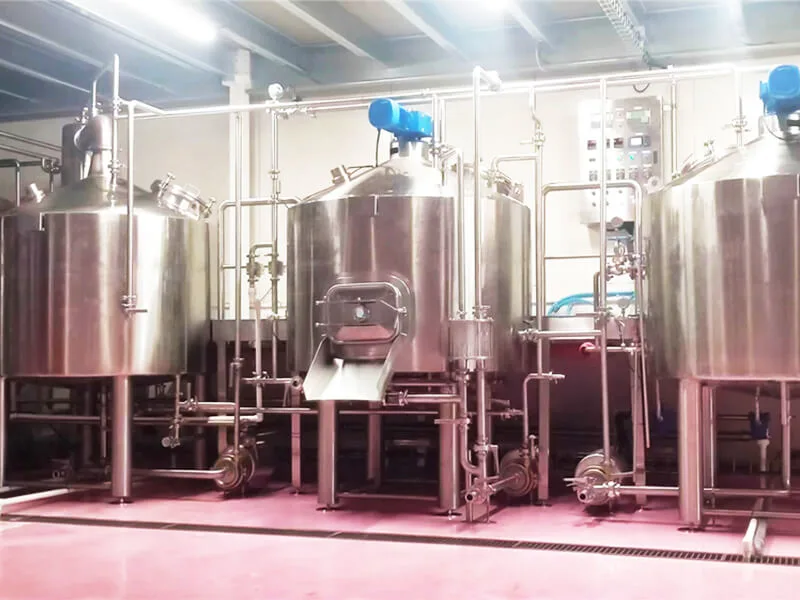
The brewery is designed around a 2,500L four-vessel brewhouse, supported by a dedicated malt milling system, fermentation vessels, service water tanks, refrigeration equipment, and automated cleaning facilities.
The production plan is divided into two phases.
Phase I: Initial Production
- 2,500L four-vessel brewhouse
- 2.5KL and 5KL fermentation tanks
- Annual production capacity of approximately 1,200KL
- Integrated water, cooling, CIP, and auxiliary piping systems
- Siemens PLC-based automation system
Phase II: Production Expansion
- Additional 10KL fermentation tanks
- Expanded fermentation capacity
- Planned annual production capacity of up to 3,000KL at full production
This phased configuration allows the brewery to begin commercial operations with a defined production capacity while reserving room for future expansion.
The key consideration is that brewhouse capacity and annual beer production are not the same. Annual output also depends on brewing schedules, fermentation residence time, tank utilization, cleaning cycles, and production shifts.
2. Malt Milling System: Efficient Raw Material Handling
An efficient malt milling system is the starting point of the brewing process. Consistent grist preparation helps improve extract efficiency and provides a stable foundation for subsequent mashing operations.
The project adopts a dry milling system consisting of:
- Malt elevator
- Dry malt mill
- Screw conveyor
- Pipe chain conveyor
- Grist hydrator system
The milling system has a processing capacity of 1,500–2,000 kg of malt per hour.
After milling, the malt is conveyed through the material handling system and combined with brewing water through the grist hydrator.
The grist hydrator helps achieve more uniform mixing between crushed malt and water, reducing the risk of dry clumps and supporting more consistent mashing.
主要优势
- High-capacity malt processing
- Continuous material conveying
- More uniform grist hydration
- Reduced manual material handling
- Improved coordination between milling and mashing
For commercial breweries, integrating milling, conveying, and hydration helps maintain a more consistent raw material supply to the brewhouse.
3. 2,500L Four-Vessel Brewhouse: Designed for Flexible Production
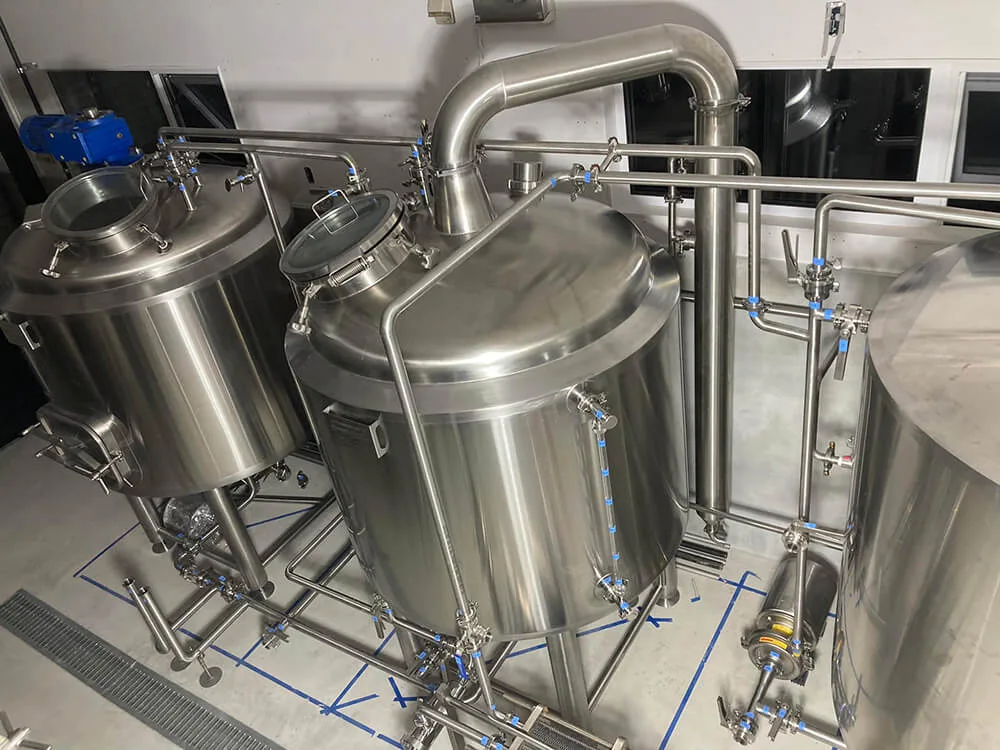
The core of the project is a 2,500L four-vessel brewhouse system, designed for a single-batch brewing capacity of 2.5KL.
The system is configured for approximately 4–5 brewing batches per day, depending on the recipe, operating schedule, and process requirements.
The four vessels include:
泥浆池
The mash tun is where milled malt is mixed with brewing water. Temperature-controlled mashing allows enzymes to convert malt starch into fermentable sugars.
烧结炉
The lauter tun separates the sweet wort from spent grain. An appropriate filtration structure and lautering process help achieve stable wort separation and efficient extract recovery.
Brew Kettle
The brew kettle provides controlled wort boiling. This stage supports hop addition, wort sterilization, and the development of the beer’s desired flavor profile.
惠而浦水箱
After boiling, the wort enters the whirlpool tank, where centrifugal flow helps separate hop residues and hot break from the wort.
The system is also equipped with a pneumatic spent grain discharge system and an advanced automation control system.
These features improve operational convenience and reduce manual handling during brewing.
Why choose a four-vessel brewhouse?
Compared with a simpler brewing configuration, a four-vessel system offers greater process flexibility and allows different brewing stages to be organized more efficiently.
For breweries targeting multiple daily batches, the configuration provides a practical balance between production capacity, process management, and operational flexibility.
4. Fermentation System: Supporting 1,200KL to 3,000KL Annual Production
Fermentation is one of the most important stages in beer production. Yeast converts fermentable sugars in wort into alcohol and carbon dioxide while developing the beer’s characteristic flavor and aroma.
The fermentation system is planned in two stages to support the brewery’s production growth.
Phase I Fermentation Configuration
- 2.5KL fermentation tanks
- 5KL fermentation tanks
- Dedicated fermentation piping corridor
- Integrated cooling and CIP connections
The initial production plan supports an annual brewing capacity of approximately 1,200KL.
Phase II Expansion
Additional 10KL fermentation tanks are planned to increase fermentation capacity.
After expansion and under the planned full-production operating conditions, the brewery targets an annual output of up to 3,000KL.
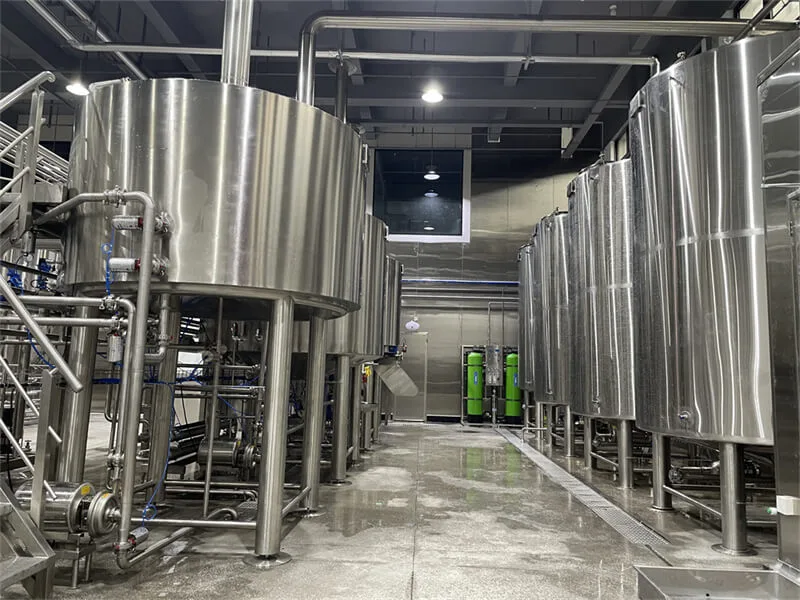
Integrated Fermentation Piping Corridor
An important feature of this project is the dedicated piping corridor arranged in front of the fermentation tanks.
The corridor includes separate pipelines for:
- 麦汁输送
- 啤酒转运
- CIP cleaning
- 压缩空气
- Carbon dioxide
- Wastewater discharge
Separating these process lines makes equipment connections more organized and facilitates daily operation, cleaning, maintenance, and production management.
For a commercial brewery, fermentation capacity must be carefully matched with brewhouse output. An appropriately planned tank configuration helps prevent fermentation from becoming a production bottleneck as brewing capacity increases.
5. Service Water System: Stable Water Supply for Brewing Operations
Water is a major ingredient in beer production and an essential resource for equipment operation and cleaning.
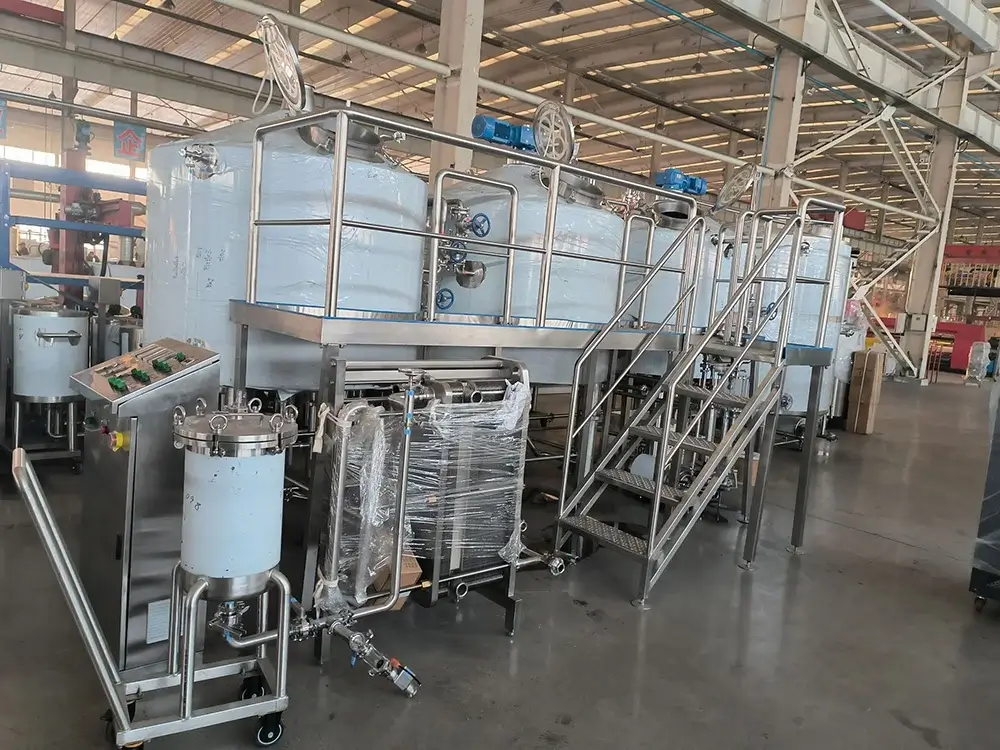
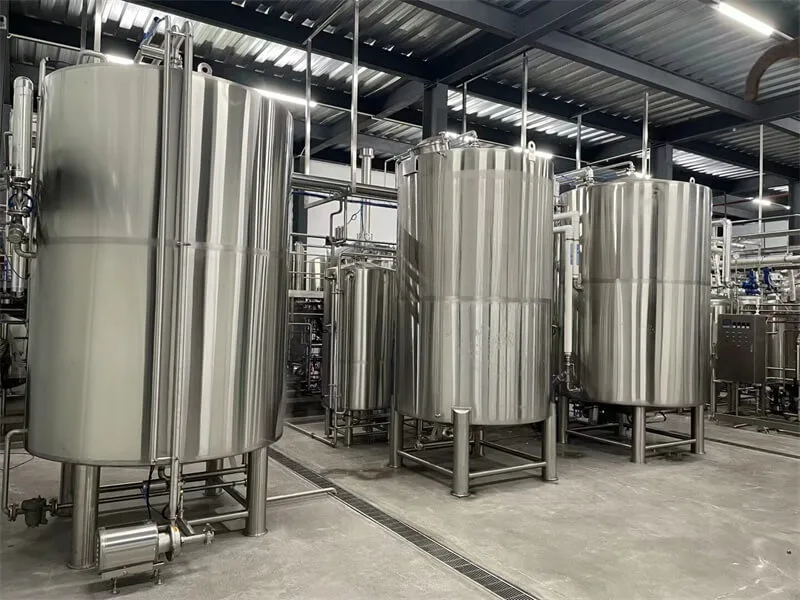
The project includes four 8KL service water tanks:
- 8KL chilled water tank
- 8KL RO water tank
- 8KL hot water tank
- 8KL cold water tank
Each tank is equipped with corresponding pumps and piping connections.
The service water system provides storage and distribution for different brewing and cleaning requirements.
Its main functions include:
- Supplying brewing water with consistent quality
- Providing hot water for process operations
- Supporting equipment cleaning and CIP procedures
- Maintaining an adequate water supply for continuous production
- Improving coordination between different brewing stages
A properly designed service water system helps reduce interruptions caused by insufficient process water and supports more efficient brewery operations.
6. Refrigeration System: Precise Temperature Control
Temperature control directly affects wort cooling, yeast activity, fermentation performance, and beer quality.
This project uses a dedicated refrigeration system consisting of:
- 8KL glycol water tank
- 20HP industrial chiller
- Supporting refrigeration pipelines
The refrigeration system supplies cooling capacity for the brewery’s temperature-controlled processes.
Its main applications include:
麦汁冷却
After boiling, hot wort needs to be cooled to the appropriate pitching temperature before yeast is introduced.
Fermentation Temperature Control
During fermentation, temperature must be controlled according to the yeast strain and beer recipe. Stable cooling conditions help maintain fermentation consistency.
Cold Storage and Conditioning
After primary fermentation, cooling supports beer maturation, clarification, and cold conditioning.
By integrating the glycol water tank, chiller, and distribution pipelines, the system provides a centralized cooling solution for the brewery.
The actual refrigeration load should be calculated according to fermentation tank volume, cooling requirements, production schedules, ambient conditions, and the intended operating temperature.
7. Automated CIP System: Improving Cleaning Efficiency and Hygiene
Cleaning and sanitation are essential for commercial beer production.
Residual yeast, protein, hop materials, and microorganisms can affect product quality if tanks and pipelines are not cleaned properly.
The project includes an integrated CIP (Clean-in-Place) system with:
- 1KL alkaline solution tank
- 1KL acid solution tank
- 1KL sanitizer tank
- 1KL hot water tank
- Centrifugal CIP pumps
- Dedicated cleaning pipelines
The CIP system is designed to support automated cleaning and disinfection of connected brewing equipment and process pipelines.
A typical cleaning procedure may involve pre-rinsing, alkaline cleaning, intermediate rinsing, acid cleaning when required, and final sanitization according to the established cleaning procedure.
Benefits of an Integrated CIP System
- Reduces manual cleaning operations
- Improves cleaning process consistency
- Supports hygienic production conditions
- Simplifies cleaning management
- Helps reduce production downtime
For breweries operating multiple brewing batches per day, an appropriately configured CIP system is important for maintaining production continuity and consistent sanitation standards.
8. Siemens PLC Control System: Automated Brewing Management
Automation plays an increasingly important role in commercial brewery operations.
This project uses a Siemens PLC control system combined with an MCGS touchscreen HMI.
The control system is designed to manage brewing operations and monitor equipment status throughout the production process.
Main features include:
- Centralized process control
- Real-time equipment status monitoring
- Brewing parameter management
- Automated operation of connected equipment
- Production data recording and traceability
- WiFi-based connectivity with compatible mobile devices and tablets
Through the touchscreen interface, operators can monitor process conditions and manage equipment operation from a centralized control point.
Under a suitable WiFi network environment, the system can also connect with mobile phones and tablets for convenient monitoring.
For brewery owners, automation helps reduce dependence on manual operation, improve process repeatability, and maintain more consistent production conditions.
The exact automation functions can be configured according to the brewery’s process requirements and control scope.
9. Auxiliary Brewery Piping: Connecting Every Production Stage
A complete brewery project requires more than individual machines. Properly designed piping connects the entire production system and ensures that materials, utilities, and cleaning fluids can move between different equipment units.
The auxiliary piping system in this project includes:
- 麦汁管道
- Beer pipelines
- Yeast discharge pipelines
- CIP pipelines
- Compressed air pipelines
- CO2 pipelines
Each pipeline serves a specific purpose in the production process.
Separating different process lines helps improve operational organization, simplify maintenance, and reduce the risk of cross-contamination.
For turnkey brewery projects, piping design should be considered during the initial engineering stage rather than treated as an afterthought.
The arrangement of tanks, pumps, valves, and pipelines should be coordinated with the brewery layout to improve accessibility and facilitate future expansion.
10. Why Choose METO for Turnkey Brewery Equipment?
A successful commercial brewery project depends on the coordination of equipment design, manufacturing, installation, commissioning, and technical support.
METO is a brewery equipment manufacturer integrating engineering design, research and development, production, sales, installation, commissioning, and after-sales service.
Since its establishment in 2013, METO has supplied brewing and fermentation equipment to customers in more than 100 countries and regions.
Our manufacturing capabilities cover:
- Craft beer brewing systems
- 商业酿酒设备
- 不锈钢发酵罐
- Industrial refrigeration and supporting systems
- CIP清洗系统
- Automated brewing control systems
- Customized stainless steel process vessels
For brewery projects, METO focuses on the complete production process rather than supplying individual tanks alone.
Our engineering team can help customers evaluate:
- Required brewhouse capacity
- Daily brewing batch targets
- Fermentation tank quantity and volume
- Water and refrigeration requirements
- CIP system configuration
- Brewery layout and piping arrangement
- 自动化要求
- Future production expansion plans
From a compact craft brewery to a large commercial beer production facility, equipment configuration can be developed according to the customer’s production goals, available space, and investment plan.
11. Planning a 2,500L or Larger Commercial Brewery?
Choosing brewery equipment is a long-term investment. Before purchasing, it is important to understand the relationship between brewhouse capacity, fermentation capacity, cooling requirements, and annual production targets.
A well-designed turnkey brewery system should not only meet current production requirements but also provide a practical path for future expansion.
Whether you are planning a new brewery, expanding an existing beer production facility, or upgrading an older brewing system, METO can provide customized equipment solutions based on your brewing process and project requirements.
联系 METO to discuss your brewery project.
Send us your target annual production capacity, preferred brewing system size, available installation space, and beer styles. Our engineering team can help develop a suitable brewery equipment configuration and provide a customized quotation.