1. Project Overview: Building a Flexible 1000L Commercial Brewery
For a growing craft brewery, choosing the right equipment is about more than reaching a target production capacity. Brewers also need the flexibility to develop new recipes, produce different beer styles, maintain consistent quality, and manage daily production efficiently.
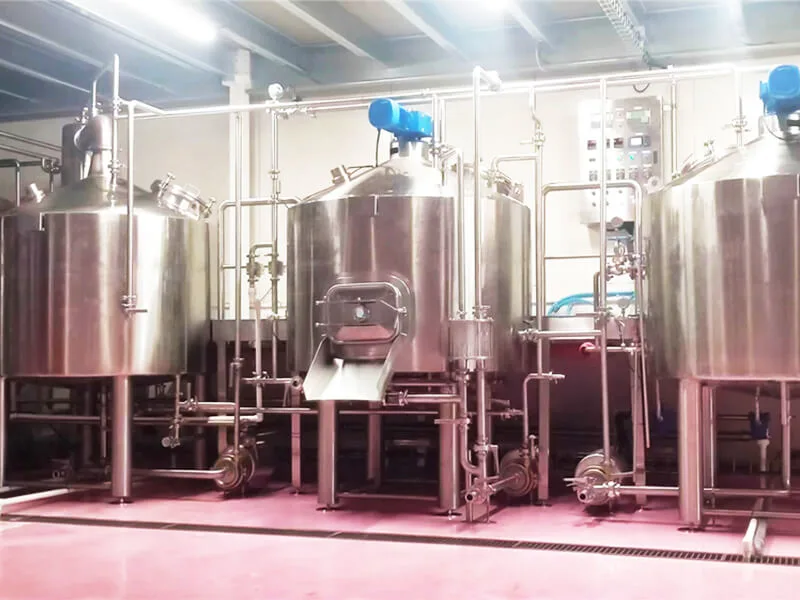
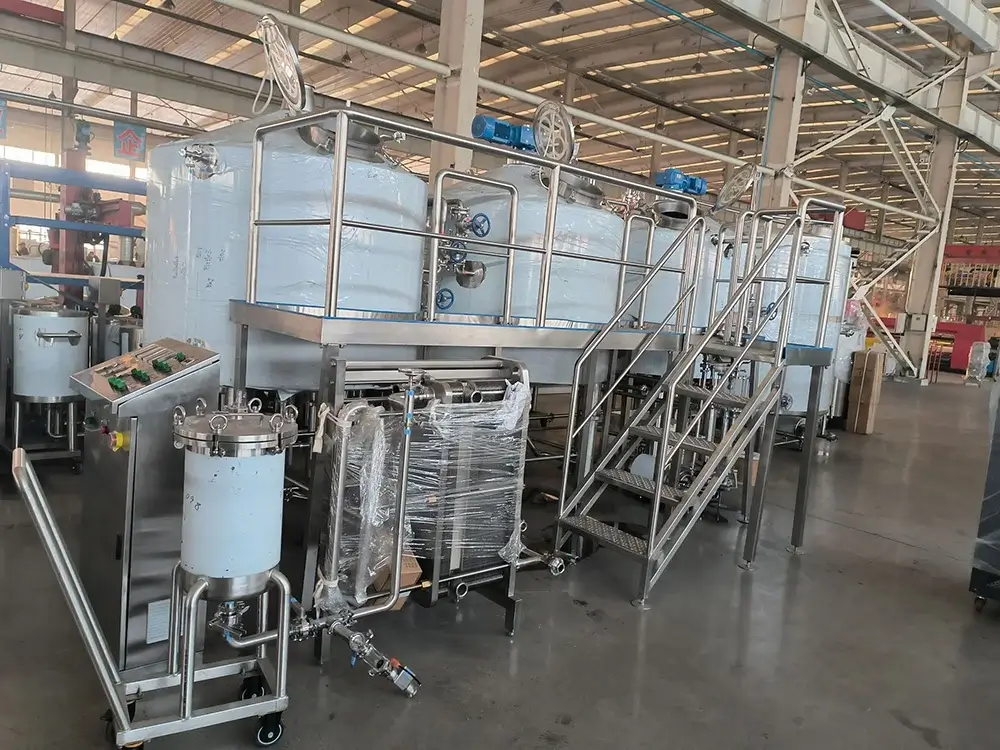
To meet these requirements, METO designed and manufactured a customized 1000L intelligent craft brewery system. The project integrates a five-vessel brewhouse, multiple fermentation vessels, service water tanks, a glycol refrigeration system, independent CIP systems, and a Siemens PLC control system.
The brewhouse has a nominal capacity of 1,000 liters per batch and is designed to support approximately 4–6 brewing batches per day, depending on the brewing process and operating schedule.
Unlike a basic brewing package, this project focuses on process flexibility and integrated equipment management. From dry malt milling and decoction mashing to fermentation monitoring and automated cleaning, each section is configured to support the brewery’s production requirements.
Project Configuration at a Glance
| Equipment | Main Configuration |
|---|---|
| 酿酒车间容量 | 1,000L per batch |
| Brewhouse Type | Five-vessel system |
| Daily Brewing Capacity | 4–6 batches |
| 铣削系统 | Dry milling with vertical conveying |
| 发酵系统 | 1T and 2T fermenters, plus 1T horizontal tank |
| Service Water System | 3 × 3,000L tanks |
| Refrigeration System | 3T glycol tank + 10HP chiller |
| CIP 系统 | Two independent CIP systems |
| 控制系统 | Siemens PLC + 15-inch touchscreen |
| Pipeline System | Wort, beer, and CIP pipelines |
The complete system is designed around the practical needs of commercial craft beer production, combining production flexibility with centralized process management.
2. Dry Milling System: Flexible Malt Handling for Recipe Development
The milling system uses a dry milling process combined with a vertical conveying device. At the feeding end, a specially designed malt-water mixing unit helps combine crushed malt with water during feeding.
This arrangement helps reduce dry malt clumping and promotes more consistent mash preparation.
For craft breweries that frequently develop new products, the ability to adjust malt combinations and brewing recipes is particularly important. A flexible milling and feeding arrangement makes it easier to handle different grain bills without unnecessarily complicating the production process.
The system also includes forward, reverse, and stop controls, providing convenient operation during daily production.
By integrating milling, conveying, and mash-water mixing, METO creates a more organized material-handling process between raw material preparation and the brewhouse.
3. Five-Vessel Brewhouse: More Control Over Different Brewing Processes
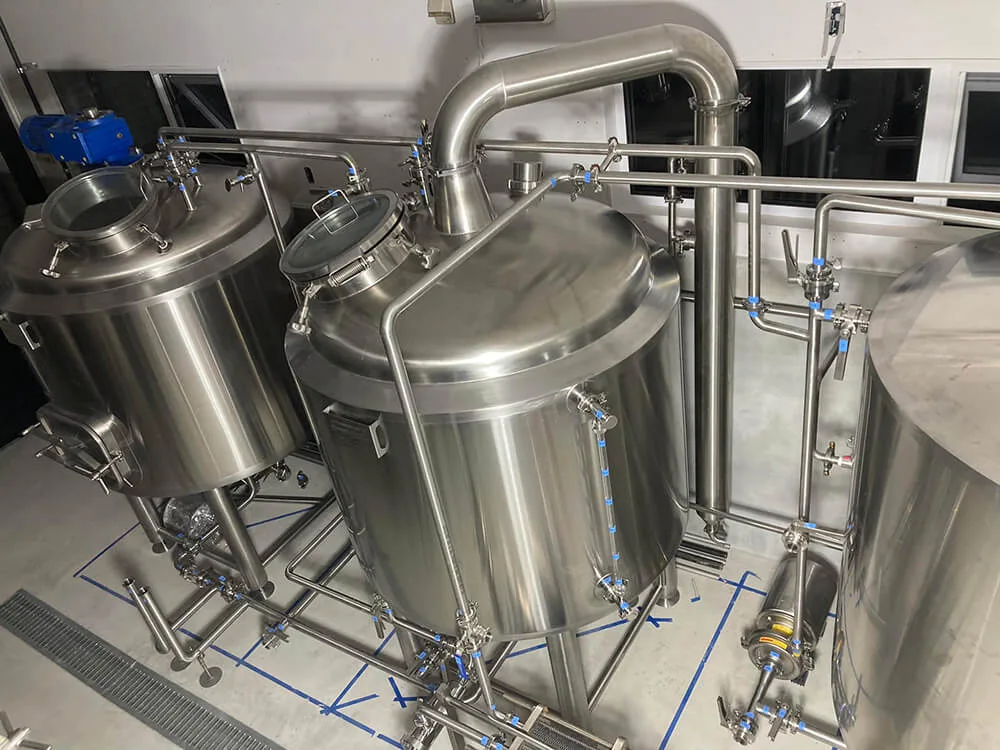
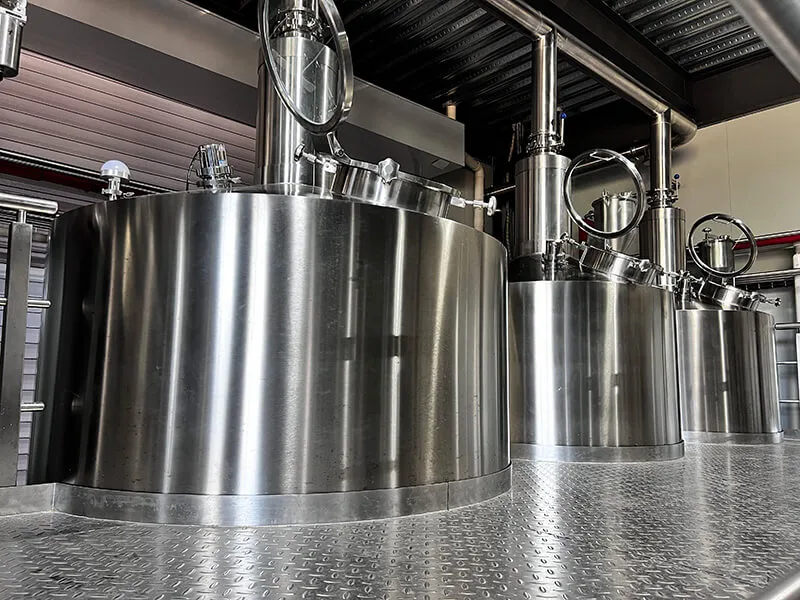
The five-vessel brewhouse is the core of this 1000L brewery project.
It consists of a pre-mash tun, mash tun, lauter tun, boiling kettle, and whirlpool tank. Each vessel performs a dedicated function, providing brewers with greater flexibility in managing different brewing stages.
For breweries producing multiple beer styles, a five-vessel configuration can offer more process options than a conventional four-vessel arrangement.
Pre-Mash Tun for Decoction Brewing
One of the main advantages of this configuration is the dedicated pre-mash tun.
Decoction mashing is a traditional brewing method that involves heating a portion of the mash before returning it to the main mash. It is commonly associated with traditional Central European brewing practices and can be used when producing styles such as Czech Pilsner.
By incorporating a separate pre-mash vessel, the brewery can explore decoction-based recipes and different mashing schedules.
This gives brewers more flexibility when developing traditional beer styles or experimenting with specialized recipes.
Enlarged Lauter Tun for High-Gravity Recipes
The lauter tun features an enlarged diameter and supports a maximum malt grist charge of approximately 450kg.
This design is particularly useful for breweries experimenting with high-gravity beer recipes or different malt formulations.
When evaluating lauter tun capacity, brewers should consider more than the nominal batch volume. Grain bill weight, grain bed depth, wort gravity, and filtration performance all influence the actual brewing process.
The enlarged lauter tun in this project provides additional room for recipe development and production trials.
Nitrogen Protection to Reduce Oxygen Exposure
Another distinctive feature is the nitrogen protection arrangement.
Nitrogen can be introduced into the relevant vessel during brewing operations to help reduce oxygen exposure.
Oxygen management is an important consideration in beer production, particularly when brewers are concerned about oxidation and its potential impact on flavor stability.
This design provides an additional process option for breweries seeking greater control over oxygen exposure during mashing operations.
Industrial Cameras and LED Status Indicators
To improve operational visibility, the brewhouse vessels are equipped with industrial cameras designed to withstand high temperatures, water exposure, and mechanical impact.
Operators can monitor vessel conditions through the central control interface and supported mobile devices.
LED status indicators are also installed on the vessels. Different colors indicate equipment operating conditions, allowing operators to identify the status of individual vessels more easily.
These features make daily operation more convenient, especially when multiple brewing stages are running simultaneously.
4. Fermentation System: Combining Conical Fermenters and a Horizontal Tank
Fermentation capacity is one of the most important factors when planning a commercial brewery.
A brewhouse may complete several batches per day, but the fermentation area must have sufficient capacity to accommodate the brewing schedule and the time required for each beer style.
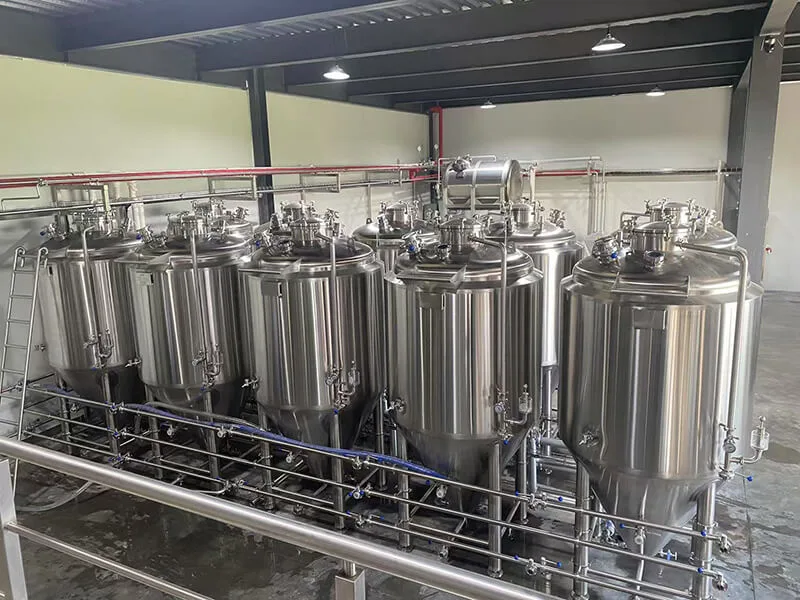
For this project, METO configured 1T and 2T fermentation vessels together with a 1T horizontal tank.
This combination provides flexibility for different production arrangements and fermentation requirements.
Conical Fermenters for Commercial Beer Production
Conical fermenters are widely used in commercial breweries because their cone-shaped bottoms facilitate the collection and removal of yeast and sediment.
They can be used for a wide range of ale and lager fermentation processes, depending on the brewery’s recipe and operating procedures.
Different vessel capacities also allow brewers to organize production according to batch size and fermentation schedules.
For a brewery producing several beer styles, selecting appropriate fermenter capacities is essential for maintaining a balanced production flow.
Horizontal Tanks for Specialized Brewing Requirements
The project also includes a horizontal tank, providing another vessel configuration for the brewery.
Compared with vertical tanks, horizontal vessels have a different height-to-diameter ratio and liquid column. Under comparable conditions, this can result in lower hydrostatic pressure.
Some brewers prefer horizontal vessels for particular fermentation or conditioning applications, especially when developing beer styles with specific yeast-derived flavor characteristics.
However, the final beer profile depends on several factors, including yeast strain, fermentation temperature, pitching rate, pressure, and process management.
The combination of conical and horizontal vessels gives the brewery more options when planning different production processes.
Observation Windows and Sight Lamps
The fermentation vessels feature observation windows and sight lamps, allowing operators to inspect internal conditions more conveniently.
Visible conditions include:
- Liquid level changes
- Fermentation activity
- Hop residue
- Remaining beer volume
For breweries operating multiple fermentation tanks, these features provide additional visual information and help simplify routine inspections.
5. Service Water System: Three Dedicated Tanks for Brewing Operations
Water quality and availability directly influence beer production.
Different brewing stages require water at different temperatures and with appropriate quality characteristics. A well-designed service water system helps coordinate these requirements and supports continuous production.
This project includes three 3,000L service water tanks:
- 3,000L ice water tank
- 3,000L pure water tank
- 3,000L hot water tank
Matching pumps are included to support water transfer and supply.
The hot water tank provides water for brewing and cleaning operations. The ice water tank supplies cold water for relevant process applications, while the pure water tank provides a dedicated water source for processes requiring controlled water quality.
Separating these water supplies helps improve process organization and makes water management easier for brewery operators.
When designing a brewery water system, the required storage capacity should be evaluated according to the number of daily brewing batches, cleaning cycles, water consumption, and available utilities.
6. Glycol Refrigeration System: Supporting Stable Temperature Control
Temperature management is essential throughout beer production, from wort cooling to fermentation and cold storage.
To support the brewery’s cooling requirements, METO configured a refrigeration system consisting of:
- 3T glycol tank
- 10HP refrigeration chiller
- Supporting glycol pipelines
The glycol system provides a cooling medium for connected equipment and supports temperature control during different production stages.
Stable cooling capacity helps maintain appropriate fermentation conditions, preserve beer quality, and coordinate production schedules.
The refrigeration system should always be considered together with the number and size of fermentation tanks, fermentation temperature requirements, ambient conditions, and the expected operating schedule.
For breweries planning future expansion, evaluating refrigeration capacity at the initial design stage can also help avoid unnecessary system modifications later.
7. Independent CIP Systems: Separate Cleaning for the Brewhouse and Fermentation Area
Cleaning and sanitation are essential for maintaining brewery hygiene and product consistency.
Instead of using one shared cleaning system for the entire brewery, this project is equipped with two independent CIP systems.
One CIP system serves the brewhouse, while the other is dedicated to the fermentation area.
This arrangement allows cleaning operations to be organized according to the requirements of different production sections.
The main advantages include:
- Dedicated Cleaning Circuits: Brewhouse and fermentation equipment can be cleaned through separate systems.
- Improved Scheduling Flexibility: Cleaning operations can be coordinated with different production schedules.
- More Organized Hygiene Management: Independent systems make it easier to manage cleaning procedures for different equipment groups.
- Reduced Operational Interference: Separate cleaning arrangements help avoid unnecessary dependence on a single shared CIP system.
For breweries operating multiple fermenters and frequent brewing cycles, independent CIP systems can provide practical advantages in daily production management.
The cleaning process itself should be configured according to equipment materials, product characteristics, cleaning chemicals, temperature requirements, and the brewery’s sanitation procedures.
8. Siemens PLC Control System: Centralized and Intelligent Brewery Operation
Modern commercial breweries increasingly require more than manual control of individual machines.
A centralized automation system helps operators coordinate different production stages, monitor equipment conditions, and manage operating parameters.
This 1000L brewery project uses a Siemens PLC control system with a 15-inch industrial touchscreen.
Two integrated control stations are provided:
- One for brewhouse operations.
- One for fermentation vessels and auxiliary systems.
The control system integrates the operation of the five brewhouse vessels and relevant supporting equipment.
What Does the PLC System Control?
The system is designed to manage relevant functions, including:
- Individual brewhouse vessel operation
- Steam and process water supply
- Wort transfer and pipeline functions
- Cooling-related operations
- CIP 功能
- Equipment status monitoring
- Manual and automatic operating modes
- Preset parameters and process curves
The touchscreen interface provides operators with a centralized view of the equipment and its operating conditions.
Combined with the industrial cameras and LED status indicators, the automation system makes it easier to monitor the brewing process and coordinate different equipment sections.
For breweries looking to improve operational consistency, a properly configured PLC system can help reduce repetitive manual operations and establish more standardized production procedures.
The automation level can also be customized according to the brewery’s operating requirements and investment plans.
9. Integrated Brewery Pipeline Design: Connecting Every Production Stage
A complete brewery system requires more than well-designed tanks and processing equipment.
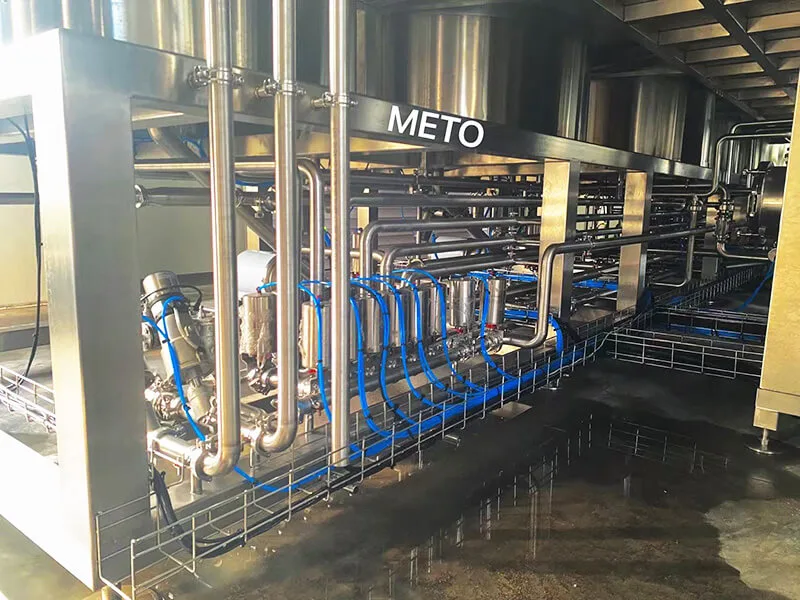
The pipeline layout determines how wort, beer, water, and cleaning solutions move between different equipment sections.
For this project, METO integrated three main pipeline groups:
Wort Pipelines
These pipelines connect the brewhouse vessels and supporting equipment, enabling wort transfer between different brewing stages.
Beer Pipelines
These pipelines support beer transfer between fermentation, conditioning, and other connected processing equipment.
CIP Pipelines
These pipelines connect the cleaning systems to the relevant equipment and provide separate cleaning and return circuits.
Planning these pipelines together with the equipment layout helps improve system organization, simplify connections, and support future maintenance.
For overseas brewery projects, pipeline design should also consider factory dimensions, equipment positioning, drainage, installation access, and local utility conditions.
This is why METO treats pipeline integration as an important part of complete brewery equipment engineering rather than an afterthought.
10. Why Choose METO as Your Brewery Equipment Manufacturer?
A commercial brewery is an integrated production system. Its performance depends on how well the brewhouse, fermentation vessels, refrigeration, CIP, automation, and pipelines work together.
As a brewery equipment manufacturer, METO provides customized equipment design and manufacturing services for craft breweries, commercial breweries, and beverage production facilities.
Our capabilities cover:
- Brewery process and equipment configuration
- Customized brewhouse manufacturing
- Stainless steel fermentation tank production
- Hot water, cold water, and glycol systems
- CIP cleaning system integration
- PLC automation and electrical control
- Brewery pipeline design and integration
- 安装与调试支持
From individual stainless steel vessels to complete brewery production systems, METO works with customers to develop equipment configurations based on their production capacity, beer styles, available space, and future expansion plans.
Our manufacturing-oriented approach allows us to coordinate equipment design, fabrication, assembly, and system integration within one project framework.
For overseas customers, this means working with a manufacturer that understands not only individual equipment specifications but also the engineering requirements of an entire brewery project.
11. Planning Your Own 1000L or Commercial Craft Brewery?
There is no single brewery configuration suitable for every business.
A brewpub, a specialty craft beer producer, and a commercial brewery supplying regional distributors may all require different equipment arrangements, even when their initial brewhouse capacities are similar.
Before selecting brewery equipment, consider the following factors:
Production Capacity
Estimate your target daily and annual production, as well as the number of brewing batches required.
Beer Styles
Different beer styles may require different mashing methods, fermentation conditions, and conditioning arrangements.
Fermentation Capacity
Calculate the number and volume of fermenters based on fermentation time, tank turnover, and production schedules.
公用设施
Evaluate available steam, electricity, water, drainage, and refrigeration capacity.
Automation Requirements
Determine whether manual operation, semi-automatic control, or a more integrated PLC system is appropriate.
未来扩展
Consider whether the initial equipment configuration can support additional fermentation tanks, increased production, or new beer styles.
A properly planned brewery should balance production capacity, equipment investment, operating efficiency, and long-term development.
Work with METO on Your Brewery Project
Whether you are planning a new craft brewery, expanding an existing production facility, or upgrading your brewing process, METO can help you evaluate the equipment configuration and develop a customized solution.
As an integrated brewery equipment manufacturer, we focus on delivering practical engineering solutions that connect individual equipment with complete production processes.
联系 METO to discuss your brewery project.
Share your target batch capacity, expected annual production, beer styles, and available installation space. Our engineering team can help you evaluate the brewhouse configuration, fermentation capacity, and supporting systems required for your project.
METO – Brewery Equipment Design, Manufacturing and Integrated Solutions.
常见问题解答
1. How much beer can a 1000L brewery produce per day?
A 1000L brewhouse has a nominal capacity of 1,000 liters per batch. The system in this project is designed for approximately 4–6 batches per day. Actual output depends on the brewing schedule, fermentation capacity, cooling performance, and operating conditions.
2. What is the advantage of a five-vessel brewhouse?
A five-vessel brewhouse includes a dedicated pre-mash tun in addition to the mash tun, lauter tun, boiling kettle, and whirlpool. This arrangement provides greater flexibility for different mashing processes, including decoction brewing.
3. Why does this brewery use both conical and horizontal tanks?
Conical fermenters are widely used for commercial fermentation and yeast collection. Horizontal tanks provide a different vessel geometry and may be suitable for specific fermentation or conditioning requirements. Combining the two allows greater flexibility in production planning.
4. Is a Siemens PLC control system necessary for a 1000L brewery?
Not every brewery requires the same automation level. However, a PLC system can help centralize equipment operation, monitor process conditions, and improve operational consistency. The appropriate configuration depends on production complexity and the brewery’s operating requirements.
5. Why are two separate CIP systems used?
Separate CIP systems allow the brewhouse and fermentation area to have independent cleaning arrangements. This can improve cleaning flexibility and simplify production scheduling, particularly in breweries with multiple fermentation tanks.
6. Can METO customize a complete brewery equipment system?
Yes. METO can customize brewhouse equipment, fermentation tanks, service water systems, refrigeration, CIP systems, PLC automation, and supporting pipelines according to the customer’s production requirements and installation conditions.