Whether you’re a craft spirits enthusiast or a small-scale distiller looking to create your own single malt whisky, this guide will walk you through the three essential stages—from grain to alcohol. By comparing different equipment setups and techniques, we aim to help you make better-informed decisions at every step.
I. What is Single Malt Whisky?
Single Malt Whisky refers to whisky produced at a single distillery using 100% malted barley as the raw material. It undergoes mashing, fermentation, and distillation before being matured in oak casks for a minimum of three years. Defined by its “single origin” and “pure malt” character, it is one of the most expressive categories in the world of whisky, often reflecting a sense of terroir.
📌 Process Overview:
Mash Preparation
Fermentation
Distillation
Barrel Maturation
II. Mashing – Unlocking Fermentable Sugars
The goal of mashing is to convert starches in malted barley into fermentable sugars, providing the essential nutrients for yeast during fermentation.
✅ Ingredient Selection:
- Base Malt: Use 100% diastatic malted barley with sufficient enzymatic power. Distilling malt is the standard choice, similar to Pilsner malt in brewing terminology.
- Specialty Malts: These can partially replace base malts to add aromatic complexity (e.g., lightly peated malt, crystal malt). Use in moderation to avoid compromising enzyme activity.
General Mashing Procedure:
- Fill the mash tun with three-quarters of the total water volume at the target strike temperature.
- Add the milled malt grist.
- Adjust mash pH to the ideal range (5.0–5.5) if necessary.
- Conduct an enzyme rest (e.g., protein rest, optional).
- Conduct the saccharification rest.
- Cool the mash to yeast pitching temperature (approx. 20–25°C) using a heat exchanger.
- Transfer to the fermentation vessel and pitch the yeast.
💡 Key Insight: pH control is critical for optimal enzyme function and flavor clarity. Use a calibrated pH meter for consistent monitoring.
III. Comparison of Three Common Mashing Setups
Choose the approach that best fits your equipment:
1️⃣ Brewery Style
Suitable for those with a lauter tun and brewhouse-style control.
- Initial water temp: 40–50°C
- Grist-to-water ratio: 1:3
- Step mashing:
- 63°C rest for 45 minutes
- 72°C rest for 30 minutes
- Confirm conversion with an iodine test.
- Lauter the wort → Cool to 20–25°C → Pitch yeast.
- ❌ Not suitable for on-grain fermentation; wort is clarified.
2️⃣ Distillery with a Heatable Mash Tun
Ideal for professional distillers with steam-jacketed or directly fired mash tuns.
- Initial water temp: 40–50°C
- Add 85–90% of grist, adjust pH to 5.0–5.5.
- Heat to 72–74°C, hold for 30–45 minutes.
- Cool to 63°C, add the remaining 10–15% high-enzyme malt.
- Hold for 30 minutes.
- Optional: Lauter or proceed with on-grain fermentation.
- Cool to 20–25°C → Pitch yeast.
- 📈 Strategy: Rapid ramp-up, hold, cool back, and hold.
3️⃣ Distillery without a Heated Mash Tun
Designed for home-based or low-tech setups.
- Initial water temp: Up to 78°C (using hot water and natural cooling).
- Add 85–90% of grist, adjust pH to 5.0–5.5.
- Allow mash to cool naturally to 72–74°C, hold for 30–45 minutes.
- Cool further to 63°C, add remaining 10–15% high-enzyme malt.
- Hold for 30 minutes.
- ❗ Do not filter—retain all grain solids for fermentation and distillation.
- Cool to 20–25°C → Pitch yeast.
- 📉 Temperature profile: Declining steps, relying on thermal inertia.
IV. Fermentation – Creating Character
Fermentation is where yeast converts sugars into alcohol and generates the flavor precursors that define the final spirit.
⏱ Recommended Parameters:
- Duration: 3–5 days (depending on yeast strain and temperature).
- Temperature: Keep below 35°C to minimize fusel oil production.
- Vessel Seal: Use an airlock or a loose cover to prevent oxygen ingress while allowing CO₂ to escape.
- Headspace: Leave approx. 20% empty space; use food-grade antifoam if necessary.
- pH Trend: Drops from 5.0–5.5 initially to 4.2–4.5 at completion.
- Endpoint: Residual sugar ≤ 2.5%; final alcohol content approx. 7–9% ABV.
⚠️ Important: Distill the fermented wash promptly—do not store it for extended periods to avoid spoilage.
🧭 On-Grain vs. Off-Grain Fermentation:
| Type | Method | Flavor Profile |
|---|---|---|
| Off-Grain | Wort is separated from solids before fermentation. | Cleaner, lighter, more delicate spirit. |
| On-Grain | Whole mash (including husks) is fermented. | Fuller-bodied, more complex, aromatic. |
V. Distillation – The Art of Separation and Concentration
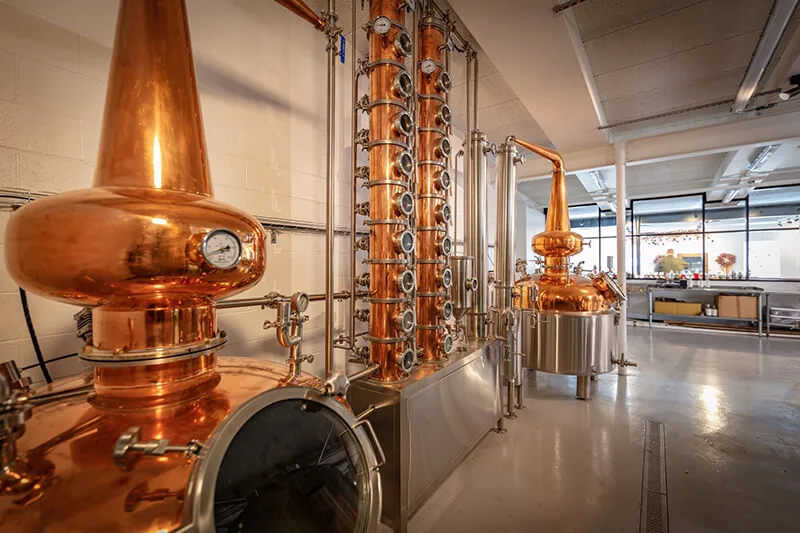
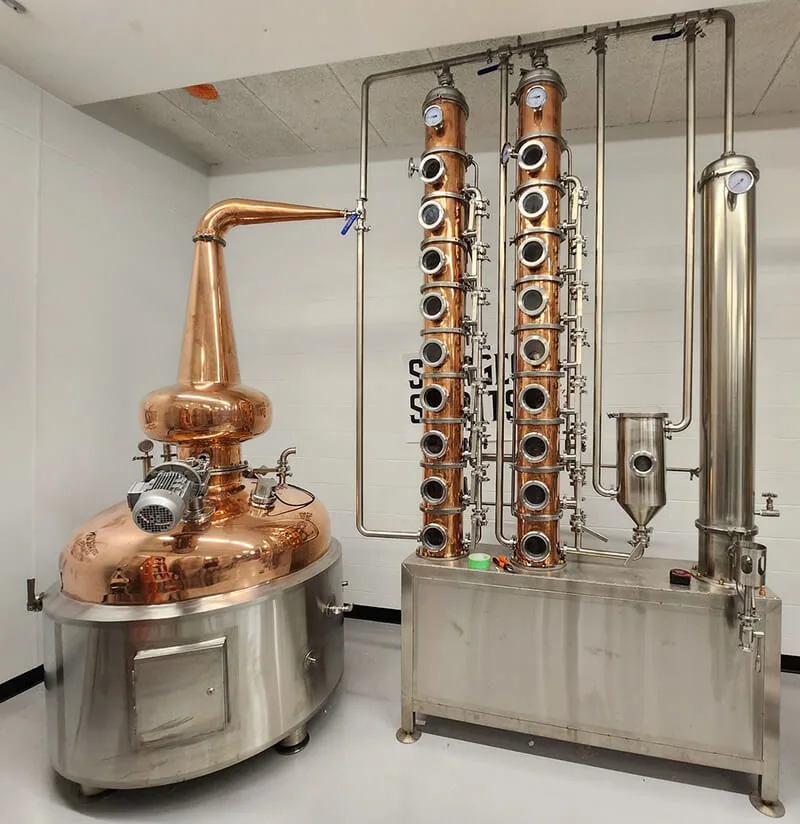
Distillation separates alcohol and volatile flavor compounds from water and solids based on differences in boiling points. It is the defining step in concentrating and refining the spirit.
🥃 Two Main Still Types:
1. Pot Still
- Process: Typically double-distilled batchwise (low wines run followed by spirit run).
- Output ABV: Approx. 65–70%
- Flavor: Rich in esters and congeners; full-bodied, oily texture. Traditional choice for Scotch single malt.
2. Column Still
- Design: Equipped with multiple plates and a reflux control system (e.g., a dephlegmator).
- Output ABV: Can reach 80–85% in a single run.
- Flavor: Light, clean, and high in purity. Often used for grain whisky or vodka; also serves as base spirit for blends.
✂️ Cut Management: Heads, Heart, and Tails
During distillation (especially in pot stills), the run is divided into three fractions:
- Heads (Foreshots): Contain low-boiling point compounds like acetone and solvents. Discard or redistill.
- Heart: The desired product—clean, flavorful, and balanced. Collected for maturation.
- Tails (Feints): High in water and heavy fusel oils. Discard or add to the next low wines charge.
VI. Useful Tools for Process Control
Regardless of scale, these instruments will improve precision and repeatability:
✅ Key Monitoring Points:
- Batching: Malt weight, water volume.
- Chemistry: pH, extract content (specific gravity), residual sugar.
- Conversion: Iodine test for starch.
- Physical: Temperature profile, fermentation activity.
🛠 Recommended Equipment:
- Scale
- Measuring stick (for volume)
- pH meter (calibrated)
- Refractometer / Saccharimeter
- Iodine solution
- Thermometer
- Alcoholmeter
👃 The Distiller’s Most Sensitive Tool: Your nose and palate. Train and trust them.
VII. Final Thoughts: Craft Your Own Whisky Story
The beauty of single malt whisky lies in the choices you make along the way. From malt selection and mashing techniques to fermentation management and distillation cuts, every decision contributes to the unique character of your spirit.
Whether you’re experimenting in your garage or planning a commercial micro-distillery, we hope this guide serves as a reliable companion on your journey.
If you are planning or upgrading your line, contact the Meto team to visit and start your craft beer journey!