1. Executive Summary: A Brewery Built for the Next Decade
The global craft beer market is entering a new phase—consumers demand authenticity, variety, and local character, while producers require operational efficiency, cost control, and scalability. The 2,000 kL/year craft brewery presented here is designed precisely at this intersection.
This facility is not a scaled-down industrial plant, nor an oversized pilot system. It is a purpose-built mid-capacity brewing hub capable of producing approximately 3.0 to 3.5 million 500 mL bottles annually, serving a metropolitan area of 1–2 million people or a well-distributed regional network of retail, hospitality, and specialty outlets.
More importantly, this solution is delivered as a complete turnkey investment package, covering:
- Recipe engineering and sensory development
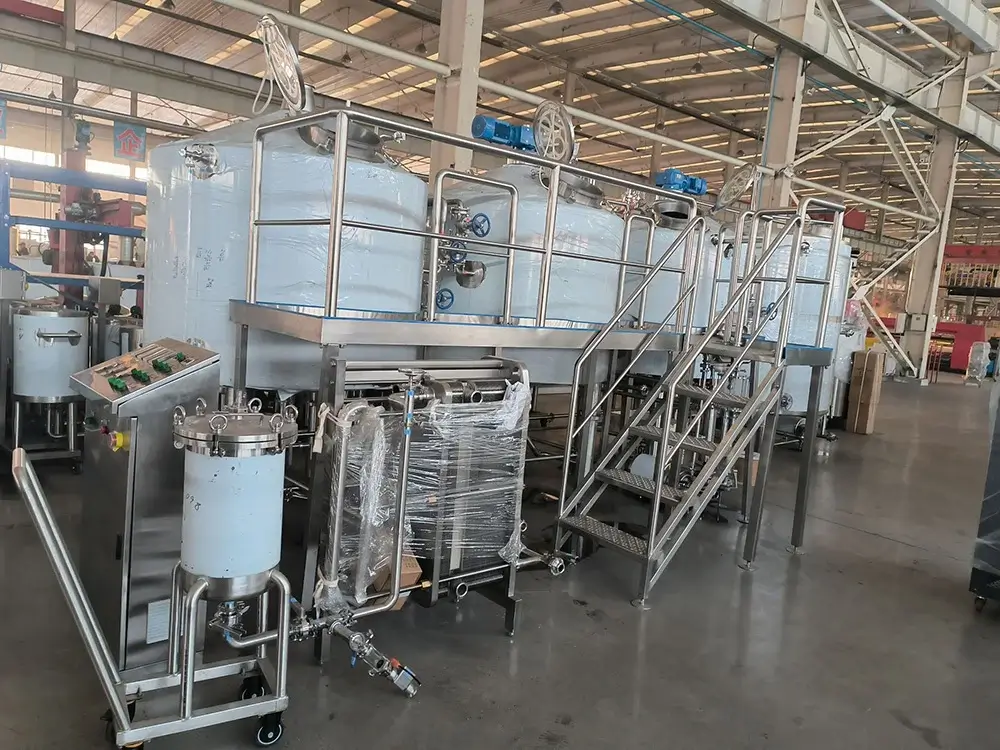
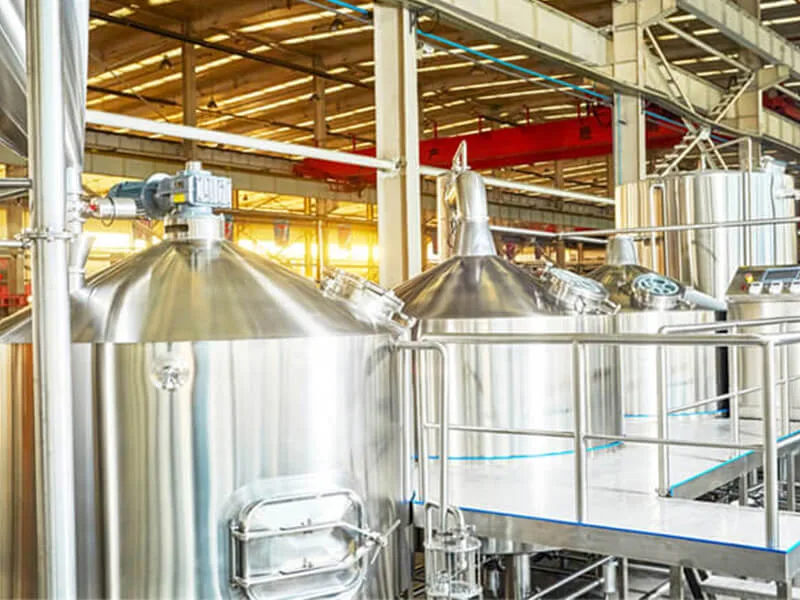
- Custom-fabricated stainless steel equipment
- Full civil, mechanical, and electrical installation
- Commissioning, training, and ongoing technical support
Whether you are an established beverage group diversifying into craft beer, a family-owned enterprise upgrading from a brewpub, or an investment team entering the F&B sector, this brewery offers a low-risk, high-flexibility entry point with a clear pathway for future expansion.
2. Design Philosophy: Where Efficiency Meets Craftsmanship
2.1 Compact Intelligence – Space as a Strategic Resource
Land costs and building footprints are among the largest fixed capital expenditures in any brewery project. Our design team approaches spatial planning with military precision:
- 프로세스 중심 레이아웃: Every vessel, pipe run, and service corridor is positioned to minimize dead space, reduce product transfer distances, and lower pumping energy consumption.
- Vertical integration where possible: Fermenters and bright beer tanks are arranged to maximize cubic utilization without compromising accessibility for cleaning and maintenance.
- Future-proofing: The layout includes space for additional fermenters (e.g., +4 units of 8 kL) and a second packaging line, allowing capacity expansion to 3,000–4,000 kL/year without major civil reconstruction.
2.2 Experiential Brewing – Production as a Brand Statement
In today’s competitive market, the brewery itself is a marketing asset. Our designs incorporate:
- Glass-walled brewhouse viewing areas
- Tasting and education zones adjacent to the fermentation hall
- Visual storytelling elements (material finishes, lighting, signage) that reflect your brand identity
This transforms the facility from a mere factory into a destination, enabling brewery tours, private events, and direct-to-consumer sales channels.
2.3 Human-Centric Equipment Engineering
Automation should serve the brewer, not replace them. Our equipment features:
- Ergonomic valve and control panel placements – reducing operator fatigue during multiple daily batches
- Modular sensor suites – allowing brewers to manually override or fine-tune parameters for experimental batches
- Clear visual indicators – for flow, temperature, and pressure at every critical point
- Quick-access manways and hinged covers – simplifying dry-hop additions, yeast harvesting, and CIP verification
This approach ensures that standardized quality and creative freedom coexist seamlessly.
3. Brewing Process & Recipe Engineering – From Classic to Cult
3.1 Comprehensive Recipe Library
Our process team provides validated, production-ready recipes for a broad portfolio:
| Style Category | Specific Examples |
|---|---|
| European Classics | German-style Pilsner, Munich Helles, Vienna Lager |
| Ale Traditions | English Bitter, American Pale Ale, Belgian Dubbel |
| Modern Craft Staples | New England IPA, West Coast IPA, Session IPA |
| Dark & Robust | Dry Stout, Oatmeal Stout, Imperial Stout, Porter |
| Sour & Wild | Berliner Weisse, Gose, American Fruit Sour |
| Fruit & Flavored | Raspberry Wheat, Peach Ale, Cherry Sour |
| Seasonal & Experimental | Pumpkin Spice Ale, Christmas Porter, Wet Hop Harvest Ale |
3.2 Signature Infusions – Local Identity in Every Pint
We actively encourage terroir-driven brewing. Our formulation support extends to:
- Local grains: Oats, rye, spelt, or ancient grains from regional farmers
- Agricultural co-products: Honey, maple syrup, molasses, fruits, herbs, and spices
- Regional specialties: Tea leaves, coffee beans, ginger, chilies, cacao nibs, or even smoked ingredients
Our technical team will conduct small-scale trials and scale-up calculations to ensure consistent flavor, mouthfeel, and foam stability when integrating these ingredients.
3.3 Full Process Parameter Design
We deliver a complete process specification document for each recipe, including:
- Raw material selection: Malt kilning profiles, hop alpha-acid content, yeast strain performance data
- Mashing program: Temperature rests, enzyme activity windows, pH adjustment protocols
- Lautering & sparging: Run-off speed, sparge water volume, and gravity monitoring
- Boiling & hopping: Bittering, flavor, and aroma addition schedules; whirlpool stand times
- Fermentation management: Pitching rates, aeration levels, temperature profiles, diacetyl rest timing
- Maturation & conditioning: Lagering periods, dry-hop durations, fining agents usage
- Post-treatment: Centrifugation, flash pasteurization, or sterile filtration parameters
- Packaging control: Dissolved oxygen (DO) targets, carbonation levels, and foam fill heights
This level of detail ensures batch-to-batch consistency while allowing brewers the latitude to innovate.
4. Production Capacity & Tank Sizing – The Mathematical Backbone
4.1 Capacity Matrix
| Metric | Value | Commentary |
|---|---|---|
| Annual production target | 2,000 kL | Equivalent to ~2,000 metric tons of finished beer |
| Operating schedule | 330 days/year | Allows 35 days for statutory holidays, maintenance, and deep cleaning |
| Shift structure | 3 shifts × 8 hours | Continuous operation maximizes asset utilization |
| Daily output | 6 kL | Smoothly achieved with 2 brews/day |
| Brewhouse batch size | 4 kL | Standard industry vessel size for this capacity tier |
| Batches per day | 2 | A comfortable pace—3 batches/day is possible for peak seasons |
| Average fermentation cycle | 20일 | Includes primary fermentation, diacetyl rest, and cooling; lagers may extend to 28–30 days |
| Required fermentation storage | > 120 kL | Calculated based on cycle time × daily output + safety margin |
| Bright beer tank storage | 16 kL total | Supports continuous packaging even when fermenter turnover varies |
4.2 Vessel Configuration Rationale
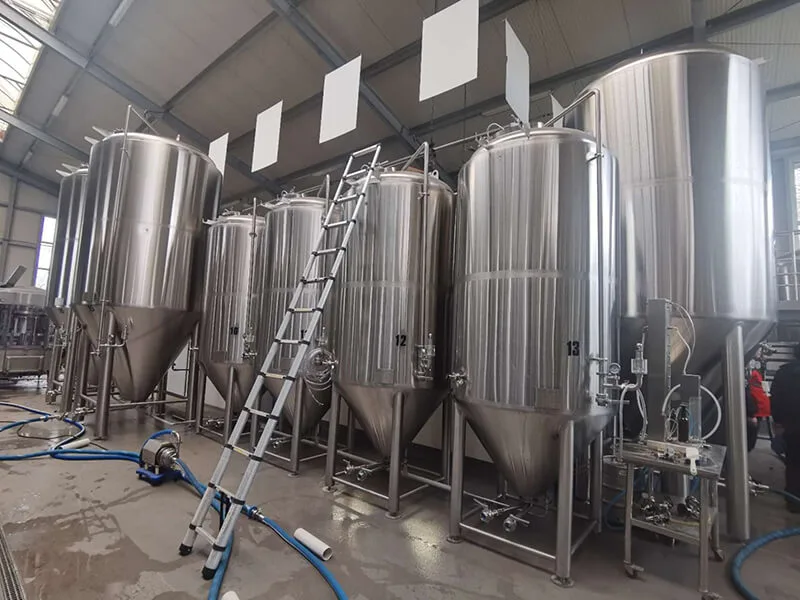
Fermenter Fleet:
- 4 kL × 8 units – Dedicated to small-batch specialty runs, test batches, and seasonal releases
- 8 kL × 12 units – Workhorse vessels for core brands and larger production runs
- Total: 128 kL – Exceeds the minimum requirement, providing buffer for overlapping cycles and simultaneous style production
밝은 맥주 탱크:
- 4 kL × 2 units – For short-run or high-gravity filtered beers awaiting canning
- 8 kL × 1 unit – For main-brand settling and carbonation prior to high-speed filling
This dual-tier tank strategy enables concurrent production of 4–6 different beer styles at any given time, giving you agility in responding to market trends.
5. Comprehensive Equipment Scope – Every Component Specified
5.1 Raw Material Processing
| Equipment | 사양 | Purpose |
|---|---|---|
| Grain flat storage | 120 m² | Holds 5–7 days of malt supply; climate-controlled option available |
| Dry malt mill | 3,000 kg/hour | Four-roller mill with adjustable gap settings; dust collection system integrated |
| Weighing & conveying | Pneumatic or auger system | Loss-in-weight feeder ensures recipe accuracy |
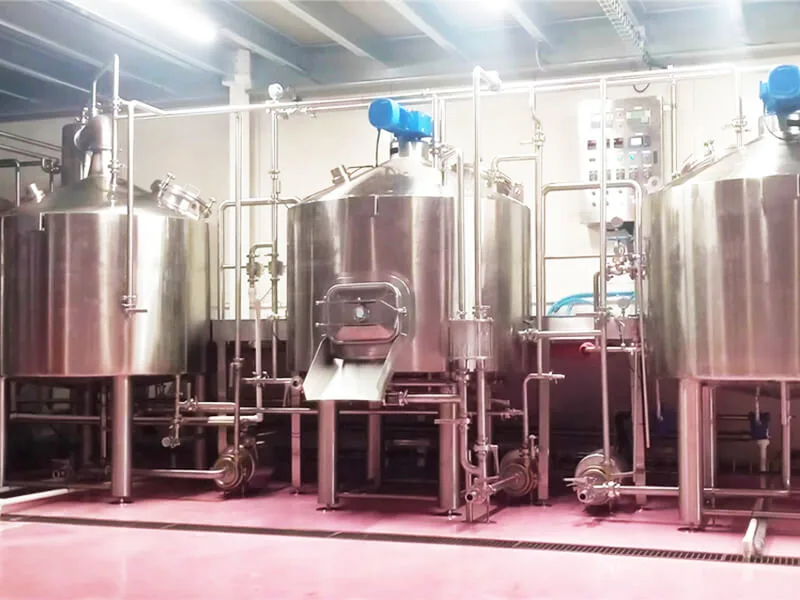
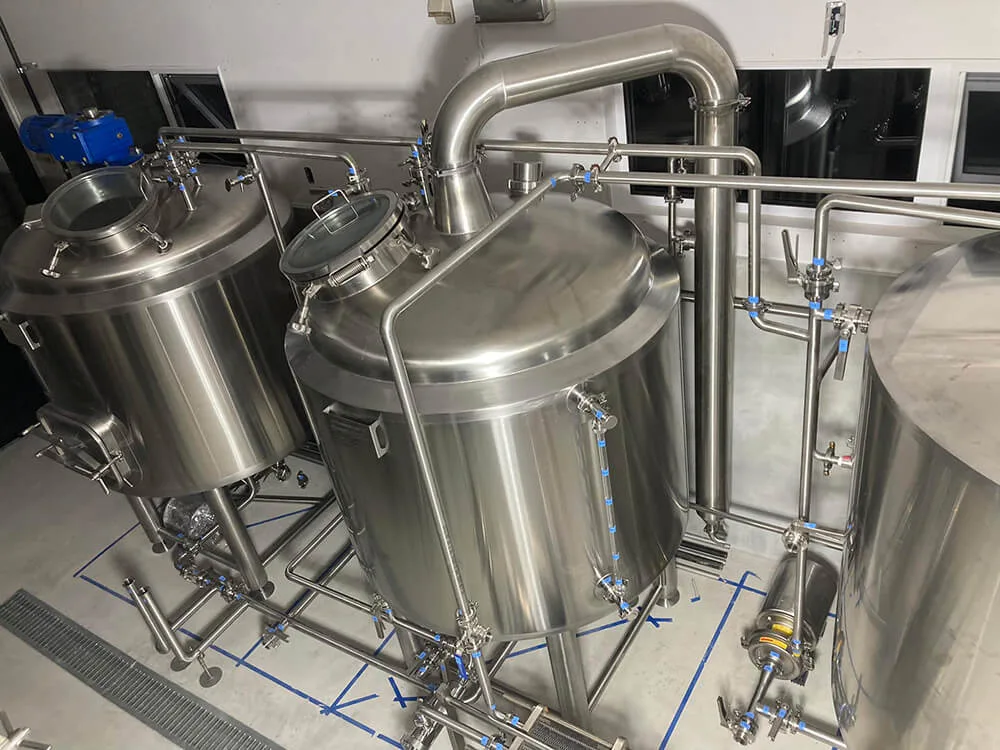
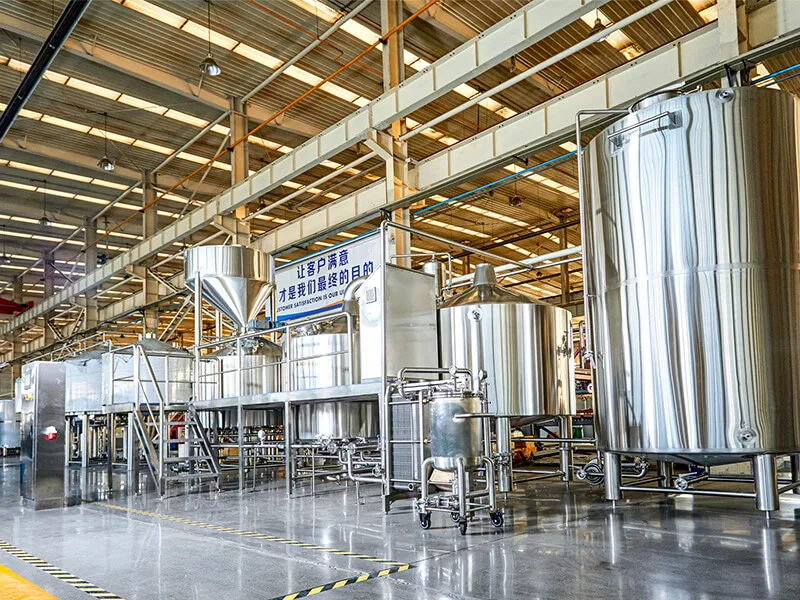
5.2 Brewhouse – 4-Vessel System (4 kL/Batch)
| Vessel | 특징 |
|---|---|
| Mash tun | Steam-jacketed, side-entry agitator, temperature probes at multiple heights |
| Lauter tun | Stainless steel false bottom, rotating rakes, spent grain discharge valve |
| Boiling kettle | Internal or external calandria; whirlpool nozzle for trub separation |
| Whirlpool tank | Dedicated vessel for trub settlement, reducing load on heat exchanger |
| Wort cooler | Plate-and-frame heat exchanger, two-stage (city water + chilled glycol) |
5.3 Fermentation & Yeast Management
- Yeast propagation station: 500 L × 2 conical vessels with temperature control and aeration rings – enables in-house yeast cropping and repitching for up to 8–10 generations
- Automatic yeast pitching system: Volumetric dosing based on wort gravity and volume
- Dry-hop porting: 6-inch tri-clamp fittings on each fermenter for oxygen-free additions
5.4 Filtration & Stabilization
- Centrifugal separator: 3 m³/hour capacity – removes suspended yeast and trub with minimal flavor stripping
- Flash pasteurizer: 3 m³/hour – plate-type with holding tube, suitable for both can and bottle lines; PLC-controlled temperature profile
5.5 Utility Systems – The Unseen Backbone
| Utility | 용량 | Note |
|---|---|---|
| Hot water supply | 12 m³/hour | Recovered from wort cooling and pasteurizer; stored at 85–90°C |
| Chilled water supply | 10 m³/hour | For initial cooling and general cleaning |
| Glycol refrigeration | 10 m³/hour | Dual-circuit system: fermenter cooling (to -4°C) and cellar cooling |
| Brewing water supply | 10 m³/hour | Pre-filtered and UV-sterilized; flow-matched to brewhouse demand |
| CIP 시스템 | 4 × 500 L tanks (caustic, acid, sanitizer, rinse) | Automated spray-ball cleaning with recipe-based cycle programming |
5.6 Supporting Utilities
- Water treatment: 3 m³/hour reverse osmosis + dealkalization – produces both brewing liquor and CIP rinse water
- Steam boiler: 500 kg/hour, natural gas or diesel fired – sufficient for mashing, boiling, and hot water generation
- Compressed air: 2.4 m³/min at 7 bar, 15 kW screw-type with desiccant dryer – for pneumatic valves, can seamers, and bottle rinsers
- CO₂ supply: Manifolded cylinder bank with vaporizer – used for blanketing, carbonation, and counter-pressure filling
- Electrical distribution: Main switchgear, variable-frequency drives for all motors, emergency stop loops
- Pipe bridges: Pre-fabricated stainless steel pipe racks with integral condensate drainage and insulation
5.7 Packaging Lines – Multi-Format Flexibility
The brewery is equipped to handle four primary packaging formats, allowing you to target diverse sales channels:
| Line Type | Target Output (approx.) | Typical Applications |
|---|---|---|
| Glass bottle | 2,000–3,000 bottles/hour | 330 mL, 500 mL, 750 mL; crown or cork finish |
| Aluminum can | 1,500–2,500 cans/hour | 330 mL and 500 mL; ideal for off-trade and outdoor events |
| Tinplate can | 1,000–2,000 units/hour | Niche packaging for premium or export markets |
| Keg washer/filler | 20–30 kegs/hour | 20 L, 30 L, 50 L stainless steel kegs; fully automated washing and filling station |
All filling lines include:
- In-line dissolved oxygen (DO) measurement
- Automatic fill-height correction
- Air rinsing or CO₂ purging prior to fill
- Integrated labelers, coders, and pack-off conveyors
6. Investment and Operational Economics
While exact pricing depends on site conditions, localization requirements, and automation level, the following benchmarks provide a realistic framework:
- Typical capital expenditure (CAPEX) range: US$1.2M – $2.0M (equipment + engineering + commissioning), excluding land and building shell
- Estimated payback period: 3–5 years, based on conservative sales volume projections and regional retail pricing
- Operating cost drivers: Malt (35–40%), packaging materials (20–25%), labor (10–15%), utilities (8–12%), depreciation and overhead (remainder)
- Gross margin potential: 50–65% for direct-to-retail sales; 30–45% for wholesale distribution
We provide customized financial modeling as part of our consulting service, including sensitivity analysis for raw material price fluctuations and packaging format shifts.
7. Project Execution – Our Turnkey Delivery Model
Phase 1: Feasibility & Planning (Weeks 1–4)
- Site assessment and utility availability audit
- Custom layout drafting (2D and 3D)
- Recipe selection and ingredient sourcing strategy
- Regulatory compliance review (local food safety, environmental, and labor regulations)
Phase 2: Engineering & Fabrication (Weeks 5–20)
- Detailed mechanical, electrical, and piping (MEP) drawings
- Vessel and skid fabrication (ASME or PED certification available)
- Procurement of boilers, chillers, compressors, and control panels
- Factory acceptance testing (FAT) for major equipment prior to shipment
Phase 3: Installation & Integration (Weeks 21–30)
- Civil preparation and foundation work (coordinated with local contractors)
- Equipment placement, pipe-fitting, and wiring
- Utility tie-ins and loop checks
- On-site quality and safety inspections
Phase 4: Commissioning & Training (Weeks 31–36)
- Cold commissioning (water trials) and hot commissioning (brewing trials)
- Brewing team training – theoretical sessions + hands-on brewing of 3–5 reference beers
- Maintenance and troubleshooting workshops
- Final handover with complete documentation (P&IDs, O&M manuals, spare parts list)
Phase 5: Post-Launch Support (Ongoing)
- Remote diagnostics and troubleshooting via IoT-enabled control system
- Annual performance review and optimization recommendations
- Recipe development support for new product launches
8. Why This Brewery Is a Strategic Investment
8.1 Market Agility
The 2,000 kL scale is large enough to achieve economies of scale in raw material purchasing and utility consumption, yet small enough to pivot quickly—launching a new style in as little as 3–4 weeks from concept to packaged product.
8.2 Quality Assurance
With dedicated bright beer tanks, a centrifuge, and a flash pasteurizer, you can achieve commercial shelf stability without compromising sensory qualities. The system supports both unfiltered, unpasteurized (for local draft) and filtered, pasteurized (for national/international distribution) versions of the same brand.
8.3 Sustainability Features
- Heat recovery: Wort cooling water is reused for next batch’s mashing liquor
- Spent grain management: Can be sold as animal feed or used in bio-energy systems
- Effluent pre-treatment: Optional integration of pH neutralization and solids screening
- Energy-efficient motors: All pumps and agitators equipped with IE3-rated drives
8.4 Scalability Pathway
When market demand grows beyond 2,000 kL, expansion requires only:
- Adding 4–6 fermenters and 2–3 bright beer tanks
- Upgrading the malt mill and brewhouse control software
- Extending the pipe bridge and utilities
No changes to the brewhouse vessel sizes or building footprint are needed—a capital-efficient growth model.
9. Target Markets and Use Cases
This brewery is ideally suited for:
| Region/Context | Rationale |
|---|---|
| Fast-growing secondary cities | Rising disposable income, Western-style consumption habits, limited local craft competition |
| Tourism-driven regions | Brewery tours and tasting rooms add significant revenue per visitor |
| Export-oriented zones | Flexible packaging lines (cans, bottles, kegs) satisfy diverse export documentation and labeling requirements |
| Agricultural regions | Opportunity to incorporate local fruits, honey, or grains into value-added beer products |
| Hotel and resort groups | Private-label beer production for in-house brands, wedding venues, and corporate events |
10. Final Word – Brewing Your Legacy
A brewery is more than stainless steel and glycol pipes. It is a living enterprise—one that connects farmers, artisans, distributors, bartenders, and drinkers in a shared cultural experience. The 2,000 kL/year solution we offer is engineered to honor that connection while delivering financial returns, operational reliability, and creative freedom.
We do not sell “off-the-shelf” systems. We engage with each client as a long-term partner, adapting every aspect—from tank geometry to control logic to recipe formulation—to your unique market position and brand DNA.
Let us build your brewery. Let your beer tell the story.