When planning a commercial brewery, determining the brewhouse capacity is only the first step. An equally important consideration is whether the fermentation cellar can handle the wort produced by the brewing system.
A brewery may have a brewhouse capable of producing several batches per day, but if the available fermentation tanks cannot accommodate the incoming wort, production will eventually be restricted by fermentation capacity.
This creates a common challenge in brewery engineering: how to balance brewhouse output with fermentation capacity while maintaining sufficient flexibility for different beer styles and production schedules.
Unlike brewhouse operations, which can often be completed within a working day, fermentation and maturation occupy tanks for much longer periods. The required tank capacity therefore depends not only on daily wort production but also on fermentation duration, maturation time, cleaning cycles, tank utilization, and the brewery’s product portfolio.
In this article, we explain how to calculate fermentation capacity, estimate the required number of fermentation tanks, and optimize tank configurations for commercial breweries.
A 1000L brewery project featuring 1-ton and 2-ton conical fermenters alongside a 1-ton horizontal fermentation tank is also used to illustrate practical equipment planning considerations.
1. Understanding Fermentation Capacity in Commercial Brewing
Fermentation capacity refers to the total usable volume of wort or beer that can be accommodated by the fermentation system at a given time.
It is different from brewhouse capacity.
Brewhouse capacity generally describes the volume of wort produced per batch, while fermentation capacity describes how much product can be processed and held in the fermentation cellar simultaneously.
For example, a brewery with a 1000L brewhouse may produce four batches per day, resulting in approximately 4,000L of wort entering the fermentation section daily.
However, the fermenters cannot simply be sized according to one day’s production.
If fermentation and maturation require 14–21 days, multiple production days must be accommodated simultaneously.
This means the fermentation cellar must be designed around the relationship between:
- Daily wort production.
- Fermentation and maturation duration.
- Fermenter working volume.
- Tank cleaning and turnaround time.
- Product variety and fermentation schedules.
- Expected production utilization.
A correctly sized fermentation system ensures that wort can move continuously from the brewhouse into available tanks without unnecessary production interruptions.
2. Calculate Daily Wort Production
The first step in determining fermentation capacity is calculating the daily wort volume.
The basic formula is:
Daily Wort Production = Brewhouse Batch Volume × Number of Batches per Day
For example, consider a commercial brewery with:
- Nominal brewhouse capacity: 1,000L per batch.
- Daily brewing frequency: 4 batches.
- Operating days: 25 days per month.
The daily wort production is:
1,000L × 4 = 4,000L/day
The monthly wort production is:
4,000L × 25 = 100,000L/month
If the brewery operates at six batches per day, daily wort production increases to 6,000L.
This calculation establishes the production demand that the fermentation system must accommodate.
However, actual fermenter filling volume may differ from nominal brewhouse batch volume because of transfer losses, process requirements, and the need for headspace.
For accurate equipment selection, the calculation should use the expected volume entering each fermenter rather than assuming every vessel can be filled to its geometric capacity.
3. Calculate the Required Fermentation Capacity
Once daily wort production is established, the next step is to determine how much fermentation capacity must remain available.
The basic planning formula is:
Required Working Fermentation Capacity = Daily Wort Input × Total Tank Occupancy Days
Tank occupancy includes all the time during which a fermenter is unavailable for another production batch.
This generally includes:
- Filling and preparation.
- Active fermentation.
- Conditioning or maturation.
- Emptying and beer transfer.
- Cleaning and sanitization.
- Inspection and preparation for reuse.
3.1 A Practical Calculation Example
Assume the brewery produces 4,000L of wort per day and the average fermenter occupancy period is 14 days.
The required working fermentation capacity is:
4,000L/day × 14 days = 56,000L
This means the brewery needs approximately 56,000L of usable fermentation capacity to support the planned production rate under these assumptions.
If the average occupancy period increases to 21 days:
4,000L/day × 21 days = 84,000L
The difference is significant.
An additional seven days of tank occupancy increases the required working capacity by 28,000L.
This is why fermentation duration must be considered during the initial brewery design stage rather than after the brewhouse has already been installed.
3.2 Consider Tank Utilization
In practice, not all installed tank capacity is available for production at all times.
Some vessels may be undergoing cleaning, waiting for transfer, or reserved for specific beer styles.
A planning allowance can be introduced to account for these operational factors.
A more complete planning formula is:
Installed Fermentation Capacity = Daily Wort Input × Tank Occupancy Days ÷ Target Utilization Rate
예를 들어
- Daily wort input: 4,000L.
- Tank occupancy: 14 days.
- Target utilization: 85%.
Required installed working capacity:
4,000 × 14 ÷ 0.85 = approximately 65,882L
This provides a more practical planning estimate than assuming every installed tank is continuously available.
The utilization rate should be based on the expected production schedule and operating conditions, not selected arbitrarily.
4. Determine the Number and Size of Fermentation Tanks
After calculating the total required working capacity, the next step is selecting individual tank sizes and quantities.
The most suitable configuration depends on production volume, batch size, fermentation cycle, and the brewery’s product portfolio.
4.1 Match Fermenter Size to Brewhouse Batch Volume
For a brewery using a 1000L brewhouse, fermenters should generally be selected according to the actual wort volume transferred per batch.
예를 들어
- 1,000L fermenter: Suitable for approximately one 1,000L wort batch, subject to required headspace and working-volume specifications.
- 2,000L fermenter: Can accommodate larger production volumes or appropriately combined batches.
- Multiple smaller fermenters: Provide greater flexibility for separate recipes and experimental batches.
It is important to distinguish between nominal tank volume and working volume.
A fermentation vessel needs sufficient headspace for foam formation, krausen, and fermentation activity. Therefore, a nominal 1,000L tank does not necessarily have a 1,000L recommended working capacity.
The actual working volume should be confirmed according to vessel geometry, beer style, fermentation behavior, and manufacturer specifications.
4.2 Calculate the Number of Tanks
A simplified tank quantity formula is:
Required Tank Quantity = Total Working Fermentation Capacity ÷ Working Volume per Tank
For example, if the required working capacity is 56,000L and each tank has a working volume of 2,000L:
56,000 ÷ 2,000 = 28 tanks
In practice, the final tank quantity should also consider production scheduling, different fermentation cycles, cleaning time, and the need to accommodate different beer styles.
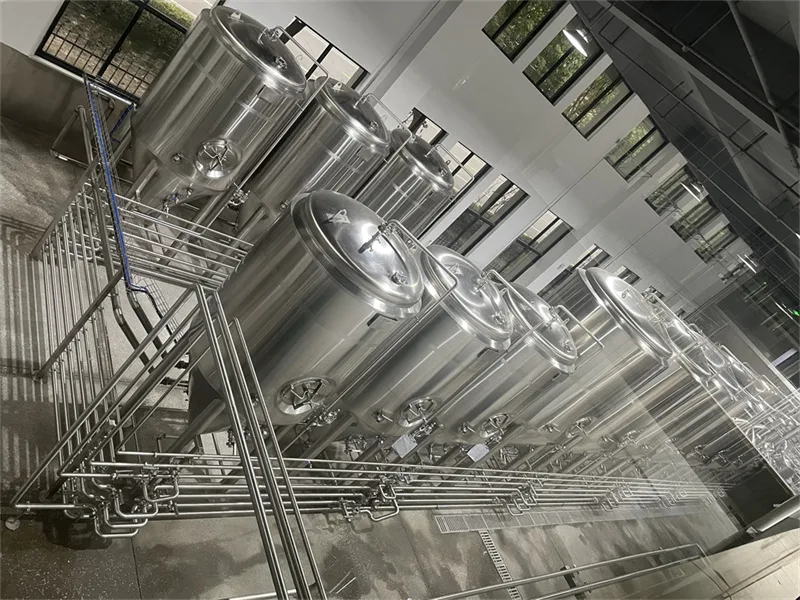
4.3 Use Different Tank Sizes for Greater Flexibility
A brewery does not necessarily need to use identical fermenters throughout the production facility.
Combining different tank capacities can improve production flexibility.
예를 들어
- Smaller fermenters can be used for pilot batches, seasonal products, and recipe development.
- Medium-sized fermenters can accommodate standard commercial batches.
- Larger fermenters can support higher-volume products and reduce the number of transfers.
The objective is to achieve a practical balance between tank utilization, production flexibility, and equipment investment.
5. How Beer Style Influences Fermentation Capacity Planning
One of the most important factors in fermentation cellar design is the type of beer being produced.
Different beer styles require different fermentation conditions and tank occupancy periods.
5.1 Ale Fermentation
Many ale fermentation programs use relatively warm fermentation temperatures and can complete primary fermentation within several days.
However, the total tank occupancy period may extend beyond primary fermentation because of:
- Yeast settling.
- Diacetyl rest.
- Conditioning.
- Dry hopping.
- Cooling and maturation.
- Beer transfer and cleaning.
Therefore, the actual tank occupancy period should be based on the complete production recipe rather than primary fermentation alone.
5.2 Lager Fermentation
Lager production generally requires lower fermentation temperatures and often involves a longer conditioning or maturation period.
This means lager breweries may need substantially more fermentation capacity than breweries producing only fast-turnaround ales at the same daily wort volume.
For example, if one production line has a 14-day tank occupancy period and another has a 28-day occupancy period, the second line requires approximately twice the working fermentation capacity at the same daily wort input.
This difference should be considered when designing breweries that produce both lagers and ales.
5.3 Mixed-Style Production
Breweries producing multiple beer styles face additional scheduling complexity.
A production plan may include:
- Pale ales.
- IPAs.
- Wheat beers.
- Pilsners.
- Lagers.
- Seasonal and experimental beers.
These products may have different fermentation durations, yeast requirements, dry-hopping procedures, and conditioning schedules.
Using different fermenter sizes and maintaining some reserve capacity can help accommodate this variation.
6. Conical vs. Horizontal Fermenters: Choosing the Right Configuration
Fermentation vessel geometry is another important consideration in commercial brewery planning.
Although conical fermenters are widely used in commercial breweries, horizontal fermentation tanks also offer specific advantages for certain brewing applications.
6.1 Conical Fermentation Tanks
Conical fermenters feature a sloped bottom that allows yeast and sediment to collect in a concentrated area.
Their main advantages include:
- Convenient yeast collection and harvesting.
- Efficient removal of sediment.
- Practical integration with CIP systems.
- Suitable configurations for temperature-controlled fermentation.
- Flexible use across different beer styles.
For breweries with established production schedules, conical fermenters provide a practical and widely adopted solution.
6.2 Horizontal Fermentation Tanks
Horizontal fermenters feature a lower vessel profile and a larger horizontal footprint.
Compared with a taller vertical tank of similar capacity and filling conditions, a horizontal vessel generally creates a shorter liquid column and lower hydrostatic pressure at the bottom.
Hydrostatic pressure is one of the factors that can influence yeast behavior during fermentation.
Some brewers use horizontal fermenters for particular ale production programs where they want to explore the effects of vessel geometry and lower liquid-column pressure on fermentation characteristics.
However, the relationship between vessel orientation, pressure, and flavor formation is complex.
Yeast strain, fermentation temperature, pitching rate, wort composition, and actual pressure conditions all contribute to the finished beer’s flavor profile.
Horizontal tanks should therefore be selected according to the brewery’s intended process rather than assuming they automatically produce more fruity aromas or better beer.
6.3 Combining Both Configurations
For breweries producing multiple beer styles, combining conical and horizontal fermenters can provide additional operational flexibility.
A practical arrangement may include:
- Conical tanks for regular commercial production.
- Horizontal tanks for selected fermentation programs.
- Smaller vessels for recipe development and limited releases.
The final configuration should reflect the brewery’s production strategy, available floor space, and cleaning requirements.
7. Optimize Fermentation Capacity Through Better Tank Scheduling
Installing sufficient fermentation capacity is only part of the solution.
The brewery must also organize tank occupancy efficiently.
Poor scheduling can result in idle vessels, delayed transfers, or insufficient capacity during peak production periods.
7.1 Establish a Tank Occupancy Schedule
A tank occupancy schedule records the major stages of each fermentation batch:
- Tank preparation and CIP.
- Wort filling.
- Active fermentation.
- Conditioning and maturation.
- Cooling and final preparation.
- Beer transfer.
- Cleaning and sanitization.
- Tank release for the next batch.
This schedule helps operators identify when each fermenter will become available.
It also makes it easier to coordinate brewhouse production with the fermentation cellar.
7.2 Avoid Bottlenecks Between Brewing and Fermentation
If the brewhouse produces more wort than the fermentation cellar can accept, the brewery may need to delay brewing or adjust the production schedule.
Conversely, excessive fermentation capacity increases initial equipment investment and may leave some tanks underutilized.
The ideal configuration balances:
- Daily wort production.
- Fermentation tank occupancy.
- Beer packaging schedules.
- Cleaning turnaround.
- Seasonal production changes.
7.3 Reserve Capacity for Product Development
Craft breweries frequently introduce new products and experiment with different recipes.
If every fermenter is permanently assigned to standard production, there may be insufficient capacity for seasonal beers or experimental batches.
Maintaining a reasonable amount of flexible capacity can help breweries develop new products without disrupting their regular production schedule.
8. A Practical Example: Fermentation System Configuration for a 1000L Brewery
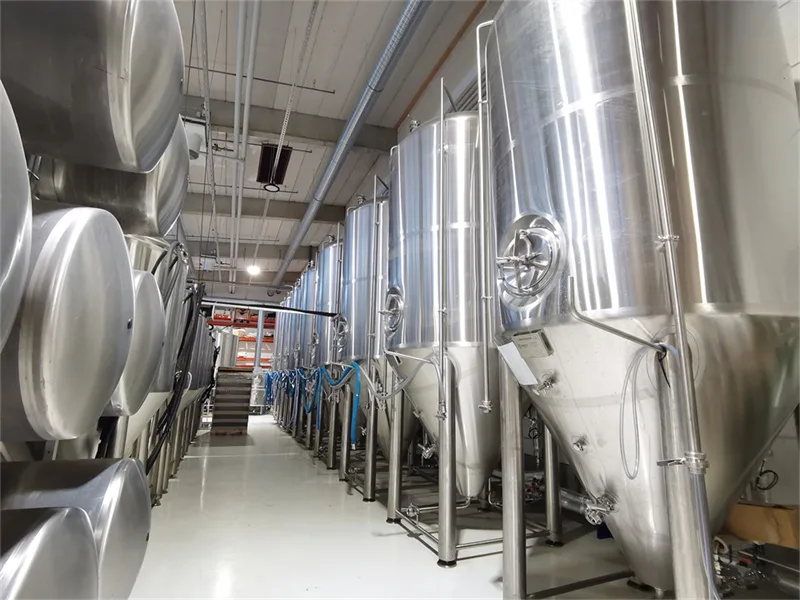
A 1000L commercial brewery project provides a useful example of how different fermenter configurations can support a flexible production strategy.
The system incorporates:
- 1-ton conical fermenters.
- 2-ton conical fermenters.
- 1-ton horizontal fermentation tank.
The brewhouse is designed for a nominal batch capacity of 1,000L, with a target of approximately 4–6 batches per day.
The planned annual production capacity is approximately 2,000 tons, subject to the actual operating schedule, product mix, fermentation cycles, and packaging capacity.
8.1 Why Combine 1-Ton and 2-Ton Fermenters?
Using different tank capacities allows the brewery to organize production according to different batch requirements.
The 1-ton fermenters provide greater flexibility for individual production batches and product development.
The 2-ton fermenters can accommodate larger working volumes and may reduce the number of vessels required for certain production arrangements.
The combination provides more options when planning fermentation batches and allocating cellar capacity.
8.2 Why Include a Horizontal Fermentation Tank?
The additional 1-ton horizontal fermenter introduces another fermentation configuration.
This allows the brewery to explore different fermentation conditions for selected beer styles while maintaining conventional conical fermenters for its regular production program.
The combination is particularly useful for breweries that value both production efficiency and product differentiation.
8.3 Visual Monitoring During Fermentation
The fermentation vessels also incorporate sight lamps and observation windows.
These features allow operators to observe visible fermentation activity and liquid-level changes without opening the vessel.
Depending on the vessel design, operators can inspect:
- Liquid-level changes.
- Krausen development.
- Visible fermentation activity.
- Residual hop material.
- Remaining beer volume during relevant operations.
Visual monitoring complements temperature, pressure, and other process measurements, helping operators maintain better awareness of fermentation conditions.
9. Common Mistakes in Fermentation Capacity Planning
Several mistakes can lead to insufficient or inefficient fermentation capacity.
Mistake 1: Sizing fermenters only according to brewhouse batch volume
A 1000L brewhouse does not necessarily require only 1,000L of total fermentation capacity. Multiple batches may occupy fermenters simultaneously for several weeks.
Mistake 2: Ignoring tank occupancy time
Primary fermentation is only one stage of the complete tank cycle. Conditioning, maturation, transfer, and cleaning must also be included.
Mistake 3: Confusing nominal tank volume with working volume
Fermenters require adequate headspace. The usable working volume must be established before calculating the number of tanks.
Mistake 4: Using only one fermenter size
A uniform tank configuration may be less flexible for breweries producing multiple beer styles and batch sizes.
Mistake 5: Ignoring packaging capacity
Even when fermentation capacity is sufficient, limited packaging capacity can delay tank turnover and reduce overall production.
Mistake 6: Planning without future production requirements
A brewery that expects to expand should consider additional tank connections, glycol cooling capacity, floor space, and utility infrastructure during the initial design stage.
10. METO: Integrated Fermentation System Design and Manufacturing
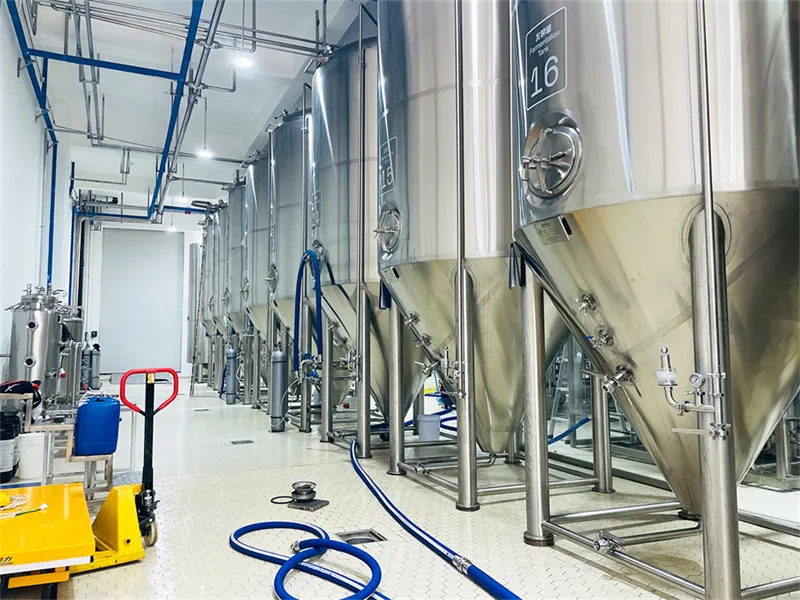
As a brewery equipment manufacturer, METO provides customized fermentation systems for craft breweries and commercial beer producers.
Fermentation equipment selection is based on the relationship between brewhouse capacity, daily wort production, fermentation duration, tank utilization, and the brewery’s product portfolio.
METO can customize:
- Fermentation tank capacity and quantity.
- Conical and horizontal fermenter configurations.
- Stainless steel material and surface finish.
- Cooling jacket and insulation design.
- Pressure ratings according to process requirements.
- CIP spray devices and cleaning connections.
- Sight glasses and observation windows.
- Temperature monitoring and control systems.
- Glycol cooling and auxiliary equipment.
Beyond individual fermenter manufacturing, METO considers the complete production system to help ensure that fermentation capacity matches the brewery’s intended operating schedule.
From equipment design and manufacturing to system integration, installation, and commissioning, METO supports breweries in developing practical production solutions for their long-term growth.
결론
Fermentation capacity planning is one of the most important aspects of commercial brewery engineering.
A properly designed fermentation cellar must accommodate daily wort production while allowing sufficient time for fermentation, maturation, cleaning, and tank turnaround.
By calculating daily wort input, estimating tank occupancy periods, selecting appropriate working volumes, and optimizing tank scheduling, breweries can avoid production bottlenecks and improve equipment utilization.
Combining different fermenter sizes and configurations can provide additional flexibility for breweries producing multiple beer styles.
Ultimately, the best fermentation system is not simply the one with the largest total tank volume. It is the one that matches the brewery’s production schedule, beer portfolio, and long-term operating requirements.
Planning a commercial brewery or expanding your fermentation cellar?
METO에 문의 to discuss your brewhouse capacity, fermentation schedule, tank quantities, and customized fermenter configurations. Our engineering team can help develop a fermentation system that matches your production requirements.