Choosing the right number of fermenters is one of the most important decisions when designing a brewery. Too few fermenters can limit production and create scheduling problems. Too many can increase the initial investment, cooling load, floor space and cleaning requirements.
The right number depends on more than the brewhouse size. A brewery equipment manufacturer needs to consider brewing frequency, fermentation time, tank working volume, annual production targets, beer styles and future expansion.
This guide explains how to estimate the number of fermenters needed for a brewery and what factors should be considered before ordering fermentation tanks.
Brewhouse Capacity Is Not the Same as Fermentation Capacity
A common mistake is assuming that a 1000L brewhouse automatically requires a fixed number of 1000L fermenters.
In practice, the brewhouse determines how much wort can be produced per batch, while the fermenter system determines how much beer can be processed through fermentation at the same time.
For example, a 1000L brewhouse may produce one 1000L batch per brew. If the brewery ferments most beers for 10–14 days, the brewery needs enough fermentation capacity to receive new batches while previous batches are still in the tanks.
Therefore, fermenter quantity should be designed around the production schedule, rather than simply matching the brewhouse tank count.
What Determines the Number of Fermenters?
Several factors affect the required number of fermentation tanks.
1. Brewing Frequency
Start by determining how often the brewery plans to brew.
A brewery producing one batch per week has very different fermentation requirements from a brewery producing four or five batches per week.
For example, if a 1000L brewery produces four batches per week, the fermentation system needs to accommodate approximately 4000L of new wort every week.
2. Fermentation Time
Fermentation time is one of the most important variables.
Ale production may require approximately 7–14 days depending on the recipe and process. Lager production can require considerably longer fermentation and conditioning periods.
The longer beer remains in the fermenter, the more tanks are required to maintain the same brewing frequency.
For example, a brewery producing one 1000L batch every two days may need significantly more fermentation capacity if the average tank residence time is 14 days rather than 7 days.
3. Fermenter Working Volume
Fermenters are not normally filled to their total geometric volume.
A tank needs sufficient headspace for fermentation activity, foam and process control. Therefore, a 1000L nominal fermenter does not necessarily mean 1000L of usable beer volume.
The actual working volume should be confirmed when designing the brewery system.
4. Beer Styles
Different beer styles may have different fermentation and maturation requirements.
A brewery producing mainly fast-turnover ales may operate with fewer fermenters than a brewery specializing in lagers, strong ales or beers requiring longer maturation.
If a brewery produces several styles simultaneously, additional tanks may also be useful for maintaining production flexibility.
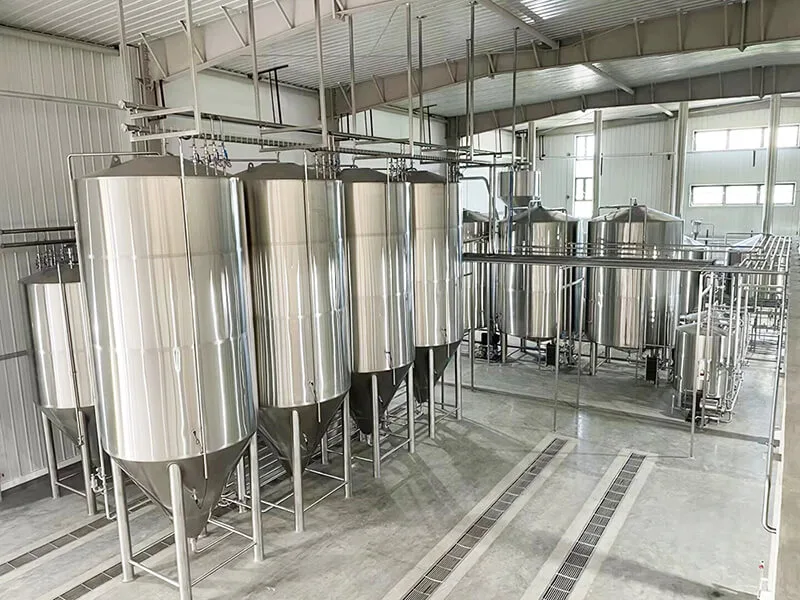
A Simple Way to Estimate Fermenter Requirements
A useful starting point is:
Required Fermentation Capacity ≈ Weekly Brewing Volume × Average Fermentation Time ÷ 7
For example, suppose a brewery operates a 1000L brewhouse and produces four batches per week.
Weekly brewing volume:
1000L × 4 = 4000L/week
If the average fermentation cycle is 14 days:
4000L × 14 ÷ 7 = 8000L
The brewery would therefore need approximately 8000L of active fermentation capacity.
This could be configured as:
8 × 1000L fermenters
or another combination such as:
4 × 2000L fermenters
depending on the brewing schedule, recipes and tank configuration.
This calculation is only a starting point. Actual brewery design should also include headspace, cleaning turnaround, transfer schedules, production peaks and spare capacity.
How Many Fermenters Does a 1000L Brewery Need?
A 1000L brewery is often used by growing craft breweries, brewpubs and pilot-to-commercial operations.
A typical configuration might include:
- 4–8 × 1000L fermenters for smaller or flexible production
- 8–12 × 1000L fermenters for higher brewing frequency
- A combination of different tank sizes for multiple beer styles
For example, a brewery brewing two batches per week may require considerably less fermentation capacity than one brewing five batches per week.
The final configuration should therefore be based on the production plan rather than a standard equipment package.
How Many Fermenters Does a 2000L Brewery Need?
A 2000L brewhouse can support a larger commercial craft brewery, but the number of fermenters depends heavily on brewing frequency.
If the brewery produces three 2000L batches per week and the average fermentation period is 14 days:
2000L × 3 × 14 ÷ 7 = 12,000L
A possible configuration could be:
6 × 2000L fermenters
This provides approximately 12,000L of nominal fermentation capacity.
If the brewery plans to brew more frequently or produce beers with longer fermentation times, additional tanks may be required.
Should All Fermenters Be the Same Size?
Not necessarily.
Using identical fermenters simplifies production scheduling, cleaning and spare-parts management. However, a mixed tank configuration can provide greater flexibility.
For example, a brewery could use:
4 × 2000L + 4 × 1000L fermenters
This allows the brewery to handle full batches as well as smaller production runs.
Mixed-capacity fermentation systems can be particularly useful for breweries producing seasonal beers, specialty beers or experimental batches.
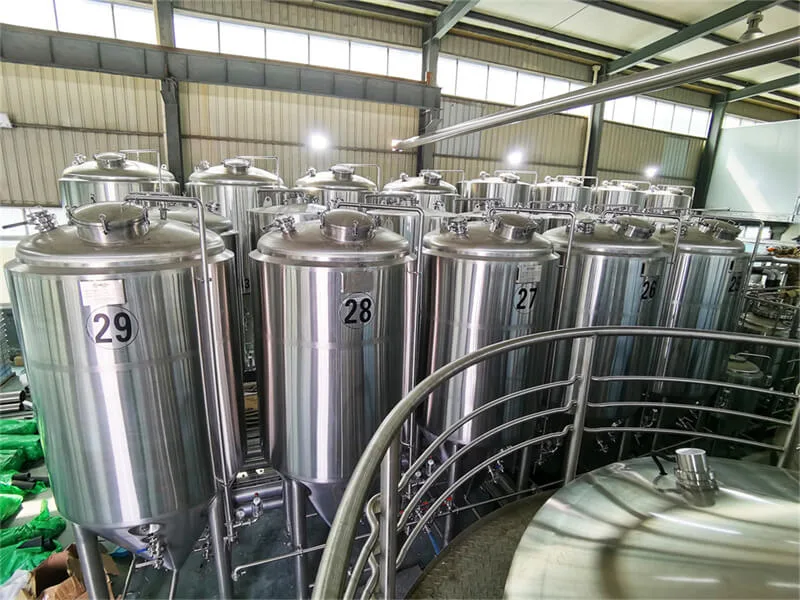
Why Extra Fermentation Capacity Can Be Useful
A brewery does not always operate at its average production level.
Seasonal demand, new product launches and increased sales can create periods when additional fermentation capacity is required.
Adding a reasonable production buffer can help avoid situations where the brewhouse is ready to brew but no fermenter is available.
However, excessive spare capacity also increases:
- Equipment investment
- Glycol cooling requirements
- Floor-space requirements
- Cleaning workload
- Maintenance costs
The objective is not to install as many fermenters as possible, but to create a balanced production system.
Fermenter Capacity Should Match the Entire Brewery System
Fermentation tanks should not be designed separately from the rest of the brewery.
The fermenter system needs to work together with:
양조장
The batch size and brewing frequency determine how quickly wort enters the fermentation system.
글리콜 냉각 시스템
More fermenters mean greater cooling demand, especially during peak fermentation activity.
CIP 시스템
The number and size of tanks directly affect cleaning procedures and CIP capacity.
밝은 맥주 탱크
If beer is transferred to BBTs for carbonation, clarification or packaging, the number of BBTs and transfer schedule should also be considered.
Packaging System
The packaging line needs to match the production rate. Otherwise, fermentation capacity may become larger than the actual downstream production capacity.
Plan for Future Brewery Expansion
A brewery may start with a small number of fermenters and add more tanks as sales grow.
For example, a brewery might initially install:
1000L brewhouse + 6 × 1000L fermenters
and reserve floor space, glycol connections and utility capacity for future expansion to:
1000L brewhouse + 10–12 × 1000L fermenters
This approach can reduce the initial investment while allowing production capacity to grow without completely redesigning the brewery.
When planning the site, it is therefore useful to consider not only the first-stage equipment but also the possible second-stage expansion.
How METO Designs Fermentation Systems
As a brewery equipment manufacturer, METO does not determine fermenter quantity from brewhouse capacity alone.
We consider the brewery’s target production, brewing frequency, fermentation time, beer styles, tank working volume, cooling requirements, CIP system, packaging capacity and available installation space.
METO can provide stainless steel fermentation tanks in different capacities and configurations, including customized tank dimensions, cooling jackets, insulation, pressure ratings, fittings and control options.
For a complete brewery project, the fermenters can also be integrated with the brewhouse, glycol cooling system, CIP system, BBTs, controls and other supporting equipment.
Final Considerations
There is no universal number of fermenters for a brewery.
A practical calculation should begin with:
Brewhouse batch size → Brewing frequency → Fermentation time → Required fermentation volume → Tank quantity
For example, a 1000L brewery producing four batches per week with an average 14-day fermentation cycle may require around 8000L of active fermentation capacity, before allowing for operating margins and other process requirements.
The best fermentation system is therefore the one that matches the brewery’s actual production schedule and provides enough flexibility for future growth.
If you are planning a new brewery or expanding an existing system, a brewery equipment manufacturer can calculate the required fermenter capacity based on your production target, brewing schedule and available space rather than relying on a standard tank package.
Share your target annual production, desired batch size, number of brews per day, beer styles, available space, and packaging requirements with METO. Our engineering team can help develop a brewery equipment configuration based on your production goals.