A brewpub or on-site brewery combines two businesses in one space: food and beverage service at the front, beer production at the back. That changes how brewery equipment should be selected.
A conventional production brewery can prioritize throughput and production efficiency. A brewpub has additional constraints: limited floor space, customer visibility, noise, cleaning access, aesthetics and fast beer turnover.
The right brewery equipment therefore needs to support both the brewing process and the commercial operation of the venue. Capacity, layout and equipment configuration should be considered together rather than choosing a brewhouse first and trying to fit everything into the building afterward.
Start With Brewery Equipment Capacity, Not Tank Size
The most common mistake is choosing equipment based on the available space or the owner’s preferred tank size without first calculating expected beer sales.
For many brewpubs and small craft beer venues, a brewhouse capacity of 200L to 2000L per batch can provide a practical starting range. The appropriate brewery equipment capacity depends on seating, expected daily beer sales, operating days, beer styles and fermentation time.
예를 들어
- 200–500L brewhouse: suitable for small brewpubs, restaurants and pilot-scale operations.
- 500–1,000L brewhouse: a common choice for growing craft beer venues with several house beers.
- 1,000–2,000L brewhouse: better suited to larger beer restaurants or businesses supplying multiple service areas.
The calculation should not stop at brewhouse volume. Fermentation tanks determine how much beer can actually be produced and stored.
A useful engineering approach is to calculate annual demand → weekly production → brewhouse batches → fermentation capacity → serving capacity. This prevents the common situation where the brewhouse has sufficient capacity but the fermentation cellar becomes the production bottleneck.
Choose a Brewhouse System Around the Available Space
For a commercial brewpub, the brewhouse system should balance productivity, footprint and operating complexity.
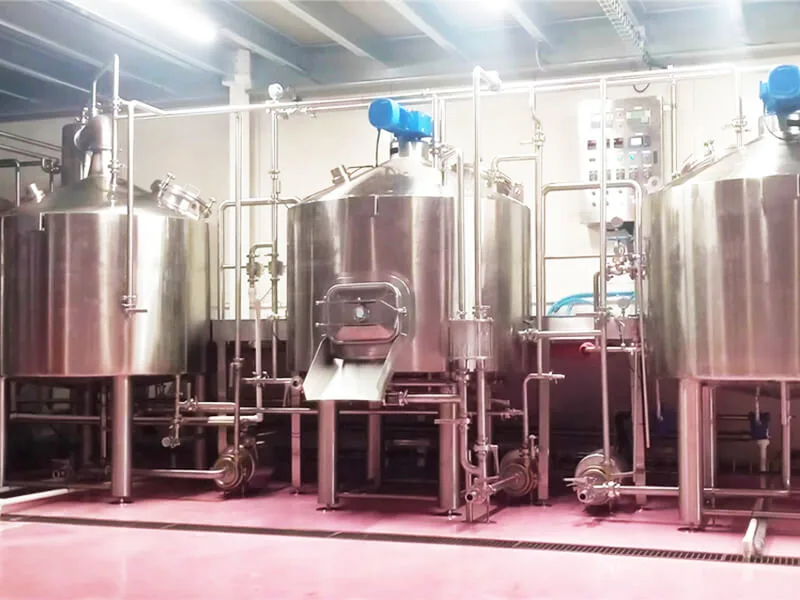
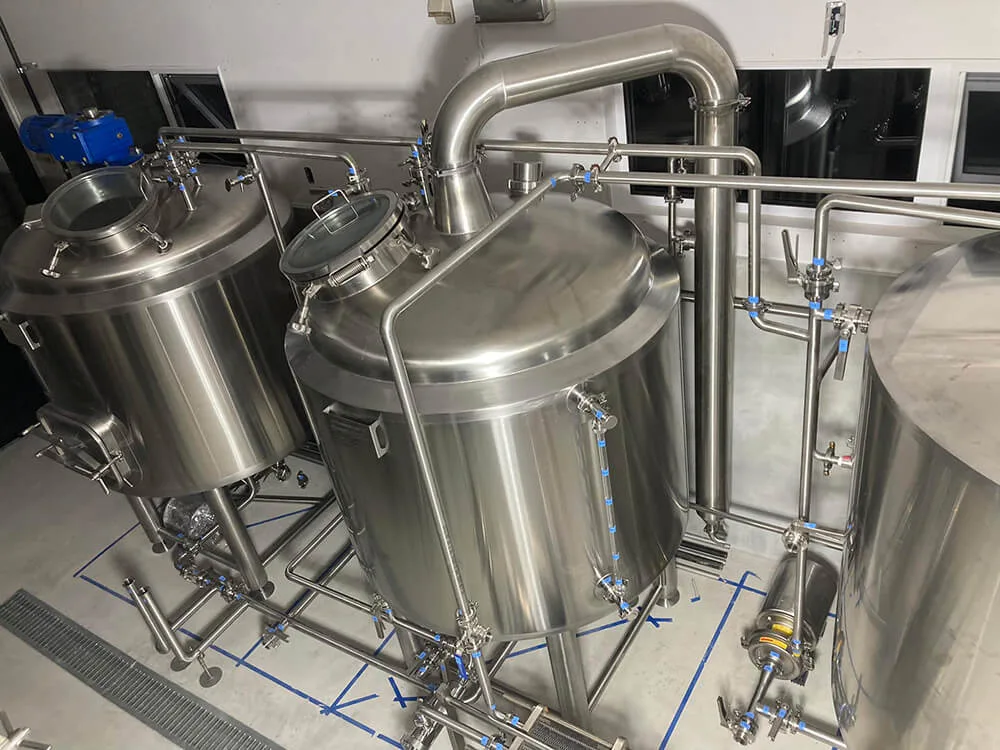
A compact two-vessel system can combine functions and reduce the equipment footprint, making it attractive where floor space is limited. Three-vessel and four-vessel configurations provide greater process flexibility and can be preferable when the brewery expects frequent brewing or multiple recipes.
Layout is equally important.
The equipment should allow operators to move efficiently between:
- Milling and grist handling
- Mashing and lautering
- Wort boiling
- Whirlpooling
- Wort cooling
- 발효
- Beer transfer
- CIP and sanitation
A compact design is not simply about putting more equipment into less space. Operators still need sufficient clearance for valve operation, maintenance, cleaning and eventual component replacement.
Make the Fermentation Cellar Work Harder
For a brewpub, fermentation tanks are both production equipment and part of the customer experience.
Conical fermenters with integrated cooling jackets allow fermentation temperature to be controlled independently for different beer styles. Insulation reduces cooling losses, while properly designed CIP connections simplify cleaning between batches.
The number of tanks should be based on production frequency rather than brewhouse capacity alone.
For example, a 1,000L brewhouse may require several 1,000L fermenters if the business wants to brew multiple times per week while maintaining enough maturation and serving inventory.
Tank configuration should also consider:
- Working volume and headspace
- Fermentation pressure
- Cooling jacket configuration
- CIP connections
- Sampling and carbonation points
- Manway access
- Tank height and ceiling clearance
- Cleaning and maintenance access
This is where an experienced brewery equipment manufacturer can add value: the brewhouse, cellar and utility systems need to be designed as one production system.
Use the Brewery as Part of the Customer Experience
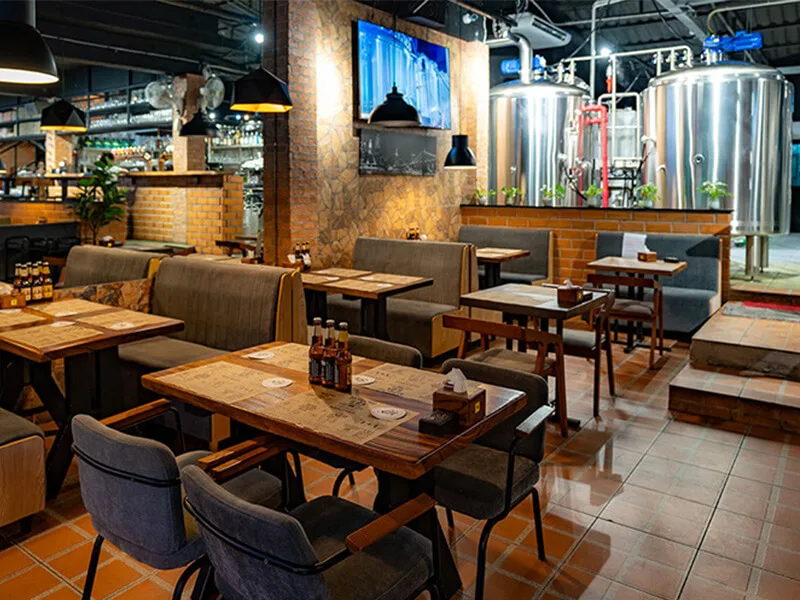
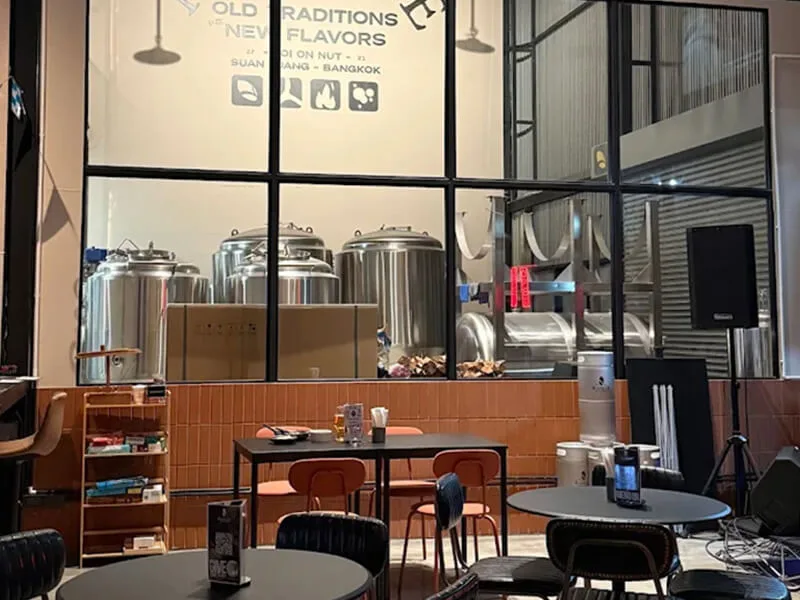
One advantage of a front-of-house brewery is that the equipment can become part of the interior design.
Polished stainless steel brewhouses, copper-clad vessels and visible fermentation tanks can create a strong visual connection between the beer on the table and the production process behind it.
However, visibility should not compromise production.
A glass-walled brewing room, for example, should still provide adequate ventilation, drainage, temperature control and operator access. Fermenters positioned near the bar should have carefully planned pipework and electrical connections rather than being installed purely for appearance.
Good design makes the equipment look attractive because the process has been engineered well, not because functionality was sacrificed for aesthetics.
CIP and Hygiene Should Be Designed Into the System
Cleaning is one of the most important operational considerations in a brewpub.
Beer production involves frequent cleaning of tanks, pipelines, heat exchangers, filling and dispensing equipment. Manual cleaning may appear inexpensive initially, but labor requirements increase rapidly as production grows.
A properly configured CIP system can standardize cleaning procedures and reduce operator workload. Spray devices, pumps, valves, return lines and chemical circulation should be sized according to the actual equipment configuration.
Food-contact surfaces should also be manufactured from appropriate stainless steel, with welds, internal finishes and connections designed to minimize contamination risks and simplify sanitation.
For commercial operations, hygiene is not an optional upgrade. It is part of the production system.
Automation Should Solve Real Operating Problems
Not every brewpub needs a fully automated brewery.
For a small operation, manual or semi-automatic controls may offer a better balance between investment and flexibility. As production volume increases, PLC-based control can improve process repeatability and reduce operator errors.
Useful automation functions include:
- Mash temperature monitoring
- Pump and valve control
- Wort transfer sequencing
- Fermentation temperature management
- Tank pressure monitoring
- CIP process control
- Production data recording
The goal should be repeatable brewing with fewer operational errors, rather than adding automation simply because it is available.
Why Turnkey Brewery Solutions Reduce Project Risk
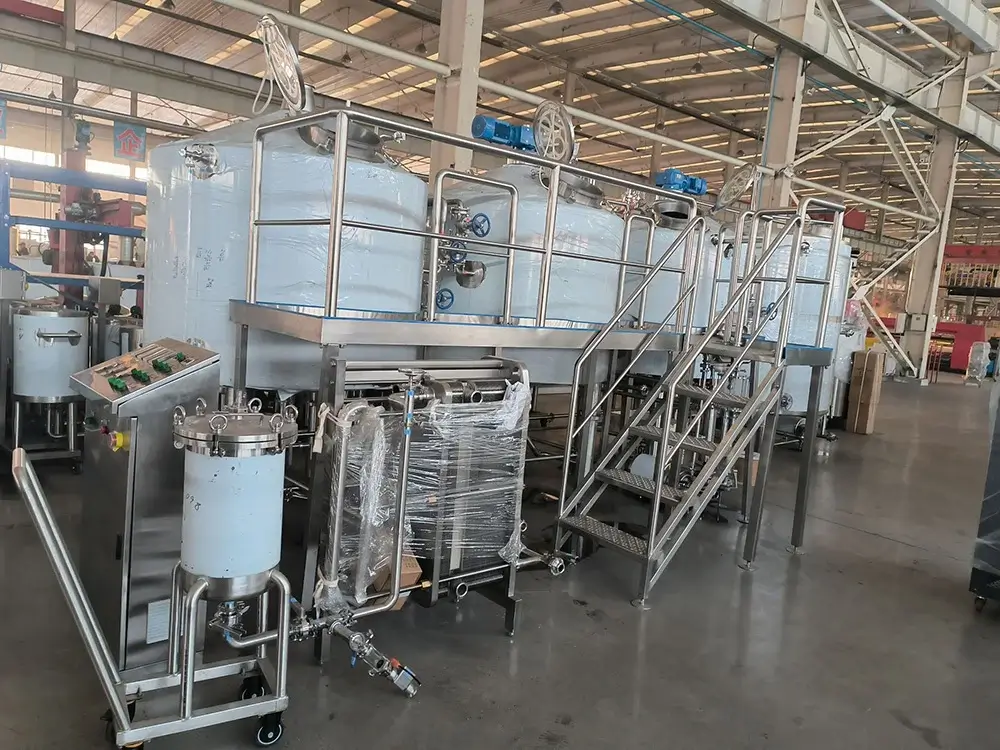
A front-of-house brewery involves more than purchasing stainless steel tanks.
The project may require equipment layout, utility planning, steam or electric heating, glycol cooling, water treatment, drainage, ventilation, piping, electrical integration and installation.
A turnkey brewery solution brings these elements into one engineering plan.
An experienced brewery equipment supplier can help determine brewery equipment capacity, design the brewhouse and fermentation area, coordinate auxiliary equipment and provide commissioning and operator training.
For investors and restaurant owners without previous brewing experience, this integrated approach can significantly reduce the risk of buying incompatible equipment or discovering layout problems after installation.
Build the Brewery Around the Business Model
The best brewpub equipment is not necessarily the largest or most automated system. It is the system that matches the venue’s sales volume, available space, product range and expansion plans.
Before purchasing commercial brewery equipment, evaluate:
- Expected beer sales and peak demand
- Available production and cellar space
- Required brewery equipment capacity
- Number and size of fermentation tanks
- Heating and cooling utilities
- CIP and sanitation requirements
- Customer-facing equipment visibility
- Future expansion requirements
At METO, brewery projects are designed around the complete production process rather than individual pieces of equipment. From brewhouse system and fermentation tanks to CIP, cooling, controls and installation, the objective is to create a brewery that can operate efficiently from day one and scale with the business.
Planning a front-of-house, back-of-house brewery? METO에 문의 for a brewery equipment capacity assessment and customized layout proposal.