Selecting the right microbrewery equipment is the foundational cornerstone of a craft brewery’s success. From system design and material craftsmanship to automation configuration, equipment not only dictates beer quality and batch consistency but also directly impacts future operational costs and expansion potential.
Below is a professional equipment selection and technical guide for microbreweries.
1. Introduction
In recent years, the global craft beer market has shifted from explosive, rapid growth toward refined, quality-driven operations. Driven by rising consumer demand for flavor diversity, localized styles, and premium quality, microbreweries and brewpubs continue to flourish.
Across the craft brewing chain, equipment serves as the primary vessel for quality and efficiency. The precise execution of brewing processes—from mash temperature control and fermentation pressure management to strict aseptic hygiene—relies entirely on high-performance equipment. For start-up breweries, a scientifically sound equipment selection strategy minimizes initial investment risk while ensuring batch-to-batch consistency and building brand reputation.
2. Six Systems of a Microbrewery
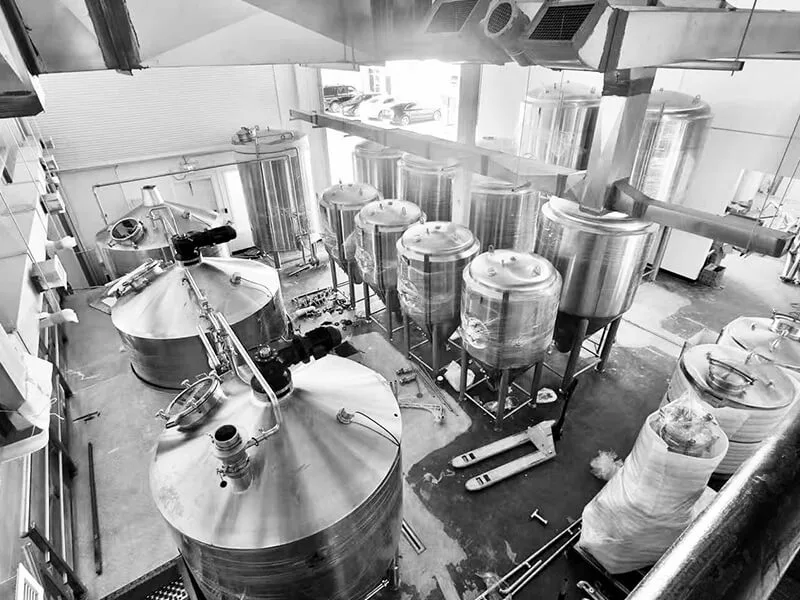
A complete setup splits into six subsystems: brewhouse, fermentation, cooling, CIP, automation, and auxiliaries. We use 10 HL throughout — the most common entry size, matching a brewpub plus light local distribution.
2.1 Brewhouse
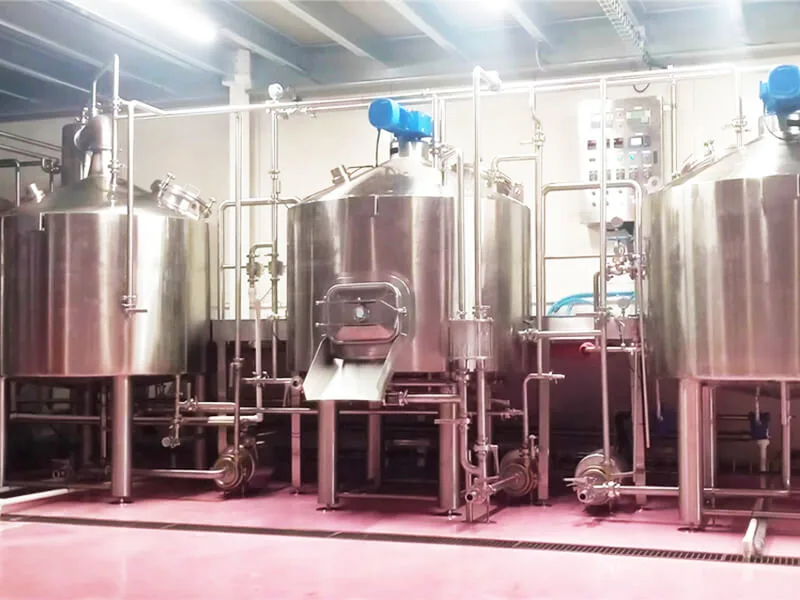
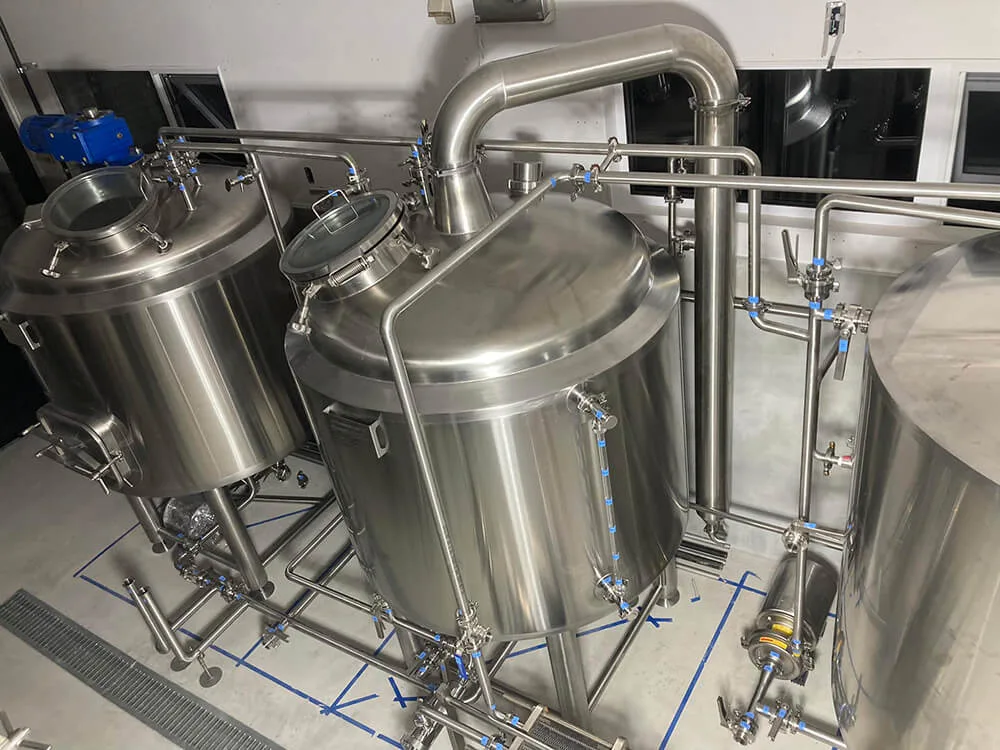
Four vessels do the work after milling: the mash tun / cereal cooker handles gelatinization and protein rests; the lauter tun separates wort from spent grain; the kettle boils and hops the wort; the whirlpool settles trub and hot break.
| Vessel | Key specs |
|---|---|
| Tino di ammostamento | 10 HL working / 12 HL total; SUS304, 3–4 mm wall; double jacket; ≥50 mm insulation; variable rakes 0–40 rpm; ±0.5°C control; CIP spray ball |
| Agire con maggiore sincerità | 12 HL; false bottom ≥8% open area; rakes 1–3 rpm |
| Kettle | 11 HL; 8–10% boil-off; calandria or steam jacket; vapor condenser recommended |
| Whirlpool | 12 HL; tangential feed; 20–30 min settling |
One caveat: combined mash/lauter vessels save money at 5 HL and below, but above 10 HL keep them separate — a shared vessel adds turnaround time that gets painful once volumes climb.
2.2 Fermentation
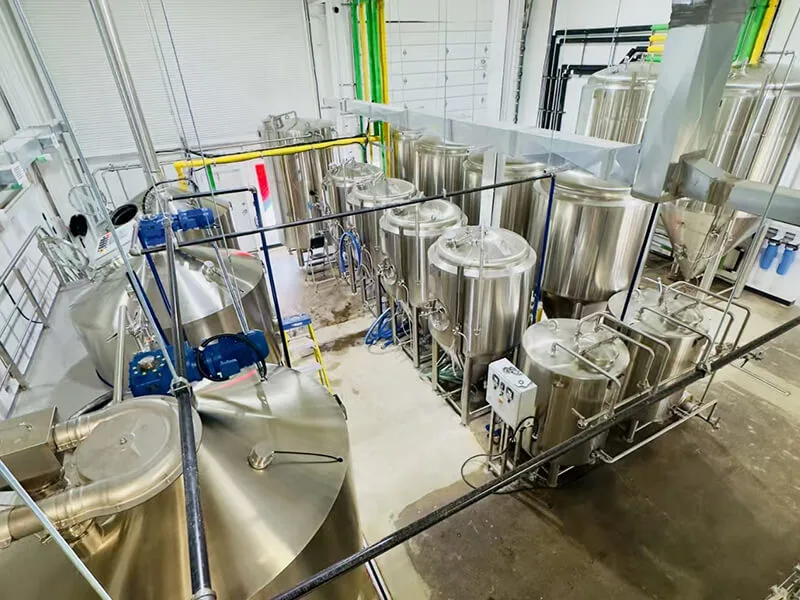
Cylindroconical fermenters (CCTs) are the standard: 60–70° cone, dual cooling jackets (body and cone), yeast dumped straight from the cone. Reference specs: 12.5 HL total volume (20–25% headspace for krausen), 2 bar design / 1.5 bar operating pressure, SUS304, ≥50 mm insulation, sample and yeast dump valves, manway. Bright beer tanks hold finished beer under 1.5–2 bar so CO₂ stays put during packaging. Start with venting and counter-pressure; add CO₂ recovery later, with payback usually under two years. For a 10 HL brewhouse, plan 4–6 CCTs plus 1–2 BBTs — lagers cycle in 3–4 weeks, ales in 2–3, so stagger brews and keep the tanks rolling.
2.3 Cooling
The standard build is a glycol buffer tank (30–35% glycol, freeze point around −15°C), a chiller (3–5 HP for 10 HL, sized about 20% above peak load), and dual pumps with separate circuits for brewhouse, fermenters, and BBTs. The payoff is fermenters held at ±0.5°C without cycling the compressor flat out — cooling is the system easiest to underinvest in and most expensive to regret.
2.4 CIP
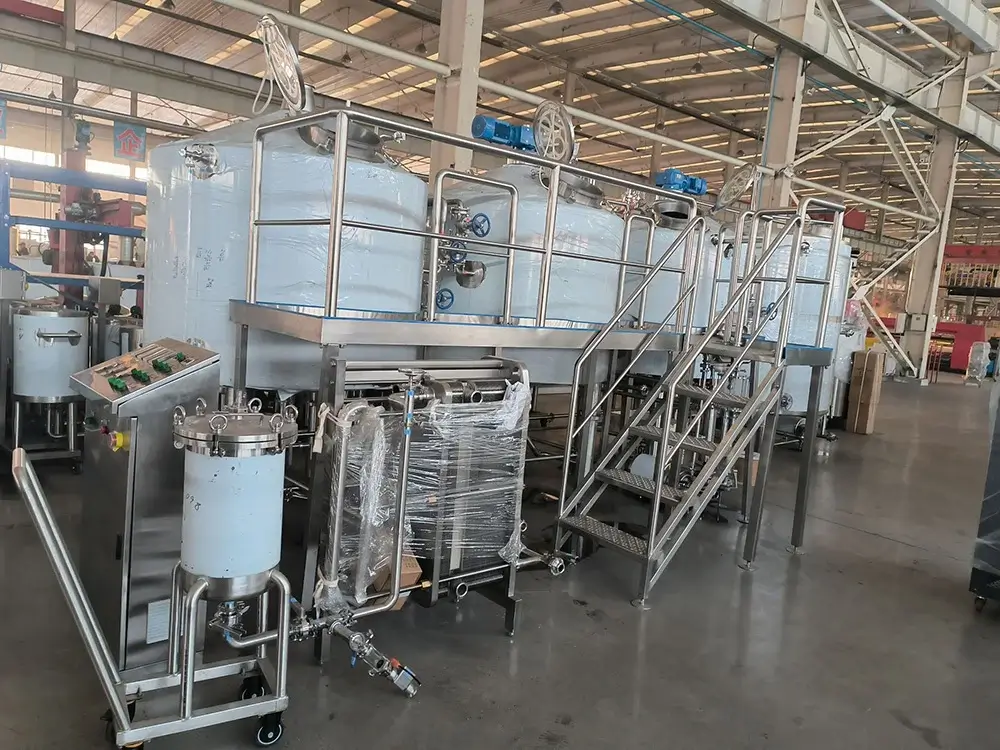
Three vessels do the job: caustic (2–3% NaOH at ~80°C), acid (0.5–1% nitric or phosphoric), and hot water (80–85°C), served by a plate heat exchanger. Automated cycles — pre-rinse, caustic, intermediate rinse, acid, final rinse — run on PLC-set parameters for consistency and cut water and chemical use by 30–40%. If budget is tight, start semi-automatic and keep the panel upgrade-ready.
2.5 Automation
PLC control is standard: touchscreen HMI, recipe management, real-time alarms, data logging, and 4G/Wi-Fi remote monitoring. The value is consistency — a PLC holds mash and fermentation temperature within ±0.5°C where manual operation drifts ±2°C — plus batch traceability when quality questions come up.
2.6 Auxiliaries
Water treatment (carbon, softener, reverse osmosis; near-zero chlorine), an oil-free compressor for pneumatics, an electric steam generator (no boiler licensing) for brewhouse and CIP heat, and a simple keg filler to start. Bottles and cans come once distribution is stable.
3. How to Choose the Right Equipment
3.1 Size capacity first
Define the market before reading spec sheets: a brewpub (on-premise) can start at 5 HL; distribution argues for 10 HL with 4–6 fermenters. Then favor modular designs — fixed brewhouse, fermenters added year by year — so expansion doesn’t mean repeat investment.
3.2 Materials
Food-grade stainless everywhere that touches beer: SUS304 vessels, SUS316L for caustic, acid, and high-heat parts (CIP lines, jackets, heat exchangers). Internal finish Ra ≤ 0.8 μm (0.6 μm preferred on beer-contact surfaces), welds ground and passivated. Ask for material certificates, a factory audit, and compliance documents (CE, food-contact reports).
3.3 Heating method
| Method | Pros | Cons | Il migliore per |
|---|---|---|---|
| Elettrico | Low cost, fast install, simple | Higher energy cost, slower ramp-up | 5–10 HL |
| Vapore | Efficient, even, continuous | Boiler plus licensed operators | 10 HL+, steady volume |
| Direct fire | Fast heat-up, caramel character | Hard to control, scorching risk | Tiny traditional brewhouses |
Straight advice: electric for simplicity, steam for long-run operating cost; direct fire only for deliberate traditional character at very small scale.
3.4 Automation level
Automate what must be consistent — mash and fermentation temperature, CIP cycles. Keep manual what happens rarely — grain-in, tank transfers. Confirm recipe management and data export; traceability depends on them.
3.5 After-sales
The first three years are the high-failure window. Before signing, clarify installation, commissioning (will they brew your first batch?), training, spare parts, and response times — in writing. Supplier proximity and responsiveness beat extra wall thickness on paper.
4. Equipment Trends for 2026
- Data-driven brewing. PLCs now push mash profiles, temperatures, pH, and gravity to the cloud for cross-batch comparison, so recipe fixes finally have evidence. The dividing line is hardware-only versus hardware plus a data service.
- Energy efficiency. Vapor condensers recover roughly 30% of boil energy and are near-standard now; CIP water recovery and variable-speed pumps cut running costs. These are lines on the power bill, not green posturing.
- Modular expansion. Standard modules with unified interfaces let you start small, then add tanks or upgrade the kettle in sync with sales.
- Unitanks. Fermentation, conditioning, and carbonation in one vessel cut tank count and floor space — practical for tight city brewpubs, though scheduling needs care and they don’t suit high-volume single styles.
5. Recommended Startup Package (10 HL Example)
| Module | Spec | Notes |
|---|---|---|
| Birreria | 10 HL four-vessel, electric | Combine mash + lauter if budget is tight |
| Fermentazione | CCT ×4–6, BBT ×1–2 | Fewer for ales, more for lagers |
| Raffreddamento | Glycol tank + 3–5 HP chiller, dual pumps | Size at peak load plus 20% |
| CIP | Caustic / acid / hot water + plate heat exchanger | Start semi-automatic |
| Automazione | PLC + touchscreen + recipe + remote monitoring | Confirm data export |
| Auxiliary | RO treatment, compressor, electric steam, keg line | Kegs first |
Spend on the brewhouse and fermentation — quality and consistency live there. Don’t cut cooling and CIP — that’s your stability and hygiene baseline. Keep packaging minimal at first. At three brewhouse turns per month, 10 HL × 4 tanks works out to roughly 120 HL a month, enough for a brewpub plus modest distribution.
6. How to Choose a Reliable Supplier
Complete line. One supplier for brewhouse, fermentation, cooling, CIP, and automation avoids interface and protocol mismatches; mixed sourcing shifts the integration risk to you. Look for turnkey references.
Support that’s written down. Commissioning that actually brews beer, training for your whole team, and spare-part lead times plus response times on paper — these beat any verbal promise.
Customization and process know-how. Layout and pipe runs must fit your site, and the best suppliers also advise mash schedules and fermentation curves for your target styles. At that point you’re buying their experience of opening breweries, not just tanks.
7. Conclusion
Craft beer’s growth continues in 2026, but the game is now “can you make money reliably.” Equipment is the most expensive, least reversible decision on that road — it locks in mash efficiency, consistency, energy use, and expansion room. There’s no perfect answer, but there is a floor: capacity math done properly, material grades that don’t compromise, a heating method that fits, automation that fits your team, and support terms in writing. Get those five right, and the rest is process and time.
If you are currently planning a craft brewery project and require tailored advice on facility layout designs, specialized setups (such as sour beer production), or detailed budget breakdowns for specific system scales, feel free to share your requirements.