Thinking of Starting, Upgrading, or Expanding a Brewery? This Playbook Could Save You Years of Expensive Mistakes.
We’ve been involved in over 1000 brewery installations worldwide, and we’ve seen the same patterns play out again and again. Some breweries thrive. Others struggle. The difference usually comes down to one decision made early on: automation.
This isn’t about hype or buzzwords. It’s about real-world production, actual cost data, and the kind of long-term profitability that lets you sleep at night. Let’s get into it.
So, What Exactly Is an Automated Brewery?
At its core, an automated brewery is a facility where the key steps — mashing, lautering, boiling, fermentation, cooling, cleaning, and packaging — are managed by an integrated control system rather than by hand.
In plain English: automation replaces guesswork with precision. It takes the “art” that varies from shift to shift and turns it into a science that repeats itself flawlessly every single time.
I’ve watched this shift unfold over the past decade. And the numbers don’t lie: breweries that embraced automation early almost always outperformed their traditional counterparts within 18 to 24 months — not by a little, but by a significant margin.
Traditional vs. Automated: A Side-by-Side Look
| Facteur | Traditional Brewery | Automated Brewery |
|---|---|---|
| Process Control | Manual, hands-on | PLC / SCADA integrated |
| Batch Consistency | Inconsistent, operator-dependent | Highly repeatable, batch-to-batch |
| Besoins en personnel | Heavy labor, multiple stations | One trained operator can run the show |
| Recipe Execution | Variable | Precise, every time |
| Scaling Up | Painful and costly | Straightforward, modular |
| Data Visibility | Paper logs, limited insight | Real-time monitoring + full history |
Bottom line: a traditional brewery relies on the brewer’s intuition and stamina. An automated brewery relies on engineered repeatability and data.
What’s Actually Inside an Automated Brewing System?
These systems aren’t monolithic. They’re a suite of tightly integrated modules, all talking to each other through industrial control software.
Here’s the breakdown:
- Brewhouse Control – Automated grain milling, programmable mash temperature steps, automated lautering and wort transfer, and precisely controlled boil and whirlpool cycles.
- Fermentation Management – Exact temperature control, pressure regulation, automated yeast pitching and harvesting, plus continuous fermentation data logging.
- CIP (Cleaning-in-Place) Systems – Pre-programmed caustic and acid washes, rinse cycles, and sanitization routines. Uses less water and fewer chemicals than manual cleaning.
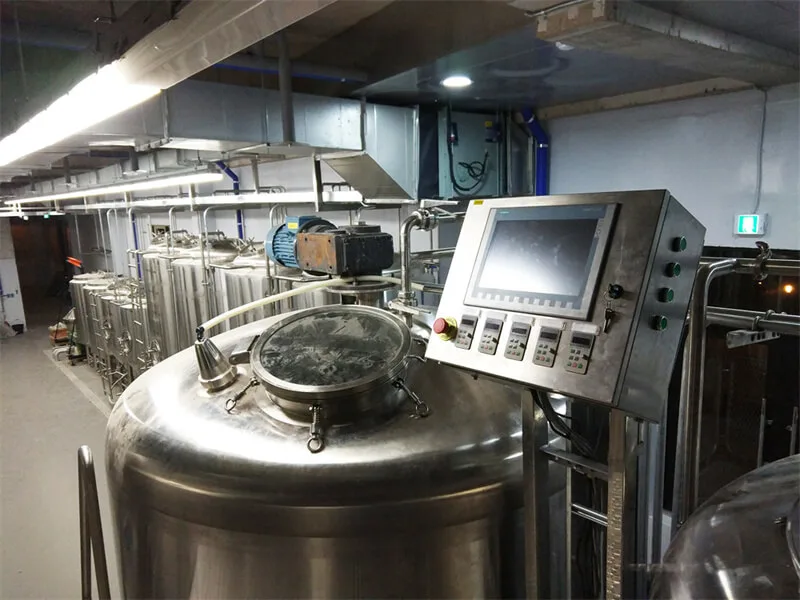
- Central Command Hub – PLC-driven, with touch-screen HMIs, full recipe storage, and even remote access for off-site monitoring.
As one brewer put it: “Automation lets me be a manager of the process, not a worker inside it.”
What Do You Actually Gain from Automation?
Based on real operational data from hundreds of breweries, these are the benefits that show up on the bottom line:
- Flawless Consistency – Every batch tastes identical. That builds trust with your drinkers and your distributors.
- Lower Labor Costs – One skilled operator can supervise an entire brewhouse, instead of stationing people at every vessel.
- Better Yield – Precise control means less beer loss, less oxygen pickup, and less product dumped down the drain.
- Faster Turnaround – Automated transitions between stages cut out the idle time that adds up over a production day.
- Easy Expansion – Adding new tanks or modules? They slide right into the existing control framework.
- Proactive Quality Control – Continuous data lets you spot small issues before they become expensive problems.
The Money Question: Cost vs. ROI
Upfront Investment Snapshot
| Article | Traditional Brewery | Automated Brewery |
|---|---|---|
| Coût de l'équipement | Plus bas | Plus élevé |
| Installation | Modéré | Modéré |
| Control Systems | Basic | Advanced |
| Formation | Minime | More involved, but quick to pick up |
But here’s the catch: initial price tag isn’t the same as total cost of ownership.
5-Year Operating Cost Comparison
| Area | Traditional | Automated |
|---|---|---|
| Labor Expense | Haut | Significantly lower |
| Energy Use | Modéré | More efficient |
| Product Loss | Noticeable | Minime |
| Maintenance | Unpredictable | Predictable, often lower |
| Production annuelle | Capacity-limited | Higher and stable |
Most automated breweries recoup their investment within 24 to 36 months, driven by:
- Fewer staff needed per shift
- More barrels out the door each year
- Less beer wasted
- Faster ability to scale up when demand spikes
Automation Isn’t One-Size-Fits-All
- Small Breweries (3–10 BBL) – Perfect for brewpubs or startups. Focus automation on the brewhouse, fermentation, and CIP — that’s where you’ll feel the biggest impact immediately.
- Medium Breweries (10–30 BBL) – Ideal for regional craft players. Full automation with packaging integration gives you both flexibility and growth headroom.
- Large Breweries (30–100+ BBL) – Commercial-scale production. Here, you automate everything from grain intake to palletized finished goods.
The goal is simple: automation grows with you. It doesn’t box you in.
How to Choose the Right Equipment
Buying automated brewing equipment is not about pinching pennies upfront. It’s about building a system that stays profitable, stable, and competitive for decades.
Here’s what actually matters:
- Materials and Build Quality – Insist on 304 or 316L food-grade stainless steel, with proper welding and full passivation. This isn’t optional — it’s the difference between a system that lasts and one that becomes a maintenance headache.
- Control Platform – Look for stable PLC hardware, an intuitive HMI (touchscreen interface), and robust recipe/data management. It should feel easy to use today and flexible enough to expand tomorrow.
- Temperature Precision – Fermentation quality lives and dies by temperature control. Full-jacket tank design with even heating and cooling is non-negotiable.
- Support après-vente – Training, technical support, and a real warranty matter more than most people think. A system is only as good as the backup behind it.
At Meto, we build every system with globally sourced components, mirror-polished vessels, fully passivated welds, and uniform jacketed heating and cooling. We back our tanks with a 3-year warranty — because we know they’ll outlast it.
FAQ
- Is automation only for big operations?
Not at all. Small breweries often see the fastest payback, thanks to immediate labor savings and quality gains. - Does automation kill creativity?
No — it kills repetitive, mind-numbing labor. That frees you up to focus on recipes, branding, and growth. - How long does installation take?
Typically 60 to 120 days, depending on the scope. Most projects are on the shorter end if the site is prepared in advance. - Is the system hard to learn?
Modern HMI systems are designed to be intuitive. Most operators are comfortable within a week.
The Verdict: Which Model Wins?
When you stack up quality, cost control, scalability, and long-term profitability — the answer is clear. Automation isn’t just the future of brewing. It’s the present reality for any brewery that plans to thrive.
Automated breweries deliver rock-solid consistency, lower running costs, and far more operational stability. And perhaps most importantly, they give you the freedom to grow without hitting a wall every time you add a new tank or try to enter a new market.
In a competitive landscape where margins are tight and drinkers have endless choices, automation isn’t a luxury anymore. It’s the foundation for sustainable growth and better profitability.
For any brewery serious about the long game, the automated model is the only logical choice.
This version uses natural phrasing, a confident but approachable tone, and flows the way an experienced industry consultant would speak. Let me know if you’d like any section shortened, expanded, or tuned for a specific audience (e.g., investors, brewers, or equipment buyers).
Feel free to contact our engineering team for professional technical guidance, customized equipment solutions, and in-depth distillery setup knowledge tailored to your project.