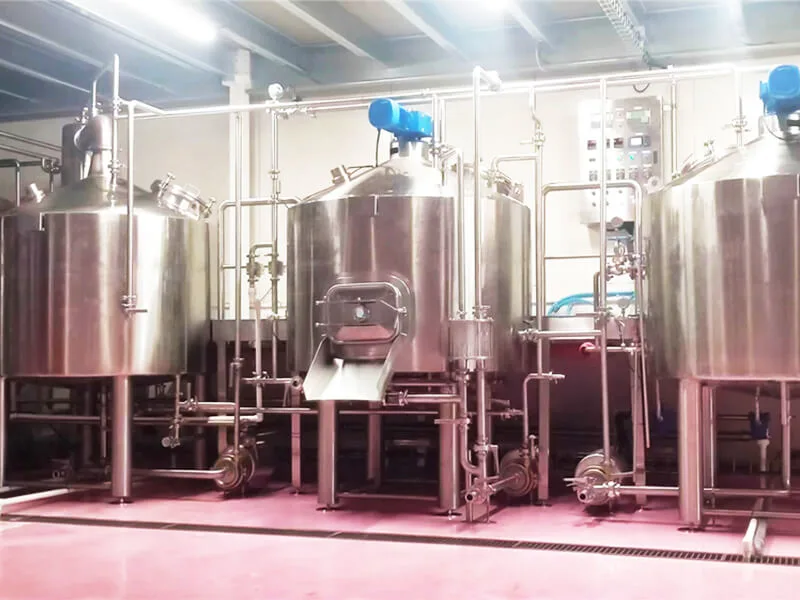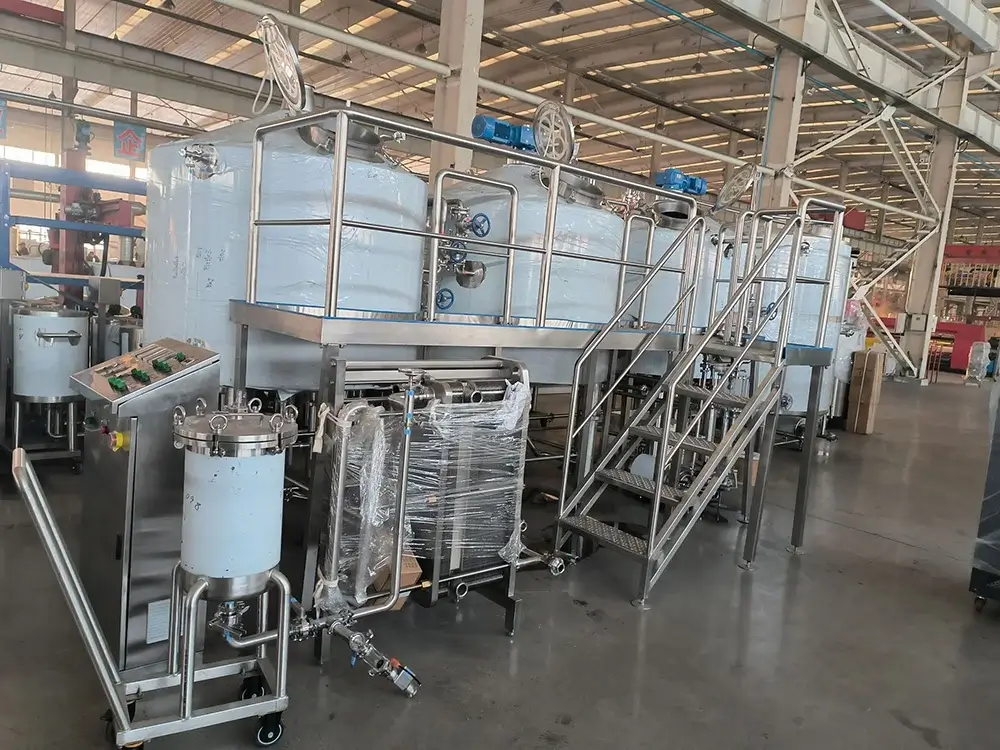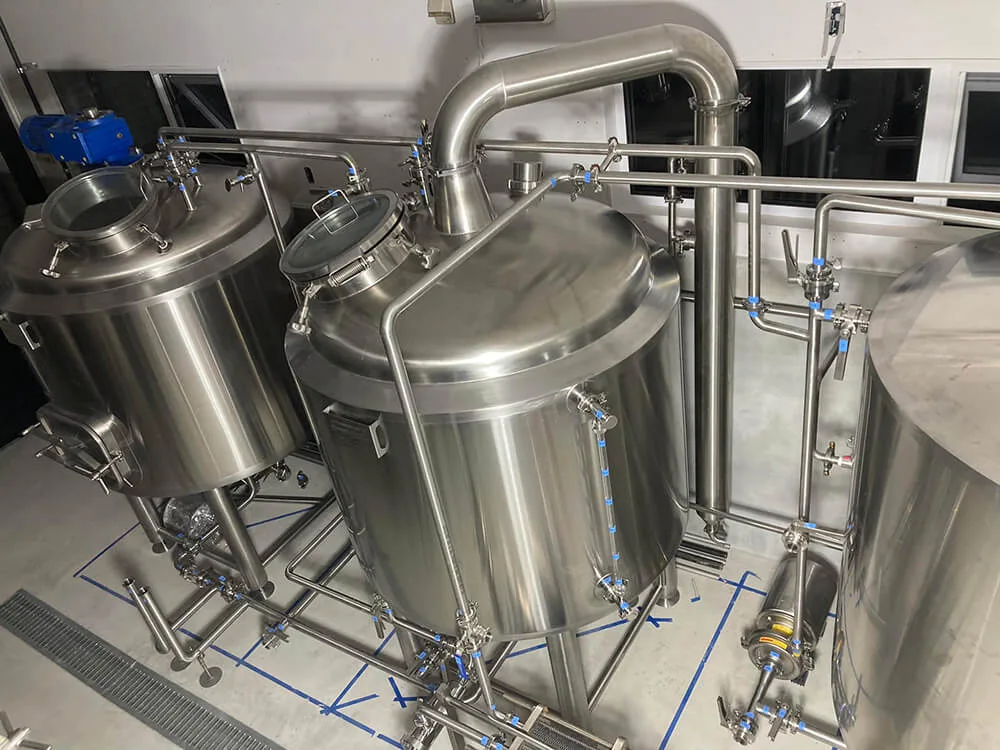
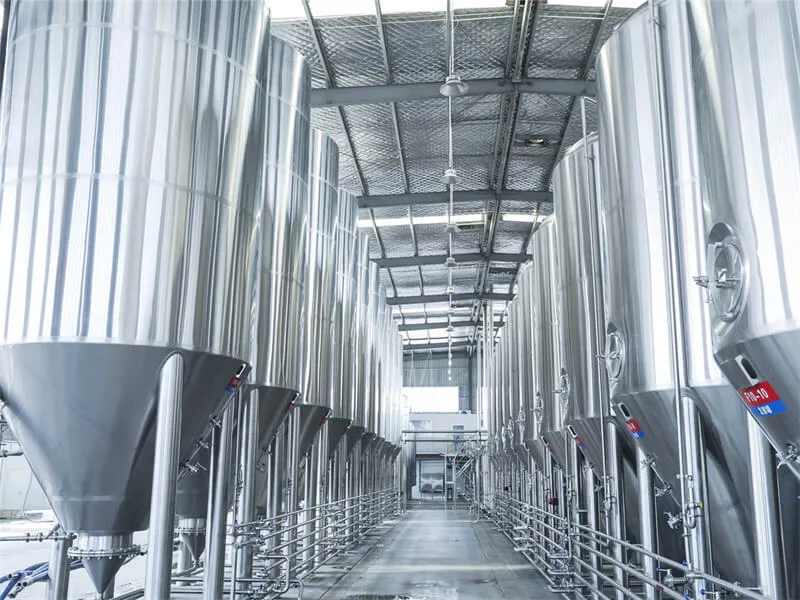
Stainless steel tanks are widely used in breweries, wineries, beverage production facilities, food processing plants, and pharmaceutical manufacturing. Although fermentation tanks and storage tanks may look similar from the outside, they are designed for different production purposes.
A stainless steel fermentation tank is engineered to support biological processes such as yeast fermentation, temperature control, and pressure management. A stainless steel storage tank, on the other hand, is primarily designed to hold liquids or ingredients under specified storage conditions.
Choosing the wrong tank can affect production efficiency, product quality, cleaning procedures, and long-term operating costs.
This guide explains the key differences between fermentation tanks and storage tanks, helping manufacturers select the right stainless steel vessel for their production requirements.
1. What Is a Stainless Steel Fermentation Tank?
A stainless steel fermentation tank is a specialized vessel designed to provide a controlled environment for fermentation.
During fermentation, microorganisms such as yeast or bacteria convert sugars and other nutrients into alcohol, organic acids, carbon dioxide, and other products. This process generates heat and may produce gas or pressure, depending on the application.
Therefore, fermentation tanks require more than basic liquid storage capabilities. Their design must consider temperature regulation, pressure control, product mixing, sanitation, and process monitoring.
Parmi les applications courantes, on peut citer :
- Beer fermentation and maturation
- Wine and fruit wine fermentation
- Kombucha and other fermented beverages
- Sake and other alcoholic beverage production
- Industrial and biopharmaceutical fermentation
Key Features of a Fermentation Tank
Contrôle de la température
Fermentation temperature directly affects microbial activity and final product characteristics. Many fermentation tanks use jacketed cooling systems to regulate internal temperature.
Glycol cooling jackets are commonly used in breweries, while other applications may require different heating or cooling arrangements.
Pressure Management
Certain fermentation processes generate carbon dioxide or other gases. Beer fermentation tanks may therefore be designed for controlled operating pressure and equipped with pressure gauges, pressure relief devices, and adjustable pressure control components.
The design pressure and working pressure must be determined according to the specific application and applicable standards.
Sanitary Design
Fermentation vessels require effective cleaning and sanitation to reduce contamination risks. Typical configurations may include CIP spray devices, sanitary manways, hygienic valves, and appropriately finished internal surfaces.
Process Monitoring
Depending on the production process, fermentation tanks can be equipped with temperature sensors, pressure gauges, sampling valves, and automated control systems.
These components help operators monitor fermentation conditions and maintain consistent production.
2. What Is a Stainless Steel Storage Tank?
A stainless steel storage tank is designed primarily to hold liquids, ingredients, or intermediate products before they move to the next production stage.
Unlike fermentation tanks, standard storage tanks do not necessarily need to support biological activity, gas generation, or active fermentation control.
They are commonly used for:
- Water and purified water storage
- Beer and beverage holding
- Wine and juice storage
- Syrup and liquid ingredient storage
- Chemical and process liquid storage
- Food and pharmaceutical liquid storage
Key Features of a Storage Tank
Basic Liquid Holding Function
The primary purpose is to provide a suitable container for liquid materials. Tank capacity, material compatibility, and installation conditions are important design considerations.
Optional Temperature Control
Not every storage tank requires temperature regulation. However, applications involving temperature-sensitive products may require insulation, cooling jackets, or external temperature-control systems.
Compatibilité des matériaux
The stainless steel grade should be selected according to the stored medium, cleaning chemicals, operating temperature, and applicable hygiene requirements.
SUS304 stainless steel is commonly used for many food and beverage applications. SUS316L may be considered when greater corrosion resistance is required.
Flexible Structural Design
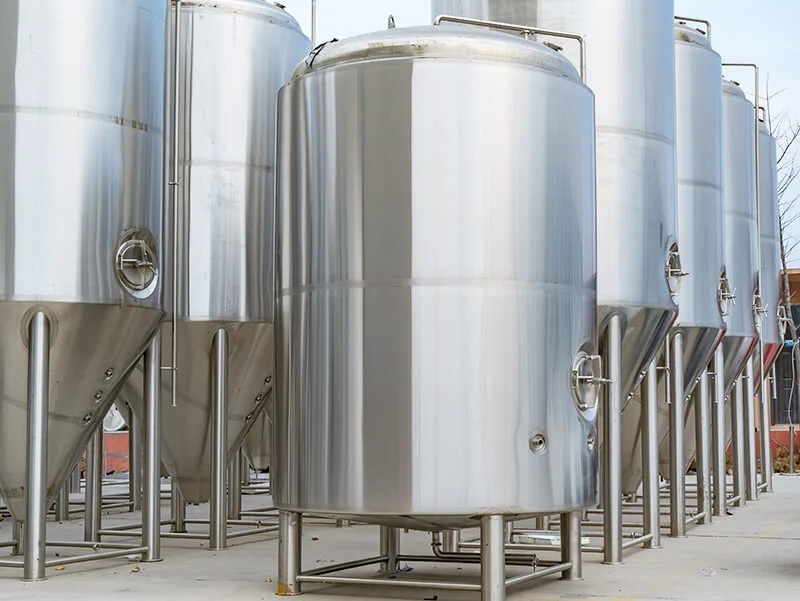
Storage tanks can be designed in vertical or horizontal configurations, with flat, dished, or conical bottoms depending on the product and discharge requirements.
Their internal structure is generally simpler than that of specialized fermentation vessels.
3. Fermentation Tank vs. Storage Tank: Key Differences
Although both types of tanks can be manufactured from stainless steel, their engineering requirements are different.
The following comparison highlights the main distinctions.
| Comparison | Réservoir de fermentation | Storage Tank |
|---|---|---|
| Main function | Supports fermentation | Holds and stores liquids |
| Contrôle de la température | Usually important | Facultatif |
| Régulation de la pression | Required when the process generates pressure | Depends on application |
| Enveloppe de refroidissement | Common | Facultatif |
| Internal structure | May include a cone bottom and process connections | Generally simpler |
| Monitoring | Temperature, pressure, sampling | Level and temperature as required |
| Nettoyage | Usually sanitary CIP design | Depends on hygiene requirements |
| Typical applications | Beer, wine, kombucha, bioprocessing | Water, juice, beer, wine, ingredients |
3.1 Different Design Requirements
The most important difference is the operating environment.
A fermentation tank must accommodate the conditions created during fermentation. For example, a beer fermenter needs to handle temperature changes, yeast activity, carbon dioxide generation, and sediment collection.
A standard storage tank mainly needs to maintain the integrity of the stored product.
This difference affects the tank’s structural design, accessories, connections, and control requirements.
3.2 Different Cooling Requirements
Temperature control is a critical part of many fermentation processes.
For example, beer fermentation requires controlled temperatures to maintain yeast activity and achieve the desired flavor profile.
A fermentation tank may therefore include:
- Dimple cooling jackets or other jacket configurations
- Insulation layers
- Glycol inlet and outlet connections
- Capteurs de température
- Automatic temperature-control valves
Storage tanks may not need these features unless the stored product requires temperature maintenance.
3.3 Different Pressure Requirements
Fermentation can generate gas, which means the tank may need to withstand internal pressure.
For pressure-rated beer fermentation tanks, the design may include:
- Manomètres
- Pressure relief valves
- Adjustable pressure control valves
- Sanitary pressure connections
Storage tanks are not automatically designed for pressurized operation. If a storage application requires pressure or vacuum resistance, these conditions must be included in the original engineering specifications.
A tank’s pressure rating should never be assumed based on its appearance or material thickness alone.
3.4 Different Bottom and Discharge Designs
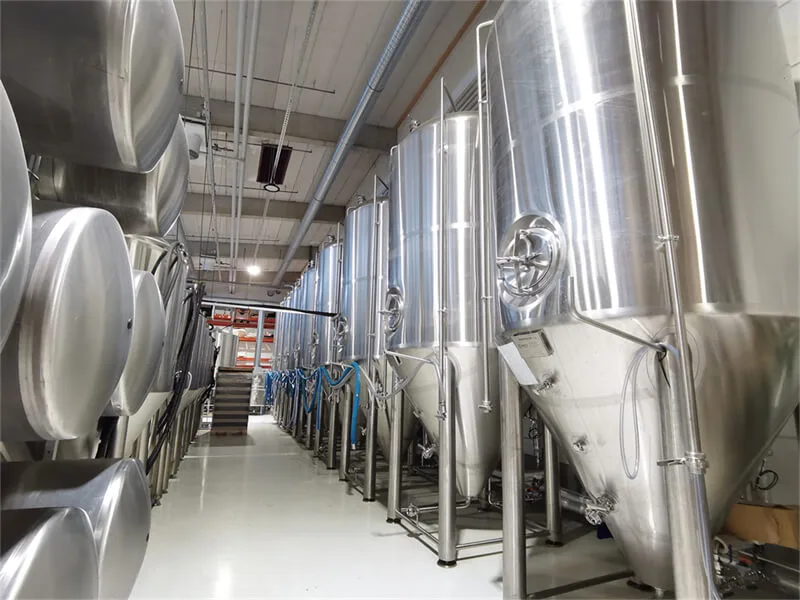
Many beer fermentation tanks feature a conical bottom that allows yeast and sediment to collect at the bottom of the vessel.
This makes it easier to remove yeast and transfer beer during production.
Storage tanks may use flat, sloped, dished, or conical bottoms depending on the liquid characteristics and discharge requirements.
The bottom structure should be selected according to the actual process rather than appearance alone.
4. Can a Storage Tank Be Used as a Fermentation Tank?
In some cases, a storage tank can be modified for fermentation. However, a standard storage tank should not automatically be considered suitable for fermentation.
The answer depends on the process conditions and the tank’s original engineering design.
For example, a basic stainless steel storage tank may lack:
- A cooling jacket for temperature regulation
- Conception résistante à la pression
- Gas management connections
- Appropriate sanitary fittings
- A suitable bottom structure for sediment removal
- Temperature monitoring and control components
If these functions are required, the tank may need substantial modifications.
For beer production, using a purpose-built fermentation vessel is generally the more practical choice. It provides a structure designed around the requirements of fermentation, yeast management, cooling, and cleaning.
For simple liquid holding, a standard storage tank is usually more economical and easier to configure.
5. How to Choose the Right Stainless Steel Tank
Before purchasing stainless steel tanks, manufacturers should evaluate several important factors.
5.1 Define the Production Process
Start by identifying what will happen inside the tank.
Will the vessel be used for active fermentation, maturation, liquid storage, mixing, or temporary holding?
Different production stages require different equipment.
Par exemple :
- Beer fermentation requires temperature and pressure management.
- Wine storage may prioritize product protection and suitable sanitation.
- Kombucha fermentation may require specific ventilation or controlled gas management, depending on the process.
- Pharmaceutical applications may require additional hygienic design, documentation, and process validation.
The actual process should determine the tank configuration.
5.2 Select the Appropriate Stainless Steel Material
Material selection affects corrosion resistance, product compatibility, cleaning performance, and service life.
Two commonly used grades are:
SUS304 Stainless Steel
SUS304 is widely used in food and beverage equipment because of its general corrosion resistance, workability, and cost-effectiveness.
It is suitable for many beer, beverage, and food processing applications when the operating conditions are compatible.
SUS316L Stainless Steel
SUS316L contains molybdenum, which improves resistance to certain corrosive environments.
It is often considered for pharmaceutical, chemical, and specialized food processing applications where higher corrosion resistance or specific hygiene requirements are necessary.
The final selection should consider the product composition, cleaning agents, temperature, and operating environment.
5.3 Determine Tank Capacity
Tank capacity should match production volume and the operating cycle.
For fermentation tanks, nominal capacity and working volume are not necessarily the same. Additional headspace may be required for foam, gas release, and process operation.
For storage tanks, capacity should account for the volume of liquid being held, transfer frequency, and production scheduling.
Selecting an appropriate capacity helps avoid unnecessary capital investment and production bottlenecks.
5.4 Consider Cleaning and Sanitation
Cleaning requirements should be evaluated before manufacturing.
For sanitary applications, consider:
- CIP spray devices
- Sanitary manways
- Hygienic valves and connections
- Finition de la surface interne
- Capacité de drainage
- Compatibility with cleaning chemicals
The internal structure should allow effective cleaning without unnecessary dead spaces or difficult-to-access areas.
5.5 Evaluate Automation Requirements
For commercial production, automation can improve process consistency and reduce manual operation.
Depending on the application, a tank can be equipped with:
- Surveillance de la température
- Automatic cooling control
- Surveillance de la pression
- Liquid level sensors
- Vannes automatisées
- Systèmes de commande par automates programmables (PLC)
Not every project requires full automation. The configuration should match the production scale, process complexity, and operating budget.
6. Why Custom Stainless Steel Tank Design Matters
Standard tank configurations may not meet every production requirement.
For breweries, wineries, beverage factories, and pharmaceutical manufacturers, customized tank design can improve equipment compatibility and production efficiency.
A professional stainless steel tank manufacturer should evaluate the following factors before production:
Process Requirements
The manufacturer needs to understand the medium, operating temperature, pressure conditions, cleaning method, and production cycle.
Tank Dimensions and Installation Space
Diameter, height, manway position, nozzle arrangement, and support structure should match the available factory space and pipeline layout.
Material and Surface Treatment
Stainless steel grade, welding quality, internal polishing, and surface treatment should meet the intended application requirements.
Cooling and Heating Configuration
Jacket type, insulation thickness, heat-transfer requirements, and connection positions should be determined according to the process.
Applicable Standards
Depending on the equipment type, pressure rating, destination market, and project requirements, relevant design, manufacturing, inspection, and certification standards should be confirmed before production.
7. METO: Stainless Steel Fermentation Tank and Storage Tank Manufacturer
METO is a manufacturer specializing in stainless steel process equipment, fermentation systems, and industrial vessels.
With integrated design, engineering, manufacturing, and project support capabilities, METO provides customized tank solutions for breweries, wineries, beverage producers, distilleries, and biopharmaceutical manufacturers.
Our product range includes stainless steel fermentation tanks, beer fermenters, bright beer tanks, wine tanks, mixing tanks, storage vessels, and industrial process tanks.
Our Manufacturing Capabilities
Customized Tank Engineering
Tank dimensions, capacity, material, cooling systems, insulation, pressure requirements, and connection configurations can be designed according to individual project specifications.
Stainless Steel Fabrication
Our manufacturing processes include plate cutting, forming, automatic welding, manual argon arc welding, laser welding, and surface finishing.
Quality Inspection
Equipment quality control can include material verification, welding inspection, dimensional checks, and pressure testing where applicable.
Project Support
From initial technical communication and equipment design to manufacturing, installation guidance, and after-sales service, METO supports customers throughout the equipment procurement process.
Whether you need a stainless steel fermentation tank for commercial beverage production or a customized storage tank for industrial liquid handling, METO can help develop an equipment configuration that matches your process requirements.
Contacter METO to discuss your stainless steel tank project.
8. Frequently Asked Questions
Q1: What is the main difference between a fermentation tank and a storage tank?
A fermentation tank is designed to support biological processes, including temperature regulation, gas management, and process monitoring. A storage tank is primarily designed to hold liquids under specified storage conditions.
Q2: Can a stainless steel storage tank be used for beer fermentation?
Not necessarily. A storage tank can only be used for beer fermentation if its material, pressure rating, cooling system, sanitary design, and connections meet the requirements of the brewing process.
Q3: Is SUS304 or SUS316L better for fermentation tanks?
Both materials can be suitable. SUS304 is commonly used for beer and beverage fermentation tanks, while SUS316L may be preferred for applications requiring additional corrosion resistance. The choice depends on the product and operating conditions.
Q4: Do all stainless steel fermentation tanks need cooling jackets?
No. However, cooling jackets are common in commercial beer and beverage fermentation tanks because fermentation generates heat and often requires controlled temperatures. The exact configuration depends on the process.
Q5: Why do beer fermentation tanks have conical bottoms?
A conical bottom allows yeast and sediment to collect at the bottom of the tank. This makes yeast removal and product transfer easier and supports efficient brewery operations.
Q6: Can fermentation tanks also be used for storage?
Yes, certain fermentation tanks can also be used for maturation or temporary product holding if their design and operating conditions are suitable. However, this does not mean every fermentation tank is optimized for long-term storage.
Q7: How do I choose a stainless steel tank manufacturer?
Evaluate the manufacturer’s engineering experience, stainless steel fabrication capabilities, welding quality, inspection procedures, customization capabilities, and after-sales support. It is also important to confirm whether the manufacturer understands your actual production process.
Réflexions finales
Fermentation tanks and storage tanks may share similar stainless steel construction, but their engineering purposes are different.
A fermentation tank requires process-oriented features such as temperature control, pressure management, and sanitary design. A storage tank focuses on safe and efficient liquid holding.
Understanding these differences before purchasing equipment helps reduce unnecessary costs and ensures that the selected vessel meets your production requirements.
When planning a new production facility or upgrading an existing line, work with an experienced stainless steel tank manufacturer to develop a solution based on your actual process.