Introduction
In commercial beer production, brewhouse efficiency is determined by more than the heating capacity of individual vessels or the number of batches produced per day. It depends on how effectively the entire brewing process is organized, how equipment operates together, and how consistently raw materials are converted into usable wort.
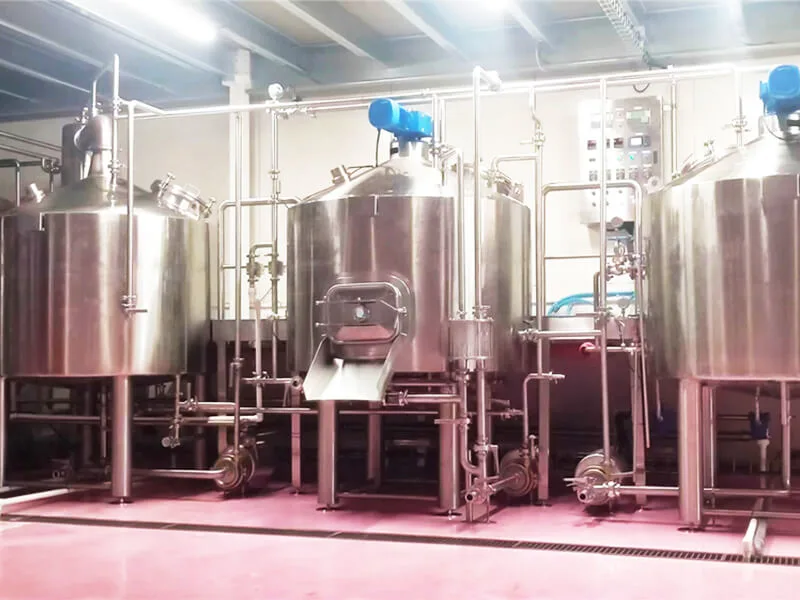
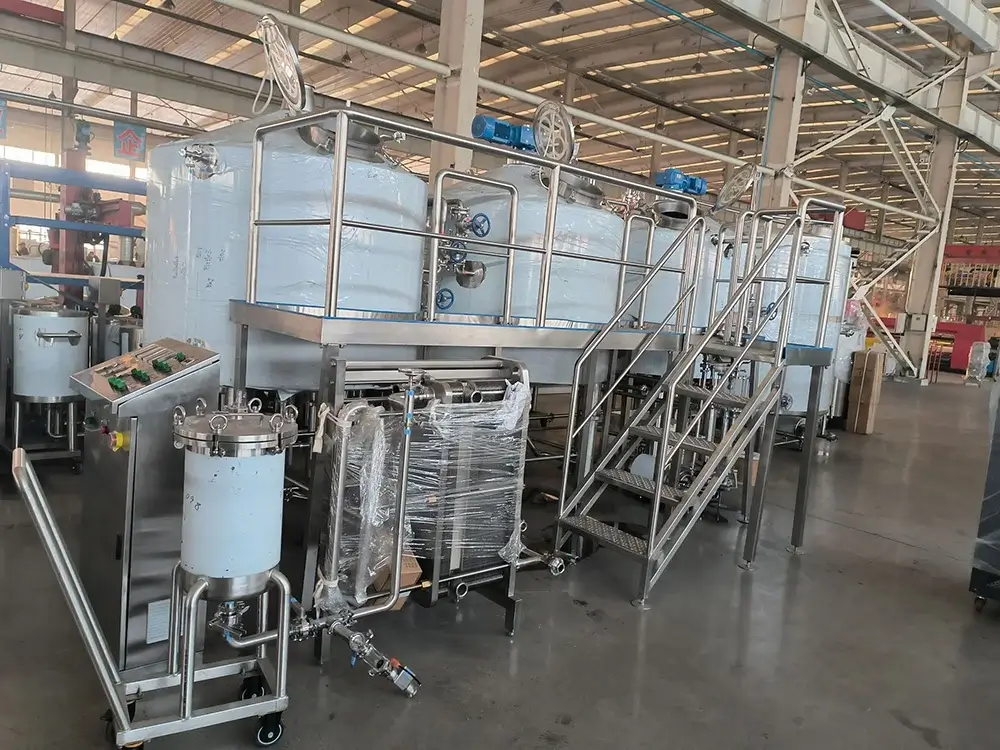
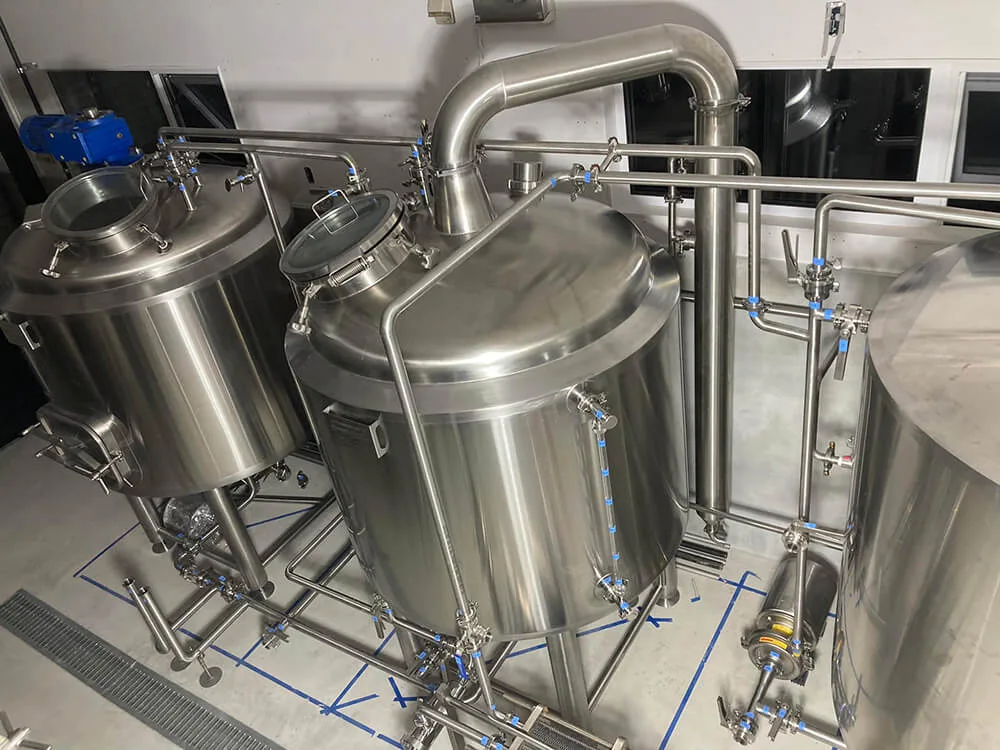
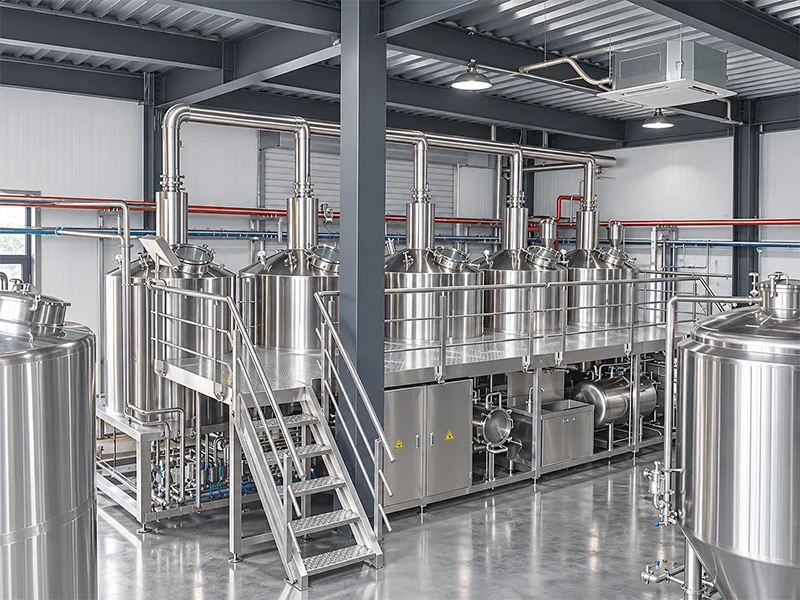
For breweries seeking higher production capacity and greater recipe flexibility, a five-vessel brewhouse offers an interesting engineering solution.
By separating pre-mashing, mashing, lautering, boiling, and whirlpool operations into dedicated vessels, this configuration provides greater process independence and opportunities for parallel operation.
However, installing five vessels does not automatically guarantee higher productivity. Poorly coordinated transfers, insufficient filtration capacity, long heating cycles, and inefficient cleaning procedures can still create production bottlenecks.
The real objective is to optimize the complete brewing process rather than simply increase the number of vessels.
This article examines the key engineering considerations for improving five-vessel brewhouse efficiency, including vessel configuration, process scheduling, lautering performance, thermal management, automation, and production planning.
1. Understanding the Five-Vessel Brewhouse Configuration
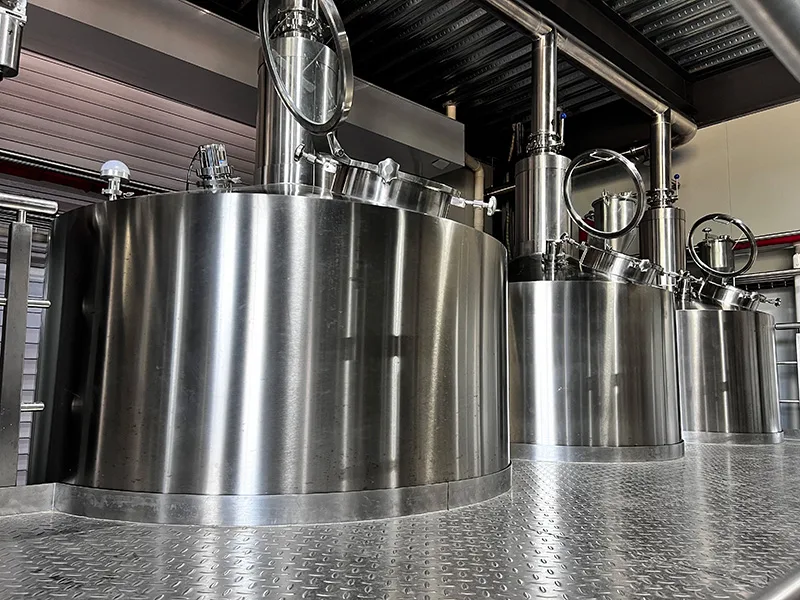
A five-vessel brewhouse typically consists of:
- Tunnel de pré-mélange
- Cuve de fermentation
- Tunnel de Lauter
- Boil Kettle
- Réservoir Whirlpool
Each vessel performs a specific function, allowing the brewer to manage individual brewing stages more independently.
1.1 Pre-Mash Tun: Supporting Flexible Mashing Programs
The pre-mash tun provides additional flexibility for handling different malt bills and traditional mashing methods.
One important application is decoction mashing, where a portion of the mash is separated, heated, and returned to the main mash to achieve specific temperature rests.
Compared with a basic infusion process, decoction brewing requires additional heating and transfer operations. A dedicated pre-mash vessel makes these operations easier to organize without unnecessarily interrupting other brewing activities.
For breweries producing traditional lagers, including Czech-style Pilsners, this configuration provides greater flexibility in developing different mashing programs.
From an efficiency perspective, the pre-mash tun should be designed around the intended decoction volume, heating requirements, transfer arrangements, and batch schedule.
1.2 Mash Tun: Improving Temperature Control and Extract Consistency
The mash tun is where malt starches are converted into fermentable and unfermentable sugars through enzymatic activity.
Temperature consistency is critical because different temperature ranges influence enzyme performance, wort fermentability, and the finished beer’s body.
An efficient mash tun should provide:
- Uniform heat distribution.
- Reliable temperature measurement.
- Effective agitation and mash circulation.
- Suitable insulation to reduce heat loss.
- Stable operation across different recipe programs.
Heating capacity and temperature uniformity should be evaluated together. A powerful heating system may shorten the initial heating period, but uneven heat distribution can create local temperature differences and affect extract consistency.
A properly designed mash tun should therefore balance heating performance, circulation, insulation, and control accuracy.
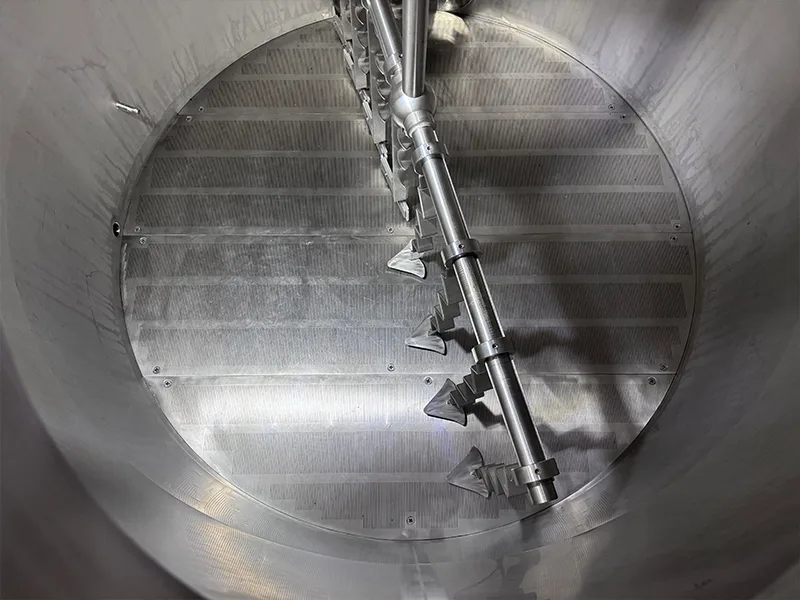
1.3 Lauter Tun: Managing the Main Filtration Bottleneck
The lauter tun is often one of the most important vessels when optimizing brewhouse throughput.
After mashing, the wort must pass through the grain bed while spent grain remains inside the vessel.
Filtration performance depends on several interacting factors:
- Malt milling particle size.
- Husk integrity.
- Grist composition.
- Grain bed depth.
- False-bottom design and open area.
- Wort viscosity.
- Recirculation and runoff rates.
If the grain bed becomes compacted or the wort is withdrawn too quickly, filtration resistance can increase significantly.
This may lead to slow runoff, incomplete extraction, or unstable production schedules.
For this reason, lautering efficiency should not be evaluated by vessel volume alone. The vessel diameter, usable filtration area, grist loading, and expected wort flow rate must all be considered.
1.4 Boil Kettle: Balancing Heating Performance and Boiling Requirements
The boil kettle performs wort boiling, hop utilization, volatile compound removal, and thermal treatment.
Heating performance directly influences the duration of the boiling stage and therefore affects the overall brewing schedule.
An efficient boil kettle should provide:
- Sufficient heating capacity.
- Uniform heat distribution.
- Appropriate vapor removal.
- Reliable temperature and process monitoring.
- Suitable insulation to minimize thermal losses.
The objective is to achieve the required boiling conditions without excessive energy consumption or unnecessary process time.
The optimal boiling intensity and duration depend on the beer recipe, hop schedule, wort composition, and desired finished product characteristics.
1.5 Whirlpool Tank: Improving Wort Separation
After boiling, wort is transferred to the whirlpool tank.
Controlled tangential flow creates a rotating liquid movement that encourages hot break material and hop particles to collect in a central sediment cone.
Effective whirlpool operation helps reduce suspended solids before wort cooling and fermentation.
However, excessively aggressive circulation or unsuitable transfer conditions may disturb the sediment cone.
Whirlpool performance therefore depends on vessel geometry, inlet arrangement, flow rate, residence time, and the characteristics of the wort.
A properly designed whirlpool process helps improve downstream wort handling and supports consistent fermentation performance.
2. Optimize Process Scheduling Through Parallel Operations
One of the main advantages of a five-vessel brewhouse is the possibility of performing different brewing operations simultaneously.
In a simpler brewhouse, several processes may need to use the same vessel in sequence. This creates unavoidable waiting periods between operations.
A five-vessel configuration separates the major process stages, allowing the brewer to coordinate multiple operations more efficiently.
For example, while one batch is undergoing lautering, another batch may be undergoing mashing or preparation, depending on the vessel arrangement and transfer schedule.
2.1 Identify the Critical Production Bottleneck
The actual production capacity of a brewhouse is determined by the slowest or most restrictive stage in the process.
Typical bottlenecks include:
- Long mash heating and temperature-rest periods.
- Slow wort separation in the lauter tun.
- Insufficient boil kettle heating capacity.
- Extended whirlpool settling time.
- Delays caused by vessel cleaning.
- Limited transfer pump or pipeline capacity.
Adding more vessels will not solve a bottleneck if the restricted process remains unchanged.
For example, if lautering takes significantly longer than other brewing operations, increasing the number of mashing vessels may have little effect on the number of completed batches.
The first step should therefore be to record the operating time of each process stage and identify where production time is being lost.
2.2 Coordinate Vessel Transfers
Transfer arrangements are equally important.
Each transfer requires suitable pumps, pipelines, valves, and control logic.
An inefficient transfer system can introduce unnecessary waiting time, even when the vessels themselves have sufficient capacity.
The design should consider:
- Short and practical pipeline routes.
- Appropriate pump sizing.
- Suitable valve configurations.
- Reduced unnecessary transfer operations.
- Adequate drainage and residual liquid management.
- Clear process sequencing.
For automated systems, transfer interlocks can help prevent incorrect valve operation and reduce the risk of simultaneous conflicting operations.
2.3 Develop a Repeatable Batch Schedule
A production schedule should be developed based on the actual duration of each brewing operation.
For a 1,000L five-vessel brewhouse designed for approximately 4–6 batches per day, the daily schedule must account for mashing, lautering, boiling, whirlpool separation, transfers, and cleaning.
The target should be validated through process simulations and actual commissioning data rather than determined solely by the nominal batch volume.
3. Improve Lautering Efficiency Through Better Milling and Grist Management
Malt milling and lautering are closely connected.
The quality of the crushed malt directly affects the permeability of the grain bed and the efficiency of wort separation.
A milling system that produces excessive flour may cause filtration problems, while excessively coarse milling can leave starch insufficiently exposed.
3.1 Balance Particle Size and Husk Integrity
An effective milling process should expose the malt’s internal starch while retaining enough husk structure to support natural filtration.
This balance is especially important for high-gravity recipes, where the quantity of malt per batch is relatively high.
The milling configuration should be selected according to:
- Malt type and modification level.
- Target grist particle distribution.
- Grist loading per batch.
- Lauter tun geometry.
- Desired wort clarity and runoff rate.
3.2 Integrate Milling and Grist Hydration
For commercial breweries that frequently develop new recipes, the milling system should also support flexible raw material handling.
A dry milling system combined with vertical conveying and a grist-water mixing unit can simplify the transfer process.
At the feeding end, the grist-water mixing unit combines crushed malt with brewing water to help achieve more uniform hydration and reduce dry pockets or clumping.
This arrangement is particularly useful for breweries working with different malt combinations and frequently adjusting their recipes.
3.3 Match Grist Loading to Lauter Tun Design
The lauter tun must be designed according to both the required grist capacity and the intended filtration performance.
A larger vessel diameter can provide a greater filtration area and help control grain bed depth at a given grist loading.
However, simply increasing vessel diameter does not guarantee faster filtration.
The false bottom, grain bed permeability, wort withdrawal rate, and grist composition must all be considered.
For high-gravity brewing, these factors become even more important because increased grist loading can raise filtration resistance.
4. Improve Thermal Efficiency Across the Brewhouse
Heating and hot water preparation account for a substantial portion of the energy requirements in many breweries.
A well-designed thermal system can reduce energy consumption while maintaining stable process conditions.
4.1 Improve Vessel Insulation
Insulation helps reduce heat loss from mash tuns, boil kettles, and hot water tanks.
The required insulation thickness depends on vessel size, operating temperature, ambient conditions, insulation material, and the desired heat-loss performance.
Proper insulation can reduce unnecessary heating demand and improve temperature stability during production.
4.2 Recover Heat from Wort Cooling
After boiling and whirlpool separation, hot wort must be cooled before entering the fermentation system.
A plate heat exchanger is commonly used for this process.
During wort cooling, heat can be transferred from the hot wort to incoming brewing water.
The recovered heat can then be used to preheat water for subsequent brewing operations.
This creates an opportunity to reduce the energy required by the hot water system.
The effectiveness of heat recovery depends on wort cooling temperature, incoming water temperature, flow rates, heat exchanger sizing, and the brewery’s water demand.
4.3 Coordinate Hot Water and Brewing Demand
Hot water requirements should be calculated according to the actual brewing schedule.
If the hot water tank cannot supply the required volume at the appropriate temperature, the brewhouse may experience delays between batches.
A properly sized hot water system helps maintain continuity between mashing, lautering, equipment cleaning, and other operations.
Thermal planning should therefore consider the entire production schedule rather than sizing individual vessels independently.
5. Reduce Cleaning Time Through Integrated CIP Design
Cleaning is an essential part of brewery operation and directly affects equipment availability.
In a high-throughput brewhouse, inefficient cleaning procedures can reduce the time available for production.
A well-designed CIP system helps improve cleaning consistency while reducing unnecessary manual intervention.
Important design considerations include:
- Appropriate CIP tank capacity.
- Suitable cleaning solution circulation rates.
- Spray ball coverage.
- Effective pipeline cleaning.
- Drainage and residual liquid removal.
- Separation of cleaning and production circuits where required.
The CIP system should be designed according to the geometry of each vessel and the actual soil conditions generated during brewing.
For example, mash tuns, lauter tuns, and boil kettles may accumulate different types of residues and therefore require different cleaning procedures.
Automated CIP sequences can improve repeatability by controlling cleaning time, temperature, chemical concentration, and circulation.
However, cleaning effectiveness should be verified through suitable inspection and validation procedures rather than assumed from automation alone.
6. Use Automation to Improve Process Consistency
Automation helps coordinate equipment operation and reduce dependence on individual operator decisions.
For a five-vessel brewhouse, a PLC-based control system can manage key process operations, including:
- Pump start and stop sequences.
- Valve opening and closing.
- Temperature monitoring.
- Liquid transfer.
- Agitator operation.
- Heating control.
- Alarm management.
- Process status indication.
6.1 Real-Time Process Monitoring
Temperature, pressure, flow, and liquid-level instruments provide quantitative information about brewing conditions.
When connected to a centralized control interface, operators can monitor several vessels without repeatedly checking each piece of equipment manually.
6.2 Visual Monitoring of Vessel Conditions
Industrial cameras provide another layer of operational visibility.
For example, cameras installed on brewing vessels can help operators observe internal process conditions, while LED status indicators make the operating state of individual vessels easier to identify.
These visual tools are particularly useful when several brewing operations are taking place simultaneously.
However, camera monitoring should complement rather than replace process sensors, safety interlocks, and PLC control logic.
6.3 Standardize Brewing Recipes
A programmable control system can store different brewing recipes and process parameters.
This is particularly valuable for breweries that frequently develop new products.
Standardized temperature rests, transfer sequences, and operating procedures help reduce process variation between batches.
Recipe management also makes it easier to reproduce successful brewing conditions and train new operators.
7. Integrate Brewhouse Capacity with Fermentation Requirements
Optimizing the brewhouse alone is not sufficient.
The fermentation cellar must be capable of receiving and processing the wort produced by the brewing system.
If brewhouse production increases while fermentation capacity remains unchanged, the fermentation section can quickly become the main production bottleneck.
7.1 Calculate Fermentation Tank Requirements
Fermentation capacity depends on several factors:
- Daily wort production.
- Working volume of each fermenter.
- Fermentation and maturation duration.
- Cleaning and turnaround time.
- Beer style and product mix.
- Available tank utilization.
A brewery producing different beer styles may need different fermentation schedules.
For example, some ales can complete their main fermentation relatively quickly, while lager production generally requires additional maturation time.
Therefore, the number of fermenters should be determined according to actual tank occupancy rather than simply matching the brewhouse batch volume.
7.2 Use Different Fermenter Sizes for Production Flexibility
A combination of different fermenter capacities can help breweries organize production more flexibly.
For example, a system incorporating 1-ton and 2-ton conical fermenters together with a 1-ton horizontal fermenter can support different batch arrangements and fermentation strategies.
Conical tanks provide practical advantages for yeast collection and sediment removal, while horizontal tanks offer an alternative vessel geometry for specific fermentation applications.
The final configuration should reflect the brewery’s product portfolio and operating schedule.
8. A Practical Example: Optimizing a 1000L Five-Vessel Brewhouse
A 1000L craft brewery project provides a useful example of how these engineering principles can be integrated into a commercial production system.
The brewhouse is designed for a nominal batch capacity of 1,000L and a target of approximately 4–6 batches per day, depending on recipe requirements and operating conditions.
Main Equipment Configuration
Malt Milling System
- Dry malt milling configuration.
- Vertical conveying equipment.
- Integrated grist-water mixing unit.
- Designed for flexible malt handling and recipe development.
Salle de brassage à cinq cuves
- Pre-mash tun.
- Mash tun.
- Lauter tun.
- Boil kettle.
- Whirlpool tank.
Tunnel de Lauter
- Enlarged vessel diameter.
- Maximum grist loading capacity of approximately 450kg.
- Suitable for high-gravity recipe trials and production, subject to process conditions.
Brewhouse Process Features
- Decoction brewing capability.
- Nitrogen protection during selected mashing operations.
- Industrial cameras for vessel monitoring.
- LED operating status indicators.
Système de fermentation
- 1-ton conical fermenters.
- 2-ton conical fermenters.
- 1-ton horizontal fermentation tank.
- Sight lamps and observation windows.
Engineering Value of the Configuration
The value of this system lies in the coordination of its individual equipment sections.
The dry milling and grist hydration arrangement supports flexible raw material handling. The five-vessel brewhouse separates major brewing operations and provides opportunities for parallel scheduling.
The enlarged lauter tun accommodates substantial grist loading, while nitrogen protection helps reduce oxygen exposure during selected brewing operations.
Industrial cameras and LED indicators improve operational visibility, and the combination of conical and horizontal fermenters provides additional flexibility in fermentation management.
Together, these features create a production platform designed to balance brewing capacity, process flexibility, and product development requirements.
9. Key Factors to Consider When Designing a High-Efficiency Five-Vessel Brewhouse
Before selecting a five-vessel brewhouse, breweries should evaluate the complete production process rather than focusing only on individual vessel specifications.
The following engineering factors should be considered:
| Engineering Factor | Key Design Consideration |
|---|---|
| Batch capacity | Match vessel working volumes to the target wort production |
| Vessel configuration | Select vessels according to the intended brewing methods |
| Lauter tun sizing | Evaluate filtration area, grist loading, and grain bed depth |
| Système de chauffage | Provide sufficient heating capacity and temperature control |
| Transfer system | Reduce unnecessary transfer time and pipeline restrictions |
| Thermal efficiency | Integrate insulation and heat recovery |
| Système CIP | Minimize cleaning time while maintaining validated cleaning performance |
| Automatisation | Coordinate pumps, valves, heating, and process monitoring |
| Capacité de fermentation | Match cellar capacity with daily wort production |
| Développement futur | Allow for additional vessels and increased production demand |
A high-efficiency brewhouse is ultimately the result of coordinated process engineering.
The most effective design is not necessarily the one with the largest number of vessels or the highest installed power. It is the one that achieves the required production output with stable process conditions, appropriate energy consumption, and manageable operating costs.
10. METO: Engineering Commercial Brewhouse Systems
As a brewery equipment manufacturer, METO focuses on designing and manufacturing brewing systems for craft breweries and commercial beer producers.
Our engineering approach considers the relationship between individual equipment units and the complete production process.
From malt milling and brewhouse vessel configuration to fermentation equipment, CIP systems, cooling systems, and automation, each section is designed according to the project’s brewing requirements.
For five-vessel brewhouse projects, METO can customize:
- Brewhouse capacity and vessel configuration.
- Decoction and infusion mashing arrangements.
- Lauter tun diameter and grist loading capacity.
- Heating methods and thermal systems.
- Nitrogen protection configurations.
- PLC control and monitoring systems.
- Fermentation tank capacity and geometry.
- CIP and auxiliary equipment.
Through integrated design, manufacturing, installation, and commissioning support, METO helps breweries develop production systems suited to their brewing processes and long-term operational goals.
Conclusion
Optimizing a five-vessel brewhouse requires a complete understanding of brewing processes and equipment coordination.
The separation of pre-mashing, mashing, lautering, boiling, and whirlpool operations provides greater flexibility, but the actual production benefits depend on how effectively these stages are scheduled and integrated.
By improving malt milling, optimizing lautering conditions, coordinating vessel transfers, recovering thermal energy, standardizing CIP procedures, and integrating automation, breweries can improve overall production efficiency without compromising brewing consistency.
For growing commercial breweries, a properly engineered five-vessel brewhouse is not simply an equipment upgrade. It is an investment in production flexibility, process stability, and long-term manufacturing capability.
Planning a commercial five-vessel brewhouse?
Contacter METO to discuss your target batch capacity, brewing methods, production schedule, and equipment configuration. Our engineering team can help develop a customized brewhouse solution for your brewery.