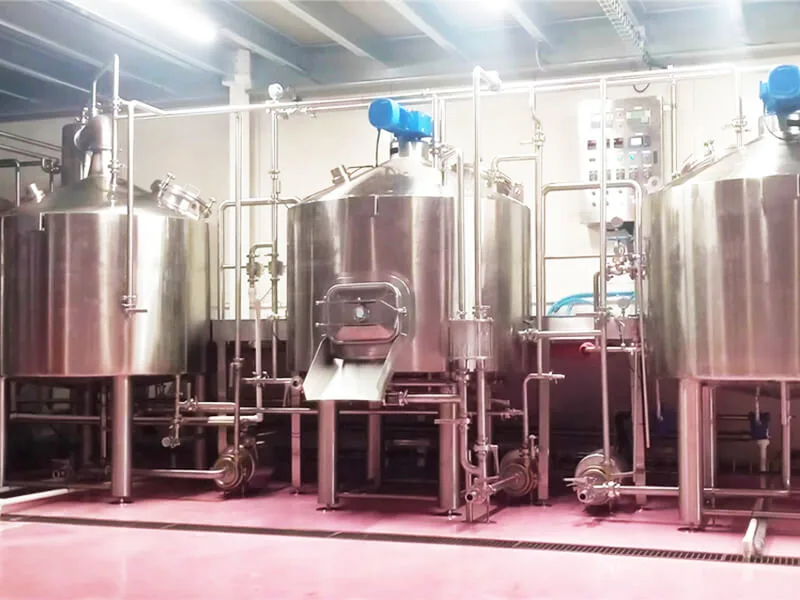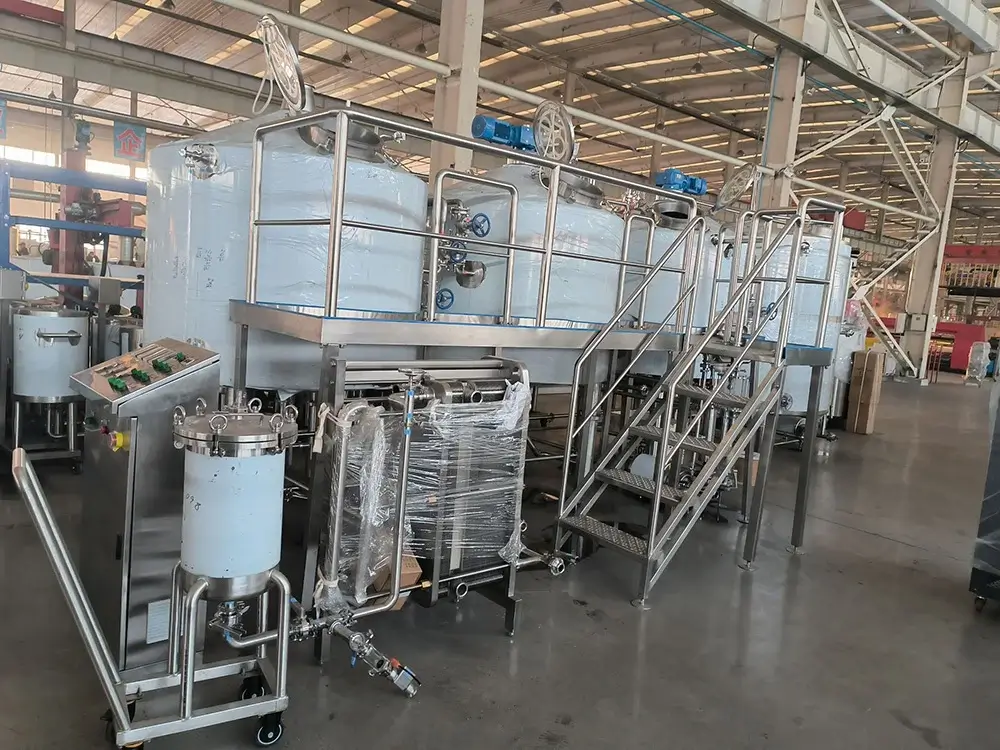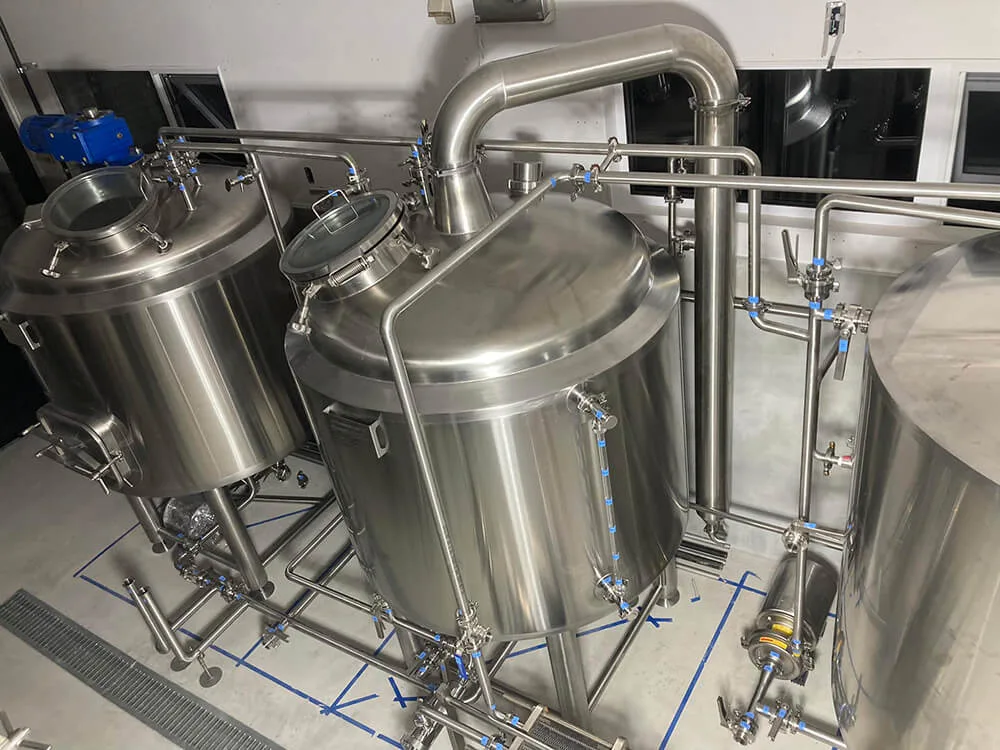
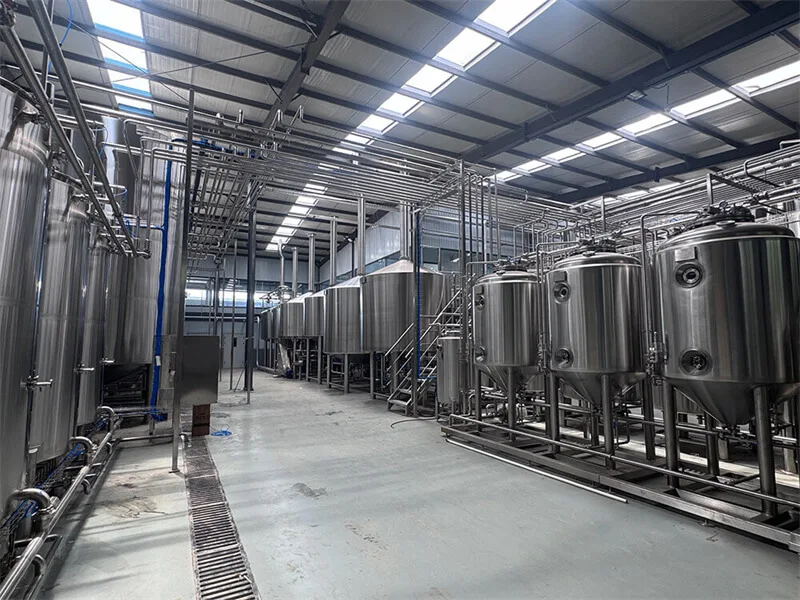
For craft breweries planning to expand capacity or new mid‑sized breweries, choosing the right commercial brewing system is a critical decision that directly affects production efficiency, product quality, and operating costs. In the 20 to 50 hectoliter (HL) capacity range, steam‑heated brewing equipment has become the industry standard due to its uniform heating, precise temperature control, and batch‑to‑batch consistency. This guide analyzes key aspects such as facility requirements, control options, vessel configurations, and manpower needs, while also highlighting essential purchasing considerations to help you make the best choice.
1. Basic Specifications and Facility Requirements
20HL–50HL commercial brewing systems are typically aimed at mid‑to‑large craft breweries, brewpubs, or regional brands. Before installation, pay close attention to the following:
- Heating method: Gas‑fired steam boilers provide steam heating. Compared to direct fire or electric heating, steam delivers gentle, rapid, and uniform heat transfer during mashing and boiling, avoiding local overheating or scorching, reducing wort flavor loss, and ensuring consistent beer body.
- Control system options:
- PLC semi‑automatic touch panel: Operators can manually adjust key parameters (valve opening, pump start/stop, temperature fine‑tuning). Ideal for brewers who value process flexibility and need to adapt recipes to raw material variations or seasonal changes, especially for small‑batch recipe development.
- PLC fully automatic control panel: One‑touch recipe setting – the system automatically executes all steps (mashing, lautering, boiling, whirlpool) with fault alarms and parameter logging. Suitable for standardized, continuous production, greatly reducing human error and enabling production traceability.
- Power supply: Supports standard industrial voltages – three‑phase 380V/50Hz (customizable to 220/415/480V and 60Hz), single‑phase 220V (or 110/240V) for auxiliary control circuits. A dedicated distribution box is recommended to ensure stable operation and avoid voltage fluctuations.
- Facility space: Depending on the number of vessels and layout (mostly vertical or horizontal), a minimum ceiling height of 5 meters is recommended (for installation, maintenance, and material hoisting). Floors should be slip‑resistant and corrosion‑resistant (able to withstand wort and cleaning solution exposure). Separate areas should be reserved for the boiler, heat exchanger, CIP station, and control room. The boiler area must comply with fire and environmental regulations (ventilation and exhaust flues), with at least 1.5 m clearance around equipment for operation and maintenance.
- Environmental and fire safety requirements: The steam boiler must meet local emission standards (e.g., NOx limits); low‑NOx boilers are preferred. The brewhouse should be equipped with fire extinguishers and fire hydrants; electrical equipment should be explosion‑proof to avoid hazards from steam or alcohol vapor. Some regions require a boiler operating permit – confirm that the supplier can provide relevant compliance support.
2. Manpower Configuration: Semi‑Automatic vs. Fully Automatic
Labor cost is a major long‑term operating expense. The manpower requirements differ significantly between the two control options:
- Semi‑automatic system: Requires 2–3 brewers working together – one monitors the control panel and adjusts parameters, one handles materials (malt, hops, yeast) and piping connections, and another is responsible for cleaning and preparing the next batch. Best for breweries with many varieties, small batches, and frequent recipe changes (e.g., craft taprooms, small regional brands). Advantage: high process controllability, allowing brewers to optimize flavor based on experience.
- Fully automatic system: Only 1–2 brewers are needed – one loads recipes, starts the system, and monitors parameters, while the other inspects equipment status and handles unexpected issues (e.g., clogged pipes, temperature anomalies). Labor costs are significantly reduced (saving 2–3 employee salaries per year), and daily batch output can increase by more than 30%. Ideal for scaled, standardized production in mid‑sized breweries, especially those focusing on one or a few core beer styles.
Additional note: Regardless of control type, it is advisable to have one dedicated maintenance person responsible for daily upkeep and replacement of wearing parts to extend equipment life and reduce downtime.
3. Core Vessel Configurations: 4‑, 5‑, and 6‑Vessel Steam Systems
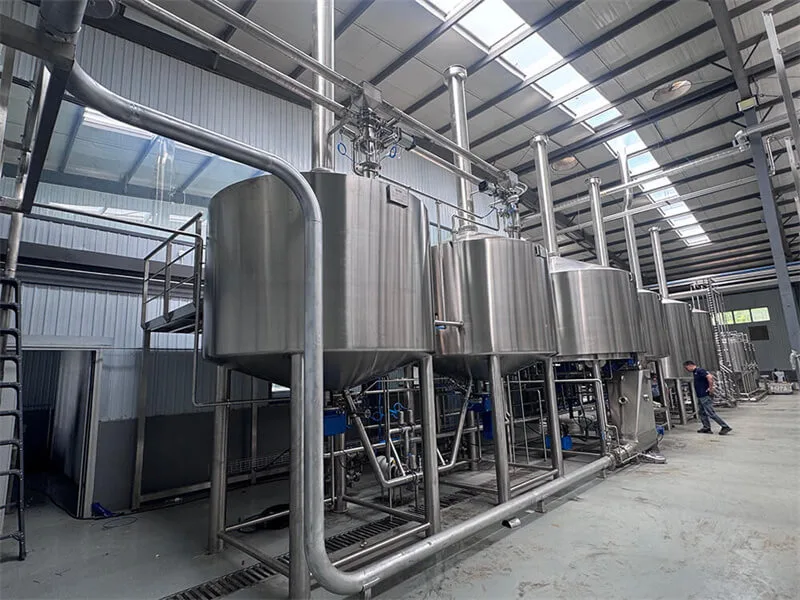
Based on how the mashing and lautering functions are split, common commercial systems fall into three configurations. Choose according to your actual capacity and recipe needs to avoid over‑ or under‑specification.
3.1 4‑Vessel System (Mash Tun + Lauter Tun + Brew Kettle + Whirlpool)
- Features: High functional separation – mashing and lautering are independent, resulting in a compact process cycle (about 8–10 hours per batch). Moderate footprint, lower initial investment, easy maintenance.
- Best for: Small to mid‑sized standardized production, suitable for mainstream lagers and ales with good batch consistency. Ideal for new breweries with limited budgets, capacity needs of 20–50 HL per batch, and relatively few recipes.
- Note: No dedicated hot water tank – hot water must be prepared on the fly, which may affect the efficiency of subsequent batches. Suitable for breweries running ≤2 batches per day.
3.2 5‑Vessel System (Mash Tun + Lauter Tun + Brew Kettle + Whirlpool + Hot Water Tank / Temporary Wort Tank)
- Features: Adds a dedicated hot water tank or wort holding tank. Hot water can be prepared in advance (for mashing and cleaning), enabling staggered use of hot water and wort – significant energy savings (15–20% less gas consumption). A wort holding tank buffers the process, preventing delays in one stage from affecting the entire schedule.
- Best for: Breweries that prioritize energy efficiency or plan to produce high‑gravity worts, with 2–3 batches per day. Suitable for capacities of 30–50 HL per batch, balancing cost and efficiency.
- Additional advantages: Insulation on the hot water tank reduces heat loss; the wort holding tank minimizes wort exposure to oxygen, preserving freshness.
3.3 6‑Vessel System (adds a Cereal Cooker or second Mash Tun to the 5‑vessel setup)
- Features: Supports dual mashing (two mash tuns operating in parallel) or separate cooking of adjuncts like rice or corn, greatly improving daily output (up to 3–4 batches per day). Can process raw grains to optimize mouthfeel (e.g., reducing astringency, increasing crispness).
- Best for: Large commercial production with very high output demands (50–80 HL per batch) and recipes that include raw grains (e.g., American light lagers). Suitable for breweries planning significant expansion or regional chain brands.
- Note: Higher investment cost, larger footprint, and requires a fully automatic control system to achieve maximum efficiency. Best for long‑term, large‑scale operations with stable market demand.
4. Customization and Expandability
A good supplier will offer comprehensive customization based on your capacity, recipes, and facility conditions. Key customization areas include:
- Heating zone design: Optimize the layout and area of steam jackets for different batch sizes (e.g., 20HL, 50HL) to ensure rapid heating and vigorous boiling without batch‑to‑batch temperature variation. Jacket insulation can be added to reduce heat loss and energy costs.
- Power and fuel adaptation: Boiler evaporation rate can be customized (e.g., 0.3–0.5 t/h for 20–30HL systems, 0.6–1 t/h for 40–50HL systems). Voltage can be tailored to local mains frequency (50/60Hz). Fuel options include natural gas, LPG, or light diesel – choose the most cost‑effective and readily available fuel in your area.
- Expandability: Design with interfaces for future upgrades – add more vessels (e.g., 4‑vessel to 5‑vessel) or upgrade the control system (semi‑auto to fully auto). Pre‑provision mounting positions for hop addition systems or yeast addition systems to support future process enhancements (e.g., IPA, fruit beers).
- Material customization: Main vessels can be 304 or 316L stainless steel (316L offers better corrosion resistance for fruity or sour beers). Pipes and valves should be food‑grade to avoid contamination.
5. Key Component Selection Points
The quality of core components directly determines production stability and product quality. Pay special attention to the following when selecting equipment:
- Steam boiler: Prefer low‑NOx, high‑efficiency gas boilers (thermal efficiency ≥90%) with automatic pressure regulation, low‑water protection, and overpressure alarm. Boiler materials must meet food‑grade standards to avoid steam contamination. Choose a reputable brand for better after‑sales support and spare parts availability.
- Agitation system: Mash tun and brew kettle need efficient agitators with adjustable speed to suit different mixing requirements. Agitator blades should be food‑grade stainless steel with a well‑designed geometry (blade angle, speed) to prevent uneven heating or incomplete mashing. Variable‑frequency drive (VFD) agitation is recommended for energy savings and low noise.
- Temperature and pressure sensors: Use high‑accuracy sensors (temperature error ≤±0.5°C, pressure error ≤±0.01 MPa) to monitor critical parameters in real time. Sensors must be waterproof and corrosion‑resistant to survive the humid, caustic brewhouse environment, and easy to calibrate and replace.
- CIP system: A fully automatic CIP station enables automatic cleaning and sanitizing of vessels and pipes, reducing manual labor and preventing contamination from inadequate cleaning. The CIP system should have adjustable temperature and pressure to work with different cleaning solutions (e.g., caustic, acid) and meet food hygiene standards.
6. Supplier Selection and After‑Sales Support
Choosing a reliable supplier is key to long‑term stable operation. Evaluate potential suppliers on the following:
- Qualifications and experience: The supplier must have food‑grade equipment manufacturing credentials (e.g., ISO9001, food‑contact stainless steel certification) and proven experience in producing and installing 20HL–50HL steam‑heated systems. Ask for references from similar breweries (site visits are best).
- Customization and technical capability: The supplier should have a dedicated engineering team that can tailor the design to your facility, recipes, and capacity needs, and provide process optimization advice (e.g., mashing parameters, energy savings).
- After‑sales support: Warranty period (typically 1–2 years) covering free replacement of wearing parts and on‑site repairs during the warranty period. Lifetime technical support with fast response (preferably within 24 hours). Provide comprehensive training on equipment operation and maintenance.
- Spare parts availability: The supplier should maintain adequate inventory of wearing parts (valves, seals, sensors) to avoid extended downtime due to parts shortages.
7. How to Choose the Right System for Your Needs?
| Consideration | Recommended Configuration | Additional Advice |
|---|---|---|
| Limited initial budget, frequent recipe changes | 4‑vessel + semi‑auto control | Reserve expansion interfaces for future upgrade to 5‑vessel or fully auto |
| Focus on long‑term labor savings and standardization | 5‑vessel + fully auto control | Pair with a low‑NOx, high‑efficiency boiler to reduce long‑term energy costs |
| High output with adjuncts (e.g., rice, corn) | 6‑vessel + fully auto control | Choose 316L stainless steel for better corrosion resistance with adjunct brewing |
| High energy costs | 5‑vessel (with hot water tank) + high‑efficiency boiler | Add insulation to vessels and optimize steam usage |
| New brewery, uncertain future capacity needs | 5‑vessel + semi‑auto control | Balances flexibility and expandability; can be adjusted later based on market demand |
Summary
A 20HL–50HL steam‑heated commercial brewing system is an important milestone as a brewery moves from “handcrafted artisan” to “stable commercial production.” When selecting equipment, carefully consider your recipe complexity, operator skill level, facility constraints, and production plans for the next three years. Choose the right number of vessels, control system, and core components, while balancing initial investment against long‑term operating costs, and select a reliable supplier with strong after‑sales support.
Whether you prefer the hands‑on control of a semi‑automatic system or the efficiency and consistency of a fully automatic one, modern steam brewing technology provides a reliable, clean, and efficient solution. Proper equipment selection not only improves production efficiency and product quality but also lowers operating costs, laying a solid foundation for your brewery’s long‑term growth.
Need further information on pricing, system design, or site visits to existing breweries? Contact a professional brewing engineering team to create a custom 20HL–50HL steam brewhouse, with full technical support and turnkey implementation services.
Let me know if you need a different format (e.g., plain text, Word, or a summarized version).