
With the rapid rise of craft beer, brewpubs, and small commercial breweries, many brewers face the same challenge: how to scale up production efficiently without compromising quality. While a 1000L system is ideal for startups and pilot breweries, upgrading to a 2000L turnkey brewing system is the natural next step for brands expanding into broader markets or introducing packaged products.

Why Choose a 2000L Turnkey Brewing System?
1. Double Your Brewing Capacity
A 2000L system typically allows daily output of around 2000 liters (or more, depending on fermentation time and tank quantity), effectively doubling production compared to a 1000L setup. This increase provides greater flexibility to meet growing customer demand and expand into new sales channels.
2. Economies of Scale
Larger systems share utilities, controls, and automation features, which reduces production costs per liter and improves operational efficiency.
3. Room for Brand Expansion
The 2000L setup supports multiple product lines and packaging types—bottles, cans, and kegs—allowing breweries to distribute regionally or nationally while maintaining product consistency.
4. Turnkey Advantage
A turnkey system covers everything from design, fabrication, and installation to commissioning, training, and after-sales service. The supplier manages the complex process of equipment integration, piping, cooling, and control systems, enabling brewers to focus on recipe development and brand growth.
Core Components of a 2000L Turnkey Brewery
A complete 2000L brewery system typically includes the following key sections, covering the process from raw material handling to final beer packaging:
1. Malt Handling System
- Malt mill – Crushes malted grains to prepare for mashing. Throughput: up to several hundred kg/hour.
- Conveying system – Transfers milled malt to the mash tun automatically.
- Hot and cold water tanks – Provide process water for mashing, sparging, and cleaning.
2. Brewhouse System
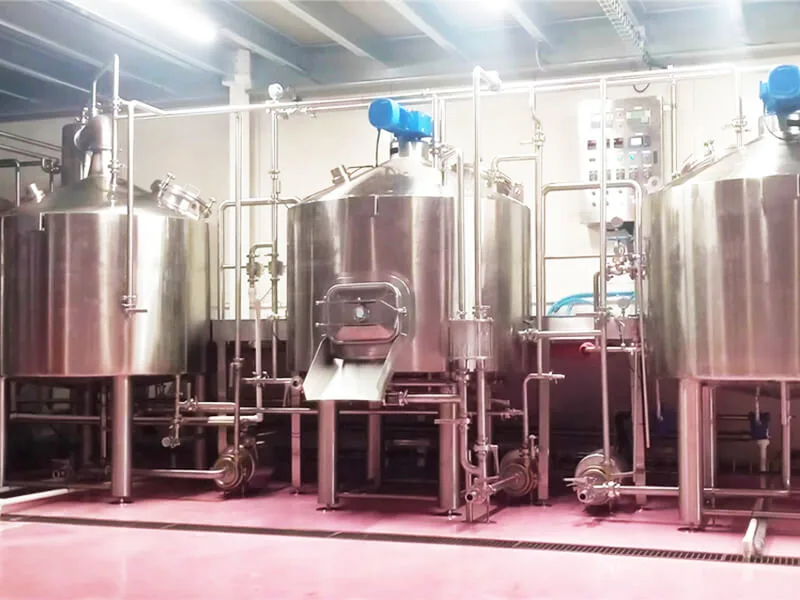
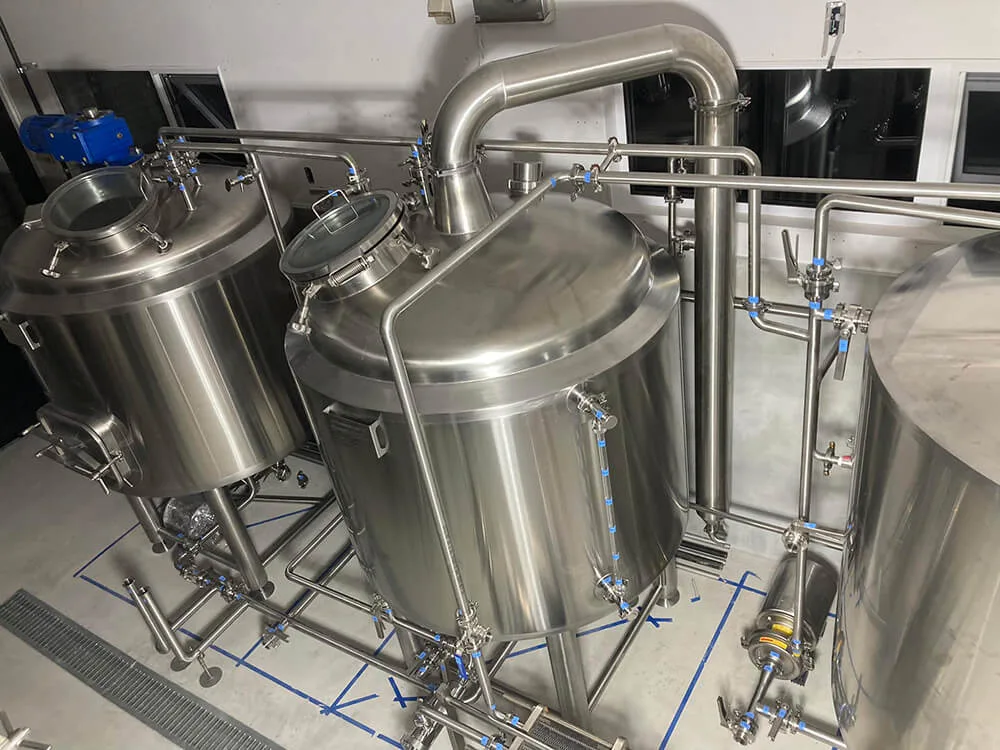
- Mash tun & lauter tun (or combined unit) – For mashing and wort separation.
- Boil kettle & whirlpool – For wort boiling, hop addition, and trub separation.
- Hot liquor tank (HLT) and cold liquor tank (CLT) – For brewing water and cleaning cycles.
- Automation system – PLC or semi-automatic control for pumps, valves, and temperature regulation. Many 2000L systems use Siemens PLCs with touch screens and pneumatic valves for precision control.
3. Fermentation and Maturation
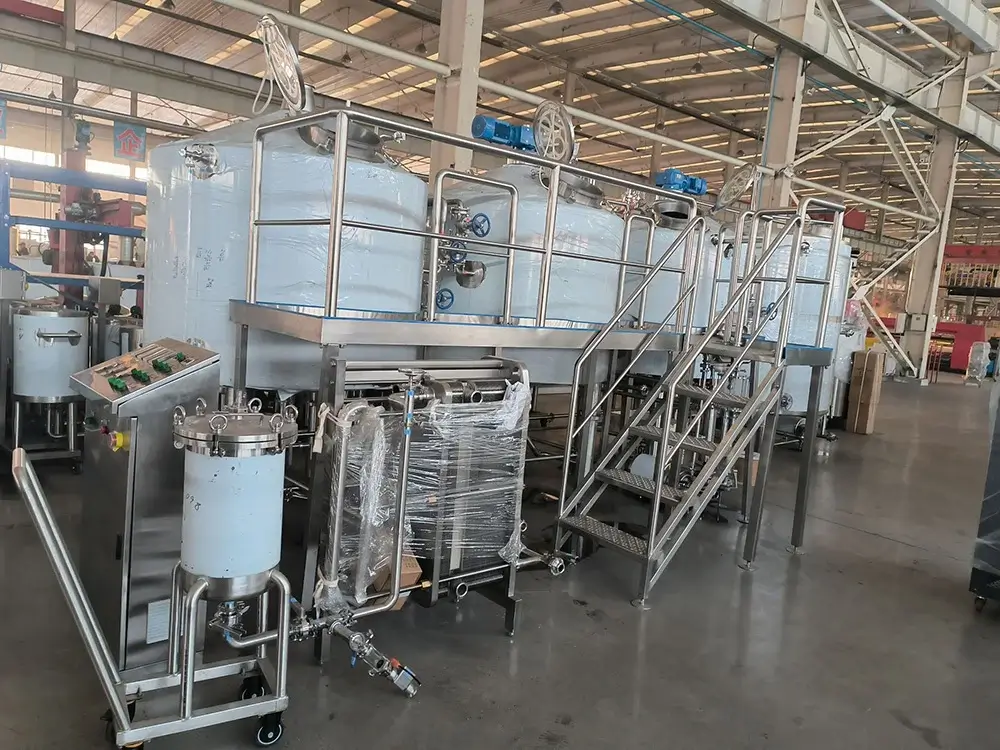
- Cylindroconical fermentation tanks (CCTs) – 2000L per unit, typically 8–12 tanks depending on production plan.
- Brite beer tanks (BBTs) – For maturation, carbonation, and packaging preparation.
- Refrigeration system – Includes glycol chiller, buffer tank, and pumps to control fermentation temperature and energy efficiency.
4. Auxiliary Systems
- Sistema CIP (limpieza in situ) – For internal cleaning and sanitization of tanks and pipelines.
- Process piping and valves – Includes flow meters, sensors, safety valves, and pressure regulators.
- Packaging line (optional) – Bottling, canning, or kegging systems, depending on production needs.
- Automation and data recording – For consistent quality and easy process monitoring.
Typical 2000L Brewery Configuration (Example)
| Component | Especificación |
|---|---|
| Malt Mill | 1500-2000 kg/h |
| sistema de sala de cocción | 2000L ( 3/4/5-Vessel brewhouse ) |
| Hot Liquor Tank | 2000L (customize) |
| Tanques de fermentación | 2000L/4000L (customize) |
| Brite Tanks | 2000L (customize) |
| Unidad de refrigeración por glicol | With chiller and buffer tank |
| Sistema CIP | Three-tank cleaning station |
| Control Panel | Siemens PLC + Touchscreen |
| Embalaje | Optional bottle/keg/can line |
This setup provides an ideal balance of efficiency, automation, and scalability for small to mid-sized commercial breweries.

Investment and Business Considerations
Estimated Cost
The total investment includes equipo de la sala de cocción, fermentation tanks, refrigeration, automation, installation, and training. Scaling from 1000L to 2000L can significantly reduce cost per liter produced.
Return on Investment (ROI)
With daily output around 2000L, monthly production can reach approximately 60,000L (depending on fermentation cycles). Annual capacity may exceed 700,000L, offering a solid return when paired with proper sales and distribution strategies.
Operational Challenges
- Maintaining consistent product quality across larger batches.
- Managing utilities such as energy, water, and wastewater.
- Ensuring proper installation space, ceiling height, and ventilation.
- Choosing reliable suppliers with proven turnkey experience.
Why Work with a Turnkey Equipment Supplier?
- Simplified management: The supplier handles design, fabrication, and installation.
- Optimized integration: Systems are designed to work seamlessly together.
- Technical expertise: Suppliers bring experience from past 1000L and 2000L projects.
- Full lifecycle support: From setup to maintenance and operator training.
Key Success Factors for Implementation
- Define production goals clearly – Batch size, fermentation time, and tank quantity determine system scale.
- Plan your layout carefully – Ensure adequate space for tanks (often 3–4 m high), utilities, and workflow.
- Choose the right automation level – PLC control improves consistency and efficiency.
- Prioritize training and after-sales service – Ensure operators understand cleaning, maintenance, and safety.
- Account for utilities and environmental management – Cooling, wastewater, and CO₂ recovery are essential for sustainability.
- Develop your brand alongside expansion – Brewing capacity means little without strong marketing, quality, and customer loyalty.
Conclusión
For breweries aiming to scale up from pilot or small commercial systems, a 2000L turnkey brewing system offers the perfect combination of capacity, flexibility, and efficiency. It simplifies setup, accelerates production readiness, and ensures professional brewing standards across every batch.
By partnering with an experienced turnkey equipment manufacturer, breweries can focus on what truly matters — crafting distinctive, high-quality beer and building a brand that stands out in the competitive craft beer market.
If you’re planning to upgrade to a 2000L brewing system, contact our engineering team to discuss:
- Customized system configuration (3-vessel, 4-vessel, or 5-vessel brewhouse)
- Automation and control options
- Layout design and installation support
- Commissioning, operator training, and lifetime service
Together, we can help you transform your brewing vision into a fully operational, high-performance brewery.