1. Introduction: Choosing the Right Brewery Equipment Manufacturer
Building a commercial brewery is a significant investment. Whether you are planning a craft brewery, a regional beer production facility, or a large industrial brewery, the equipment manufacturer you choose will influence more than the initial purchase price.
The right manufacturer should understand your brewing process, calculate equipment capacity, design an efficient production layout, manufacture reliable stainless steel vessels, and coordinate the supporting systems required for daily operation.
However, the brewery equipment market includes different types of suppliers. Some companies focus mainly on trading and distribution, while others operate their own manufacturing facilities and provide engineering, production, installation, and technical support.
For brewery investors and procurement teams, distinguishing between these business models is an important first step.
A professional commercial brewery equipment manufacturer should be able to demonstrate its manufacturing capabilities, explain its engineering decisions, provide verifiable quality documentation, and support the project beyond equipment delivery.
This guide outlines ten important factors to evaluate before choosing a brewery equipment manufacturer.
2. Verify Whether the Supplier Is a Real Manufacturer
The first step is to understand who will actually design and manufacture your brewery equipment.
A supplier may have an attractive website, professional sales representatives, and a wide product catalog. However, these factors alone do not establish whether the company owns its production facilities or has direct control over manufacturing.
For a large brewery project, manufacturing capability directly affects quality control, production scheduling, customization, and technical communication.
Check the Factory and Production Facilities
Ask the supplier to provide information about:
- Factory location and workshop area.
- Stainless steel processing equipment.
- Welding and fabrication capabilities.
- Assembly and testing facilities.
- Engineering and technical teams.
- Production and quality management procedures.
If possible, arrange a factory visit or a live video inspection.
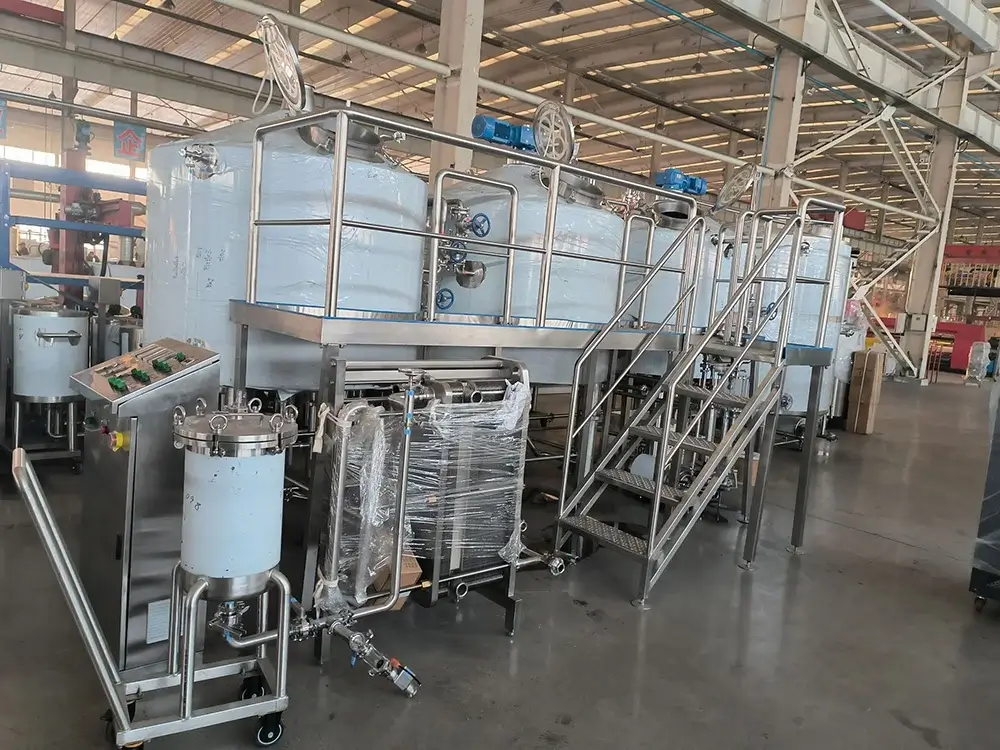
During the visit, pay attention to the actual production environment. Check whether the factory performs material processing, tank fabrication, welding, polishing, assembly, and inspection, rather than simply storing equipment purchased from other manufacturers.
Understand the Difference Between a Manufacturer and a Trading Company
A trading company can sometimes provide useful sourcing and project coordination services. However, when equipment requires customized engineering or technical modifications, direct access to the manufacturing team becomes particularly important.
Working directly with a manufacturer can make it easier to discuss:
- Tank dimensions and structural requirements.
- Material selection and surface finish.
- Pipeline configuration.
- Control system functions.
- Production schedules.
- Technical changes during manufacturing.
The key is not simply whether a supplier calls itself a manufacturer. It is whether the company can demonstrate direct responsibility for the equipment it supplies.
3. Evaluate Engineering and Customization Capabilities
A commercial brewery is not a collection of independent machines. It is an integrated production system.
The brewhouse, fermentation tanks, glycol cooling system, CIP station, process pipelines, and filling equipment must work together.
A manufacturer should therefore have sufficient engineering capability to develop a solution around the customer’s production requirements.
Start with the Brewing Process
Before recommending equipment, the manufacturer should understand your project fundamentals:
- Target annual beer production.
- Wort volume per batch.
- Planned brewing batches per day.
- Beer styles and recipes.
- Fermentation and maturation requirements.
- Packaging formats.
- Available factory space.
- Heating method and utility conditions.
- Expected future expansion.
These details help determine the appropriate brewhouse configuration and fermentation capacity.
For example, a 1,000L brewhouse and a 5,000L brewhouse may serve very different production requirements, even if both are described as commercial brewery systems.
The manufacturer should explain how its proposed configuration matches your production plan.
Review the Engineering Deliverables
A professional brewery equipment project may require:
- Process flow diagrams.
- General arrangement drawings.
- Equipment layout drawings.
- Tank specifications.
- Pipeline and utility layouts.
- Electrical and control system diagrams.
- Equipment lists.
- Installation and commissioning plans.
Not every project requires the same documentation. However, the manufacturer should be able to provide drawings and technical information appropriate to the project’s complexity.
Customization should also be based on engineering requirements rather than cosmetic changes alone.
4. Compare Brewery Equipment Manufacturing Quality
Stainless steel brewery equipment operates in an environment involving moisture, temperature changes, cleaning chemicals, and repeated production cycles.
Manufacturing quality therefore has a direct impact on equipment durability, hygiene, maintenance, and operational reliability.
When evaluating a brewery equipment manufacturer, do not focus only on the appearance of finished tanks. Pay attention to the complete manufacturing process.
Stainless Steel Material Selection
SUS304 is widely used for brewery tanks and product-contact equipment. SUS316L may be selected for applications requiring additional corrosion resistance.
The appropriate material depends on the product, cleaning chemicals, operating environment, and project specifications.
Ask the manufacturer to clarify:
- Stainless steel grade.
- Material thickness.
- Product-contact surface requirements.
- Insulation material and thickness.
- Design and working pressure, where applicable.
- Applicable material documentation.
Material selection should be consistent with the equipment’s intended operating conditions.
Welding and Surface Treatment
Welding quality is particularly important for pressure vessels, fermentation tanks, and hygienic process equipment.
A manufacturer’s production capabilities may include:
- Laser cutting.
- Automatic plasma welding.
- Laser welding.
- Manual argon arc welding.
- Mechanical polishing.
- Internal surface finishing.
The appropriate welding method depends on the material, joint configuration, vessel geometry, and manufacturing requirements.
For product-contact surfaces, internal polishing and weld finishing should support effective cleaning and drainage.
Inspection and Testing
A reliable manufacturer should have a documented inspection process.
Depending on equipment type and design requirements, inspection may include:
- Raw material verification.
- Dimensional inspection.
- Welding inspection.
- Surface finish inspection.
- Pressure or leak testing.
- Electrical inspection.
- Functional testing.
For pressure equipment, the applicable design code, inspection requirements, and certification scope should be confirmed before ordering.
Do not assume that every brewery tank requires the same pressure test or certification. Requirements vary according to equipment design, intended use, destination market, and applicable regulations.

5. Check the Manufacturer’s Complete Product Range
A commercial brewery requires several interconnected equipment systems.
Choosing a manufacturer with experience across the major process sections can simplify technical coordination and reduce communication gaps between different equipment suppliers.
Main Brewery Equipment Categories
Malt Milling System
The milling system prepares malt for mashing. Depending on production capacity, it may include a malt elevator, dry miller, flexible or pipe-chain conveyor, and grist hydrator.
Sudhaus-System
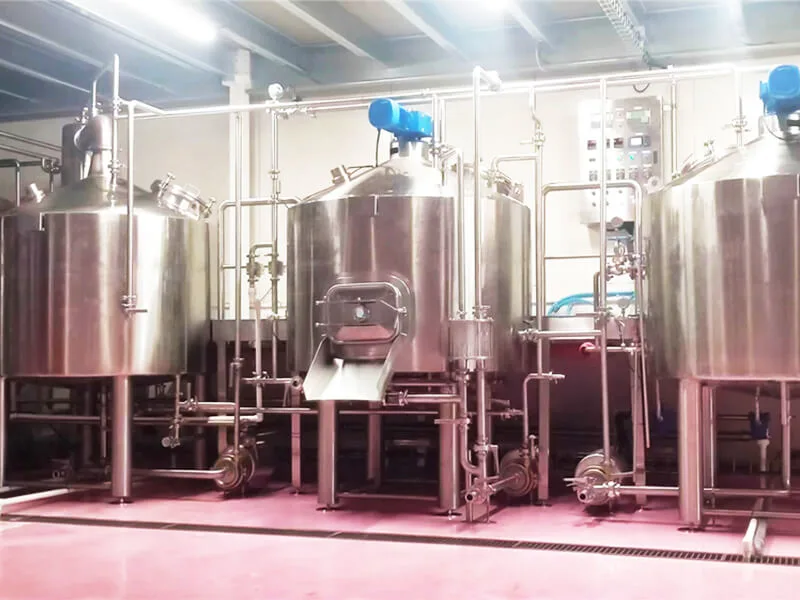
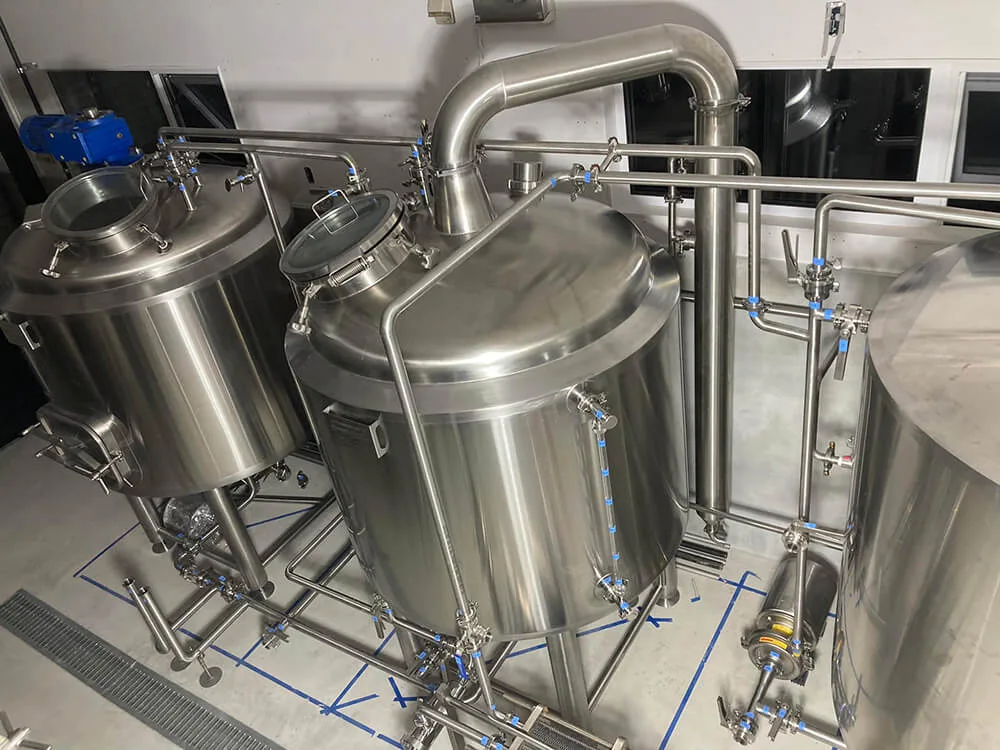
The brewhouse performs mashing, lautering, wort boiling, and whirlpool separation.
Common configurations include two-vessel, three-vessel, and four-vessel systems. The appropriate configuration depends on batch capacity, brewing frequency, available space, and automation requirements.
Gärsystem
Fermentation tanks provide controlled conditions for yeast activity and beer development.
Tank capacity, working volume, cooling jackets, insulation, CIP devices, and process connections should be designed around the brewery’s production schedule.
Glykol-Kühlsystem
The refrigeration system provides cooling for wort, fermentation tanks, and other process applications according to the project’s cooling requirements.
CIP-Reinigungssystem
A centralized cleaning system supports cleaning operations for tanks and process pipelines. Its configuration depends on the cleaning procedure and the number of tanks operating simultaneously.
Filling and Packaging Equipment
Filling equipment should be matched with the brewery’s packaging format, required output, and downstream production workflow.
Why System Compatibility Matters
When different equipment sections are supplied by multiple vendors, the brewery owner may need to coordinate separate technical teams.
This can create challenges involving pipeline connections, control interfaces, installation responsibilities, and commissioning schedules.
A manufacturer capable of coordinating the major brewery systems can help simplify project integration.
However, the actual scope of supply should always be clearly defined in the quotation and technical agreement.
6. Evaluate Automation and Control System Capabilities
Automation is increasingly important in commercial breweries, especially when production involves multiple brewhouse vessels and fermentation tanks.
A brewery control system can help operators manage equipment status, process parameters, temperature control, and production operations.
Understand What the PLC System Actually Controls
A PLC-based brewery control system may include:
- Touchscreen HMI.
- Pump start and stop control.
- Valve operation.
- Temperature monitoring.
- Process parameter settings.
- Alarm functions.
- Equipment status monitoring.
- Production data recording.
Depending on the project scope, mobile or tablet connectivity may also be included for supported monitoring and operation.
When comparing manufacturers, ask for a clear description of the automation functions rather than relying on general claims such as fully automatic or intelligent control.
Consider Future Maintenance
The control system should also be practical to operate and maintain.
Ask whether the manufacturer can provide:
- Electrical drawings.
- PLC and HMI documentation.
- Operating instructions.
- Alarm descriptions.
- Backup procedures.
- Technical support for troubleshooting.
A well-designed control system should support production operations without making routine maintenance unnecessarily complicated.
7. Review Project Experience and Reference Cases
Previous project experience can provide useful evidence of a manufacturer’s technical capabilities.
However, the number of projects alone is not enough. It is important to understand the actual equipment configuration and the manufacturer’s responsibilities in each project.
Look for Relevant Project Experience
When reviewing case studies, consider:
- Similar production capacity.
- Similar beer styles or process requirements.
- Similar brewhouse configuration.
- Fermentation tank arrangement.
- Automation level.
- Installation conditions.
- Project delivery scope.
For example, a manufacturer experienced in 500L brewpub systems may not automatically have the engineering experience required for a 5,000L industrial brewery.
Likewise, experience with fermentation tanks does not necessarily demonstrate the ability to design a complete brewery production system.
Ask for Verifiable Project Information
Useful reference materials may include:
- Project photographs.
- Equipment configuration lists.
- Factory acceptance test records, where available.
- Installation photographs.
- Commissioning documentation.
- Customer references, subject to permission.
A detailed case study is generally more valuable than a collection of equipment photographs without technical context.
8. Compare Installation, Commissioning, and After-Sales Support
Equipment manufacturing is only one stage of a brewery project.
After delivery, equipment must be installed, connected, tested, and commissioned before commercial production can begin.
For international projects, installation and technical support should be discussed before the contract is signed.
Installation und Inbetriebnahme
Clarify whether the manufacturer provides:
- Installation drawings.
- Equipment connection instructions.
- Remote technical guidance.
- On-site installation services.
- Electrical and pipeline commissioning.
- Operator training.
- Trial operation support.
The responsibilities of the customer, manufacturer, local contractor, and other suppliers should be documented.
This is particularly important for projects involving steam boilers, refrigeration equipment, electrical systems, and local building infrastructure.

Spare Parts and Long-Term Technical Support
A brewery may operate for many years, so after-sales service should not be evaluated only by the warranty period.
Ask the manufacturer about:
- Spare parts availability.
- Warranty terms.
- Response procedures for technical issues.
- Remote troubleshooting.
- Maintenance documentation.
- Availability of replacement components.
A supplier that understands the original equipment design is often better positioned to provide technical support and identify compatible replacement parts.
9. Evaluate Delivery Capability and International Project Experience
For overseas brewery projects, manufacturing quality must be supported by reliable export and delivery arrangements.
Large stainless steel tanks and integrated brewery systems may involve complex transportation and installation requirements.
Check Export Experience
Ask whether the manufacturer has experience shipping brewery equipment to your destination market.
Relevant considerations include:
- Equipment dimensions and shipping weight.
- Container loading plans.
- Packaging and surface protection.
- Export documentation.
- Shipping coordination.
- Destination port requirements.
- On-site unloading and installation arrangements.
Large tanks may require special transportation planning depending on their dimensions and the destination’s road, port, and site-access conditions.
Confirm the Production and Delivery Schedule
The supplier should provide a realistic manufacturing schedule based on the confirmed technical scope.
The project timeline may include:
- Technical confirmation.
- Engineering drawings.
- Material procurement.
- Tank fabrication.
- Welding and polishing.
- Inspection and testing.
- Assembly and pre-shipment checks.
- Packaging and loading.
- International transportation.
- Installation and commissioning.
A clearly defined delivery plan helps the buyer coordinate factory preparation, local contractors, and production launch.
10. Compare Total Project Cost Instead of Only Equipment Price
Price is an important factor, but the lowest quotation does not necessarily represent the best value.
Two brewery equipment quotations may appear similar while covering very different equipment specifications and project responsibilities.
One quotation may include pumps, valves, insulation, pipelines, control systems, and installation support. Another may cover only the main tanks.
For this reason, buyers should compare the complete technical scope.
What Should Be Included in a Cost Comparison?
| Cost category | What to verify |
|---|---|
| Main equipment | Brewhouse, fermentation tanks, and storage tanks |
| Auxiliary equipment | Pumps, heat exchangers, mills, and supporting units |
| Das Kühlsystem | Chiller, glycol tank, pumps, and pipelines |
| KVP-Anlage | Cleaning tanks, pumps, valves, and connections |
| Automatisierung | PLC, HMI, sensors, and control cabinets |
| Rohrleitungen | Product, utility, and cleaning pipelines |
| Installation | Engineering support, labor, and commissioning |
| Logistics | Packaging, inland transport, and international shipping |
| After-sales | Warranty, spare parts, and technical support |
Consider Long-Term Operating Requirements
The initial purchase price is only one part of the total investment.
Equipment maintenance, energy consumption, cleaning procedures, spare parts, and production flexibility also influence long-term operating costs.
A technically appropriate brewery system may provide better value than an underspecified system that requires modifications shortly after installation.
The best purchasing decision should balance initial investment, production requirements, equipment quality, and future operating needs.
11. Prepare a Technical Checklist Before Requesting a Quotation
Before contacting a commercial brewery equipment manufacturer, prepare basic project information.
This helps the manufacturer develop a more accurate technical proposal and reduces repeated clarification during the quotation process.
Brewery Project Information
- Target annual beer production.
- Required brewhouse batch capacity.
- Planned batches per day.
- Main beer styles.
- Fermentation and maturation requirements.
- Required fermentation tank quantities and sizes.
- Packaging formats and target filling output.
- Available factory dimensions and building height.
- Heating method: steam, electric, or direct fire.
- Available water, electricity, and other utilities.
- Expected automation level.
- Future production expansion plans.
- Destination country and applicable project requirements.
You do not need to have every detail finalized before contacting a manufacturer. An experienced engineering team should be able to help evaluate the initial requirements and identify missing information.
12. Why Choose METO as Your Commercial Brewery Equipment Manufacturer?
METO is a brewery and distillery equipment manufacturer integrating engineering design, research and development, manufacturing, sales, installation, commissioning, and after-sales support.
Established in 2013, METO has developed equipment solutions for customers in the beer brewing, fermentation, distillation, and stainless steel vessel industries.
The company operates a 30,000 m² manufacturing workshop and supplies equipment to customers in more than 100 countries and regions.
Integrated Manufacturing Capabilities
METO’s manufacturing capabilities include stainless steel plate and tube laser cutting, leveling and shearing, laser welding, automatic plasma welding, and manual argon arc welding.
The company also uses inspection equipment such as spectrometers and X-ray detectors as part of its manufacturing and quality-control capabilities.
These resources support the production of brewery equipment, fermentation tanks, and customized stainless steel vessels.
Complete Brewery Equipment Solutions
For commercial brewery projects, METO can coordinate the design and supply of:
- Malt milling systems.
- Two-vessel, three-vessel, and four-vessel brewhouses.
- Stainless steel fermentation tanks.
- Glykol-Kühlsysteme.
- CIP cleaning systems.
- Process pipelines.
- PLC automation systems.
- Beer filling and packaging equipment.
Equipment configurations can be customized according to production capacity, beer styles, factory layout, heating method, and project requirements.
Engineering Support from Design to Commissioning
METO focuses on coordinating the main equipment sections as part of a complete production system.
From initial capacity planning and equipment layout to manufacturing, installation, and commissioning, the engineering team works with customers to develop solutions that match their operational requirements.
For buyers evaluating a brewery equipment manufacturer, this integrated approach provides a practical basis for discussing both individual equipment specifications and the complete project scope.
13. Frequently Asked Questions
What is the difference between a brewery equipment manufacturer and a supplier?
A manufacturer directly controls or performs equipment engineering and production, while a supplier may purchase equipment from other factories and resell it. Some companies combine manufacturing and trading activities. Buyers should verify actual factory facilities, production processes, and responsibility for quality.
How do I verify whether a brewery equipment manufacturer is reliable?
Review its factory facilities, production equipment, engineering documentation, manufacturing processes, quality-control procedures, previous projects, export experience, and after-sales support. A factory visit or live production inspection can provide additional confidence.
What should I look for when comparing brewery equipment manufacturers?
Compare technical specifications, equipment configuration, manufacturing quality, automation, project experience, installation services, warranty terms, spare parts, and total project scope. Avoid comparing quotations based only on the total price.
Can a brewery equipment manufacturer provide a complete turnkey solution?
Some manufacturers provide integrated solutions covering brewhouse systems, fermentation tanks, refrigeration, CIP, pipelines, automation, installation, and commissioning. However, the exact scope varies. Buyers should confirm which services and equipment are included in the contract.
How much does commercial brewery equipment cost?
The cost depends on production capacity, equipment configuration, stainless steel specifications, automation level, auxiliary systems, packaging requirements, and installation scope. A reliable quotation should be based on confirmed technical requirements rather than batch capacity alone.
Should I choose a local manufacturer or an overseas brewery equipment manufacturer?
The decision should consider technical capability, manufacturing quality, project experience, total delivered cost, export arrangements, installation support, and access to spare parts. An overseas manufacturer may offer integrated production and customization capabilities, but international delivery and after-sales arrangements must be evaluated carefully.
14. Final Thoughts: Choose a Manufacturing Partner, Not Just an Equipment Seller
Choosing a commercial brewery equipment manufacturer is a decision that affects the entire lifecycle of a brewery project.
A reliable partner should be able to demonstrate real manufacturing capabilities, understand brewing processes, provide practical engineering solutions, maintain consistent quality standards, and support the equipment after delivery.
Before placing an order, take time to evaluate the factory, review technical documents, compare complete equipment configurations, and clarify project responsibilities.
If you are planning a new commercial brewery or expanding an existing facility, METO can help evaluate your production requirements and develop a customized brewery equipment solution.
Kontakt zu METO to discuss your brewery project. Share your target annual production, brewhouse capacity, factory layout, beer styles, and automation requirements. Our engineering team can help you evaluate the appropriate equipment configuration and project scope.