In the world of beer brewing, the brewhouse system stands as the heart of the production process—where raw ingredients are transformed into the foundational wort that defines the final beer’s character, quality, and consistency. More than just a collection of tanks, a well-designed brewhouse system is a strategic investment that directly impacts brewhouse efficiency, flavor profile, product stability, and long-term scalability. Whether you’re launching a small craft brewery, expanding a medium-sized operation, or operating a large industrial facility, understanding the nuances of brewhouse configurations, capacities, and applications is critical to making an informed decision that aligns with your production goals.
What Is a Brewhouse System, and Why Does It Matter?
At its core, a brewhouse system is responsible for converting milled malt and adjuncts into wort—a sugar-rich liquid that serves as the base for fermentation. The process begins with mixing milled grains with water (known as mashing), followed by enzymatic conversion to break down starches into fermentable sugars, and culminates in boiling the wort with hops to add bitterness, aroma, and sterilization. Each step is precision-driven: even minor variations in temperature, timing, or vessel design can alter the wort’s composition, leading to differences in yield, flavor, and shelf stability. In short, the brewhouse system is the backbone of beer quality—there’s no great beer without a well-optimized brewhouse.
One of the most critical metrics influenced by the brewhouse is brewhouse efficiency, which measures how effectively the system extracts fermentable sugars from the grain. This efficiency directly impacts cost control: a more efficient system requires less malt to achieve the desired alcohol content, reducing raw material expenses over time. Additionally, consistent wort production ensures that every batch of beer meets your brand’s standards, building customer loyalty and trust in your product.
Brewhouse Capacity: Matching Your Production Needs
Brewhouse systems are available in a wide range of batch capacities, from compact 50 L setups ideal for pilot batches to industrial-scale 20,000 L systems designed for high-volume production. This flexibility ensures that breweries of all sizes can find a configuration that fits their output goals, without overinvesting in equipment that exceeds their current needs or limiting future growth.
When selecting a capacity, it’s important to consider not just your current daily or weekly production targets, but also your scalability plans. For example, a small craft brewery might start with a 500–3,000 L batch system but choose a design that can be expanded as demand grows. Conversely, industrial breweries require large-capacity systems that can operate continuously to meet mass-market demand. The key is to balance current efficiency with long-term adaptability—a principle that applies to both capacity and vessel configuration.
Brewhouse Configurations: Vessel Types and Their Benefits
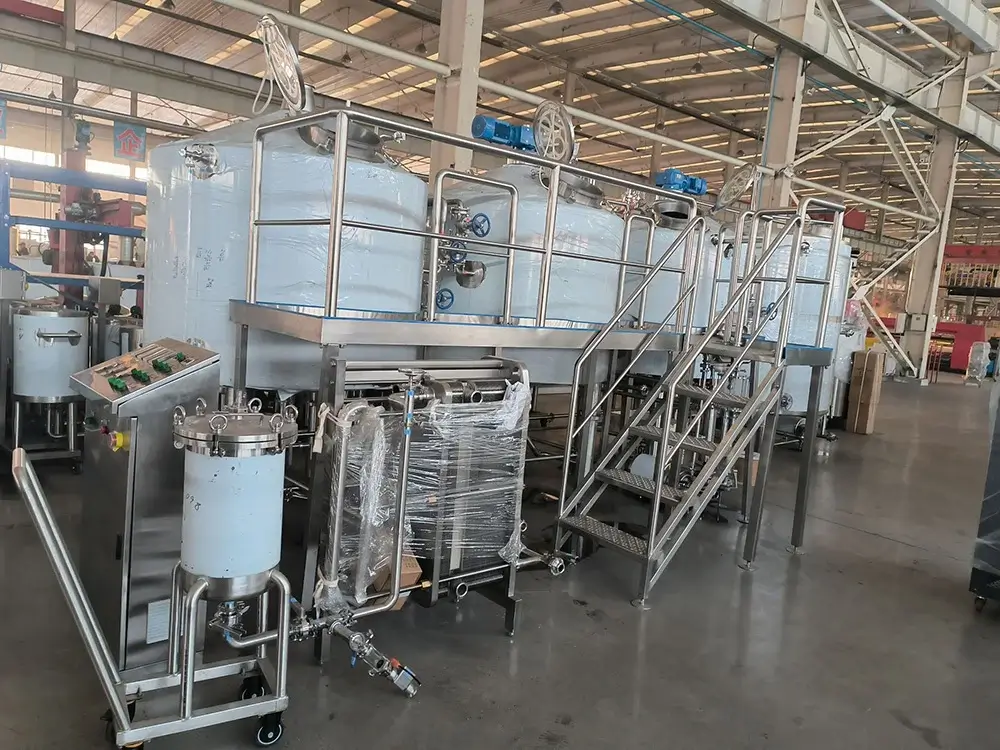
Brewhouse systems are classified by the number of vessels they include, each designed to handle specific stages of the wort production process. The number of vessels directly impacts process efficiency, flexibility, and the ability to produce complex beer styles. Below is a detailed breakdown of the most common configurations, including their design, functionality, and ideal applications.
1. Two-Vessel Brewhouse: Simplicity for Small-Scale Operations
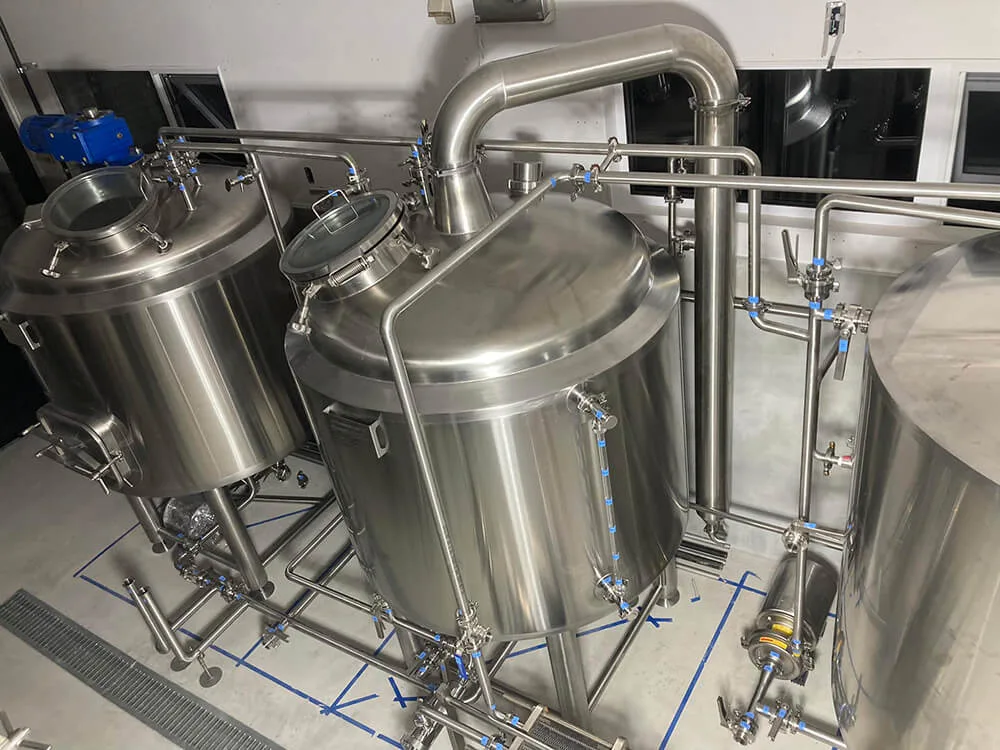
The two-vessel brewhouse is the most compact and cost-effective configuration, combining core functions into two dedicated tanks: a Mash/Lauter Tun (for mashing and separating wort from spent grains) and a Kettle/Whirlpool Tank (for boiling wort and separating hop particles and solids). This streamlined design minimizes space requirements and simplifies operation, making it an ideal choice for startups, brewpubs, and small craft breweries with limited floor space or budget.
Key advantages of the two-vessel system include lower initial investment, faster cleaning and maintenance, and a straightforward workflow that requires minimal training. While it offers less flexibility for complex mashing schedules (such as step mashing), it excels at producing standard beer styles with consistent results. For breweries focused on simplicity and cost-efficiency, the two-vessel brewhouse is a reliable starting point.
2. Three-Vessel Combination Brewhouse: Flexibility for Growing Craft Breweries
The three-vessel combination brewhouse builds on the two-vessel design by adding specialized functionality, with two common configurations tailored to regional brewing traditions:
- American Style: Mash/Lauter Tun + Kettle/Whirlpool Combination Tank. This setup separates mashing and lautering into one vessel while keeping boiling and whirlpooling combined, offering a balance of simplicity and precision. It’s well-suited for breweries looking to experiment with hop-forward styles (such as IPAs) while maintaining operational efficiency.
- German Style: Mash/Kettle + Lauter/Whirlpool Combination Tank. This configuration combines mashing and boiling in one vessel, with a separate tank for lautering and whirlpooling. It’s ideal for traditional German styles (like lagers and pilsners) that require precise temperature control during mashing and boiling.
Both combinations offer greater flexibility than two-vessel systems, allowing brewers to refine their processes and produce more complex flavors. They also serve as a stepping stone for breweries planning to expand to larger configurations in the future.
3. Three-Vessel Brewhouse: Precision for Quality-Focused Operations
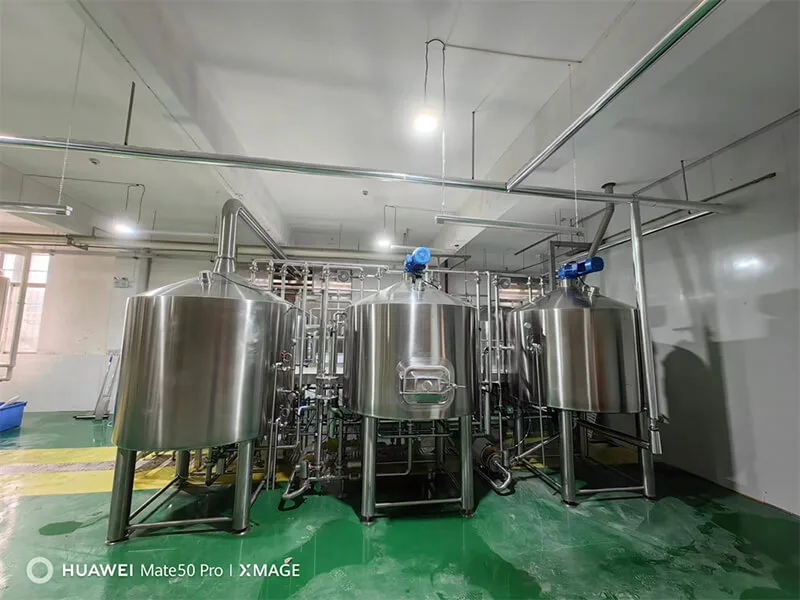
The standard three-vessel brewhouse separates the three core processes into dedicated tanks: Mash Tun (for mashing), Lauter Tun (for wort separation), and Kettle/Whirlpool Tank (for boiling and clarification). This full separation of functions provides greater control over each stage of the process, enabling brewers to optimize mashing temperatures, improve wort clarity, and reduce the risk of “stuck mash” (a common issue when mashing and lautering are combined).
This configuration is popular among production-oriented microbreweries that prioritize consistent quality and recipe repeatability. It supports advanced techniques like step mashing and decoction mashing, which are essential for crafting complex beer styles. While it requires a larger footprint and higher initial investment than two-vessel systems, the improved efficiency and quality control make it a worthwhile investment for growing breweries.
4. Four-Vessel Brewhouse: Efficiency for Medium-to-Large Breweries
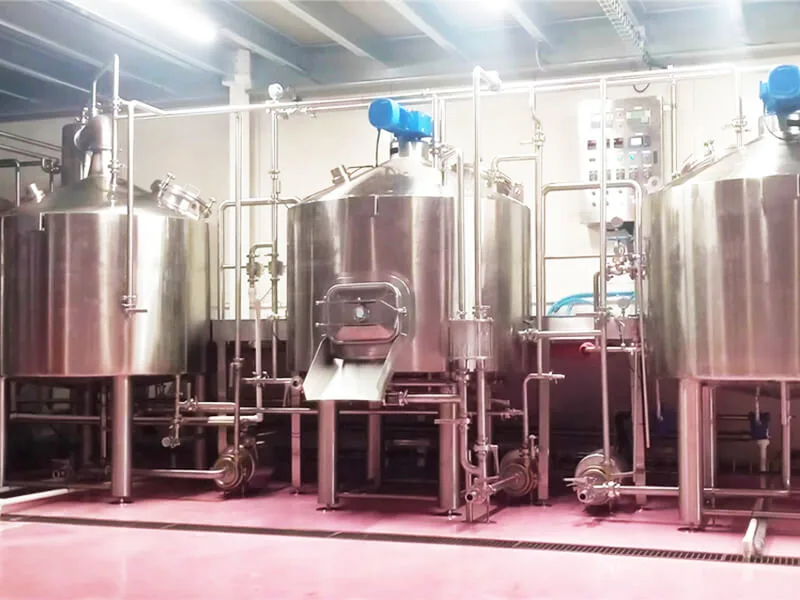
The four-vessel brewhouse is the gold standard for medium-to-large commercial breweries, featuring four dedicated tanks: Mash Tun, Lauter Tun, Kettle Tun, and Whirlpool Tank. By separating each process into its own vessel, this configuration allows for parallel operations—for example, mashing a new batch while boiling another, significantly reducing total brewing time and increasing daily throughput.
Key benefits of the four-vessel system include maximum process control, scalability, and flexibility. It supports high-gravity brewing, multiple daily batches, and advanced automation, making it ideal for breweries producing 10–100 tons per day. With proper automation, a four-vessel system can be operated by a small team, reducing labor costs while maintaining consistency. This configuration is also future-proof, as it can be easily scaled up to meet growing demand without major infrastructure changes.
5. Five-Vessel Brewhouse: Enhanced Throughput for Expanding Operations
The five-vessel brewhouse adds a Hold Tank to the four-vessel configuration, creating a setup that includes Mash Tun, Lauter Tun, Hold Tank, Kettle Tun, and Whirlpool Tank. The Hold Tank acts as a buffer, allowing wort to be collected and stored while the kettle is in use, reducing idle time and further increasing production efficiency.
This configuration is designed for medium-to-large craft breweries aiming to boost daily output without sacrificing quality. The Hold Tank improves lauter efficiency and wort clarity by allowing for more controlled wort transfer, while also enabling parallel processing of multiple batches. It’s an ideal choice for breweries transitioning from small-scale to medium-scale production, as it balances efficiency and flexibility.
6. Six-Vessel Brewhouse: Continuous Production for Industrial Scale
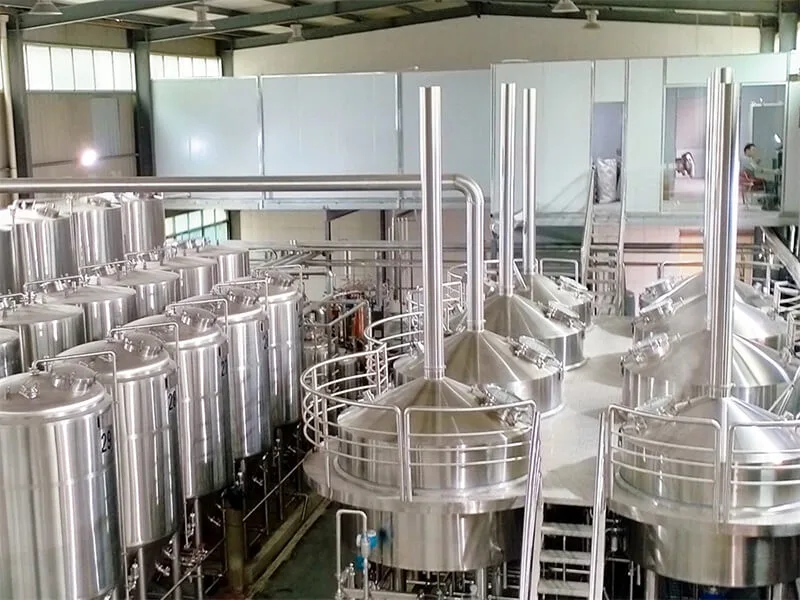
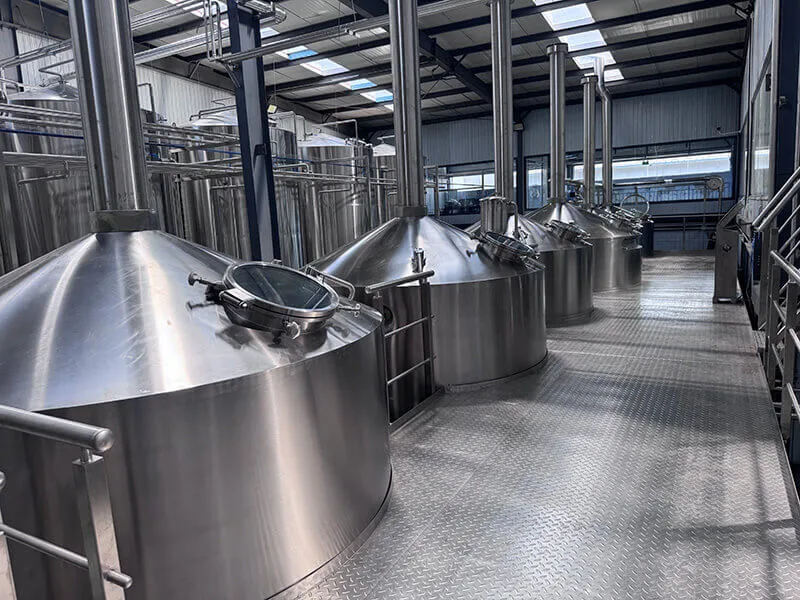
The six-vessel brewhouse is the most advanced configuration, designed for industrial breweries with daily outputs exceeding 100 tons. It adds a Pre-Mash Tun to the five-vessel setup, resulting in a complete system: Pre-Mash Tun, Mash Tun, Lauter Tun, Hold Tank, Kettle Tun, and Whirlpool Tank. The Pre-Mash Tun accelerates the mashing process by pre-hydrating and heating grains, improving extract yield and reducing overall brewing time.
This configuration enables true continuous brewing, with all stages operating simultaneously. It’s equipped with high-efficiency automation systems that control temperature, timing, and wort transfer, ensuring consistent quality even at massive scale. The six-vessel brewhouse is ideal for large industrial facilities that need to meet global demand while maintaining strict quality standards. While it requires the highest initial investment and largest footprint, its ability to deliver high-volume, consistent production makes it a cornerstone of industrial beer manufacturing.
Matching Brewhouse Systems to Your Brewery Scale
Selecting the right brewhouse configuration ultimately comes down to your brewery’s size, production goals, and long-term vision. Below is a practical guide to matching each configuration to your operation scale:
Small Craft Breweries (Including Brewpubs and Startups)
Small breweries typically prioritize simplicity, cost-efficiency, and space savings. A 2–3 vessel brewhouse system, with batch capacities ranging from 500 L to 3,000 L, is the ideal choice. These systems are easy to operate, require minimal maintenance, and can produce 1–4 batches per day—perfect for testing recipes, serving local customers, or building a small brand. Many small breweries start with a two-vessel system and upgrade to a three-vessel configuration as demand grows.
Medium to Large Breweries
Medium to large breweries focus on scalability, efficiency, and consistent quality. A 4–6 vessel automated brewhouse system, with daily production capacities of 10–100 tons, is best suited for these operations. The four-vessel configuration is particularly popular, as it balances efficiency and flexibility, allowing for multiple daily batches and advanced recipe experimentation. Five and six-vessel systems are ideal for breweries looking to expand further, with the six-vessel setup enabling continuous production to meet growing market demand.
Industrial Breweries
Industrial breweries require large-scale, high-efficiency systems that can operate continuously. Large automated brewhouse systems—typically six-vessel configurations with batch capacities up to 20,000 L—are designed to achieve daily outputs exceeding 100 tons. These systems are fully automated, with advanced controls for temperature, pressure, and wort transfer, ensuring consistent quality across millions of batches. They also prioritize energy efficiency, with features like heat recovery systems to reduce operational costs over time.
Key Considerations When Choosing a Brewhouse System
Beyond capacity and configuration, there are several critical factors to consider when selecting a brewhouse system:
- Automatisierungsgrad: Automated systems reduce manual labor, minimize errors, and ensure consistency. Small breweries may opt for semi-automatic systems, while medium-to-large facilities benefit from fully automated controls with recipe storage, alarm protection, and process logging.
- Heizmethode: Steam heating is the most stable and recommended for professional breweries (300 L and above), while electric heating is suitable for small pilot systems. Direct fire heating is less common due to uneven heating risks.
- Material Quality: High-quality stainless steel is essential for durability, corrosion resistance, and hygiene. The grade of stainless steel impacts the system’s lifespan and maintenance requirements.
- Skalierbarkeit: Choose a system that can be expanded as your brewery grows—for example, a two-vessel system that can be upgraded to three vessels, or a four-vessel system with modular components.
- Total Cost of Ownership: Consider not just the initial purchase price, but also maintenance costs, energy consumption, and labor requirements. A more efficient system may have a higher upfront cost but lower long-term operational expenses.
Conclusion: Invest in the Right Brewhouse for Long-Term Success
The brewhouse system is more than just equipment—it’s a strategic investment that shapes your brewery’s identity, quality, and growth potential. By understanding the different configurations, capacities, and applications, you can select a system that aligns with your current needs and future goals. Whether you’re a small craft brewer just starting out or an industrial operation serving global markets, the right brewhouse system will streamline your processes, enhance your beer’s quality, and set you up for long-term success.
Remember: the best brewhouse system is not the most complex or expensive—it’s the one that fits your brewery’s unique needs, production goals, and brand vision. With careful consideration and expert guidance, you can choose a system that turns raw ingredients into exceptional beer, batch after batch.
Ready to start your brewing journey? Kontaktieren Sie uns heute for a custom quote and layout design!