Temperature control is the most critical process control factor during beer fermentation. It directly affects yeast metabolic activity, fermentation speed, flavor compound formation, and the final physical and chemical stability of beer. In modern brewing systems, especially in a stainless steel fermentation tank, precise temperature management is essential for achieving consistent beer quality and efficient production.
This article systematically explains beer fermentation tank temperature control from three perspectives: control principles, stage-based temperature strategies, and engineering implementation.
Why Temperature Control Matters in a Stainless Steel Fermentation Tank
During fermentation, yeast converts sugars into alcohol and carbon dioxide while producing hundreds of flavor-active compounds. The fermentation temperature determines how yeast behaves throughout this process.
A well-designed stainless steel fermentation tank provides the thermal stability and sanitary conditions necessary for precise temperature regulation. Combined with automated cooling systems, breweries can maintain ideal fermentation conditions and ensure batch-to-batch consistency.
1. Fundamental Principles of Fermentation Temperature Control
1.1 The Direct Impact of Temperature on Yeast Metabolism
Yeast activity is highly temperature dependent. Within the biological activity range of approximately 0°C to 40°C, enzymatic reaction rates generally increase by 1.5 to 2.5 times for every 10°C rise in temperature.
High Fermentation Temperatures
When the temperature is too high:
- Yeast reproduction and fermentation accelerate rapidly
- Sugars are consumed faster
- Higher alcohols and ester compounds increase significantly
- Excessive fusel alcohols may create harsh flavors and stronger hangover effects
- Unbalanced esters can produce overpowering fruity or solvent-like aromas
Low Fermentation Temperatures
When the temperature is too low:
- Yeast metabolism slows down
- Fermentation may become sluggish or stall entirely
- Nutrient transport through the yeast cell membrane decreases
- Final attenuation may be insufficient
- Sulfur compounds such as hydrogen sulfide and dimethyl sulfide may remain in the beer
For this reason, breweries rely on automated temperature control systems inside the stainless steel fermentation tank to maintain optimal yeast performance throughout the fermentation cycle.
1.2 Heat Generation During Fermentation
Alcohol fermentation is an exothermic reaction.
Production data and theoretical calculations show that for every 1°P reduction in wort extract, beer temperature rises by approximately 1.3°C. For a 12°P lager wort, total temperature rise under adiabatic conditions may exceed 15°C.
Therefore, the primary function of a beer fermentation tank temperature control system is not heating, but precise and dynamic cooling.
Temperature Control Strategies Throughout the Fermentation Process
A complete fermentation temperature profile is one of the most important brewing process documents. Different fermentation stages require different temperature strategies.
The following example describes a typical 12°P bottom-fermented lager beer process.
2.1 Wort Transfer and Fermentation Start-Up Phase
After wort passes through the plate heat exchanger, it is cooled to 6°C–8°C, oxygenated with sterile air or pure oxygen, and transferred into the stainless steel fermentation tank with yeast pitching.
Control Objective
Gradually raise the beer temperature to the primary fermentation temperature of approximately 9°C–10°C.
Control Method
Cooling is usually not activated during this phase. Instead, natural fermentation heat and ambient thermal exchange allow the temperature to rise slowly.
This gentle warming process helps yeast adapt smoothly and enter the logarithmic growth phase without metabolic stress.
Typical Duration
12–24 hours.
2.2 Main Fermentation Phase
This is the most active stage of alcohol production and flavor formation, requiring the highest temperature control precision.
Control Objective
Maintain stable beer temperature within the target range:
- Lager beer: 9°C–12°C
- Ale beer: 18°C–22°C
Control Method
As fermentation enters peak activity, extract levels decline rapidly and heat generation reaches maximum levels.
The cooling jacket of the stainless steel fermentation tank circulates glycol coolant to remove excess heat and stabilize product temperature.
Precision Requirement
Temperature fluctuation should remain within ±0.3°C.
- Sudden cooling may cause yeast cold shock and premature flocculation
- Excessive warming increases unwanted flavor compounds
Fermentation Endpoint
Primary fermentation typically ends when apparent extract reaches the target value, usually around 4.0°P–4.5°P for lager beer.
2.3 Diacetyl Rest Phase
Diacetyl is a yeast by-product associated with buttery or cooked grain off-flavors.
Yeast naturally reabsorbs and reduces diacetyl, but this process occurs more efficiently at elevated temperatures.
Control Objective
Raise beer temperature to accelerate diacetyl reduction.
Control Method
When apparent extract approaches the target level, temperature is gradually increased:
- Lager beer: 14°C–16°C
- Ale beer: 22°C–24°C
Recommended warming rate:
- 0.2°C–0.3°C per hour
A slow ramp prevents thermal shock to stressed yeast cells.
Endpoint Determination
Beer samples are tested until diacetyl concentration falls below the flavor threshold, typically under 0.05 mg/L.
This stage also promotes maturation reactions, including sulfur compound volatilization and ester balancing.
2.4 Cold Conditioning and Lagering Phase
After diacetyl reduction is completed, beer temperature is lowered to improve clarity and stability.
Control Objective
Reduce beer temperature gradually to 0°C to -1°C.
Control Method
Cooling is performed slowly at approximately:
- 0.3°C–0.5°C per hour
Excessively rapid cooling can stimulate yeast stress responses and negatively affect sedimentation performance.
Lagering Period
Once target temperature is reached, the beer remains at 0°C to -1°C for 7–28 days.
During this stage:
- Carbon dioxide saturation stabilizes
- Colloidal stability improves
- Flavor profile matures and harmonizes
Engineering Design of Beer Fermentation Tank Temperature Control Systems
Precise brewing temperature control depends on reliable hardware and automation systems.
3.1 Temperature Sensors
The most commonly used temperature sensor in a stainless steel fermentation tank is the PT100 platinum resistance thermometer.
Advantages of PT100 Sensors
- High accuracy (±0.1°C)
- Excellent long-term stability
- Linear resistance-temperature relationship
- Suitable for hygienic brewery applications
Sensors are typically installed through the tank wall and extend directly into the beer, measuring actual product temperature rather than jacket or wall temperature.
Large fermenters may include multiple sensors at different heights for more accurate thermal monitoring.
3.2 Cooling Jackets and Glycol Systems
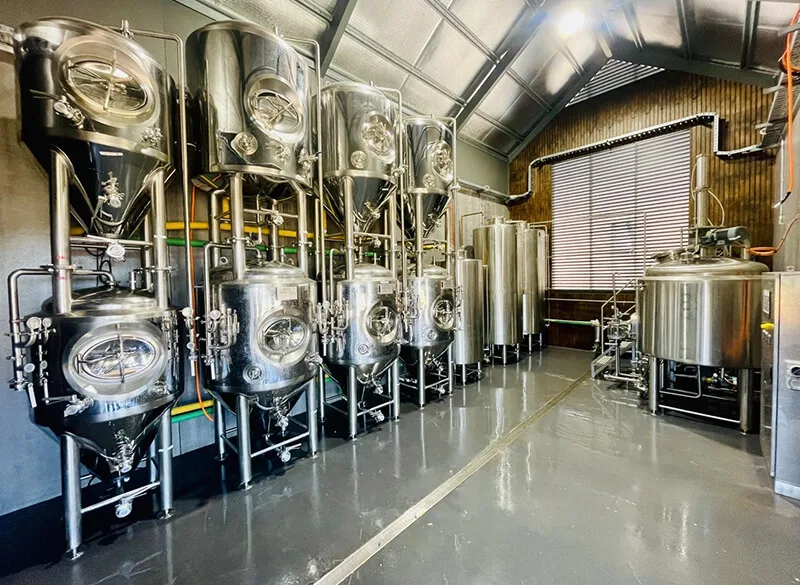
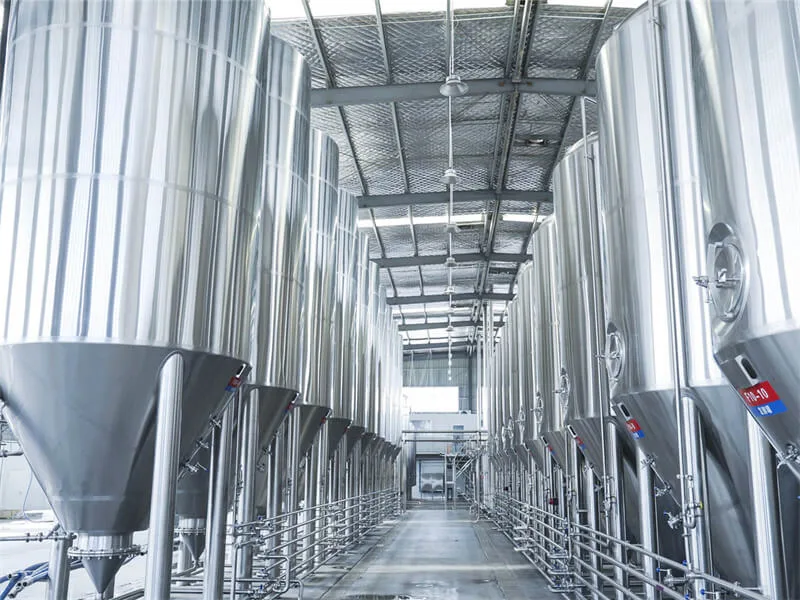
The cooling jacket is the primary heat exchange structure of a stainless steel fermentation tank.
Common Coolants
- Glycol-water solution
- Alcohol-water solution
Typical coolant temperature:
- -3°C to -4°C
Multi-Zone Jacket Design
Large conical fermenters often use 2–3 independent cooling zones:
- Cone section
- Lower cylindrical section
- Upper cylindrical section
Segmented cooling improves thermal control precision and encourages gentle natural convection inside the tank.
3.3 Automatic Temperature Control Systems
Modern breweries use PLC (Programmable Logic Controller) or DCS (Distributed Control System) platforms to automate fermentation temperature management.
PID Control Logic
The system continuously compares actual beer temperature with the programmed temperature profile.
Using PID (Proportional-Integral-Derivative) algorithms, the controller adjusts pneumatic or electric control valves regulating coolant flow into the tank jacket.
PID control minimizes:
- Temperature overshoot
- Oscillation
- Process instability
This enables ultra-precise fermentation control within ±0.1°C.
Automated Fermentation Programs
Brewers pre-program the entire fermentation profile, including:
- Target temperatures
- Holding times
- Temperature ramp rates
- Trigger conditions
The system automatically manages the complete process from wort transfer to lagering while generating alarms if abnormalities occur.
Advantages of Stainless Steel Fermentation Tanks in Modern Breweries
Modern breweries overwhelmingly choose stainless steel fermentation tanks because they offer:
- Hervorragende Korrosionsbeständigkeit
- Hygienic food-grade surfaces
- Efficient heat transfer
- Lange Lebensdauer
- CIP compatibility
- Precise temperature control integration
- Pressure-resistant closed fermentation capability
Compared with traditional open fermenters, stainless steel tanks significantly improve process stability, product consistency, and operational efficiency.
Schlussfolgerung
Beer fermentation temperature control is a dynamic, multi-objective engineering process based on yeast metabolism, thermodynamics, and process kinetics.
By carefully designing temperature curves for each fermentation stage and combining them with high-precision sensors, glycol cooling jackets, and automated PID control systems, breweries can precisely shape beer flavor profiles while ensuring stable production quality.
In modern brewing operations, the performance of the stainless steel fermentation tank and its temperature control system is one of the key factors determining beer consistency, flavor quality, and brewery competitiveness.
Haben Sie Fragen zu Ihrem Brauereianlagenprojekt? Sie können sagen Sie uns Ihre Anforderungen an die Brauerei, und wir werden Ihnen innerhalb von 24 Stunden eine schlüsselfertige Lösung anbieten.