For a growing craft brewery, choosing the right brewing system is about more than tank capacity. Brewers need to consider production volume, recipe flexibility, fermentation management, process control, cleaning efficiency, energy consumption, and the ability to scale with future demand.
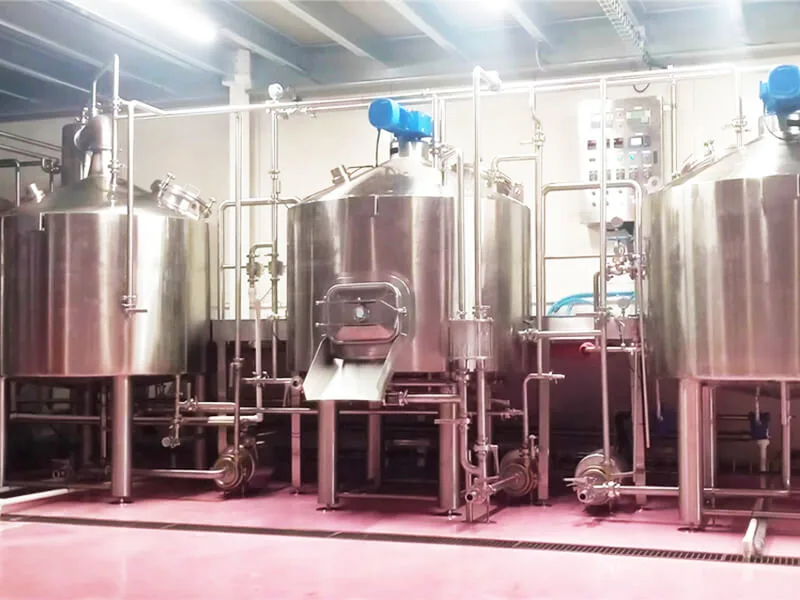
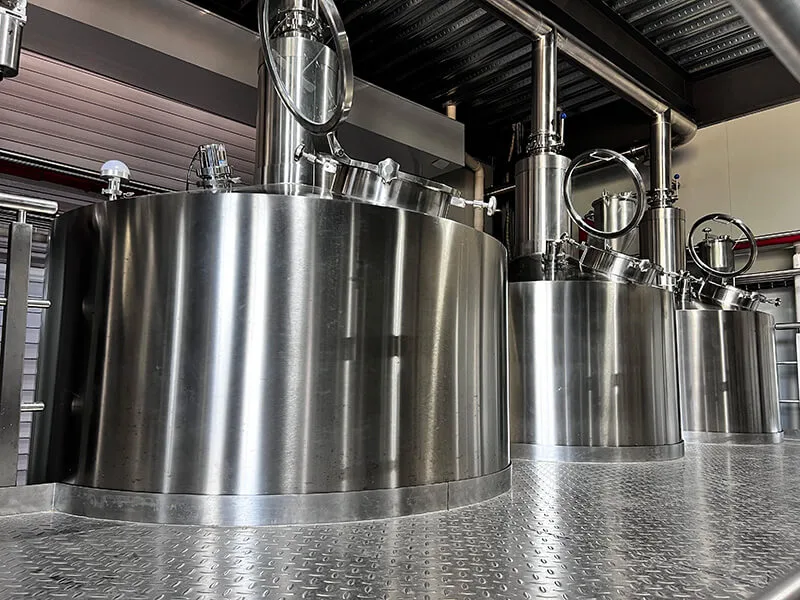
This 1000L brewery project was designed around these requirements. The system combines a 1000L five-vessel brewhouse, 1T and 2T fermenters, a 1T horizontal sake/bright beer tank, dedicated CIP systems, glycol cooling, process water tanks, Siemens PLC control, and dedicated wort, beer, and CIP piping.
With a production capability of approximately 4–6 brews per day, the system is designed for high-utilization craft beer production while maintaining the flexibility required for different beer styles and recipe development.
Project Configuration at a Glance
| System | Main Configuration | Key Purpose |
|---|---|---|
| Malt Milling | Dry mill + vertical conveyor + mash-water mixing unit | Efficient and flexible grain handling |
| Sudhaus | 1000L five-vessel system | Multi-style beer production |
| Vor-Maischebottich | Full-decoction capability | Suitable for traditional brewing processes |
| Läuterbottich | Enlarged diameter, up to 450 kg grist | High-gravity recipe trials |
| Gärung | 1T + 2T fermenters | Flexible Planung der Gärung |
| Horizontal Tank | 1T horizontal tank | Low-static-pressure fermentation/conditioning |
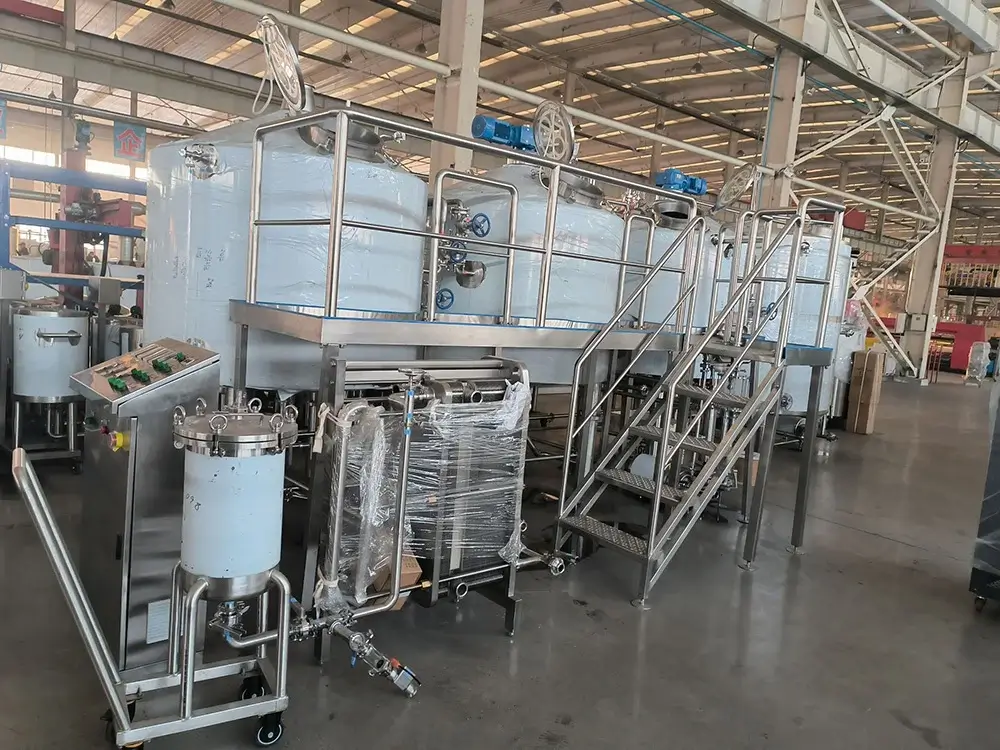
| Water System | 3T ice water + 3T pure water + 3T hot water | Stable process-water supply |
| Kühlung | 3T glycol tank + 10 HP chiller | Wort, fermentation and cold-side temperature control |
| CIP | Two independent CIP systems | Separate brewhouse and fermentation cleaning |
| Control | Siemens PLC + 15-inch HMI | Centralized process monitoring and control |
| Piping | Wort, beer and CIP pipelines | Dedicated sanitary process transfer |
01. Malt Milling Unit: Simple, Flexible and Recipe-Friendly
The brewery uses a dry malt milling system equipped with a vertical conveying device and a mash-water mixing unit at the feed end.
One of the practical advantages of this configuration is its flexibility. Instead of simply transferring dry crushed malt into the mash tun, the system can introduce water during the feeding process, helping reduce clumping and improve mash-in consistency.
This is particularly useful for craft breweries that frequently develop new recipes.
Different beer styles can require different grist compositions and milling strategies. A flexible milling system therefore gives brewers more freedom when experimenting with:
- Different malt percentages
- High-gravity recipes
- Wheat and other specialty grains
- New craft beer styles
- Seasonal and limited-release beers
For breweries focused on product development, flexibility can be just as important as maximum production capacity.
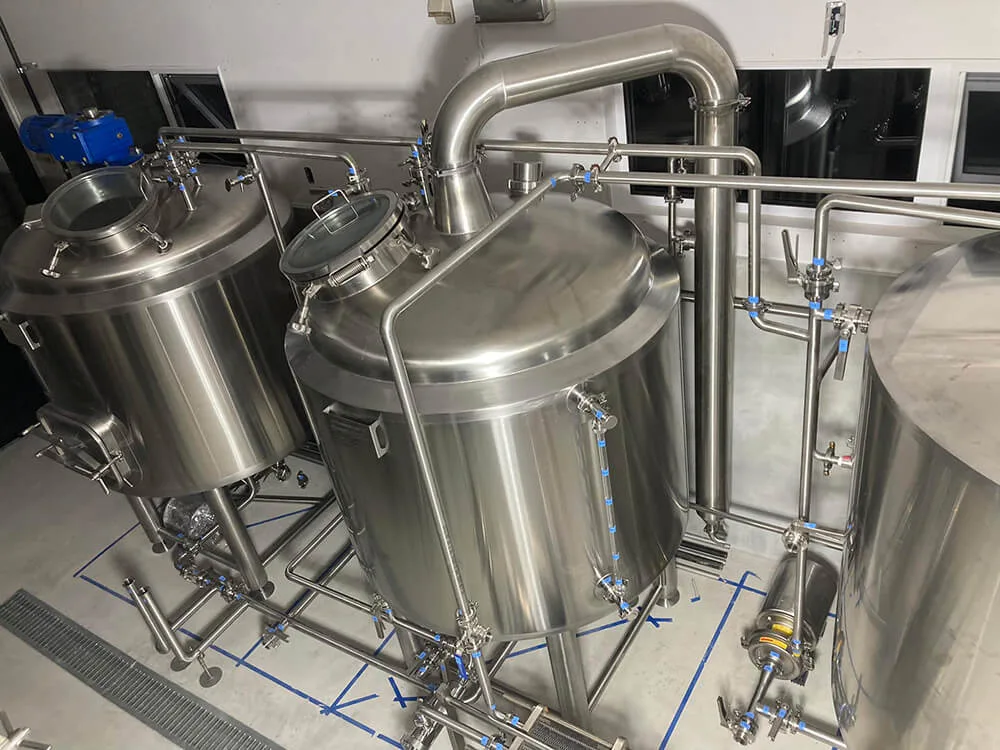
02. 1000L Five-Vessel Brewhouse
The heart of the project is a 1000L five-vessel brewhouse, with a single-batch production capacity of approximately 1,000 liters.
The system consists of:
- Pre-mash tun
- Mash tun
- Lauter tun
- Boiling kettle
- Whirlpool tank
The system is designed for approximately 4–6 brewing batches per day, depending on recipe, brewing process, working schedule and fermentation capacity.
This configuration is particularly suitable for commercial craft breweries that need to balance production efficiency and brewing flexibility.
Why Choose a Five-Vessel Brewhouse?
Compared with a basic two-vessel system, a five-vessel configuration gives the brewer more independent process control.
Different stages—including mashing, lautering, boiling and whirlpooling—can be managed in dedicated vessels. This can help reduce process conflicts and improve production scheduling when multiple batches are brewed in one day.
For breweries producing several beer styles, the additional vessel separation can also make recipe management more flexible.
03. Pre-Mash Tun for Decoction Brewing
The pre-mash tun allows the system to perform decoction-style brewing processes.
Decoction mashing has a long history in Central European brewing and is particularly associated with traditional lager styles such as Czech Pilsner.
The ability to perform a full-decoction process gives brewers greater control when developing beers that aim for:
- Rich malt character
- Complex grain-derived flavors
- Traditional Czech-style profiles
- Full-bodied lager characteristics
As interest in traditional brewing techniques continues among craft brewers, having decoction capability can give a brewery another tool for recipe differentiation.
04. Enlarged Lauter Tun for High-Gravity Brewing
The lauter tun features an enlarged diameter design with a maximum grist capacity of approximately 450 kg.
This is an important feature for breweries that want to experiment with high-gravity recipes or increase extract concentration before dilution or downstream processing.
High-gravity brewing can allow breweries to produce more finished beer from a given brewhouse volume, depending on the recipe and production strategy.
The enlarged lauter tun therefore provides additional room for recipe development while supporting commercial production.
Brewers should nevertheless consider factors such as:
- Grain bill
- Mash thickness
- Lauter performance
- Wort gravity
- Sparging strategy
- Brewhouse efficiency
when determining the practical maximum batch size.
05. Nitrogen Protection for Oxygen-Sensitive Brewing
Oxygen management is an increasingly important topic in modern craft brewing.
This brewhouse incorporates a nitrogen protection system that can introduce nitrogen into the vessel during selected brewing operations to reduce contact between the process and atmospheric oxygen.
Why does this matter?
Uncontrolled oxygen exposure can contribute to oxidation-related flavor changes, particularly when beer moves through the cold side of the process.
The purpose of nitrogen protection is therefore to help brewers create a more controlled brewing environment and reduce unnecessary oxygen exposure.
For breweries focused on maintaining fresh hop character, delicate aromas and consistent beer quality, oxygen management can become an important part of the overall process design.
06. Visual Monitoring and Smart Brewing Control
Each brewhouse vessel is equipped with high-temperature-, water- and impact-resistant cameras, allowing operators to monitor internal vessel conditions.
The system can display operating conditions on large screens and supports remote monitoring through devices such as tablets and mobile terminals, depending on the final control configuration.
The vessels are also equipped with LED status indicators.
Different colors can indicate different operating states, making it easier for operators to understand the condition of each vessel at a glance.
This type of visual monitoring is particularly useful when several brewing processes are running simultaneously.
Instead of relying entirely on manual inspection, operators can obtain a clearer overview of the brewing operation.
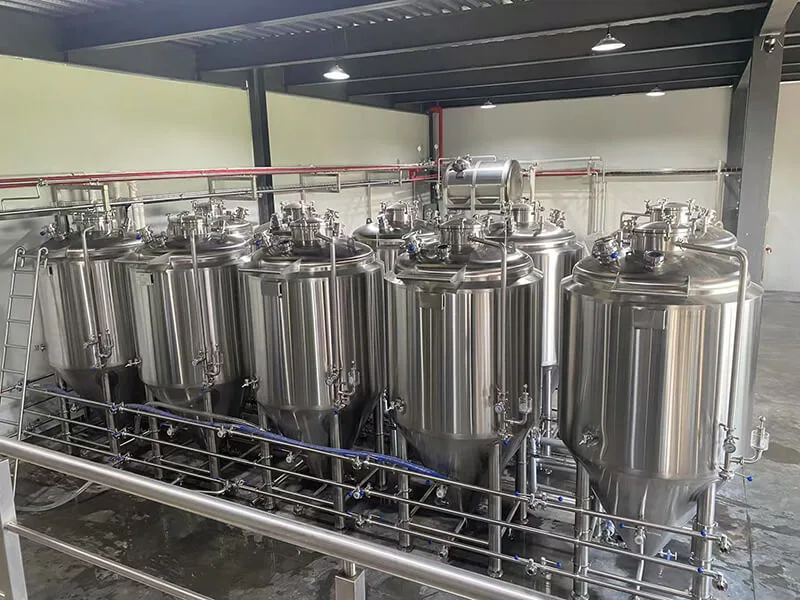
07. Fermentation System: 1T + 2T Tanks for Production Flexibility
The fermentation area combines 1,000L and 2,000L fermenters, together with a 1,000L horizontal tank.
This combination provides greater flexibility than using identical fermenters throughout the brewery.
For example, different tank sizes can be allocated to different production schedules, beer styles or batch combinations.
A brewery producing multiple SKUs may need to manage:
- Core beers
- Seasonal beers
- Limited releases
- High-gravity beers
- Different fermentation durations
Using multiple fermentation capacities can make production planning easier.
The actual annual output depends on fermentation time, beer style, tank utilization, packaging losses, working days and the number of brewing batches.
For this project, the planned production capacity is approximately 2,000 tons per year under the specified operating schedule.
08. Why Consider Horizontal Fermentation?
One of the distinctive features of this project is the use of a horizontal fermentation tank.
Traditional conical fermenters are widely used because their geometry facilitates yeast collection and fermentation management. However, horizontal fermentation provides a different fermentation environment.
The lower liquid column can result in lower hydrostatic pressure compared with a taller vertical tank of similar volume.
For certain ale styles, brewers may intentionally seek fermentation conditions that support stronger yeast-derived aroma development.
Horizontal fermentation can therefore be considered when a brewery wants to explore:
- Fuller mouthfeel
- Stronger yeast-derived character
- Ester-forward ale profiles
- Alternative fermentation techniques
- Traditional or specialty beer styles
It should not be viewed as a universal replacement for conical fermenters. Rather, it gives brewers another fermentation tool for specific recipes and product-development goals.
09. Sight Glasses and Fermentation Observation
The fermentation vessels incorporate sight lamps and observation windows, allowing brewers to observe the fermentation process more directly.
This can help operators monitor:
- Liquid level
- Fermentation activity
- Krausen development
- Hop residue
- Approximate remaining beer volume
Visual access can be particularly useful during recipe trials because the brewer can observe how different yeast strains, temperatures and dry-hopping strategies affect fermentation behavior.
For a craft brewery developing new products, this type of observation can complement data from temperature, pressure and other process sensors.
10. Process Water System
The brewery is equipped with three dedicated process-water tanks:
- 3,000L ice water tank
- 3,000L purified water tank
- 3,000L hot water tank
with corresponding pumps.
Water is one of the most important raw materials in brewing, and its management directly affects both beer quality and production efficiency.
The water system provides a buffer for different brewing and cleaning requirements.
The hot-water tank can support processes such as mashing, sparging and cleaning, while chilled water can be used for cooling-related operations.
For overseas breweries, water treatment should be considered during project planning because local water composition can vary significantly.
Important parameters may include:
- pH
- Calcium
- Magnesium
- Sulfate
- Chloride
- Bicarbonate
- Total hardness
A brewery equipment supplier can customize the water-treatment and storage configuration according to the customer’s local water analysis.
11. Glycol Cooling System
The refrigeration system consists of:
- 3T glycol tank
- 10 HP chiller
- Supporting glycol pipelines
The glycol system provides controlled cooling for the cold side of the brewery.
Temperature control is essential during:
Wort cooling → Fermentation → Cold conditioning → Beer storage
Different yeast strains require different fermentation temperatures, and precise temperature management is therefore critical for maintaining beer consistency.
The glycol system can also provide cooling capacity for multiple fermenters, provided that the chiller, glycol tank and heat-load calculation are correctly matched to the brewery’s production schedule.
When designing a cooling system, overseas customers should consider more than the nominal chiller horsepower.
Key factors include:
- Number and volume of fermenters
- Gärtemperatur
- Ambient temperature
- Number of daily brews
- Wort cooling requirement
- Cold-crashing requirements
- Tank insulation
- Heat load
- Local climate
A properly sized refrigeration system can be significantly more reliable than simply selecting a larger chiller based on horsepower alone.
12. Two Independent CIP Systems
The project uses two independent CIP systems:
- Brewhouse CIP
- Fermentation-area CIP
Separating these cleaning systems provides greater operational flexibility.
Cleaning-in-place is critical in commercial brewing because residues from wort, yeast, hops and beer can become sources of contamination if equipment is not properly cleaned.
A typical brewery CIP process may involve stages such as:
Pre-rinse → Caustic cleaning → Intermediate rinse → Acid cleaning → Final rinse/sanitization
The exact chemical concentration, temperature, contact time and cleaning sequence should be determined according to the equipment, cleaning chemicals and brewery sanitation procedures.
For international projects, CIP design should also consider local water quality, chemical availability, wastewater treatment and operator safety.
13. Siemens PLC Control System
The brewery control system uses Siemens PLC technology with 15-inch industrial display computers.
Two control stations are provided:
Station 1: Brewhouse operation
Station 2: Fermenters and auxiliary systems
Centralized control allows operators to manage key brewing parameters more efficiently.
Depending on the final automation configuration, the control system can monitor and manage parameters such as:
- Temperatur
- Pumpenbetrieb
- Valve status
- Vessel levels
- Fermentation conditions
- Cooling operation
- Brewing sequences
For overseas brewery owners, automation is particularly valuable when production volume increases and process consistency becomes more important.
However, automation should be designed around the brewer’s actual workflow rather than simply adding as many automated functions as possible.
14. Sanitary Auxiliary Pipeline System
The brewery’s auxiliary piping system includes three main categories:
Wort pipelines
Used for transferring wort between brewing vessels and the wort cooling system.
Beer pipelines
Used for transferring finished or partially processed beer between fermentation, conditioning and downstream equipment.
CIP pipelines
Dedicated for cleaning solutions and rinsing water.
Separating process lines according to their function helps simplify operation and supports sanitary production.
For international brewery projects, customers should also pay attention to:
- Pipe diameter
- Pipe material
- Weld quality
- Internal surface finish
- Valve type
- Dead-leg design
- Drainability
- CIP coverage
- Connection standards
These details can have a significant impact on long-term cleaning performance and maintenance.
15. What Makes This 1000L Brewery Different?
The key strength of this project is not simply its 1,000L batch size.
It is the combination of production capacity, recipe flexibility, fermentation diversity and process automation.
The system gives the brewer the ability to:
- Produce multiple batches per day
- Develop new beer recipes
- Perform decoction brewing
- Experiment with high-gravity recipes
- Use different fermentation tank sizes
- Explore horizontal fermentation
- Improve oxygen management
- Monitor brewing processes visually
- Separate brewhouse and fermentation CIP
- Centralize process control
- Manage brewing water and cooling independently
This makes the system suitable for breweries that are moving beyond small-scale experimentation and entering a more structured commercial production stage.
16. Key Considerations Before Buying a 1000L Brewery
For overseas customers planning a new brewery, tank volume should not be the only purchasing criterion.
Before requesting a quotation, it is recommended to define:
Production Target
Determine the required annual production rather than simply asking for a “1000L brewery.”
Zum Beispiel:
Batch size × brews per day × brewing days × annual operating schedule
This gives a much more realistic picture of required capacity.
Beer Portfolio
Will the brewery produce mainly lagers, ales, IPAs, wheat beers, stouts or specialty beers?
The beer portfolio affects brewhouse configuration, fermentation capacity, temperature control and dry-hopping requirements.
Fermentation Capacity
In many breweries, fermentation capacity becomes the real production bottleneck—not brewhouse capacity.
A 1000L brewhouse with insufficient fermenters cannot achieve its theoretical brewing capacity.
Automatisierungsgrad
Customers should decide whether they need:
- Manual control
- Semi-automatic control
- Fully automatic control
- Fernüberwachung
- Rezeptverwaltung
- Automated CIP
The best configuration depends on production scale and available operators.
Local Standards and Utilities
Before equipment manufacturing, international customers should confirm local requirements for:
- Electrical standards
- Voltage and frequency
- Pressure vessel regulations
- CE/PED or other applicable certifications
- Steam or heating requirements
- Water quality
- Entwässerung
- Wastewater
- Factory ventilation
- Installation space
These factors should be confirmed during the engineering stage rather than after the equipment has been manufactured.
17. A Brewery Designed for Growth
A commercial brewery should not only solve today’s production requirements. It should also leave room for tomorrow’s expansion.
A 1000L system can serve as a practical production platform for breweries that want to establish their brand, test different recipes and gradually expand their market.
As demand grows, expansion may focus on:
- Additional fermenters
- Larger glycol capacity
- More cold storage
- Packaging equipment
- Automated CIP
- Additional brewing vessels
- Larger malt handling systems
- Water-treatment systems
This modular approach allows the brewery to expand according to actual market demand rather than making an unnecessarily large initial investment.
Schlussfolgerung
This 1000L five-vessel brewery project demonstrates how modern craft brewing equipment can combine traditional brewing techniques with intelligent process control and commercial production efficiency.
The decoction-capable brewhouse supports traditional beer styles, while the enlarged lauter tun provides flexibility for high-gravity recipe development. The combination of vertical and horizontal fermentation vessels gives brewers additional options for developing different flavor profiles.
Meanwhile, dedicated water, glycol, CIP, control and pipeline systems create a more complete production environment.
For overseas brewery investors, the most important consideration is not simply choosing a tank size. The brewery should be engineered as an integrated production system, where brewhouse capacity, fermentation volume, cooling, water, CIP, automation and future expansion are designed to work together.
METO can customize brewery systems according to production capacity, beer styles, local utility conditions, automation requirements and available installation space, from individual brewing systems to complete turnkey brewery projects.