Discover the key steps behind every great bottle of wine—crafted with care, from grape to glass.
1. Harvesting
When is the perfect time to pick the grapes? It depends on sugar, acidity, and flavor ripeness—winemakers carefully monitor these to capture the best balance.
Grapes can be harvested by hand or machine:
- Hand-picking: Gentle and precise. Ideal for premium wines—it minimizes damage and allows selective picking of the best bunches.
- Machine harvesting: Fast and efficient, but less selective.
Fun fact: Some wineries harvest at night to keep grapes cool and reduce oxidation.
2. Sorting & Destemming
After harvest, grapes go through sorting to remove leaves, stems, and underripe or damaged fruit.
- Red wines: May be fermented as whole clusters (with stems) for added complexity.
- White wines: Always destemmed to avoid bitter compounds from stems.
✅ Our gentle destemmer-sorter ensures >98% stem removal while protecting berry integrity—and can adjust whole-cluster ratios for different styles.
3. Crushing & Cold Soak
Grapes are lightly crushed—just enough to break the skins and release juice, without crushing seeds (which can add harsh tannins).
Then comes cold soaking:
- For whites: Enhances fresh fruit aromas and texture.
- For reds: Deepens color and boosts fruit character—without extracting too much tannin.
4. Pressing
- White wines: Pressed right after harvest to separate juice from skins.
- Red wines: Pressed only after fermentation, once color and flavor have been extracted.
✅ Our pneumatic press delivers clean, high-quality juice—gentle on skins and seeds, with 12% higher yield than traditional presses.
5. 发酵
Yeast transforms grape sugar into alcohol and CO₂—turning juice into wine! Temperature control is critical for flavor and aroma.
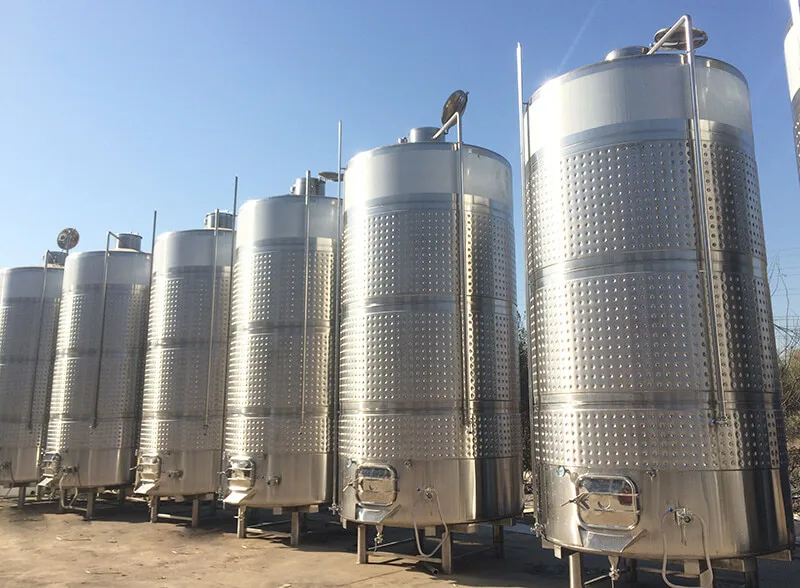
✅ Our temperature-controlled fermenters feature built-in cap management and cooling jackets, ensuring consistent, hands-off fermentation.
Standard Configurations of Our Wine Fermentation Tanks:
Our wine fermentation tanks are designed with a professional winemaking workflow in mind. Each tank is supplied with the following standard features:
- Material: Food-grade SUS 304 stainless steel (SUS 316 available on request)
- Surface finish: Internal mirror polish Ra = 0.4 μm for easy cleaning, external brushed finish
- Top manway / lid: Round, designed for filling, inspection, and cleaning.
- Side manway: Oval or rectangular, essential for red wine tanks, allowing easy marc removal.
- CIP spray ball: Fixed or rotating type, compatible with automatic cleaning systems.
- Cooling jacket: Laser welding dimpled plate jackets for precise fermentation temperature control.
- Thermowell & sampling valve: For monitoring and quality control during fermentation.
- Bottom design: Cone-shaped or sloped bottom ensures complete drainage and easy discharge.
- Butterfly valves: Sanitary-grade valves for racking and discharge.
- Legs with adjustable feet: Heavy-duty stainless steel legs with height adjustment for uneven floors.
- Pressure relief valve / vent: Ensures safe fermentation gas release.
- Welding & construction: TIG welded, 100% pickled and passivated for corrosion resistance.
6. Aging & Maturation
Wine matures in tanks or oak barrels—new barrels add spice and structure; older ones focus on smoothness.
Red wines often age for months or even years. Regular stirring and topping up prevent oxidation.
✅ Smart aging systems automatically track evaporation and adjust stirring frequency—softening tannins and improving mouthfeel.
7. Clarifying & Bottling
Before bottling, wine is either filtered or naturally clarified to ensure clarity and stability. Oxygen exposure is minimized to preserve freshness.
✅ Our sterile bottling line handles everything—from clarification to sealing—with options for cork, screw cap, or glass stopper. Zero contamination. Perfect consistency.
A Note from Our Winemakers:
“Great wine starts in the vineyard—but the right equipment unlocks its full potential. Precision, hygiene, and gentle handling at every step make all the difference.”
Our winemaking solutions support every stage—from small boutique wineries to large-scale producers—with customizable capacity and food-grade materials that meet global standards.