As craft beer continues to integrate with the food and beverage industry, a growing number of restaurants are choosing to install their own brewing systems. This approach not only delivers genuinely fresh beer but also builds a differentiated brand identity. However, designing and selecting a brewing system for a restaurant operation involves multiple technical considerations—far more than simply buying a few tanks. This article covers four areas: system types, sizing, key component functions, and design codes, using a real-world 500-liter brewhouse configuration as a reference.
1. Three Main Types of Restaurant Brewing Systems
Depending on production mode, available space, and operator skill level, restaurant brewing systems fall into three categories.
Type 1: Integrated Automated Brewing System
This type integrates mashing, lautering, boiling, and whirlpooling into two or three vessels, operated via a central control panel. Advantages include a small footprint and lower skill requirements for operators. Suitable for restaurants producing one batch per day, with an annual output of 50 to 300 hectoliters. Two-vessel and three-vessel systems are the most common configurations on the market.
Type 2: Modular Micro Brewing System
Each vessel—mash tun, lauter tun, brew kettle, whirlpool—is separate. This layout offers high process flexibility but requires more floor space and skilled brewers. Best suited for beer-focused restaurants or brewpubs with an annual output above 300 hectoliters.
Type 3: Cask Brewing System
Open fermentation vessels combined with cask conditioning, used mainly for traditional English ale styles. Lower initial investment, but fermentation cycles are longer and hygiene management is demanding. Suitable for niche restaurants focusing on retro or heritage styles.
Based on recent restaurant installations, the two-vessel brewhouse (mash/lauter combined, kettle/whirlpool combined) offers the best balance among investment, operability, and product consistency. The following sections analyze a 500-liter two-vessel system, a size that covers the needs of most small to medium restaurant operations.
2. How to Determine System Size
Choosing the right system size requires three pieces of information—not guesswork.
First, daily beer consumption.
Assume a restaurant consumes 150 liters of craft beer per day on average, and brews twice per week. The minimum single-batch brewhouse capacity is:
150 L/day × 7 days/week ÷ 2 batches/week = 525 L
Rounded up to the nearest standard size: a 500-liter brewhouse.
Second, available space.
A 500-liter two-vessel brewhouse occupies approximately 12 to 18 square meters of floor space (equipment footprint only). Additional space is required for operation: at least 1 meter of clearance at the front, side access for manway opening and cleaning, and rear access for piping maintenance. In practice, a dedicated operation room of 20 to 25 square meters is the minimum.
Fermentation tanks are typically not placed in the brewhouse room. Instead, they go into a separate cold room or temperature-controlled space. The most common constraint here is ceiling height. A 1000-liter unitank, including legs and top safety valve, often exceeds 2.6 meters in total height. Some restaurant basements or street-level units have ceiling heights of only 2.3 to 2.4 meters, making installation impossible. Therefore, before confirming floor area, measure the clear height of the installation space.
Third, utility conditions.
A 500-liter system requires a steam generator rated between 90 and 120 kW. For electric heating, a dedicated three-phase power line is necessary. For gas heating, confirm that the existing gas pipe diameter and flow rate meet the demand. For cooling water: after each batch, a plate heat exchanger must cool hot wort from 95°C to around 20°C, consuming approximately 3 tons of cooling water per hour. If cooling water storage is insufficient or the cold water tank is undersized, heat exchange efficiency drops significantly, affecting wort clarity and subsequent fermentation stability.
3. Key Components of a 500-Liter Restaurant Brewing System
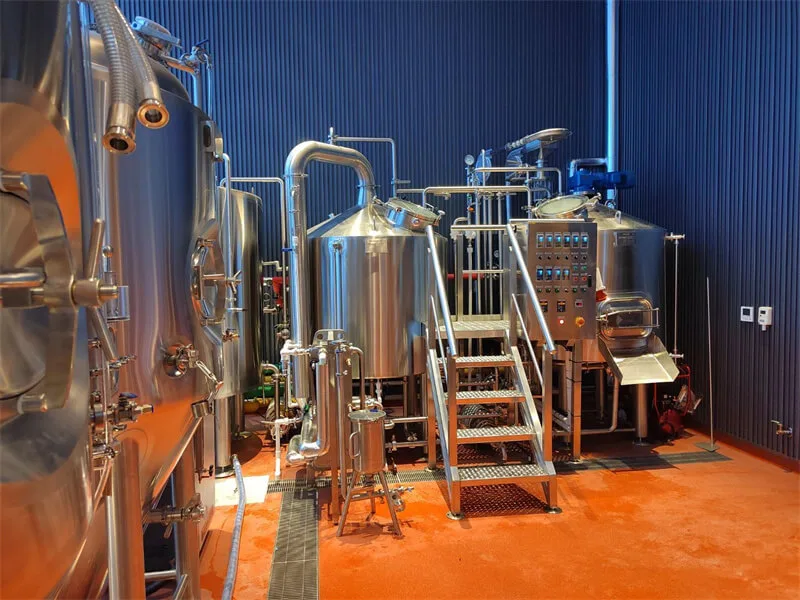
The following section describes an actual restaurant brewing system that has been in operation for two years, producing 120 to 180 liters of beer per day. Each major component is explained in terms of function and sizing rationale.
3.1 Malt Milling System
A roller mill with a capacity of 300–500 kg/h. Malt passes between two rollers; the gap determines crush fineness. The basic requirement: husks remain as intact as possible to serve as a natural filter bed, while the endosperm breaks into coarse grits for enzyme access and sugar extraction. Too many fines lead to a stuck mash and difficult sparging. Too many whole grains reduce extract efficiency. The 300–500 kg/h capacity provides ample margin for a 500-liter system—each batch uses about 100–150 kg of malt, with a crush time of 15 to 20 minutes. This can run in parallel with hot water heating, adding no extra cycle time.
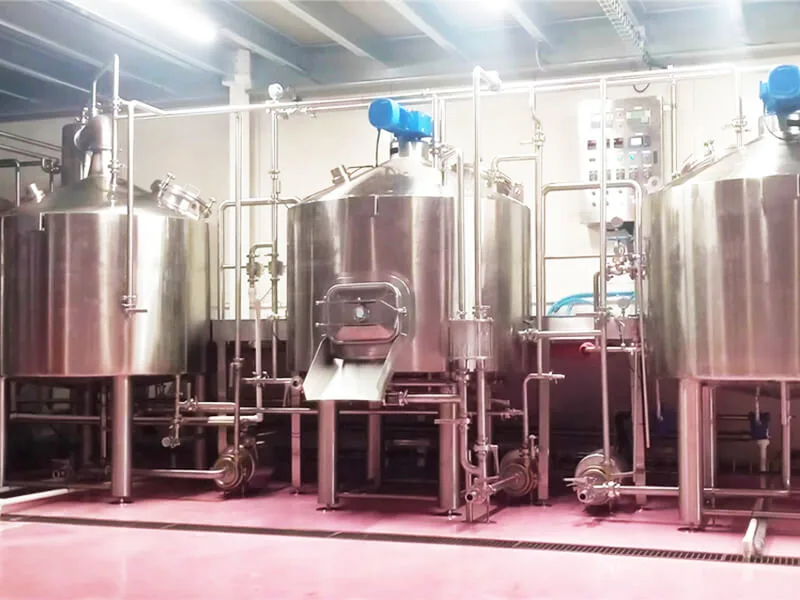
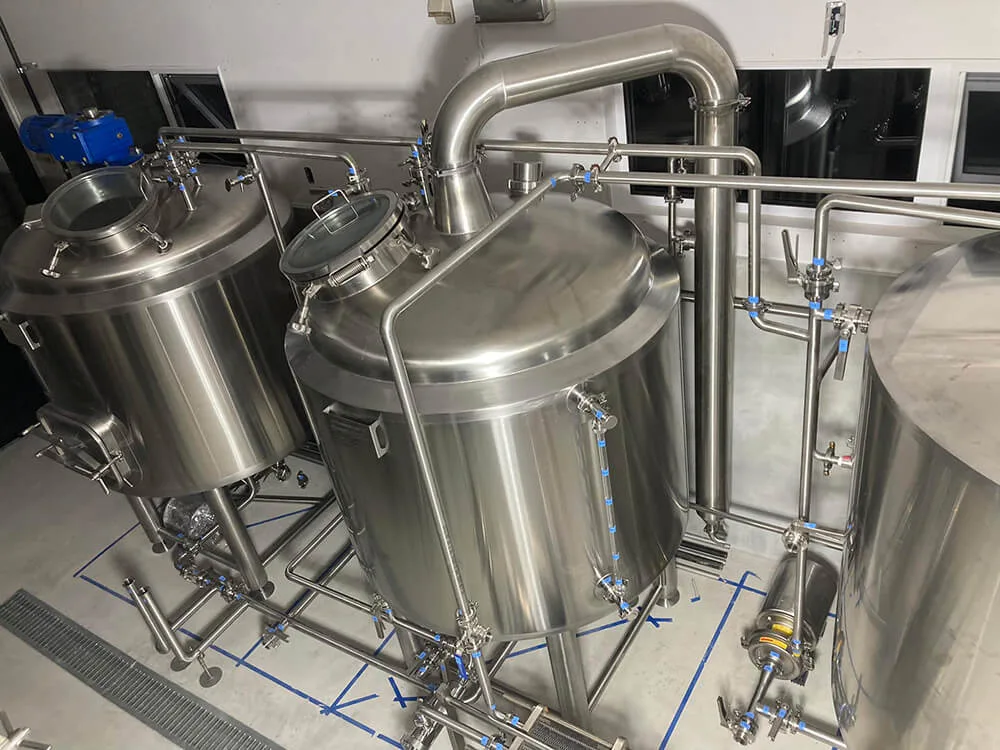
3.2 500-Liter Two-Vessel Brewhouse
- Mash/Lauter Tun (MLT) : Combines mashing and wort lautering. A stainless steel false bottom at the base allows gravity drainage of wort. A raking mechanism (slowly rotating tines) prevents the grain bed from compacting during lautering. Operation sequence: after mashing, recirculate wort until clear, then open the outlet valve to drain wort slowly while simultaneously spraying sparge water from the top.
- Kettle/Whirlpool Tun (KWT) : Receives wort from the MLT, then boils for 60 to 90 minutes. Hops are added in three stages. Boiling intensity is controlled to evaporate 8% to 10% of the volume per hour. After boiling, wort is pumped tangentially into the vessel to create a vortex, allowing trub and hop debris to accumulate in a cone at the center. Clear wort is drawn from the side port and sent to the plate heat exchanger.
- Heating method : Steam heating. Compared to electric heating, steam offers two clear advantages: faster ramp-up (10 to 15 minutes from mash-out to boiling), and no localized scorching at the bottom of the kettle. Many early restaurant installations using electric heating reported caramelized residues forming on the kettle bottom, affecting beer flavor. Steam largely avoids this problem.
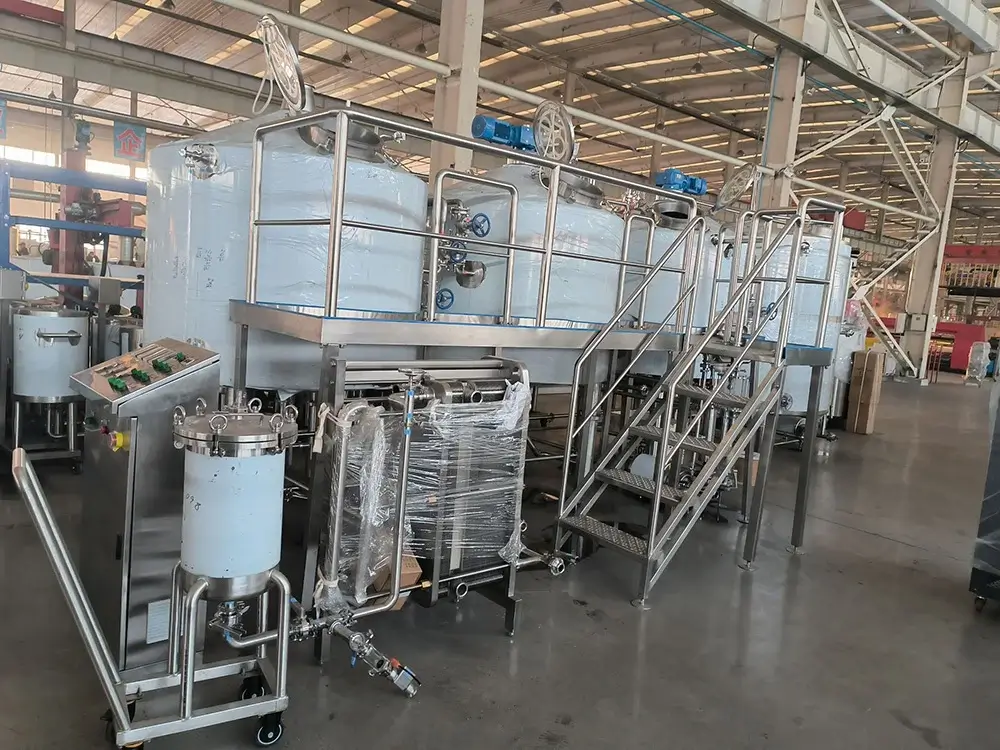
3.3 Hot Water Tank
A 1500-liter hot water tank, also steam-heated, paired with a 3-ton/hour hot water circulation pump. The role of the hot water tank is often underestimated. Mashing, sparging, and CIP cleaning all require a steady supply of hot water. Each batch of a 500-liter system uses approximately 400 to 600 liters of sparge water. A 1500-liter hot water reserve means three consecutive batches can be produced without reheating. The 3-ton/hour circulation pump ensures that hot water reaches the MLT, KWT, and CIP station quickly, avoiding temperature drop due to pipe transport delay.
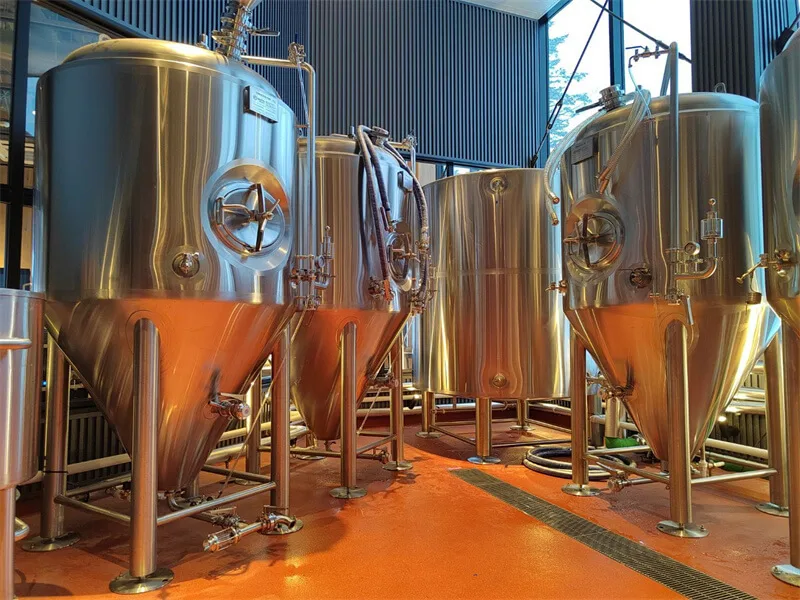
3.4 Fermentation and Conditioning Tank Farm
The fermentation tank configuration for this system:
- 5 × 1000-liter unitanks
- 2 × 500-liter unitanks
One question arises: the brewhouse produces 500 liters per batch, so why use 1000-liter unitanks? The answer lies in a process called high-gravity dilution. The wort is brewed at a higher original gravity (e.g., 14°P), and after fermentation begins, sterile deoxygenated water is added to dilute to the target gravity (e.g., 12°P). In this way, a 500-liter batch of high-gravity wort yields 800 to 1000 liters of finished beer. With the same brewhouse equipment, actual output nearly doubles. The combination of five 1000-liter and two 500-liter tanks provides a total vessel volume of 6000 liters. With two to three brew days per week, this arrangement supports a continuous and stable beer supply—neither out-of-stock nor excessive inventory. All unitanks are fitted with side manways. This detail matters greatly during cleaning: operators can inspect and wash the tank interior without climbing inside, significantly reducing maintenance difficulty and labor intensity.
3.5 Cold Water Tank
A 1500-liter cold water tank, maintained at 2 to 4°C. Two main functions: first, supplying the plate heat exchanger to cool hot wort from 95°C down to approximately 20°C (yeast pitching temperature); second, acting as a buffer tank for the glycol cooling system. The thermal capacity of 1500 liters of cold water is sufficient to cool two batches of wort without starting the chiller for forced cooling. This design reduces energy consumption and keeps fermentation temperature control more stable.
3.6 Digital Control System
A PLC-based full automation system with a touchscreen HMI. The interface is divided into functional modules:
- Mashing control : Set target temperatures and hold times for each step; the system automatically modulates the steam valve to follow the profile.
- Pump and valve control : Automatically start and stop pumps and switch valves according to pre-programmed sequences.
- Контроль брожения : Set an independent temperature profile for each tank. For example, 7 days of primary fermentation at 20°C for an ale, followed by a drop to 2°C for cold conditioning.
- Data logging : Automatically record gravity, temperature, pH, and volume for each batch, with export capability for traceability and process optimization.
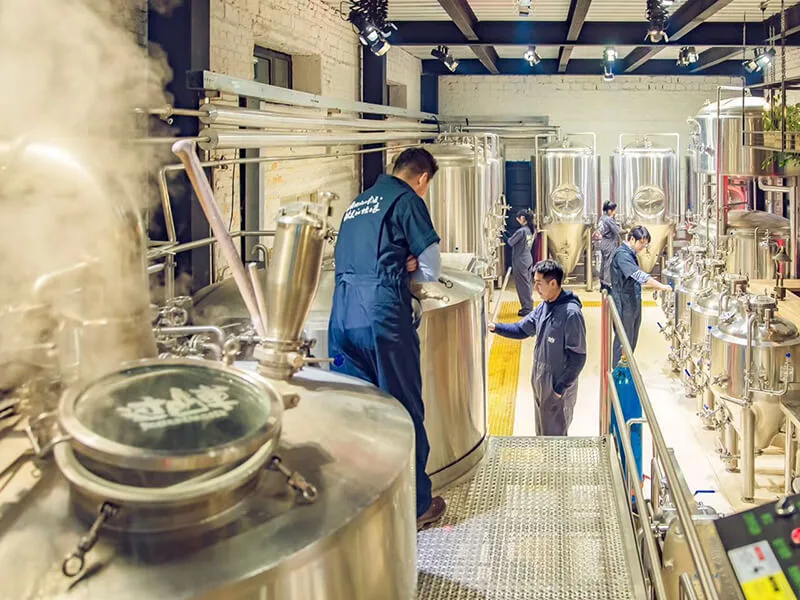
The main value of this control system for a restaurant is reducing reliance on specialized brewing staff. An employee with no brewing experience can launch a batch after half a day of training, following the recipe parameters displayed on the screen. All critical parameters are locked into the program, minimizing the margin for human error.
4. Key Standards and Codes for Restaurant Brewery Design
Although a restaurant brewing system is small in scale, it must still comply with requirements for food safety, fire protection, wastewater discharge, and operator safety. The following aspects are where project issues most frequently arise.
4.1 Food Safety and Hygienic Design
All metal parts in contact with wort or beer must be 304 or 316 stainless steel, with interior surfaces mechanically polished to Ra ≤ 0.8 μm. Surfaces with lower gloss will develop biofilm over time, which routine cleaning cannot remove.
The CIP system must cover the brewhouse, fermentation tanks, process piping, and plate heat exchanger. Caustic wash temperature ≥80°C, acid wash temperature ≥60°C. After each cleaning cycle, measure the pH of residual water in the piping to confirm no caustic residue remains before the next batch.
Fermentation tanks and bright beer tanks must be designed as pressure vessels, with a minimum working pressure rating of 2.5 bar. This requirement is not only about safety—pressure-rated tanks are necessary for isobaric transfer and forced carbonation.
4.2 Building and Fire Safety
A physical barrier must separate the brewing room from the restaurant dining area—soft curtains or simple partitions are not acceptable. The brewing room must maintain slight negative pressure, with exhaust fans removing steam and malt odors to the outside. Otherwise, the dining area becomes unpleasant.
For steam-heated systems, the boiler room must be separated from other areas. Gas lines must be equipped with leak detection sensors and automatic shutoff valves. Some restaurant owners place steam generators in corners without enclosures, and fail the initial gas company inspection.
Alcohol-based materials (e.g., high-gravity beer, ethanol for cleaning) must be stored in dedicated flammable-liquid cabinets. Total storage quantity must not exceed local fire code limits for restaurants. These limits vary by city; confirm them during the design and permitting phase.
4.3 Water Supply, Drainage, and Environmental Compliance
Every liter of beer produced generates approximately 3 to 7 liters of wastewater, primarily from cleaning, cooling water discharge, and pipe flushing. This wastewater has a high organic load (COD typically 2000–6000 mg/L). Direct discharge into the municipal sewer system often violates local limits.
The standard solution: install a bar screen and an equalization tank. The bar screen captures spent grain and large solids. The equalization tank balances flow and composition. The effluent from the equalization tank must be neutralized to a pH between 6.5 and 8.5 before discharge into the municipal sanitary sewer. Check specific discharge limits with the local water authority.
Wet spent grain cannot be left overnight in the restaurant. Each batch produces approximately 150–200 kg of wet grain. In summer heat, it begins to sour within half a day. Arrange for same-day removal, or store in sealed containers for next-morning pickup.
4.4 Operator Workspace and Safety
Any location requiring elevated work (e.g., adding hops to the kettle, cleaning a fermenter manway) must have a fixed platform or a mobile ladder with guardrails. Guardrail height must be at least 1.05 meters, with an intermediate rail.
Steam piping and the outer surface of the brew kettle must be insulated (typically mineral wool with a stainless steel cladding) and clearly marked with burn hazard warnings. There have been cases where a restaurant employee cleaning the floor near the brew kettle accidentally touched an uninsulated steam pipe and suffered severe burns.
5. Closing Remarks
A brewing system suitable for restaurant operation is not judged by the quantity of stainless steel or the number of tanks, but by whether its components work together under real production schedules. The 500-liter two-vessel system described above—from milling to fermentation to automation—has each component sized with a clear process rationale. A 300–500 kg/h mill for 100–150 kg of malt per batch. A 1500-liter hot water tank to support three sparges. Five large unitanks plus two smaller ones to create a continuous production rhythm. These choices are not guesswork; they follow from capacity calculations and operational cadence.
For restaurants considering installing their own brewing system, before purchasing equipment, visit at least three similar completed projects and work with an engineering firm that has specific experience with restaurant breweries. Details such as floor drain slope, elimination of dead legs in piping, and refrigerant flow direction are not obvious on 2D drawings, but once construction is complete, retrofitting is expensive and disruptive.
Свяжитесь с нашей инженерной командой today to get a customized nano brewery equipment solution.