1. Understanding the Complete Whisky Production Process
Building a whisky distillery requires more than selecting a suitable still. It involves integrating multiple production stages into a coordinated system, from raw material preparation and wort production to fermentation, distillation, spirit collection, and oak cask maturation.
Each stage has a direct influence on production efficiency, spirit quality, and the final whisky style.
A complete whisky production line generally consists of six major sections:
- Grain Milling and Preparation
- Mashing and Wort Production
- Sistema de fermentação
- Copper Pot Still Distillation
- Spirit Collection and Temporary Storage
- Oak Cask Maturation
The equipment configuration depends on the raw materials, target production capacity, distillation method, desired flavor profile, and future expansion plans.
For a new distillery, these factors should be considered together rather than selecting individual machines independently.
At METO, we provide integrated whisky distillery equipment solutions, combining brewing systems, fermentation tanks, copper distillation equipment, and supporting process systems to help customers establish a coordinated production line.
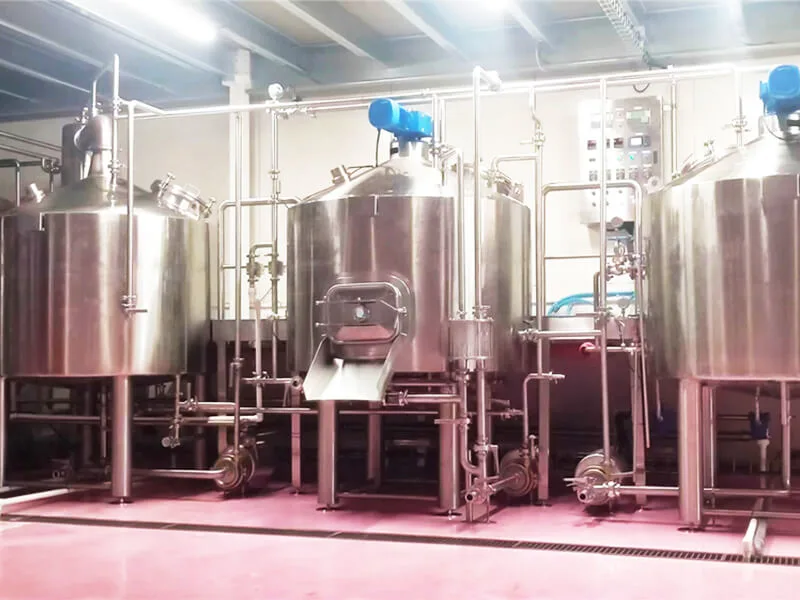
2. Brewing System: Establishing the Foundation of Whisky Flavor
The brewing system is the first major processing stage in whisky production. Its primary function is to convert grain starches into fermentable sugars and prepare a suitable wash for fermentation.
Although distillation determines how alcohol and flavor compounds are concentrated and separated, the quality of the fermented wash establishes the foundation of the final spirit.
During fermentation, yeast produces alcohol alongside esters, higher alcohols, organic acids, and other flavor compounds. These compounds contribute to the flavor precursors carried into the distillation process.
A properly designed brewing system therefore needs to balance raw material preparation, sugar extraction, temperature control, and process consistency.
2.1 Grain Milling: Preparing the Raw Materials
Grain milling is the starting point of whisky production.
A professional dual-roller malt mill is commonly used to crush malt while maintaining the integrity of the husks.
The objective is not simply to grind the grain into smaller particles. Instead, the milling process needs to expose the starch inside the grain while keeping the husks sufficiently intact.
This is particularly important because the husks can help form a natural filtration bed during lautering.
An appropriate milling configuration helps achieve:
- Consistent particle size distribution
- Effective starch accessibility
- Reduced flour generation
- Improved lautering performance
- More stable wort separation
For larger production systems, milling capacity should be matched with the batch size and mashing schedule to avoid bottlenecks in the production process.
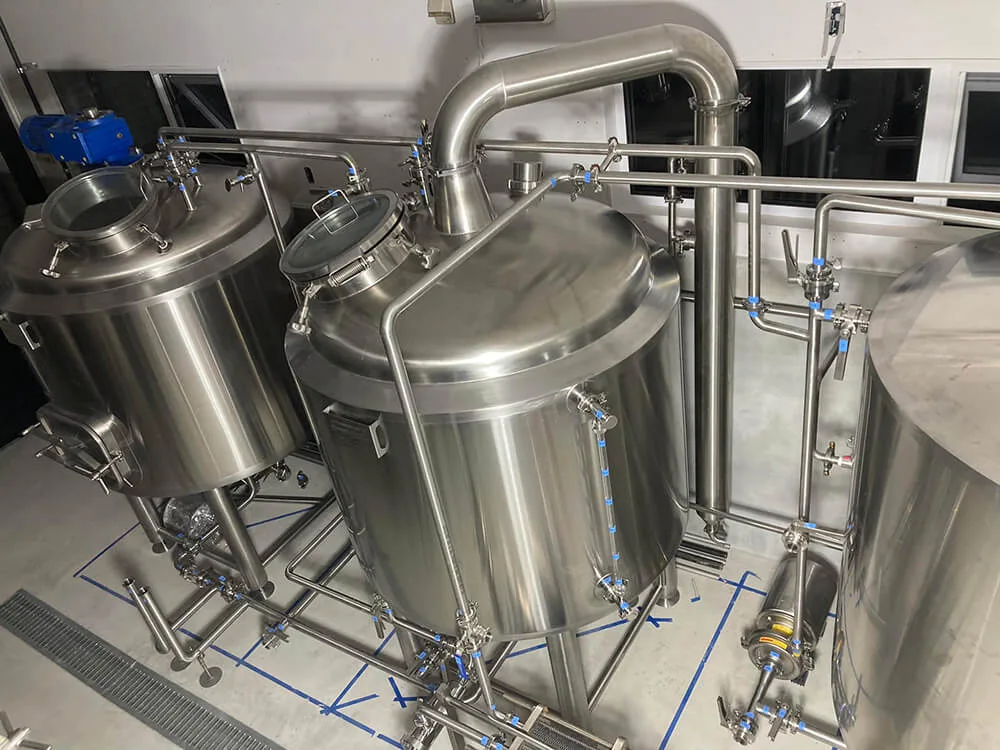
2.2 Mashing System: Converting Starch into Fermentable Sugars
After milling, the crushed grain is transferred into the mash tun.
During mashing, hot water is mixed with the grist to activate malt enzymes, which convert starch into fermentable sugars and other soluble compounds.
For the whisky production configuration described here, a single-step mashing process at approximately 65–68°C is used.
This temperature range provides a practical starting point for enzymatic conversion, although the actual operating temperature and holding time should be adjusted according to the malt specification, grain composition, and desired wort characteristics.
The main equipment considerations include:
- Mash tun capacity and heating method
- Efficient grain and water mixing
- Temperature monitoring and control
- Wort circulation and transfer
- Drainage and spent grain discharge
For distilleries using different grain formulations or unmalted raw materials, additional preparation and cooking equipment may be required.
2.3 Lautering and Wort Transfer
After mashing, the liquid wort needs to be separated from the spent grain.
A lauter tun or an integrated mash-lauter vessel can be selected according to the production scale and process requirements.
The filtration system should provide sufficient separation capacity while minimizing excessive solids carryover.
The clarified wort is then transferred to the fermentation stage.
A well-designed transfer arrangement helps reduce unnecessary handling, maintain process consistency, and simplify cleaning between batches.
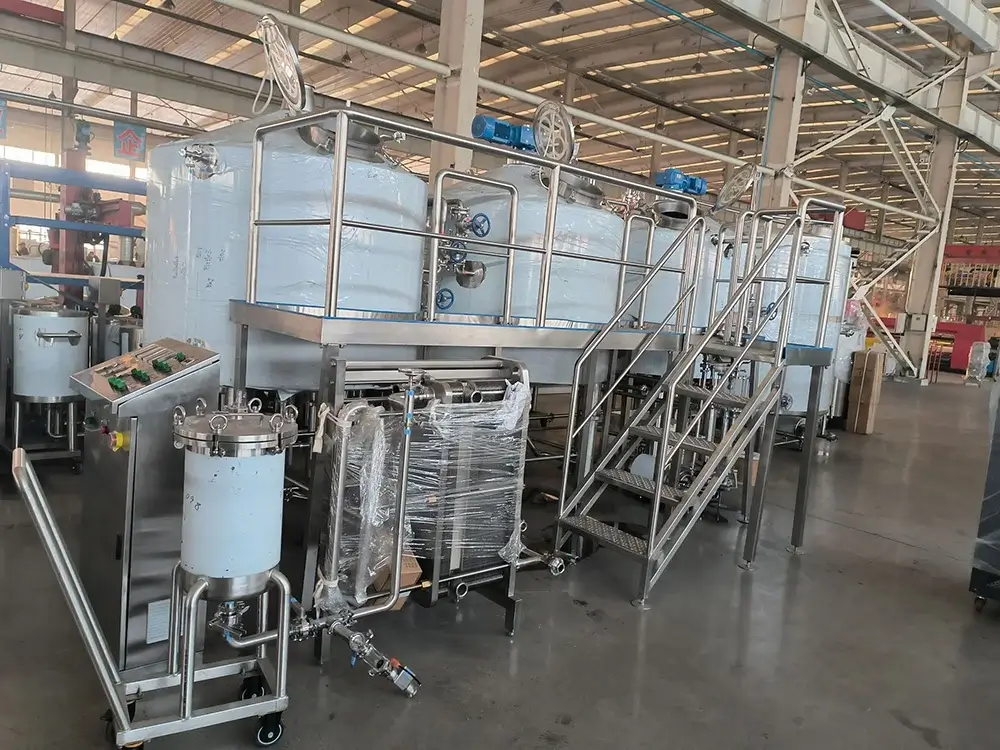
3. Fermentation System: Developing the Flavor Precursors
Fermentation is one of the most important stages in determining the character of whisky.
After the wort is prepared, yeast is introduced into the fermentation tank. Yeast converts fermentable sugars into ethanol and produces a range of secondary flavor compounds.
These include esters, higher alcohols, and organic acids, which contribute to the fruity, floral, malty, and other characteristic notes of the fermented wash.

3.1 Temperature-Controlled Fermentation Tanks
The fermentation system generally consists of stainless steel fermentation tanks equipped with temperature-control jackets, insulation, sanitary connections, and cleaning components.
The configuration should consider:
- Tank working volume and batch size
- Fermentation temperature range
- Cooling jacket design
- Yeast addition and sampling ports
- CIP cleaning connections
- Drainage and discharge arrangements
- Pressure requirements, where applicable
Stainless steel is widely used because it offers good corrosion resistance, hygienic process conditions, and ease of cleaning.
Depending on the production requirements, SUS304 or SUS316L materials can be considered.
3.2 Fermentation Time and Flavor Development
For the whisky project configuration described here, the fermentation period is approximately 48–120 hours.
However, fermentation time is not a fixed parameter for every whisky producer.
It depends on yeast strain, wort composition, fermentation temperature, original gravity, and the desired flavor profile.
Shorter fermentation periods may be used to achieve a different balance of fermentation characteristics, while longer fermentation can encourage the development of additional flavor compounds.
The fermentation system should therefore provide reliable temperature monitoring and sufficient operational flexibility.
3.3 Integrated Cooling System
Temperature control is essential for stable yeast activity.
An integrated glycol cooling system can supply cooling to multiple fermentation tanks through insulated pipelines and individual control valves.
The system should be designed according to:
- Total fermentation tank volume
- Number of tanks operating simultaneously
- Heat generated during fermentation
- Required temperature reduction
- Ambient operating conditions
Correct cooling capacity helps maintain consistent fermentation conditions and supports continuous production scheduling.
The completed wash is then transferred to the distillation system.
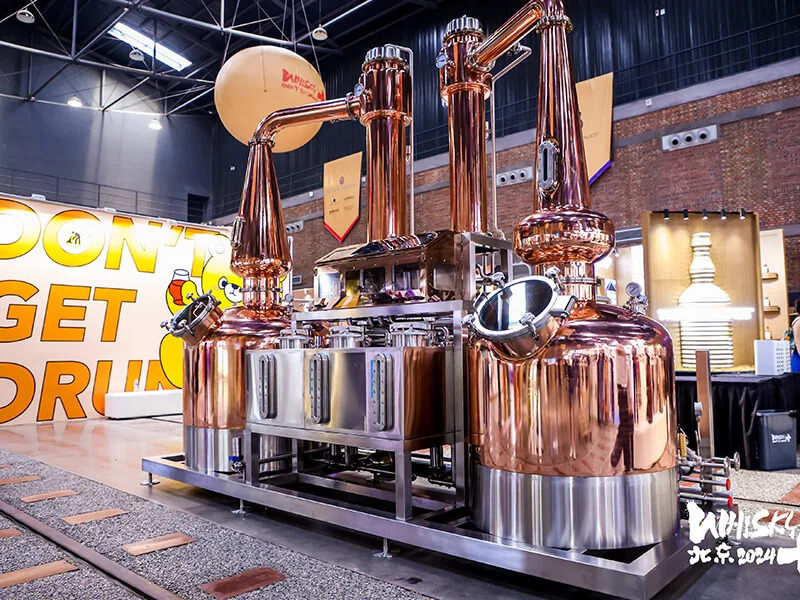
4. Whisky Distillation System: Copper Pot Still Design and Equipment Configuration
The distillation system is the central equipment section of a whisky distillery.
Its purpose is to separate and concentrate alcohol and flavor compounds from the fermented wash while developing the desired spirit character.
Traditional whisky production commonly uses copper pot stills for batch distillation.
A conventional double-distillation configuration includes two primary units:
- Wash Still: Performs the first distillation of the fermented wash.
- Spirit Still: Performs the second distillation of the low wines and separates the desired spirit fraction.
The equipment configuration can be customized according to production capacity, distillation philosophy, and target spirit style.
4.1 Copper Pot Still: Structure and Material Selection
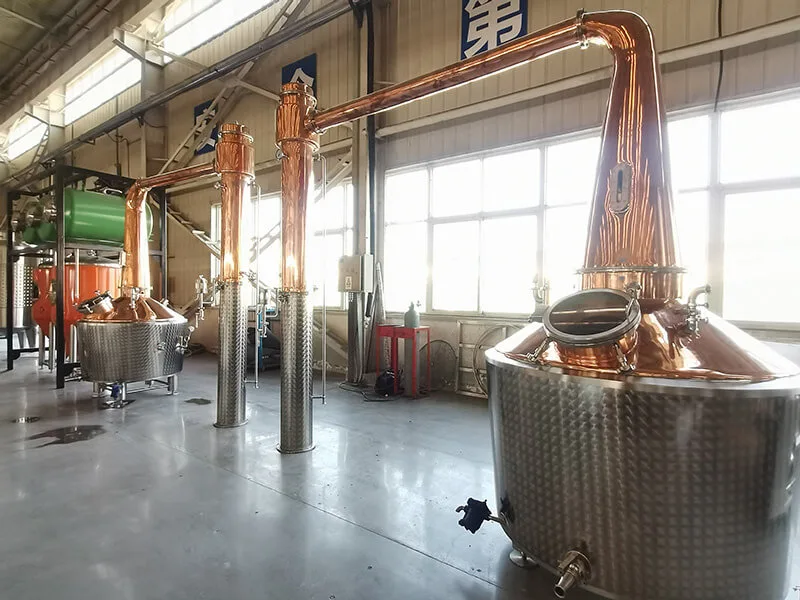
A copper pot still generally consists of several important components:
- Pote de destilação
- Onion Head or Dome
- Swan Neck
- Lyne Arm
- Condensador
These components work together to support vapor generation, vapor movement, condensation, and spirit collection.
Copper is widely used in whisky distillation because of its interaction with sulfur-containing compounds and its influence on the chemical composition of the spirit.
The amount of copper contact, still geometry, vapor path, and condenser configuration can all influence the distillation characteristics.
METO’s copper distillation equipment can incorporate TP2 copper components, selected according to the equipment structure and project requirements.
Material thickness, construction methods, welding quality, and surface finishing should be considered together when evaluating a copper still.
4.2 Wash Still: The First Distillation
The first distillation takes place in the wash still.
Fermented wash is transferred into the distillation pot and heated indirectly according to the equipment configuration.
During heating, alcohol and other volatile compounds evaporate and travel through the still’s vapor path before entering the condenser.
The vapor is cooled and collected as low wines.
The collected low wines commonly have an alcohol concentration of approximately 20–30% ABV, depending on the original wash strength and operating conditions.
The primary purpose of the wash still is to concentrate alcohol and prepare the liquid for the second distillation.
For equipment selection, several factors need to be evaluated:
- Wash still working volume
- Heating capacity and heating method
- Vapor path geometry
- Copper contact area
- Condenser heat-transfer capacity
- Batch distillation time
The condenser should be sized to match the vapor generation rate, ensuring stable condensation throughout the distillation process.
4.3 Spirit Still: Refining the New Make Spirit
The low wines from the first distillation are transferred into the spirit still for the second distillation.
This stage is particularly important because the distiller separates the collected distillate into different fractions.
The traditional process includes three main fractions:
Cabeças
The early fraction contains highly volatile compounds. Its composition depends on the raw material and distillation conditions. The heads are generally separated from the desired heart cut.
Corações
The heart is the selected central fraction of the distillation run. It contains ethanol and desirable flavor compounds that contribute to the character of the new make spirit.
Caudas
The later fraction contains a different balance of higher-boiling compounds and heavier flavor components. It is separated according to the distiller’s desired spirit profile.
The timing and strength at which these cuts are made are important production decisions.
They depend on the distillation equipment, raw material, fermentation characteristics, and desired whisky style.
Methanol and other unwanted compounds should be assessed through appropriate process control and product analysis rather than assuming that a simple heads-and-tails separation guarantees their removal.
The heart cut is collected as new make spirit, commonly at approximately 60–70% ABV in the configuration described here, although the actual strength varies with the distillation process.
4.4 Condenser System: Supporting Efficient Vapor Recovery
The condenser is another important part of the distillation system.
Its function is to cool alcohol vapor and convert it into liquid distillate.
Common condenser configurations include shell-and-tube and other project-specific heat-exchange arrangements.
The selection should consider:
- Vapor flow rate
- Cooling water temperature
- Required heat-transfer capacity
- Condensation stability
- Cleaning and maintenance accessibility
An appropriately designed condenser helps maintain stable distillation operation and reliable spirit collection.
5. Spirit Collection and Temporary Storage
After the second distillation, the selected heart fraction is transferred into a spirit receiver or temporary storage tank.
This stage provides a controlled transition between distillation and maturation.
A suitable spirit collection system should consider:
- Storage capacity
- Alcohol compatibility of materials and seals
- Drainage and transfer connections
- Sampling arrangements
- Cleaning requirements
- Applicable fire and explosion safety requirements
Stainless steel storage tanks are commonly used for temporary spirit storage.
The material and sealing configuration should be suitable for high-strength alcohol service.
For larger distilleries, storage capacity should be coordinated with the distillation schedule and the planned filling rate of oak casks.
This helps prevent unnecessary production interruptions when the maturation area is not immediately available.
6. Oak Cask Maturation: Transforming New Make Spirit into Whisky
Distillation produces new make spirit, but it is not yet the finished whisky.
Oak cask maturation is a fundamental stage in the development of traditional whisky.
During maturation, the spirit gradually interacts with the wood and undergoes several chemical and physical changes.
These include:
Color Development
The spirit extracts natural color compounds from the oak, gradually developing shades ranging from pale gold to deeper amber.
Flavor Development
Oak contributes compounds associated with vanilla, caramel, spice, and other complex flavor characteristics.
Tannin Extraction
Wood-derived tannins and other compounds contribute to the structure and mouthfeel of the spirit.
Oxidation and Evaporation
Slow interaction with oxygen and the gradual evaporation of alcohol and water contribute to the evolution of the whisky over time.
The final result depends on several factors, including oak species, cask size, previous cask use, filling strength, warehouse conditions, and maturation duration.
For distillery projects, the maturation area and cask storage capacity should be planned during the initial facility design stage.
This is especially important because whisky production involves long storage periods and significant working capital tied up in inventory.
7. How to Design a Complete Whisky Distillery Equipment System
Selecting individual machines is only part of establishing a whisky production facility.
A successful distillery project requires coordination between equipment capacity, process flow, utility systems, and facility layout.
The following factors should be evaluated before finalizing the equipment configuration.
7.1 Determine the Target Production Capacity
The first step is to define the intended production scale.
Customers should distinguish between fermentation batch capacity, distillation batch capacity, and annual finished whisky production.
These are different measurements and should not be treated as interchangeable.
For example, a distillery’s annual production depends on:
- Fermentation tank volume and turnover
- Number of fermentation batches
- Wash still capacity
- Spirit still capacity
- Number of distillation runs
- Operating days per year
- Process losses and spirit cut volumes
A larger brewing system does not automatically mean higher annual whisky output if the distillation section cannot process the fermented wash at the same rate.
7.2 Match Brewing and Distillation Capacities
The brewing and distillation systems should be designed as one integrated production process.
If the fermentation section produces more wash than the stills can process, additional storage capacity or a revised production schedule may be required.
Similarly, undersized fermentation tanks can limit the utilization of larger distillation equipment.
A practical design should establish a production balance between:
- Grain milling capacity
- Mashing batch volume
- Fermentation tank working volume
- Wash still batch capacity
- Spirit still batch capacity
- Spirit receiver capacity
This approach helps reduce production bottlenecks and improves equipment utilization.
7.3 Select the Appropriate Heating Method
Heating method selection affects equipment investment, operating costs, and facility requirements.
As opções mais comuns incluem:
- Aquecimento a vapor
- Aquecimento elétrico
- Other project-specific indirect heating configurations
Steam heating is frequently considered for larger production facilities because a central boiler can supply heat to multiple process units.
Electric heating may be suitable for smaller installations or facilities with appropriate electrical infrastructure.
The final selection should consider local energy costs, available utilities, installation conditions, and production requirements.
7.4 Plan Cooling and Water Systems
A whisky distillery requires cooling capacity at different stages.
The main cooling requirements typically include fermentation temperature control and vapor condensation during distillation.
The cooling system should be designed according to the simultaneous operating requirements of all connected equipment.
Water supply, drainage, cleaning water, and process water quality should also be considered during facility planning.
A properly designed utility system helps maintain stable production and reduces operational interruptions.
7.5 Consider Automation and Process Control
Automation can improve process consistency and simplify daily operation.
Depending on the project budget and requirements, the system can incorporate:
- PLC control panels
- Touchscreen operation interfaces
- Monitorização da temperatura
- Controlo do aquecimento
- Pump and valve control
- Fermentation cooling management
- Process alarms
- Production status monitoring
For distillation equipment, automated temperature and operating parameter monitoring can support repeatable production.
However, the selection and collection of heads, hearts, and tails still require appropriate process strategies and distiller oversight.
The level of automation should be determined by the production process rather than added simply for the sake of complexity.
8. What Should You Consider When Choosing a Whisky Distillery Equipment Manufacturer?
Choosing a whisky equipment manufacturer is a long-term investment decision.
The equipment supplier needs to understand not only individual vessel manufacturing but also the complete production process.
Here are five important factors to evaluate.
1. Complete Equipment Manufacturing Capability
A qualified manufacturer should be able to supply the main process equipment, including brewing systems, fermentation tanks, copper stills, spirit receivers, and supporting systems.
Integrated manufacturing and project coordination can help reduce communication gaps between different equipment sections.
2. Material Quality and Fabrication Standards
Copper stills and stainless steel vessels require different material selection and fabrication processes.
Customers should evaluate material certificates, welding quality, fabrication procedures, pressure testing where applicable, and surface treatment.
The applicable design and manufacturing requirements should be confirmed according to equipment type, destination market, and project specifications.
3. Process Engineering Experience
The manufacturer should understand the relationship between mashing, fermentation, and distillation.
This is essential when calculating equipment capacity, planning batch schedules, and configuring the entire production line.
4. Customization and Factory Capability
Every distillery has different production goals and site conditions.
A manufacturer with in-house design, fabrication, assembly, and testing capabilities can better coordinate customized equipment dimensions, layouts, and process connections.
5. Installation and After-Sales Support
Equipment delivery is not the final stage of a distillery project.
Installation guidance, commissioning support, operating instructions, and spare parts availability are important for long-term operation.
9. Why Choose METO for Whisky Distillery Equipment?
METO is an integrated manufacturer and supplier of industrial brewing, fermentation, and distillation equipment, providing customized solutions for commercial beverage and alcohol production.
Since 2013, METO has developed manufacturing capabilities covering equipment design, engineering, production, installation, commissioning, and after-sales service.
Our product range includes:
- Complete Whisky Distillery Equipment
- Copper Pot Still and Distillation Systems
- Grain Mashing and Brewing Systems
- Stainless Steel Fermentation Tanks
- Spirit Collection and Storage Tanks
- Industrial Cooling and CIP Systems
With a manufacturing facility covering approximately 30,000 m², METO combines engineering design with modern fabrication equipment and quality inspection processes.
Our manufacturing capabilities include laser cutting, automatic and manual welding, laser welding, material analysis, and X-ray inspection.
We also provide customized equipment configurations according to project capacity, raw materials, production processes, and installation conditions.
For customers planning a new whisky distillery or upgrading an existing production facility, METO can help coordinate equipment selection and process integration from the initial design stage through manufacturing and installation.
Our goal is not simply to supply individual machines, but to provide a practical equipment solution that supports stable production and long-term development.
10. Frequently Asked Questions About Whisky Distillery Equipment
Q1: What equipment is needed to build a whisky distillery?
A complete whisky production facility generally requires grain milling equipment, a mashing system, fermentation tanks, copper pot stills, condensers, spirit collection tanks, and supporting utility systems. Oak casks and suitable maturation storage facilities are also required for traditional whisky production.
Q2: Why are copper pot stills used in whisky production?
Copper interacts with sulfur-containing compounds during distillation and can help reduce undesirable sulfur characteristics. The shape of the still, copper contact area, and vapor path also influence the resulting spirit profile.
Q3: What is the difference between a wash still and a spirit still?
The wash still performs the first distillation of fermented wash, producing low wines. The spirit still performs the second distillation, allowing the distiller to separate the heads, hearts, and tails and collect the desired heart fraction.
Q4: How long does whisky fermentation take?
Fermentation time varies according to yeast strain, wort composition, temperature, and the desired flavor profile. A typical project configuration may use approximately 48–120 hours, but the actual operating schedule should be established through process trials.
Q5: Can whisky distillery equipment be customized?
Yes. Equipment can be customized according to production capacity, raw materials, heating method, still configuration, copper material, automation requirements, and factory layout.
Q6: How do I choose the right whisky distillery capacity?
Start by estimating your expected annual production and working backward through the fermentation and distillation schedules. Consider batch size, operating days, number of distillation runs, and available storage capacity before selecting the final equipment configuration.
Q7: Can METO provide a complete whisky distillery solution?
METO can provide coordinated brewing systems, fermentation tanks, copper distillation equipment, spirit collection tanks, and supporting systems. The specific scope of supply can be customized according to your project requirements.
11. Start Planning Your Whisky Distillery Project
Whether you are planning a small craft whisky distillery, expanding an existing production facility, or developing a commercial whisky production line, selecting the right equipment configuration is essential.
A well-designed production system should balance brewing capacity, fermentation efficiency, distillation performance, and future maturation requirements.
METO provides customized whisky distillery equipment solutions based on your production goals and site conditions.
Contactar a METO to discuss your project.
To help us prepare a suitable equipment proposal, please share:
- Expected annual whisky production
- Required fermentation and distillation batch capacity
- Preferred heating method
- Desired copper still configuration
- Factory location and available installation space
Our engineering team can evaluate your requirements and recommend a suitable equipment configuration for your whisky production project.