As craft beer continues its shift from niche culture to mainstream consumption, more entrepreneurs, restaurateurs, and traditional breweries are entering the market, aiming to capture opportunities in this fast-growing sector. However, traditional brewery construction often comes with long lead times, high capital investment, rigid capacity structures, and inconsistent product quality—barriers that discourage many newcomers.
The emergence of modular craft brewery systems is transforming this landscape. Built around the core principles of modular design, intelligent control, and flexible production, this approach redefines how breweries are built and operated—offering one of the most promising solutions in today’s craft beer industry.
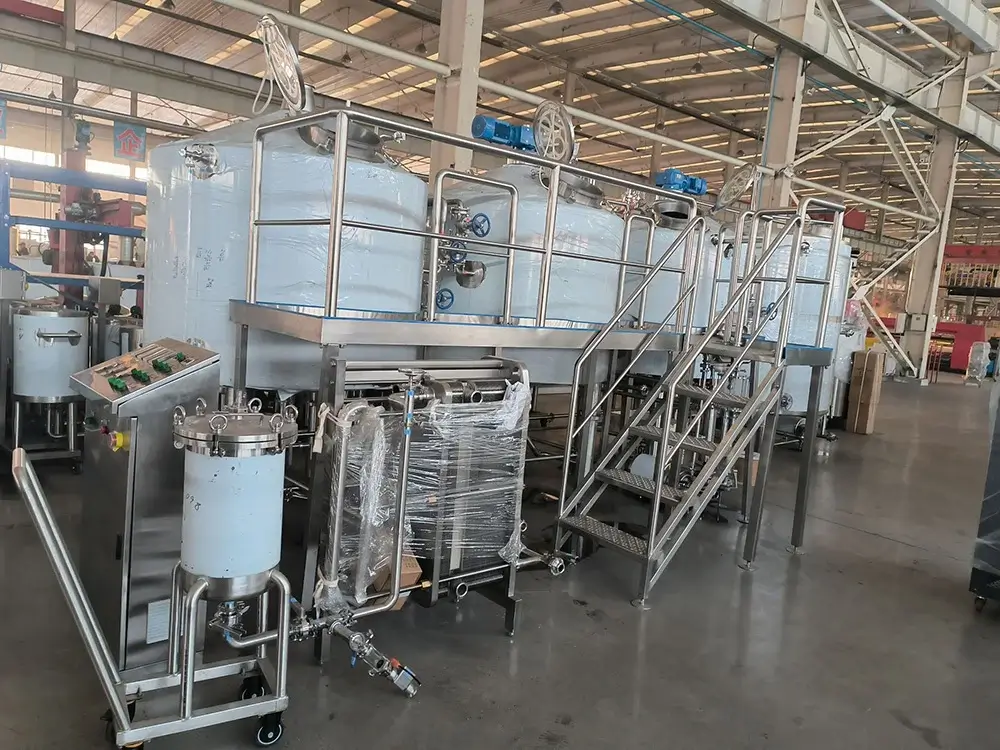
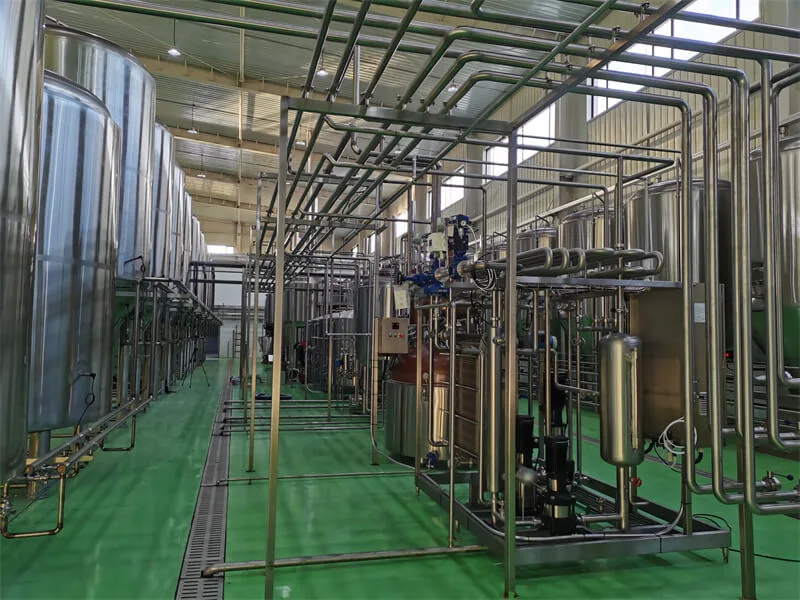
Unlike traditional fixed breweries, which are difficult to modify once built, modular breweries are based on a “divide and integrate” philosophy. The entire brewing process is split into independent functional modules that can be manufactured, transported, and installed separately, then combined and expanded as needed. This not only lowers the barrier to entry but also enables both small-batch innovation and large-scale production within a single system.
1. Modular Brewery Systems: Beyond Assembly—A Full Value Chain Upgrade
Many assume modular breweries are simply “plug-and-play equipment.” In reality, they represent a comprehensive solution covering equipment, process engineering, automation, and after-sales service.
From raw material handling to final packaging, every module is professionally engineered to ensure beer quality while optimizing efficiency and operational costs.
Flexible Production: Balancing Innovation and Scale
Craft beer thrives on creativity, but commercial success requires consistency and volume. Modular systems solve this contradiction.
For example, a standard 50HL modular brewery can:
- Produce 50HL per batch (adjustable to 30HL)
- Achieve up to 7 brews per day (expandable to 10)
- Reach equipment utilization rates above 95%
This allows breweries to:
- Maintain stable production of flagship beers
- Rapidly switch recipes for IPAs, stouts, sours, wheat beers, and seasonal releases
More importantly, modular systems support scalable expansion. A brewery can start with a 3-vessel brewhouse and gradually upgrade to 4- or 5-vessel configurations, adding fermenters and filtration systems without rebuilding the entire facility.
Intelligent Brewing: From Experience-Based to Data-Driven
Consistency is one of the biggest challenges in craft brewing. Traditional methods rely heavily on brewmaster experience, leading to batch variability.
Modern modular breweries integrate intelligent brewing systems (e.g., automated control software), enabling:
- Recipe standardization
- Real-time monitoring of temperature, pressure, and gravity
- Fermentation control accuracy of ±0.3°C
- Flavor consistency above 99%
With IoT connectivity, brewers can monitor and control production remotely via mobile devices—making remote brewing and “lights-out” operation a reality while significantly reducing labor costs.
Fast Deployment: Reduced Time & Investment
Traditional brewery construction may take 12–18 months. In contrast, modular breweries:
- Are pre-assembled and tested in factories
- Require only connection and commissioning onsite
- Can be installed within 3–6 months
This dramatically shortens time-to-market and accelerates ROI.
Cost advantages include:
- Lower upfront investment through phased purchasing
- No need for large-scale reconstruction during expansion
- Reduced energy consumption (30–40% savings) via heat recovery systems
- Steam recovery rates up to 85%
- Water usage as low as 3.5 tons per ton of beer
Automated CIP (Clean-in-Place) systems further ensure hygiene while reducing manual labor and operational risks.
Full Scenario Adaptability: From Brewpubs to Industrial Breweries
Modular brewery systems can be tailored to a wide range of applications:
- Brewpubs (15–20㎡): 200–300L/day, ideal for on-site brewing and customer engagement
- Central kitchens (80㎡): 2,000L/day for chain restaurant supply
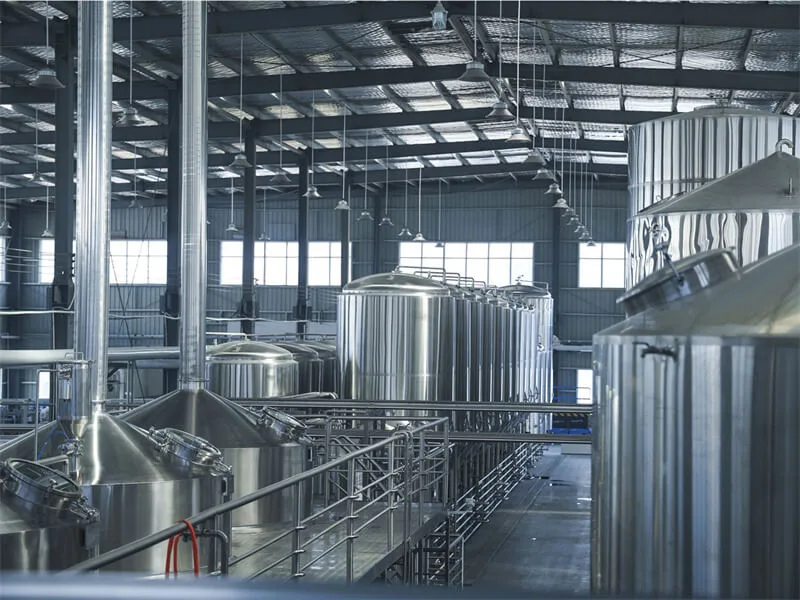
- Industrial breweries: Annual capacity up to 30,000 tons
Por exemplo:
- Brewpubs can install visible fermenters to enhance customer experience
- Startups can deploy 50HL systems for market testing
- Large breweries can scale production while maintaining R&D flexibility
2. Key Modules of a Modular Craft Brewery
A complete modular brewery includes the following core modules:
Raw Material Handling Module
Ensures quality from the source:
- Malt milling systems with adjustable crushing precision
- Optimized handling of hops and yeast
- Flexible processing capacity for different recipes
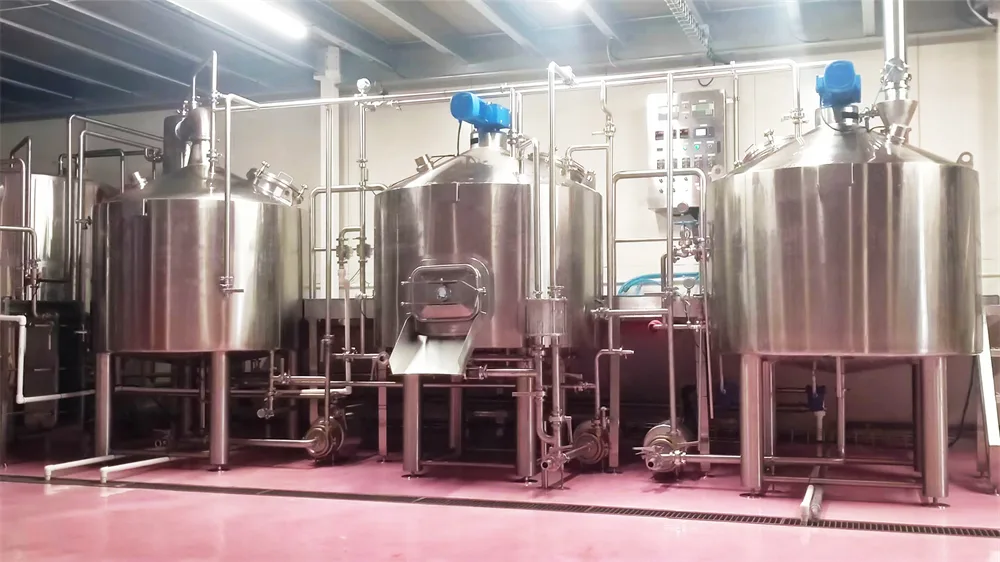
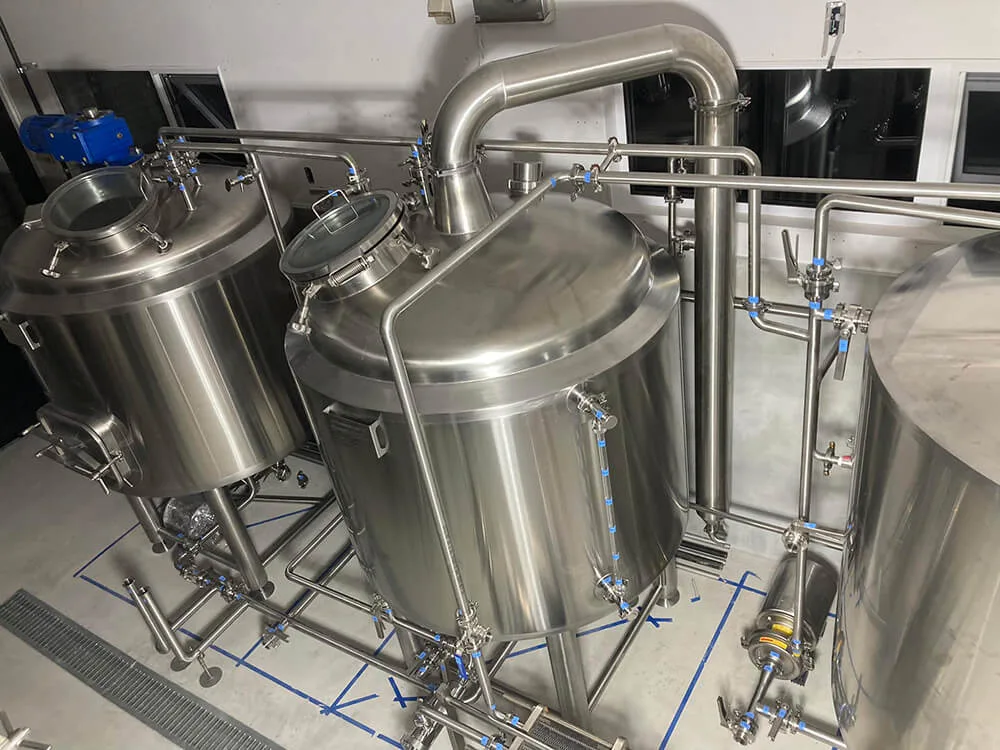
Brewhouse Module
The heart of beer production:
- Configurations: 3-vessel, 4-vessel, or 5-vessel systems
- Precise temperature control and automated mashing
- Boiling intensity ≥8%
- Optional hop dosing systems (Hop Gun) for aroma control
Fermentation & Cold Block Module
Where flavor develops:
- مخروطical fermenters with dual-zone cooling
- Temperature precision ±0.3°C
- Integrated pressure control and CO₂ recovery
- Fermentation cycles shortened by up to 20%
Optional oak barrel aging modules enable specialty beer production.
Filtration & Packaging Module
Ensures clarity and market adaptability:
- Kieselguhr-free filtration or plate filters
- Flexible packaging: kegs, bottles, cans
- High-speed bottling lines (up to 36,000 bottles/hour)
- Bottle loss rates below 0.3%
Utility & Auxiliary Systems
Critical for stable operations:
- CIP cleaning systems (multi-tank simultaneous cleaning)
- Utilities: boiler, air compressor, refrigeration, water treatment
- Wastewater treatment systems
- Central automation control system
Zero-emission steam systems also enable installation in urban or commercial environments.
3. Why Modular Breweries Are the Future of Craft Beer Startups
With the craft beer market growing at 25%–30% annually, the industry demands both scalability and differentiation.
Modular breweries align perfectly with these trends:
- Lower entry barriers: Start small, scale gradually
- Faster ROI: Payback period can be within 3 years
- Market adaptability: Quickly adjust recipes and production volumes
- Consistency + creativity: Standardized quality with room for innovation
- Turnkey solutions: Full lifecycle support from design to training and maintenance
Even non-professional operators can successfully run a brewery with proper system integration and support.
4. Conclusion: Making Craft Brewing More Accessible and Efficient
The competition in the craft beer industry is no longer just about flavor—it’s about efficiency, scalability, and operational intelligence.
Traditional brewery models struggle to keep up with dynamic market demands. In contrast, modular craft brewery systems offer:
- Flexibilidade
- Smart automation
- Cost efficiency
- Scalable growth
They lower the barriers to entry and empower brewers to transition from experience-driven brewing to data-driven production, unlocking new opportunities in a competitive market.
Whether you are a startup brand, a restaurant operator, or an established brewery looking to expand, a modular brewery system is more than equipment—it is a future-ready business model.
👉 Contact us today for a custom brewhouse system design tailored to your production goals, budget, and future expansion plans.