Fermentation tank selection is an important part of commercial brewery design. While tank capacity, material, pressure rating, and cooling configuration are commonly considered, vessel geometry also plays a significant role in fermentation management.
Among the most widely used designs, conical fermentation tanks and horizontal fermentation tanks serve different operational purposes. Conical tanks are commonly selected for their efficient yeast collection, beer transfer, and integration into modern brewery production systems. Horizontal tanks, on the other hand, provide a larger footprint and a different relationship between liquid depth, sediment distribution, and available fermentation surface.
However, the difference is not simply about which tank produces better beer. Both designs can support high-quality fermentation when properly engineered and operated. The more important question is how their structural characteristics match the brewery’s production process and beer styles.
This article examines how tank geometry influences fermentation conditions and explains how breweries can choose between horizontal and conical fermentation vessels.
1. Understanding the Structural Differences
The most obvious difference between horizontal and conical fermentation tanks is their orientation and bottom geometry. These structural characteristics influence liquid distribution, sediment collection, tank utilization, and cleaning requirements.
1.1 Conical Fermentation Tanks
Conical fermentation tanks are vertically installed vessels with a cylindrical body and a cone-shaped bottom. The cone is designed to guide yeast and other sediment toward a lower collection point.
A typical commercial conical tank includes:
- Cylindrical fermentation body
- Conical bottom section
- Cooling jacket or cooling zones
- Top manway or access opening
- CIP spray device
- Bottom yeast discharge outlet
- Beer outlet and sampling connection
- Pressure and temperature monitoring connections
The conical bottom is particularly useful during yeast collection. After fermentation, yeast and other solids gradually settle toward the lower section, where they can be discharged through the bottom outlet.
This design allows breweries to collect yeast, remove sediment, and transfer beer without necessarily moving the entire tank contents.
For commercial breweries, conical tanks are often used as primary fermentation vessels because they support repeatable operation and relatively straightforward integration with automated pipelines and CIP systems.
1.2 Horizontal Fermentation Tanks
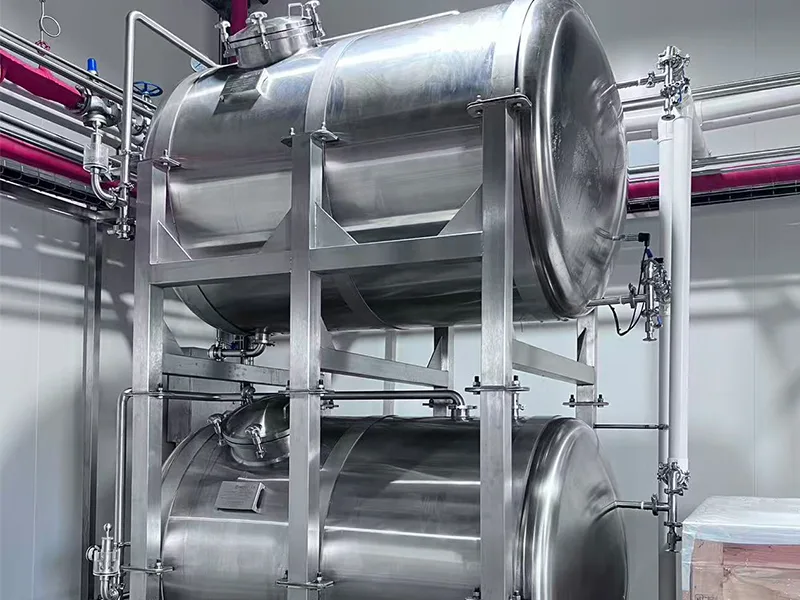
Horizontal fermentation tanks are cylindrical vessels installed horizontally, with their longitudinal axis parallel to the floor.
Unlike a vertical conical tank, a horizontal tank distributes its liquid volume along a longer vessel body. Depending on the design, it may have dished or other shaped end heads and can be equipped with cooling jackets, CIP devices, manways, and dedicated beer and yeast outlets.
Horizontal vessels are commonly used for lagering, maturation, and conditioning. They can also be designed for primary fermentation when the process requirements and tank configuration support it.
Their larger horizontal footprint creates a different relationship between liquid depth and vessel volume. Under comparable liquid volume and operating conditions, a horizontal tank may have a lower liquid column than a tall vertical vessel.
This difference can influence hydrostatic pressure distribution, but it does not automatically determine fermentation performance or beer flavor.
2. How Vessel Geometry Influences Yeast Behavior
Yeast behavior is one of the most important considerations when comparing fermentation tanks.
During fermentation, yeast cells consume fermentable sugars and produce alcohol, carbon dioxide, and various flavor-active compounds. As fermentation progresses, yeast activity changes, and cells gradually settle or remain suspended depending on the yeast strain, fermentation conditions, and beer composition.
Tank geometry can influence how yeast is distributed and collected, but it is only one part of the overall fermentation environment.
2.1 Yeast Collection in Conical Tanks
The cone-shaped bottom provides a natural collection area for sediment.
As yeast flocculates and settles, it can accumulate in the lower cone. Brewers can then discharge part of the yeast through a dedicated outlet.
This arrangement offers several operational advantages:
Controlled yeast harvesting: Brewers can collect yeast for reuse, subject to appropriate yeast-quality checks and microbiological controls.
Sediment removal: Trub and other settled solids can be removed through the bottom outlet.
Reduced beer handling: Yeast removal and beer transfer can be managed through separate connections, depending on the vessel design.
However, yeast does not always settle uniformly. Its distribution depends on flocculation characteristics, fermentation activity, temperature, vessel geometry, and the timing of collection.
A properly designed cone angle, outlet arrangement, and discharge pipeline are therefore important. The outlet should allow effective removal of settled material without creating unnecessary product losses or operational difficulties.
2.2 Yeast Distribution in Horizontal Tanks
In a horizontal vessel, sediment tends to accumulate along the lower internal surface rather than being directed toward one central cone.
The distribution and collection of yeast depend on the tank diameter, length, installation orientation, outlet location, and internal geometry.
This may make yeast harvesting less straightforward than in a conventional conical tank, particularly when the vessel is used for primary fermentation.
However, horizontal tanks can be effective for maturation and conditioning, where the focus is often on maintaining stable storage conditions and managing sediment before packaging.
It is important not to assume that a horizontal tank automatically produces a different yeast-derived flavor profile. Yeast strain, fermentation temperature, pitching rate, wort composition, oxygen availability, and pressure management generally have a much more direct influence on flavor development.
3. Hydrostatic Pressure and Fermentation Conditions
Hydrostatic pressure is another factor often discussed when comparing horizontal and conical fermentation tanks.
The liquid pressure at a given depth increases with the height of the liquid column. Therefore, in vessels containing the same liquid volume, a taller vertical configuration may create a greater pressure difference between the upper and lower liquid regions than a shorter horizontal configuration.
This is a physical difference, but its impact on fermentation should be evaluated carefully.
3.1 Liquid Depth and Pressure Distribution
In a tall conical tank, the liquid column can be relatively high. The lower part of the tank therefore experiences greater hydrostatic pressure than the upper part.
In a horizontal tank of comparable volume, the liquid depth may be lower, depending on its diameter and fill level.
This means that vessel orientation can change the hydrostatic pressure profile experienced by yeast at different positions in the tank.
However, hydrostatic pressure is not the same as the controlled head pressure maintained inside a sealed fermentation vessel.
The actual fermentation environment is influenced by both:
- Hydrostatic pressure created by the liquid column
- Gas pressure maintained in the vessel headspace
For pressure-capable fermentation tanks, the operating pressure must be determined by the vessel’s design rating, process requirements, and applicable safety standards.
3.2 Does Lower Hydrostatic Pressure Improve Beer Flavor?
Lower liquid-column pressure is sometimes discussed in connection with yeast metabolism and ester production.
There is a scientific basis for considering pressure as one of the factors that can influence yeast metabolism. Nevertheless, the relationship between vessel geometry and flavor is not simple or universal.
Ester formation and other flavor-active compounds are affected by several interacting factors, including:
- Yeast strain and physiological condition
- Temperatura de fermentação
- Pitching rate
- Wort composition and gravity
- Dissolved oxygen at pitching
- Fermentation pressure
- Fermentation stage and duration
A horizontal tank may create a different pressure distribution from a tall conical vessel, but it does not guarantee higher ester production or a more expressive beer.
For breweries producing different beer styles, fermentation trials under controlled conditions are a more reliable way to evaluate the influence of vessel configuration.
4. Temperature Control and Cooling System Design
Temperature control is essential for consistent fermentation. Vessel geometry influences the way cooling surfaces are distributed and how the tank can be integrated into a brewery’s glycol system.
4.1 Cooling Configuration in Conical Tanks
Commercial conical fermenters commonly use external cooling jackets installed around selected sections of the cylindrical body and, depending on the design, the cone.
The cooling system removes heat generated by yeast activity and helps maintain the target fermentation temperature.
For larger vessels, cooling zones may be divided into independently controlled sections. This allows the cooling system to respond to different heat loads during active fermentation and later conditioning.
Important design considerations include:
- Cooling surface area
- Jacket arrangement and coverage
- Glycol supply and return connections
- Insulation thickness
- Temperature sensor location
- Cooling capacity and control logic
The cooling system should be designed according to the actual fermentation load rather than tank volume alone.
4.2 Cooling Configuration in Horizontal Tanks
Horizontal tanks can also be equipped with cooling jackets or other suitable cooling arrangements.
Because the vessel extends horizontally, the cooling surface is distributed along its length. The final arrangement should consider the tank’s liquid level, operating volume, heat-transfer requirements, and available installation space.
The number and location of cooling zones should be determined through thermal design.
A horizontal tank is not inherently more efficient or less efficient at cooling than a conical tank. Heat-transfer performance depends on the effective cooling area, heat-transfer coefficient, glycol temperature and flow rate, insulation, and process conditions.
For breweries planning to use both tank types, the glycol system should be sized to handle their combined peak cooling demand.
5. Fermentation, Maturation, and Sediment Management
The intended process stage is often the most practical starting point for selecting a tank.
5.1 Primary Fermentation
Conical tanks are widely used for primary fermentation because their bottom geometry supports yeast collection and sediment removal.
They also provide convenient connections for wort filling, sampling, CIP, beer transfer, and yeast discharge.
For breweries producing several batches per week, these features can simplify daily operation and improve process organization.
Horizontal tanks can also be used for primary fermentation, but the brewery should evaluate yeast collection, sediment removal, tank access, and cleaning procedures before selecting this configuration.
5.2 Lagering and Maturation
Horizontal tanks are frequently associated with lagering and maturation.
Their horizontal arrangement can provide a relatively low liquid depth for a given working volume, depending on the vessel dimensions. They can also be integrated into a production layout designed around dedicated maturation and conditioning operations.
However, lagering does not require a horizontal tank. Vertical cylindroconical tanks can also perform maturation when the temperature, pressure, residence time, and other process conditions are properly controlled.
The choice should therefore reflect the brewery’s production philosophy, available floor space, tank handling requirements, and desired operating procedures.
5.3 Sediment Management Before Packaging
Before beer is transferred to a bright beer tank or packaging line, the brewery must manage yeast and other suspended solids.
A conical tank can discharge settled yeast through its bottom outlet. A horizontal vessel requires an outlet arrangement suitable for its internal sediment distribution.
In both cases, the transfer strategy should minimize unnecessary sediment disturbance.
The goal is not simply to remove as much yeast as possible. Brewers must balance clarification, product recovery, yeast reuse, and the desired beer characteristics.
6. Horizontal vs. Conical Fermentation Tanks: A Technical Comparison
The following table summarizes the main engineering and operational differences.
| Comparison | Conical Tank | Horizontal Tank |
|---|---|---|
| Main structure | Vertical cylindrical body with cone bottom | Horizontally installed cylindrical body |
| Common application | Primary fermentation and maturation | Lagering, maturation, conditioning; primary fermentation when suitably designed |
| Yeast collection | Concentrated toward the cone outlet | Distributed along the lower internal surface |
| Sediment discharge | Generally straightforward through the bottom outlet | Depends on outlet location and vessel design |
| Liquid depth | Often greater in tall vessels | Often lower for comparable volume, depending on dimensions |
| Cooling arrangement | Body and optional cone cooling zones | Cooling zones distributed along the vessel |
| Space requirement | More vertical clearance | More horizontal floor space |
| Process integration | Convenient for yeast harvesting and automated transfer | Useful for dedicated maturation and conditioning layouts |
| Limpeza | CIP design must cover the cone and vessel interior | CIP design must provide coverage along the full vessel length |
Neither configuration is universally superior. The correct choice depends on the intended process, brewery layout, production schedule, and operating requirements.
7. How to Choose the Right Fermentation Tank for Your Brewery
Tank selection should begin with the brewery’s production plan rather than with vessel shape alone.
7.1 Define the Fermentation Process
First, determine whether the tank will be used for primary fermentation, maturation, lagering, or multiple stages.
For breweries that need convenient yeast harvesting and frequent product changes, conical fermenters are often a practical choice.
For breweries with a dedicated maturation stage, horizontal vessels may provide a suitable alternative, provided their cleaning and transfer arrangements match the process.
7.2 Calculate Working Capacity
Tank capacity should be calculated according to the actual production schedule.
For example, a brewery with a 1,000L brewhouse may produce multiple batches per day. The required fermentation capacity will depend on daily wort production, fermentation duration, maturation time, tank turnaround, and the number of product styles.
A useful planning relationship is:
Required working fermentation capacity = Daily wort production × Total tank occupancy days
Tank occupancy should include fermentation, maturation where applicable, emptying, cleaning, and preparation for the next batch.
The brewery should also distinguish between nominal tank volume and usable working volume. Adequate headspace is necessary to accommodate foam and fermentation activity.
A tank configuration that looks suitable based on nominal volume may not provide enough practical production capacity.
7.3 Evaluate Floor Space and Building Height
Building dimensions can directly affect tank selection.
Conical fermenters require sufficient vertical clearance for installation, top access, fittings, and maintenance. Their height should also be considered when planning doors, lifting equipment, and pipe routing.
Horizontal tanks generally require more floor length and may need additional space for access, maintenance, and product connections.
The brewery layout should account for both tank dimensions and the operating space needed around each vessel.
7.4 Consider Cleaning and Maintenance
CIP performance should be considered during the initial tank design stage.
For conical tanks, spray coverage must include the cylindrical body, cone, fittings, and other internal surfaces.
For horizontal tanks, the CIP system must provide effective coverage along the vessel’s full length and around its internal surfaces.
The number and position of spray devices should be determined through cleaning-system design and validation, not simply by installing a spray ball.
Other considerations include drainability, dead-leg control, valve arrangement, access openings, and the ability to inspect critical areas.
7.5 Match Tank Configuration to the Brewery’s Product Portfolio
A brewery producing ales, lagers, wheat beers, and experimental craft styles may benefit from a combination of different fermentation vessels.
Conical tanks can support primary fermentation and yeast management, while horizontal tanks can be allocated to maturation or conditioning processes.
This mixed configuration provides operational flexibility without requiring every tank to perform exactly the same role.
8. Combining Conical and Horizontal Tanks in a Commercial Brewery
For breweries producing multiple beer styles, combining different tank geometries can be more practical than relying on a single vessel type.
A typical process arrangement may include:
- Wort production in the brewhouse.
- Transfer of cooled wort into conical fermentation tanks.
- Primary fermentation under controlled temperature and pressure conditions.
- Yeast collection and removal where required.
- Transfer to horizontal tanks for further maturation or conditioning, depending on the recipe and production plan.
- Final clarification, carbonation adjustment, and transfer to packaging.
This arrangement separates primary fermentation from subsequent maturation operations.
It can also help breweries organize tank availability according to different fermentation and maturation schedules.
However, transferring beer between vessels introduces additional requirements. The transfer pipeline, pumps, valves, pressure control, and sanitation procedures must be designed to minimize oxygen pickup and contamination risks.
Not every beer needs to be transferred from a conical tank to a horizontal tank. Some beers can complete fermentation and maturation in the same conical vessel. The process should be selected according to product requirements and production efficiency.
9. METO’s Approach to Fermentation Tank Configuration
As a brewery and fermentation equipment manufacturer, METO designs fermentation systems according to production capacity, beer styles, available installation space, and process requirements.
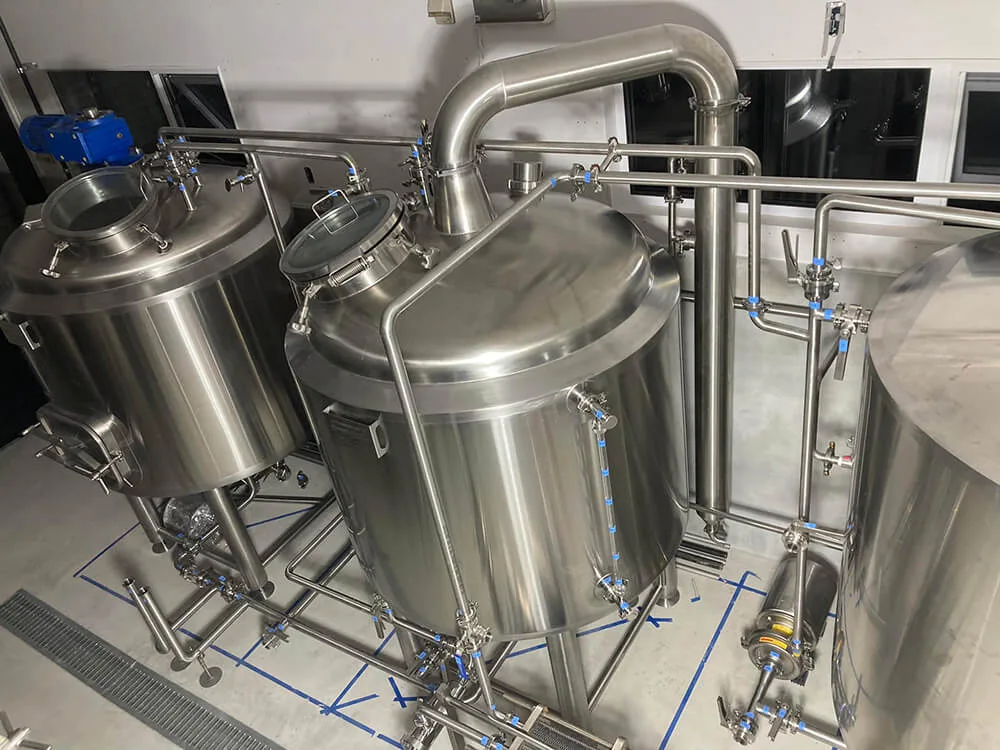
For a 1,000L craft brewery project, the fermentation configuration included 1-ton and 2-ton conical fermentation tanks together with a 1-ton horizontal tank.
This combination was designed to provide different vessel options for primary fermentation and subsequent beer handling, supporting a brewery that produces multiple beer styles.
The conical tanks provide dedicated fermentation capacity and convenient yeast collection. The horizontal vessel offers an additional option for maturation and conditioning processes where the recipe and production schedule require it.
The project also incorporated visual inspection features, including sight lights and observation windows, allowing operators to monitor liquid levels, visible fermentation activity, and sediment conditions.
These visual features support routine observation but do not replace temperature, pressure, or other process measurements.
METO’s engineering work covers tank geometry, material selection, cooling jacket configuration, insulation, pressure requirements, process connections, CIP arrangement, and installation layout.
By coordinating these factors during the design stage, METO helps breweries build fermentation systems that match their actual production requirements rather than selecting tanks based on capacity alone.
10. Conclusion
Horizontal and conical fermentation tanks have different structural characteristics, and those differences influence yeast collection, sediment management, liquid depth, cooling-system arrangement, and brewery layout.
Conical tanks are widely used for primary fermentation because their cone-shaped bottoms support convenient yeast harvesting and sediment discharge. Horizontal tanks are commonly selected for maturation and conditioning, although they can also be designed for primary fermentation.
Neither geometry guarantees better beer quality. Fermentation results depend on the complete process, including yeast selection, wort composition, temperature, pressure, oxygen management, and operating procedures.
For commercial breweries, the most effective solution is to select tank geometry according to the intended process and production schedule. In some cases, combining conical and horizontal vessels offers greater flexibility than using only one type.
Planning a commercial brewery fermentation system? Contactar a METO to discuss tank capacity, vessel configuration, cooling requirements, and a fermentation layout designed around your production goals.