Building a commercial brewery requires more than selecting brewing vessels. Production capacity, fermentation scheduling, water management, temperature control, cleaning efficiency, and automation must all work together to create a reliable and scalable brewing operation.
For breweries planning to enter the commercial market or expand existing production, an integrated brewery system can simplify equipment coordination and improve operational efficiency.
This project features a complete brewery production solution designed around a 5000L four-vessel brewhouse, supporting 4–5 brewing batches per day and a planned annual production capacity of 9,000KL. The configuration also includes multiple fermentation and bright beer tanks, utility systems, automated CIP cleaning, Siemens PLC control, and multifunctional distillation equipment.
As a brewery equipment manufacturer, METO provides integrated equipment design, manufacturing, system assembly, installation, and commissioning to support different production requirements.
1. A 5000L Brewery System Designed for Commercial Production
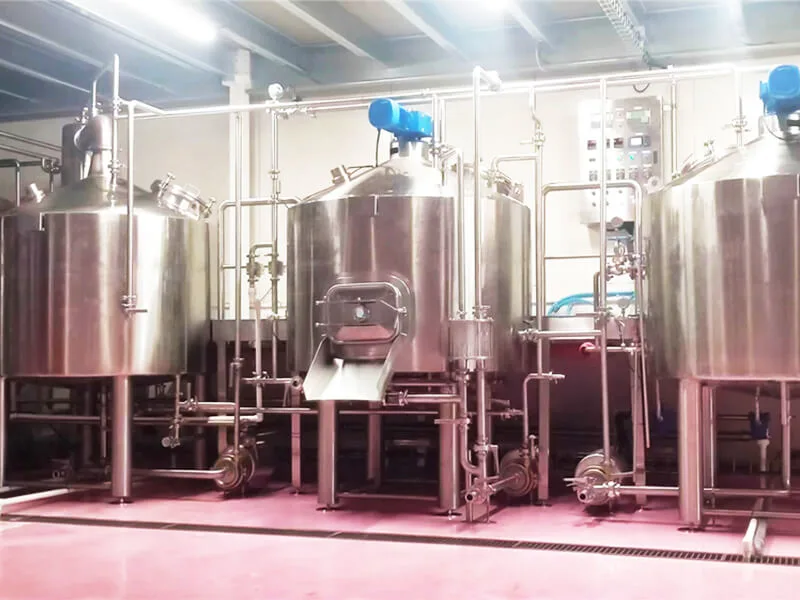
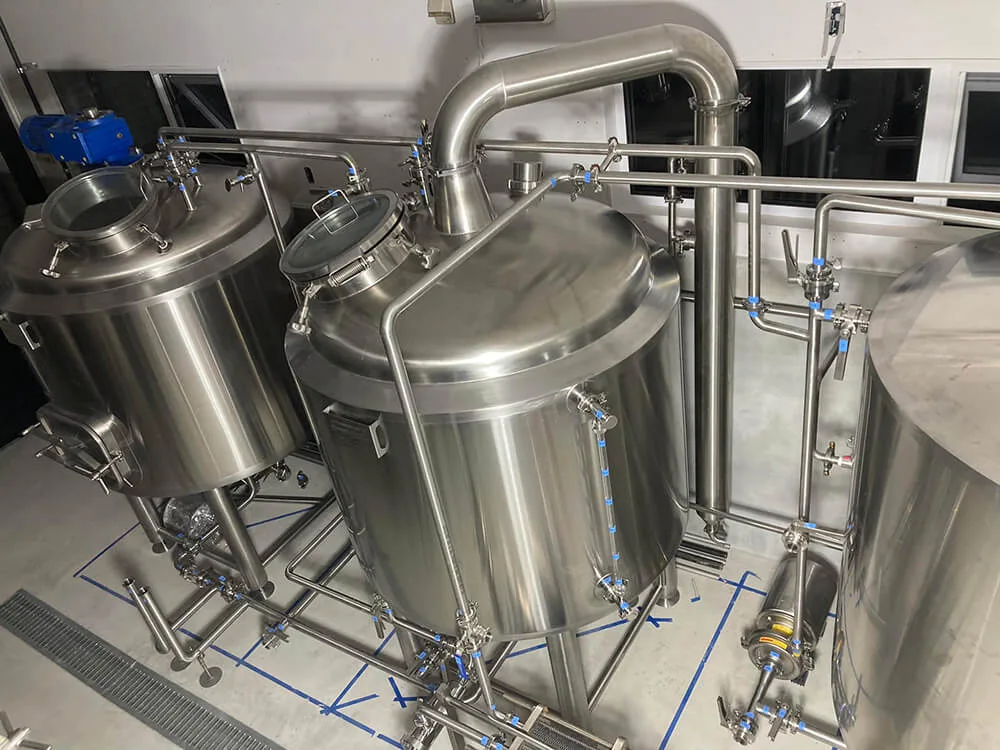
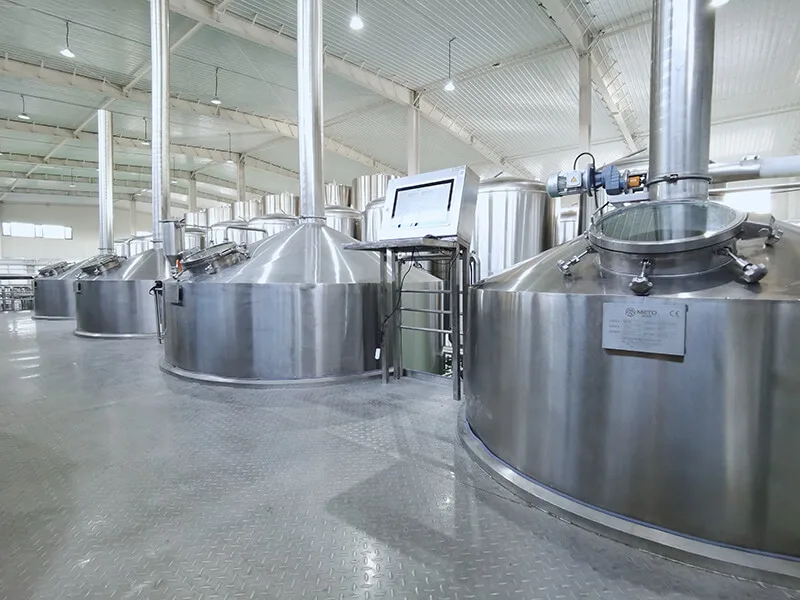
The foundation of this project is a 5000L four-vessel brewhouse.
With a 5KL brewing capacity per batch and a design schedule of 4–5 batches per day, the brewhouse provides the production capacity needed for a commercial brewing operation.
The four-vessel configuration consists of:
- Tina de brassagem
- Tina de Lauter
- Brew Kettle
- Tanque de hidromassagem
Each vessel performs a dedicated brewing function, allowing the production process to be organized into separate stages.
The system also incorporates pneumatic spent grain discharge and an advanced automation control system to simplify operation and reduce manual handling.
For breweries with increasing production requirements, a four-vessel configuration offers several practical advantages:
Flexible production scheduling: Independent vessels allow different brewing stages to be coordinated more efficiently.
Improved operational efficiency: Pneumatic spent grain discharge reduces manual work during the lautering process.
Automation support: Integrated controls help operators manage brewing temperatures, process parameters, and equipment operations.
Scalable production planning: A well-designed brewhouse provides a foundation for coordinating fermentation capacity and future expansion.
The appropriate vessel configuration should always be determined by the brewing process, expected daily batches, available floor space, and production targets.
2. High-Capacity Malt Milling and Grist Hydration System
Consistent malt preparation is an important starting point for efficient brewing.
This project uses a dry milling system consisting of a malt elevator, malt mill, and flexible malt conveying system. The system can process up to 3,000kg of malt per hour.
A grist hydration system is integrated into the milling process to mix crushed malt with brewing water before mashing.
This arrangement helps improve mash-in consistency by reducing dry pockets and uneven hydration. It also supports a smoother transfer of malt into the mash tun.
The main equipment includes:
- Malt elevator for transferring raw materials
- Dry malt mill for crushing malt
- Flexible malt conveyor for material transportation
- Grist hydration system for controlled malt and water mixing
For a 5000L brewhouse, coordinating the milling capacity with the actual brewing schedule is essential. The milling system should provide sufficient material preparation capacity without creating unnecessary bottlenecks in downstream processes.
3. Fermentation and Bright Beer Storage for 9000KL Annual Production
Fermentation capacity directly affects the overall output of a brewery.
A high-capacity brewhouse alone cannot guarantee the required annual production. The number and size of fermentation vessels, fermentation duration, tank turnover, and packaging schedule must also be considered.
This project incorporates a combination of fermentation tanks and bright beer tanks:
| Tank Type | Capacidade |
|---|---|
| Tanques de fermentação | 5KL |
| Tanques de fermentação | 10KL |
| Tanques de fermentação | 20KL |
| Tanques de cerveja brilhante | 10KL |
| Tanques de cerveja brilhante | 20KL |
The different tank capacities provide flexibility for production scheduling and beer storage.
Smaller tanks can support selected batches or product varieties, while larger tanks provide capacity for higher-volume fermentation.
The system is designed to support 4–5 brewing batches per day, with a planned annual production capacity of approximately 9,000KL.
Actual annual output depends on fermentation cycles, beer styles, tank utilization, cleaning time, packaging capacity, and operating schedules.
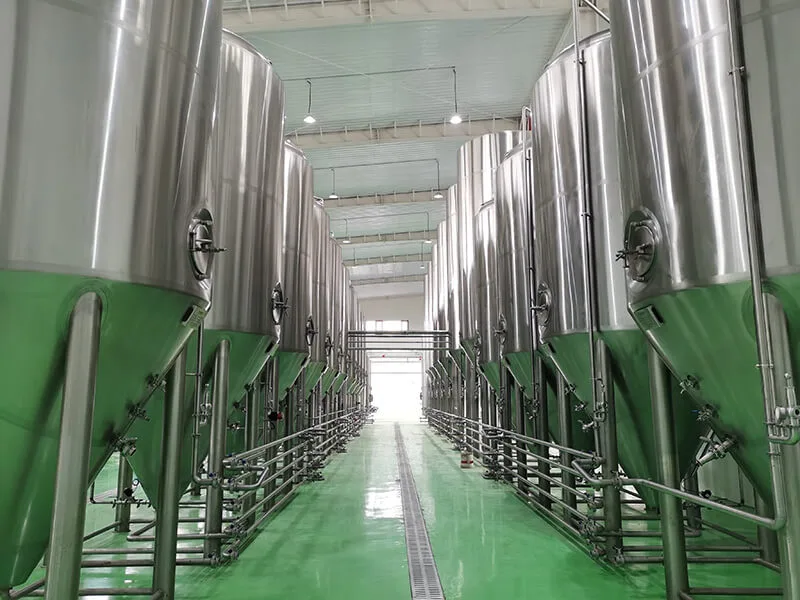
Integrated Fermentation Piping Layout
The project also includes a dedicated fermentation piping corridor.
The main pipeline categories include:
- Wort transfer lines
- Beer transfer lines
- CIP cleaning lines
- Compressed air lines
- CO2 lines
- Wastewater discharge lines
Separating and organizing these pipelines makes equipment connections easier to manage and supports daily operation, cleaning, maintenance, and production scheduling.
For large brewery installations, piping design is just as important as vessel selection. A properly planned layout helps reduce unnecessary pipeline connections and improves accessibility for operators.
4. Water Storage and Utility Systems
Water is one of the most important resources in beer production. Brewing, cleaning, and temperature management all require a stable and properly configured water supply.
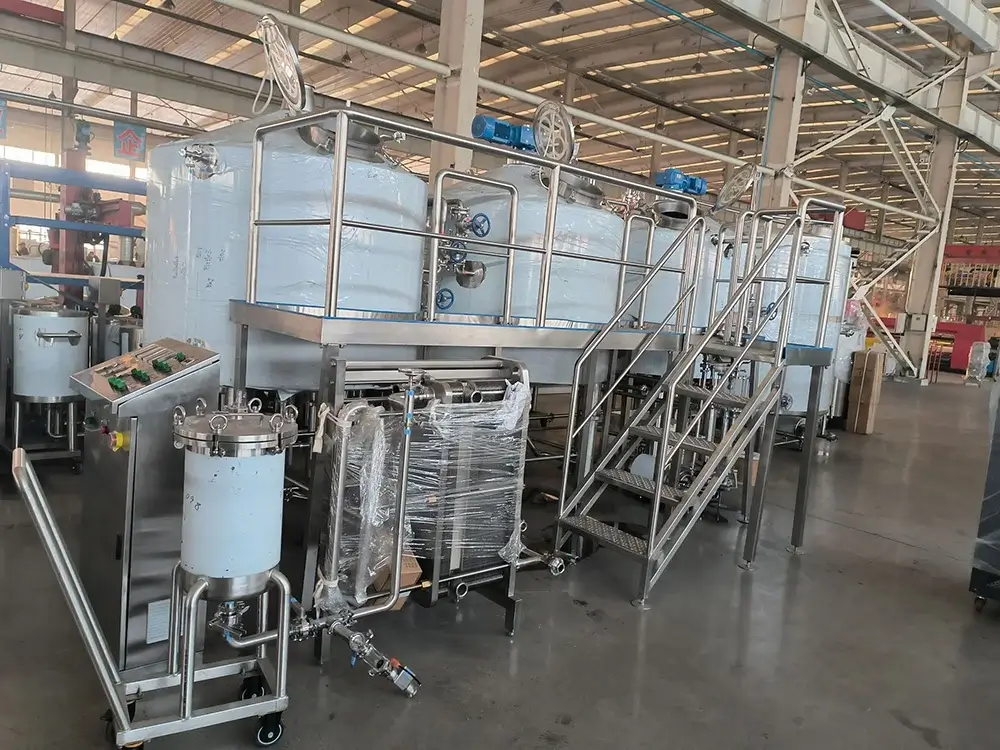
This project includes four 20KL service tanks:
| Equipment | Capacidade |
|---|---|
| Tanque de água glicolada | 20KL |
| RO Water Tank | 20KL |
| Tanque de água quente | 20KL |
| Brewing Water Tank | 20KL |
Matched pumps and piping are included to support water transfer and distribution throughout the brewery.
These tanks provide storage and buffering capacity for different process requirements, helping coordinate water supply between brewing operations and cleaning procedures.
Refrigeration System
Temperature control is essential throughout brewing, particularly during wort cooling, fermentation, and cold storage.
The refrigeration configuration includes:
- 20KL glycol water tank
- 30HP industrial chiller
- Supporting refrigeration pipelines
The system supplies chilled glycol water to the relevant cooling circuits.
Its main functions include:
Wort cooling: Supporting the cooling process before fermentation.
Fermentation temperature control: Providing cooling capacity to maintain the required fermentation temperature.
Cold storage: Supporting temperature management during beer maturation and storage.
The final refrigeration capacity and cooling configuration should be matched to the total tank volume, cooling load, ambient conditions, and operating schedule.
5. Automated CIP Cleaning System
Cleaning and sanitation are essential for maintaining consistent beer quality.
As production capacity increases, manual cleaning becomes more time-consuming and difficult to standardize. A centralized Clean-in-Place (CIP) system allows cleaning solutions to circulate through connected tanks and pipelines without dismantling the equipment.
The CIP system in this project includes:
| Equipment | Capacidade |
|---|---|
| Alkali Tank | 2KL |
| Acid Tank | 2KL |
| Sanitizer Tank | 2KL |
| Tanque de água quente | 2KL |
| CIP Pumps | Included |
| CIP Piping | Included |
The system supports the preparation, circulation, and transfer of cleaning solutions for brewery equipment.
A properly designed CIP system helps improve cleaning consistency, reduce manual intervention, and organize sanitation procedures across different production areas.
The cleaning sequence, chemical concentration, temperature, and circulation time should be configured according to the equipment, process requirements, and sanitation standards.
6. Siemens PLC Automation and Centralized Control
For a brewery operating multiple vessels and auxiliary systems, automation plays an important role in coordinating production.
This project uses Siemens PLC control and Siemens WinCC supervisory software, with two operator stations.
The control arrangement is divided into two main operating areas:
Station 1: Brewhouse Control
Dedicated to brewhouse operations and the management of brewing process parameters.
Station 2: Fermentation and Auxiliary System Control
Responsible for fermentation tanks and other supporting equipment.
The integrated control system helps operators monitor equipment operation and manage key process parameters throughout production.
Depending on the final automation configuration, functions can include:
- Process temperature monitoring
- Equipment operation and status monitoring
- Automated process control
- Pump and valve operation
- Production data recording and traceability
Centralized monitoring helps improve operational visibility and supports more consistent production management.
For commercial breweries, automation should be designed around the actual production workflow rather than simply adding PLC hardware to individual machines.
7. Integrated Brewery Piping System
A complete brewery requires multiple interconnected piping networks to transfer raw materials, intermediate products, finished beer, cleaning solutions, and utility media.
The auxiliary piping system in this project includes:
- Wort pipelines
- Beer pipelines
- Yeast discharge pipelines
- CIP pipelines
- Compressed air pipelines
- CO2 pipelines
These pipelines connect the brewhouse, fermentation area, storage tanks, and supporting systems.
METO considers pipeline routing and equipment connections during the overall system design process to help ensure that the installation layout supports production operations and future maintenance.
8. Multifunctional Distillation Equipment
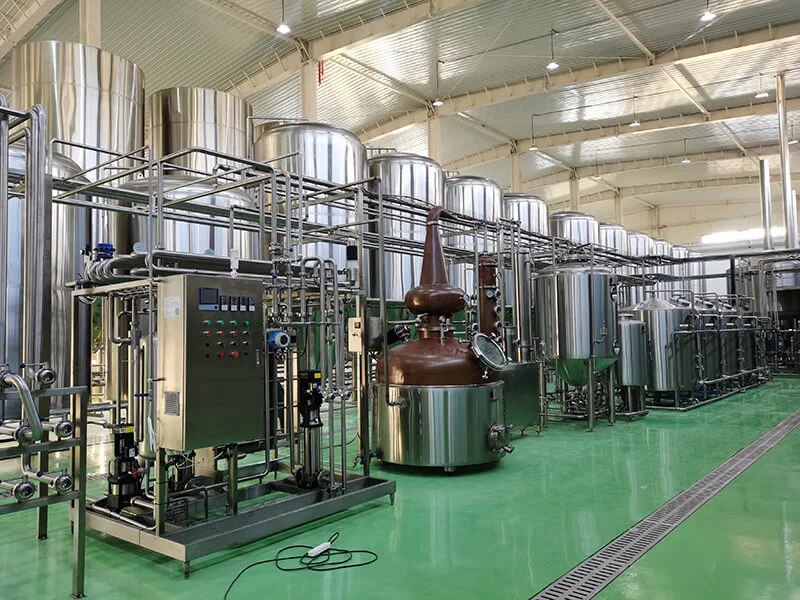
In addition to beer production, this project also includes multifunctional distillation equipment.
The system is designed to support distillation applications and includes four main components:
- Distillation kettle
- Distillation column
- Gin basket
- Condensador
The combination of a distillation kettle and column provides flexibility for different distillation processes, while the gin basket supports botanical infusion applications used in gin production.
Depending on the process configuration and operating method, the equipment can support different distillation requirements and alcohol separation objectives.
For breweries interested in diversifying their product portfolio, integrating distillation equipment can provide an additional production option alongside beer manufacturing.
The final still configuration should be selected according to the intended spirit category, raw materials, distillation method, and required output.
9. Why Choose an Integrated Brewery Equipment Manufacturer?
Purchasing individual machines from different suppliers can create challenges during equipment integration, pipeline connection, automation development, and commissioning.
Working with an integrated brewery equipment manufacturer helps coordinate these different parts of a project.
METO provides brewery and distillery equipment solutions covering:
Engineering and system design
Equipment configuration, production capacity planning, process layout, and utility requirements.
Produção própria
Stainless steel vessel fabrication, welding, polishing, assembly, and equipment inspection.
System integration
Coordination of brewhouse vessels, fermentation tanks, water systems, refrigeration, CIP, piping, and automation.
Instalação e colocação em funcionamento
Technical support during equipment installation, system connection, and commissioning.
Long-term technical support
After-sales assistance to support equipment operation and maintenance.
With manufacturing facilities, engineering capabilities, and international project experience, METO supports customers looking for customized brewing and distillation solutions.
10. Planning Your Own Commercial Brewery?
A successful brewery project starts with a clear understanding of production goals and process requirements.
Before selecting equipment, consider the following factors:
- Target annual beer production
- Expected daily brewing batches
- Beer styles and fermentation cycles
- Fermentation and bright beer tank requirements
- Available building area and installation height
- Heating, cooling, water, and electrical utilities
- CIP and automation requirements
- Future production expansion plans
The right brewery configuration is not necessarily the largest one. It is the system that matches your production schedule, available resources, and long-term business objectives.
Looking for a 5000L brewery system or a complete turnkey brewery solution?
METO is a brewery equipment manufacturer specializing in customized brewing systems, fermentation tanks, utility equipment, automation, and distillation solutions.
Contacte a nossa equipa de engenharia to discuss your brewery project. Share your target production capacity, preferred brewing process, and installation requirements, and we can help develop an equipment configuration suited to your project.
METO – Brewery Equipment Manufacturer
From individual brewing vessels to integrated commercial brewery systems, we help turn your production plans into practical equipment solutions.