Choosing the right brewery size is one of the first decisions a new brewery, brewpub, or growing beer business needs to make.
A common mistake is to choose a brewhouse based only on the batch size. For example, a customer may tell a brewery equipment manufacturer, “I need a 1,000L brewery.” But a 1,000L brewhouse does not automatically mean 1,000L of beer production per day, month, or year.
Your actual production capacity depends on several factors, including brewing frequency, fermentation time, number of fermenters, working days, beer styles, packaging requirements, and expected annual production.
So, should you choose a 300L, 500L, 1000L, or 2000L brewery?
The answer depends on how you plan to operate the brewery—not simply how much beer you want to produce in one batch.
Brewery Capacity vs. Annual Beer Production
Before choosing equipment, it is important to understand the difference between brewhouse capacity and annual production capacity.
Brewhouse capacity refers to the approximate volume of wort produced in a single brewing cycle.
Ad esempio:
- A 300L brewhouse produces approximately 300L per brew.
- A 500L brewhouse produces approximately 500L per brew.
- A 1000L brewhouse produces approximately 1000L per brew.
- A 2000L brewhouse produces approximately 2000L per brew.
However, the total amount of beer you can produce depends on how often you brew and how efficiently your fermentation system is utilized.
A simplified planning formula is:
Annual Production ≈ Brewhouse Batch Size × Brews per Day × Brewing Days × Production Efficiency
For example, a 1000L brewhouse operating two brews per day has a theoretical wort output of:
1000L × 2 brews/day = 2000L/day
If the brewery operates 250 brewing days per year:
2000L × 250 = 500,000L/year
This is a simplified calculation rather than a guaranteed finished-beer output. Fermentation losses, transfer losses, yeast management, beer style, cleaning time, equipment utilization, and packaging losses all affect the actual result.
This is why “I need a 1000L brewery” is not enough information for equipment selection.
What Brewery Size Is Right for My Business?
As a general starting point, different brewery types often require different brewhouse capacities.
| Customer Type | Suggested Brewhouse Capacity | Typical Application |
|---|---|---|
| Brewpub / Pilot Brewery | 300–500L | On-site brewing, new recipes, small-volume production |
| Small Craft Brewery | 500–1000L | Local distribution, taproom and packaged beer |
| Growing Brewery | 1000–2000L | Higher production and regional distribution |
| Commercial Brewery | 2000L+ | Large-volume production and established distribution |
These ranges are not strict rules. A 500L system may be ideal for one brewery but too small for another.
The right capacity should be calculated from your expected production requirements and operating model.
300L Brewery: A Flexible Choice for Brewpubs and Pilot Production
A 300L brewery is often suitable for brewpubs, restaurants, taprooms, pilot breweries, and businesses that want to produce beer on-site.
Its relatively small batch size makes it easier to develop new recipes and operate multiple beer styles without committing to a large production volume.
A 300L system may be suitable when you want to:
- Produce beer for an on-site taproom or restaurant
- Test new beer recipes
- Develop seasonal or limited-release beers
- Start a small craft beer business
- Produce several different styles in relatively small batches
- Keep the initial equipment investment manageable
For a brewpub, the question is not necessarily “How much beer can I produce?”
Instead, ask:
How much beer can my taproom actually sell?
If the local customer base can consume only a few hundred liters per brewing cycle, a larger brewhouse may result in unnecessary equipment costs and unused fermentation capacity.
500L Brewery: A Practical Size for Small Craft Breweries
A 500L brewery provides more production flexibility while remaining relatively compact.
It can be a good option for small craft breweries that combine:
- Taproom sales
- Restaurant or brewpub sales
- Local distribution
- Seasonal beers
- Contract or private-label production
Compared with a 300L system, a 500L brewhouse provides more volume per batch while still allowing a craft brewery to maintain a diverse product portfolio.
For breweries planning to grow gradually, 500L can also provide a useful balance between initial investment and production capacity.
However, the brewhouse is only one part of the system.
If you plan to brew frequently, you need enough fermentation capacity to receive the wort from each batch.
1000L Brewery: A Popular Choice for Growing Craft Breweries
A 1000L brewery is often considered a practical production size for breweries that have moved beyond the initial startup stage.
It can support a wider range of business models, including:
- Brewpubs with high beer consumption
- Independent craft breweries
- Taproom-focused breweries
- Local beer distribution
- Regional craft beer production
- Multiple beer brands or product lines
The major advantage of a 1000L system is production flexibility.
For example, a brewery could potentially operate:
1 brew/day → approximately 1000L wort/day
o
2 brews/day → approximately 2000L wort/day
The actual production schedule depends on the brewhouse configuration, heating method, mashing and lautering process, cleaning requirements, operator availability, and recipe.
If the brewery expects significant growth, it may also be worth considering the fermentation cellar at the same time.
A 1000L brewhouse with insufficient fermenters can become a bottleneck.
2000L Brewery: For Higher Production and Regional Distribution
A 2000L brewery is more appropriate when the business requires higher production volumes or expects to serve a larger distribution market.
It can be considered for:
- Established craft breweries
- Regional beer brands
- Larger brewpub operations
- Breweries supplying multiple locations
- Businesses with established wholesale distribution
- Breweries planning significant production growth
At this scale, equipment planning becomes more complex.
The brewery may require coordinated sizing of:
- Malt handling system
- Birreria
- Hot liquor tank
- Cold liquor tank
- Steam or electric heating system
- Wort cooling system
- Fermentation tanks
- Bright beer tanks
- Glycol cooling system
- Sistema CIP
- Packaging equipment
- Sistema di controllo
The objective is no longer simply to select a larger brewhouse.
The entire production line needs to work together.
How Do I Calculate the Brewery Capacity I Need?
Before requesting a quotation, prepare a basic production plan.
At minimum, you should estimate the following:
1. Target Annual Production
Start with the amount of finished beer you expect to sell in one year.
Ad esempio:
Target annual production: 300,000L
This gives the equipment manufacturer a starting point for calculating the required brewing frequency and fermentation capacity.
2. Brews per Day
Next, determine how many batches you expect to brew each day.
Ad esempio:
1000L brewhouse × 2 brews/day = 2000L brewing output/day
If you need 2000L per day, you may not necessarily need a 2000L brewhouse.
A 1000L system capable of two brews per day could potentially meet the same daily brewing target, depending on the process and operating schedule.
This is where equipment configuration becomes important.
3. Working Days per Year
A brewery operating 300 days per year has a very different production potential from one operating only 150 days.
Ad esempio:
1000L × 2 brews/day × 250 days = 500,000L theoretical annual brewing output
This number still needs to be adjusted for real-world production efficiency and losses.
4. Beer Styles
Beer style also affects equipment selection.
A brewery producing mostly standard ales may have a different fermentation cycle from a brewery specializing in:
- Lager
- IPA
- Sour beer
- Wheat beer
- Stout
- Barrel-aged beer
- High-gravity beer
Longer fermentation or maturation periods require more tank capacity.
5. Fermentation Time
Fermentation time is one of the most important factors in brewery sizing.
If the brewhouse can produce wort faster than the fermenters can process it, fermentation becomes the production bottleneck.
For example, if a 1000L brewery produces two batches per day but the available fermentation tanks remain occupied for several weeks, the brewhouse cannot continue operating at its theoretical maximum indefinitely.
Therefore:
Brewhouse capacity and fermentation capacity must be planned together.
How Many Fermenters Do I Need?
There is no universal answer because fermenter requirements depend on production frequency and fermentation time.
A simplified way to think about the relationship is:
Required Fermentation Volume ≈ Daily Brewing Volume × Average Fermentation/Maturation Cycle
For example, if a brewery produces:
2000L/day
and the average tank occupancy is:
10 days
the brewery may need approximately:
2000L × 10 = 20,000L
of available fermentation capacity to maintain that production rate.
This is a simplified planning calculation. Actual tank requirements depend on tank working volume, headspace, beer style, fermentation temperature, transfer schedules, cleaning time, and production planning.
This is also why a brewery quotation should not be based on brewhouse size alone.
Don’t Forget Fermenter Working Volume
Another common mistake is comparing nominal tank capacity with actual production volume.
For example, a fermenter may be described as a 1000L tank, but the usable working volume may be lower because space is required for:
- Krausen
- Foam
- CO₂ release
- Attività del lievito
- Headspace
- Process safety
The same principle applies to the brewhouse.
When comparing equipment suppliers, make sure you understand whether the stated capacity refers to:
Nominal volume, working volume, or actual production volume.
This can prevent significant differences between quotations that appear similar on paper.
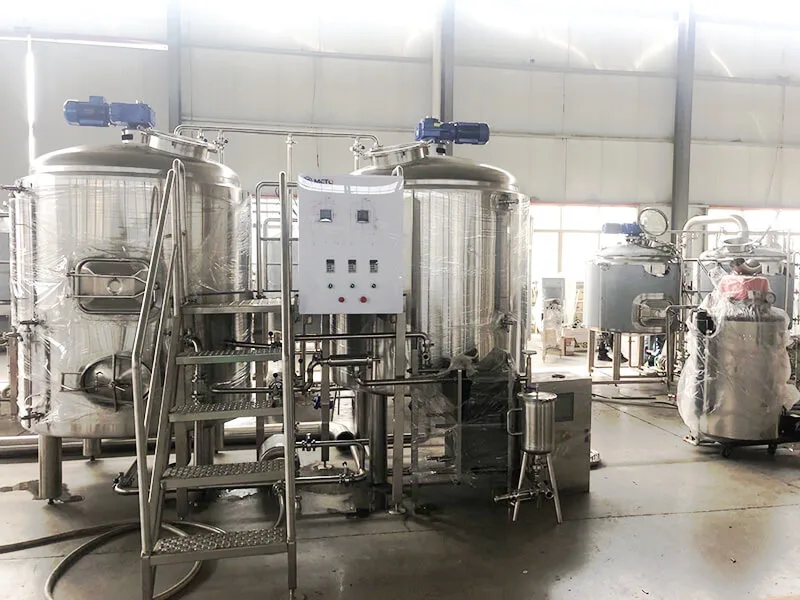
How Beer Packaging Affects Brewery Size
Packaging should also be considered before choosing the brewing system.
Your brewery may package beer in:
- Kegs
- Bottles
- Lattine
- Growlers
- Draft systems
If most beer is sold directly through your taproom, your packaging requirements may be relatively limited.
If you plan to distribute beer to supermarkets, restaurants, bars, or wholesalers, packaging capacity becomes much more important.
For example, a brewery producing 1000L per batch but using a small manual canning or bottling system may have a completely different workflow from a brewery using an automated packaging line.
Therefore, the brewing system should be designed around the complete production and sales model.
What Information Should I Give a Brewery Equipment Manufacturer?
Instead of sending only:
“Please quote a 1000L brewery.”
provide a more complete production requirement.
A useful RFQ should include:
| Information | Example |
|---|---|
| Target annual production | 300,000L |
| Brewhouse capacity | 1000L |
| Brews per day | 1–2 |
| Working days | 250 days/year |
| Main beer styles | IPA, Lager, Stout |
| Average fermentation time | 10–14 days |
| Fermenter size | 1000L |
| Number of fermenters | 10–12 |
| Bright beer tanks | 2 × 1000L |
| Imballaggio | Keg + can |
| Heating | Steam / Electric |
| Automazione | Semi-automatic / PLC |
| Installation location | Country + available utilities |
This information allows the manufacturer to evaluate the project as a complete production system rather than simply pricing a tank or brewhouse.
Should I Choose a Larger Brewery for Future Growth?
Future expansion should be considered, but buying the largest possible system is not always the best solution.
A brewery that is still developing its market may benefit from starting with a smaller brewhouse and designing the cellar for future expansion.
For example, instead of immediately installing a very large brewhouse, you may consider:
1000L brewhouse + modular fermentation expansion
As sales increase, additional fermenters, bright beer tanks, cooling capacity, or packaging equipment can be added.
This approach can help balance:
- Investimento iniziale
- Production requirements
- Available space
- Cash flow
- Future expansion
- Equipment utilization
The best brewery is not necessarily the biggest brewery.
It is the system that matches your current demand while leaving a practical path for growth.
300L vs. 500L vs. 1000L vs. 2000L Brewery
Here is a simplified comparison:
| Capacità | Best For | Main Advantage | Consideration |
|---|---|---|---|
| 300L | Brewpubs, pilot brewing | Flexible and compact | Limited production volume |
| 500L | Small craft breweries | Balance of flexibility and output | May require expansion as sales grow |
| 1000L | Growing craft breweries | Higher production flexibility | Requires proper fermentation planning |
| 2000L | Commercial/regional breweries | High production potential | Higher investment and utility requirements |
The correct choice depends on more than batch size.
A 300L brewery operating frequently may produce more annual beer than a 1000L brewery that operates only occasionally.
A Better Way to Choose Your Brewery Size
Instead of starting with:
“What size brewhouse should I buy?”
start with:
“How much beer do I need to produce and sell?”
Then work backward:
Annual demand → Brewing schedule → Brewhouse capacity → Fermentation capacity → Cooling → CIP → Packaging
This approach produces a much more realistic equipment plan.
Ad esempio:
300,000L annual target
↓
Birreria da 1000L
↓
1–2 brews/day
↓
Appropriate number of 1000L fermenters
↓
Glycol cooling capacity
↓
Bright beer tanks
↓
Keg/can/bottle packaging
This is much closer to how a complete brewery project should be engineered.
Why Work With an Equipment Manufacturer on Capacity Planning?
A professional brewery equipment manufacturer should not simply sell you a brewhouse based on the number you provide.
The manufacturer should help evaluate the relationship between:
- Brewing capacity
- Fermentation capacity
- Cooling capacity
- Heating capacity
- CIP requirements
- Packaging capacity
- Production schedule
- Available utilities
- Brewery space
- Future expansion
At METO, brewery equipment can be configured for different production scales, from compact craft brewing systems to larger commercial brewery projects.
Common configurations include 300L, 500L, 1000L, 1500L, 2000L and larger systems, with the brewhouse, fermentation tanks, cooling system, CIP system, control system, and auxiliary equipment planned according to the customer’s production requirements.
What Should I Include in My Brewery Equipment RFQ?
If you are requesting a quotation, don’t worry if you don’t have every specification finalized.
Start with the information you already know:
1. Target annual production:
How many liters of beer do you expect to produce per year?
2. Desired batch size:
Are you considering 300L, 500L, 1000L, 1500L, 2000L, or another capacity?
3. Brewing frequency:
How many brews do you expect to make per day or week?
4. Beer styles:
What types of beer will you produce?
5. Fermentation cycle:
How long will the beer typically remain in the fermenter?
6. Packaging method:
Kegs, cans, bottles, or a combination?
7. Installation location:
Country, available space, electrical supply, heating source, and other utility conditions.
With these details, an equipment manufacturer can recommend a more appropriate brewery configuration instead of simply sending a standard equipment list.
Conclusion: Choose the Brewery Around Your Production Plan
Choosing between a 300L, 500L, 1000L, or 2000L brewery should not be based on batch size alone.
The key question is not:
“How many liters can my brewhouse make?”
It is:
“How much beer do I need to produce, how often will I brew, and how will the beer move through fermentation, maturation, and packaging?”
Your target annual production, brewing frequency, beer styles, fermentation time, number of fermenters, packaging method, and future growth should all be considered before selecting the equipment.
If you are unsure whether a 300L, 500L, 1000L, or 2000L brewery is right for your project, provide your expected annual production and brewing schedule to the equipment manufacturer.
A well-designed brewery starts with the production plan—not with a tank size.
Looking for brewery equipments? Contatto METO with your project requirements and let our engineers review the equipment configuration before manufacturing begins.