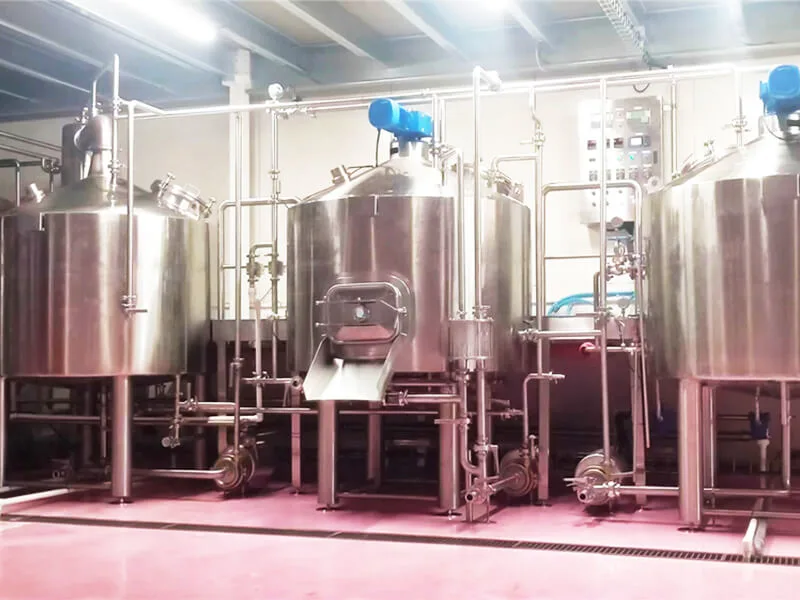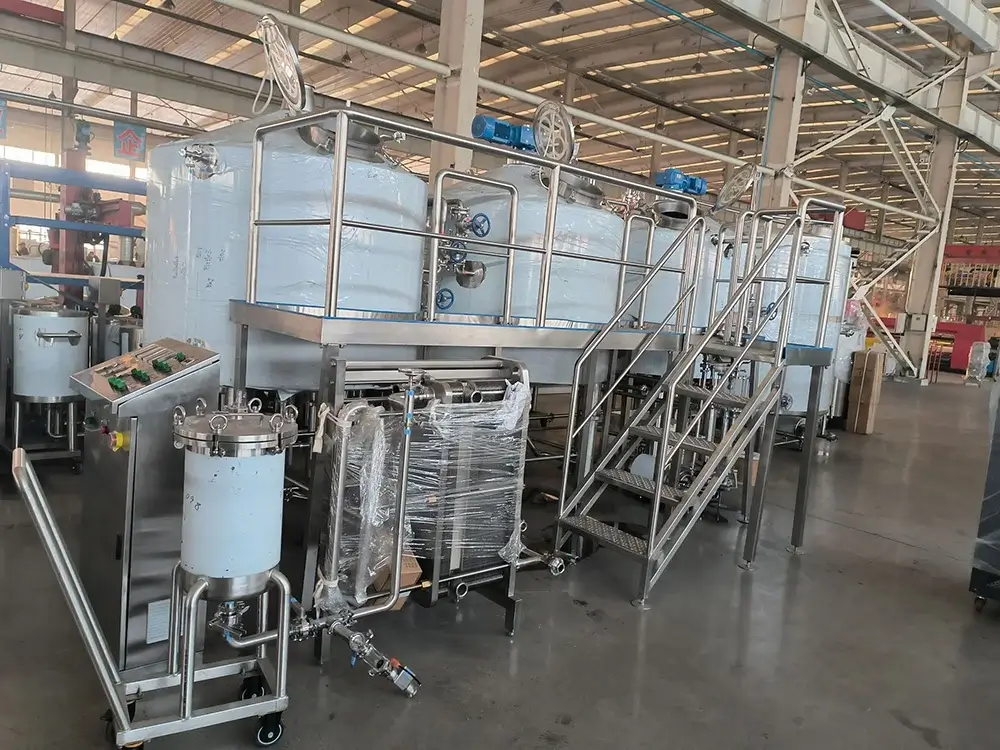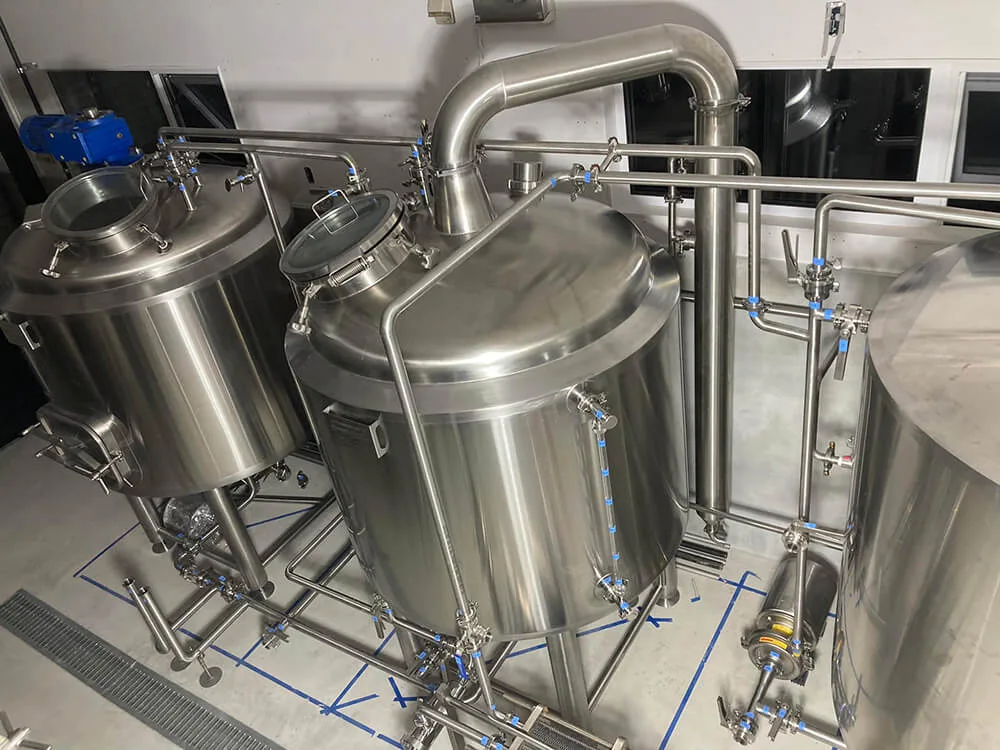
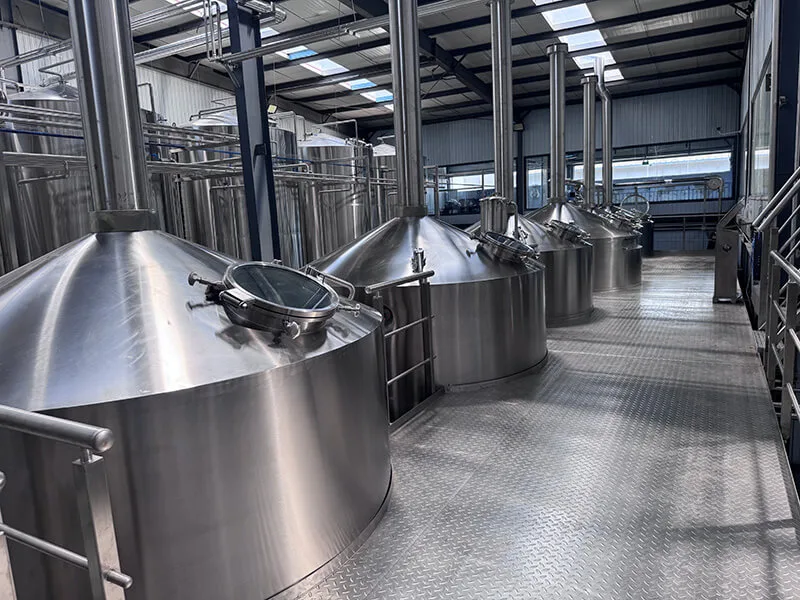
A five-vessel brewhouse is widely used in medium-to-large commercial breweries where production flexibility, process control, and brewing consistency are essential. By separating key brewing operations into independent vessels, this configuration allows multiple process stages to run simultaneously, reducing unnecessary waiting time between brewing operations.
However, installing five independent vessels does not automatically guarantee higher production efficiency. Actual performance depends on how well the vessels are sized, how brewing operations are coordinated, and how heating, wort transfer, cleaning, and automation systems are integrated.
For breweries planning to increase output or improve the utilization of existing equipment, optimizing the entire brewhouse as a coordinated production system is more important than simply increasing individual vessel capacities.
This article explores the engineering principles and practical strategies for improving the efficiency of a five-vessel brewhouse.
1. Understanding the Configuration of a Five-Vessel Brewhouse
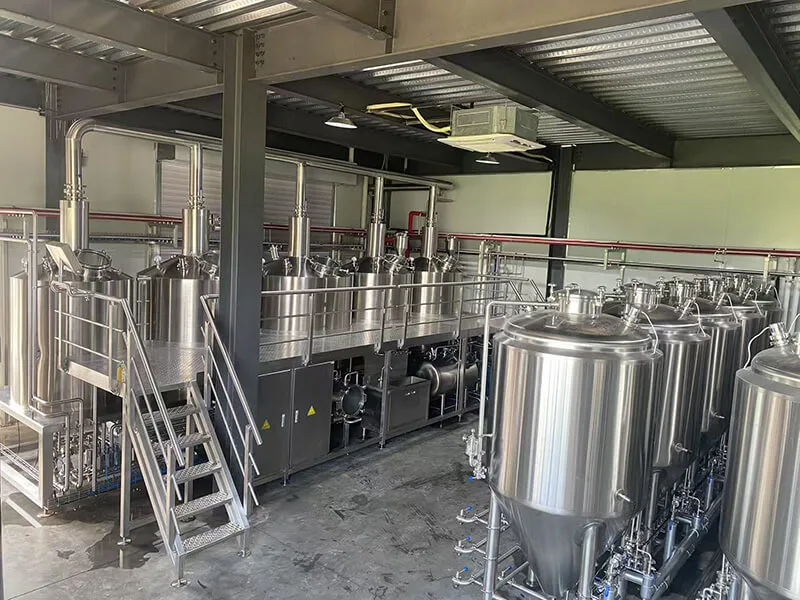
A typical five-vessel brewhouse consists of five independent processing units:
- Tunnel di ammostamento
- Tunnel di raffreddamento
- Bollitore
- Vasca idromassaggio
- Serbatoio dell'acqua calda
Each vessel performs a dedicated function, allowing different brewing operations to overlap.
1.1 Mash Tun: Improving Mash Temperature Control
The mash tun is where milled malt is mixed with brewing water to convert starches into fermentable sugars.
Its performance directly influences extract efficiency, wort composition, and downstream filtration.
To improve mashing efficiency, several factors should be considered:
Heating system design: Steam jackets or other suitable heating arrangements should provide uniform heat distribution and avoid localized overheating.
Agitation system: Proper agitator design helps maintain consistent temperature distribution and prevent excessive mechanical shear.
Temperature control: Automated temperature monitoring and controlled heating allow brewers to follow programmed mashing profiles more accurately.
Mash mixing: The grist-to-water ratio and mixing sequence should be optimized to minimize dry lumps and improve enzyme accessibility.
A properly designed mash tun creates a stable foundation for the entire brewing process.
1.2 Lauter Tun: Reducing Filtration Time
The lauter tun separates liquid wort from spent grain. Its filtration performance is one of the most important factors affecting brewhouse cycle time.
The key design considerations include:
- False bottom opening ratio and distribution.
- Raking system speed and blade geometry.
- Grain bed depth.
- Wort collection distribution.
- Sparging water temperature and flow rate.
- Spent grain discharge efficiency.
An appropriately designed raking system helps maintain a uniform grain bed and reduce the risk of compaction.
The objective is not simply to increase filtration speed. Excessively aggressive raking or sparging can negatively affect wort clarity and extract recovery.
A balanced filtration strategy should consider both lautering duration and extract efficiency.
1.3 Boil Kettle: Optimizing Boiling Performance
The boil kettle is responsible for wort boiling, evaporation, hop utilization, and thermal treatment.
Its heating capacity should match the required wort volume and target boiling time.
Important optimization measures include:
- Selecting an appropriate steam heating surface.
- Maintaining stable heating intensity.
- Designing an effective wort circulation pattern.
- Controlling evaporation rates.
- Integrating a suitable vapor exhaust or heat recovery arrangement.
Boiling intensity should be determined by the recipe, wort characteristics, and product requirements rather than maximizing evaporation.
Excessive heating can increase energy consumption without delivering proportional improvements in wort quality.
1.4 Whirlpool Tank: Improving Trub Separation
The whirlpool tank separates hot break, hop particles, and other suspended solids before wort enters the heat exchanger.
Its performance depends on:
- Tangential wort inlet design.
- Inlet flow velocity.
- Vessel geometry.
- Whirlpool circulation time.
- Resting time after circulation.
- Wort outlet position.
The inlet arrangement should generate a stable rotational flow without excessive turbulence.
A properly designed whirlpool improves wort clarity and reduces the amount of solids entering the heat exchanger and fermentation system.
1.5 Hot Water Tank: Supporting Continuous Brewing Operations
The hot water tank supplies process water for mashing, sparging, and cleaning.
In a multi-batch brewery, insufficient hot water availability can become a bottleneck even when the four main process vessels have sufficient capacity.
The hot water tank should therefore be sized according to:
- Brewing batch volume.
- Sparging water requirements.
- Number of daily brewing cycles.
- Hot water temperature requirements.
- CIP consumption.
- Heating and recovery time.
A properly sized hot water system helps maintain stable production schedules and reduces waiting time between batches.
2. Match Vessel Capacity to the Brewing Process
One of the most common causes of inefficient brewhouse operation is an imbalance between vessel capacities.
Although a five-vessel brewhouse may have a nominal batch capacity of 5,000 liters, the effective production capacity depends on the working volume and processing time of each vessel.
For example, the mash tun, lauter tun, and boil kettle must be designed around the same target production volume, while the hot water tank must support the actual water demand of the brewing schedule.
2.1 Avoid Creating Bottlenecks
Consider a 5,000L five-vessel brewhouse.
If the mash process takes 90 minutes, lautering takes 120 minutes, boiling takes 90 minutes, and whirlpool separation takes 30 minutes, these operations cannot simply be added together to calculate the complete brewing cycle.
Some operations can overlap, but others depend on the availability of downstream vessels.
For example, after wort transfer from the lauter tun, the mash tun may become available for the next batch while the boil kettle continues processing the previous wort.
This overlapping operation is one of the main advantages of a five-vessel configuration.
However, if the lauter tun requires excessive time to complete filtration, the entire production schedule may become constrained.
2.2 Calculate the Actual Production Capacity
A practical way to evaluate brewhouse capacity is to analyze the complete brewing schedule.
The theoretical daily wort production can be expressed as:
Daily Wort Production = Batch Volume × Number of Completed Batches
Ad esempio:
| Brewing Parameter | Value |
|---|---|
| Nominal batch volume | 5,000 L |
| Daily batches | 4 |
| Daily wort production | 20,000 L |
| Annual operating days | 250 |
| Theoretical annual wort production | 5,000,000 L |
This represents theoretical wort production before accounting for downtime, maintenance, cleaning, recipe changes, and other operational losses.
The actual annual production capacity must be calculated using the brewery’s real operating schedule.
3. Optimize the Brewing Schedule Through Process Coordination
The greatest advantage of a five-vessel brewhouse is its ability to perform multiple operations simultaneously.
To take full advantage of this configuration, breweries should develop a coordinated brewing schedule.
3.1 Establish a Process Sequence
A typical production sequence includes:
- Malt milling and grist preparation.
- Mashing in the mash tun.
- Mash transfer to the lauter tun.
- Lautering and sparging.
- Wort transfer to the boil kettle.
- Wort boiling and hop addition.
- Whirlpool separation.
- Wort cooling through the heat exchanger.
- Transfer to fermentation tanks.
The next mash can often begin while the previous batch is undergoing boiling or whirlpool separation, provided the vessels, utilities, and transfer systems are available.
3.2 Identify the Critical Path
The critical path is the sequence of operations that determines the minimum achievable production cycle.
For a five-vessel brewhouse, lautering may become the critical operation if filtration takes longer than the available scheduling window.
Other potential constraints include:
- Slow mash heating.
- Insufficient wort transfer capacity.
- Long boil kettle recovery time.
- Limited hot water availability.
- Inadequate cooling capacity.
- Shared pipelines that prevent simultaneous operations.
The objective is to identify the operation that limits the next batch and improve that specific process rather than upgrading every vessel unnecessarily.
3.3 Coordinate Malt Milling with Brewhouse Operations
Malt milling should be synchronized with the mashing schedule.
If the milling system cannot supply grist at the required rate, the mash tun may remain idle while waiting for raw material.
A complete milling system may include:
- Malt storage and handling equipment.
- Malt elevator.
- Dry malt mill.
- Flexible auger or chain conveyor.
- Grist hydrator.
- Dust collection system.
For larger commercial breweries, a dry milling capacity of 1,500–2,000 kg/h may be suitable for certain 5,000L brewhouse configurations, depending on malt usage, grist composition, and the required production schedule.
The milling capacity should be matched to the actual grist demand rather than selected independently.
4. Improve Thermal Efficiency Through Heat Recovery
Heating and cooling account for a significant proportion of the energy consumed during brewing.
A well-designed five-vessel brewhouse should therefore integrate thermal energy recovery wherever technically practical.
4.1 Recover Heat from Hot Wort
After boiling, hot wort passes through a plate heat exchanger before entering fermentation tanks.
During this process, the hot wort transfers thermal energy to incoming brewing water.
The recovered hot water can then be stored in the hot water tank for subsequent brewing operations.
This reduces the energy required to heat fresh brewing water.
The effectiveness of heat recovery depends on:
- Wort inlet temperature.
- Cold water inlet temperature.
- Heat exchanger surface area.
- Flow rate and temperature difference.
- Fouling and cleaning condition.
4.2 Optimize Steam Heating
For steam-heated brewhouses, energy efficiency depends on more than the boiler’s rated capacity.
Important considerations include:
- Proper steam pressure regulation.
- Adequate steam pipe insulation.
- Effective condensate drainage.
- Steam trap selection and maintenance.
- Heating surface design.
- Condensate recovery.
Returning usable condensate to the boiler system helps reduce water and energy losses.
4.3 Improve Cooling Water Utilization
Cooling water from the wort heat exchanger may be reused for other suitable process applications, depending on water quality and the brewery’s process design.
A properly configured water management system can reduce fresh water consumption and improve overall utility efficiency.
5. Integrate Automation for Better Process Control
Automation plays an important role in improving the consistency and operational efficiency of a five-vessel brewhouse.
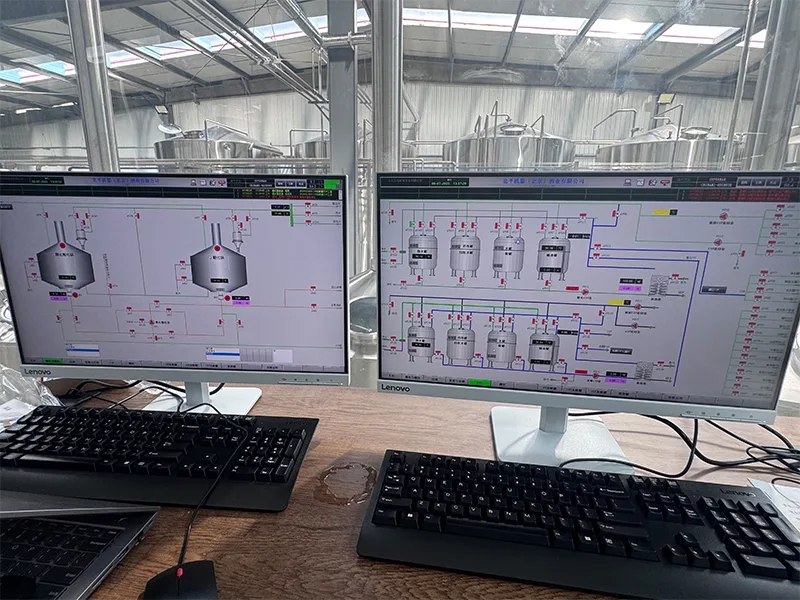
A PLC-based control system can coordinate vessel operations, monitor process parameters, and reduce unnecessary manual intervention.
5.1 Centralized Process Control
A centralized control system can manage:
- Pump start and stop sequences.
- Valve operation.
- Vessel temperature.
- Liquid level.
- Wort transfer.
- Heating and cooling processes.
- Agitator operation.
- Alarm conditions.
Operators can monitor the entire brewing process through an HMI touchscreen.
5.2 Automated Recipe Management
Different beer styles require different mashing temperatures, boiling schedules, and process parameters.
A recipe management system allows brewers to store and recall predefined process settings.
This improves repeatability when producing different beer styles or repeating the same recipe across multiple batches.
5.3 Prevent Operational Errors
Interlocks and alarm functions can prevent certain incorrect operating sequences.
Ad esempio:
- Preventing pump operation under inappropriate liquid-level conditions.
- Preventing conflicting valve configurations.
- Monitoring abnormal vessel temperatures.
- Providing alarms for pump overload or process interruptions.
The specific interlocks should be designed according to the actual piping layout and operating requirements.
Automation should support operator decision-making rather than replace proper process design and maintenance.
6. Optimize Pipeline Design and Wort Transfer
The pipeline system is often overlooked during brewhouse optimization, even though it directly affects transfer time, product loss, cleaning efficiency, and operational flexibility.
6.1 Reduce Unnecessary Pipeline Length
Long pipelines and excessive bends increase pressure losses and may extend transfer times.
A well-designed layout should minimize unnecessary pipe length while maintaining appropriate access for inspection and maintenance.
6.2 Design for Independent Process Operations
In a five-vessel brewhouse, multiple operations may need to run simultaneously.
For example, wort may be transferred from the lauter tun while another vessel is being cleaned or prepared.
The pipeline configuration should therefore support the required simultaneous operations without creating process conflicts.
This may involve:
- Dedicated transfer lines.
- Properly arranged valve groups.
- Automated valve sequencing.
- Appropriate pump selection.
- Clearly defined CIP return routes.
6.3 Consider Cleaning Requirements
Dead legs, poorly drained pipelines, and complicated valve arrangements can increase cleaning time and create hygiene risks.
Pipeline design should consider:
- Drainability.
- Appropriate pipe slopes.
- Hygienic connections.
- CIP flow velocity.
- Spray device coverage.
- Separation between product and cleaning circuits.
An efficient pipeline system improves both production availability and sanitation reliability.
7. Reduce Cleaning Time with an Integrated CIP System
Cleaning is an essential part of commercial brewing, but inefficient cleaning arrangements can reduce the number of available production hours.
A centralized Clean-in-Place (CIP) system allows tanks and pipelines to be cleaned without dismantling the equipment.
A typical CIP configuration may include:
- Caustic solution tank.
- Acid solution tank.
- Hot water tank.
- CIP supply pump.
- Return pump.
- Spray balls or rotary spray devices.
- Automated valves and control system.
7.1 Design CIP Around the Production Schedule
For a five-vessel brewhouse, cleaning operations should be coordinated with brewing operations.
Where the piping arrangement and equipment design permit, certain vessels or pipelines can undergo CIP while other brewing operations continue.
However, shared pipelines and pumps must be carefully evaluated to avoid conflicts between product transfer and cleaning circuits.
7.2 Monitor Cleaning Parameters
Effective cleaning depends on four important factors:
- Time.
- Temperature.
- Chemical concentration.
- Mechanical action or flow conditions.
A properly designed CIP system should establish suitable cleaning parameters for each equipment section.
Monitoring these parameters helps maintain consistent sanitation while avoiding unnecessary water, chemical, and energy consumption.
8. Evaluate Brewhouse Efficiency Using Measurable Indicators
Brewhouse optimization should be based on measurable operational data rather than assumptions.
Several key performance indicators can help identify areas for improvement.
| KPI | What It Measures |
|---|---|
| Brewhouse yield | Extract recovery from raw materials |
| Lautering time | Filtration efficiency |
| Tempo di ciclo del birrificio | Time required to complete a brewing batch |
| Consumo di energia | Heating and cooling efficiency |
| Consumo di acqua | Water utilization per unit of wort |
| CIP duration | Cleaning time and equipment availability |
| Wort loss | Product loss during transfer and processing |
| Equipment utilization | Productive operating time relative to available time |
For example, if the brewery consistently achieves good extract recovery but cannot complete the planned number of daily batches, the main problem may be process scheduling rather than raw material utilization.
Similarly, if the brewhouse cycle is acceptable but utility consumption remains high, thermal recovery and heating system performance should be investigated.
Tracking these indicators over several production cycles provides a more reliable basis for equipment upgrades.
9. Practical Example: Optimizing a 5,000L Four-Stage Brewing Process
Consider a commercial brewery operating a 5,000L brewhouse designed for four to six batches per day.
A typical four-vessel process configuration consists of:
- Mash Tun.
- Lauter Tun.
- Boil Kettle.
- Whirlpool Tank.
The system also includes a separate hot water tank to support mashing, sparging, and cleaning operations.
To achieve stable production, the brewery must coordinate several supporting systems.
Malt Milling System
A dry milling system with an appropriately selected capacity supplies grist according to the planned brewing schedule. A conveyor and grist hydrator support continuous material handling and uniform mash preparation.
Brewhouse Heating System
Steam heating provides controlled thermal input for mashing and boiling. Heating capacity should be evaluated against the required batch cycle and utility availability.
Sistema di raffreddamento del mosto
A plate heat exchanger cools hot wort before fermentation. Heat recovery can be integrated to preheat brewing water.
Sistema di fermentazione
Fermentation tank capacity should be matched to brewhouse output, fermentation duration, beer styles, and packaging requirements.
CIP and Automation System
A centralized PLC control system coordinates pumps, valves, temperature settings, and cleaning procedures.
The important point is that the brewhouse should not be optimized as an isolated group of tanks. Milling, brewing, cooling, fermentation, and cleaning must operate as an integrated production system.
10. How to Choose the Right Five-Vessel Brewhouse Manufacturer
The performance of a five-vessel brewhouse depends heavily on engineering design and manufacturing quality.
When evaluating a brewery equipment manufacturer, buyers should look beyond nominal batch capacity and equipment appearance.
Important evaluation criteria include:
Engineering and Process Design
The manufacturer should understand the complete brewing process and be able to design vessel capacities, heating systems, transfer pipelines, and supporting utilities around the customer’s production requirements.
Manufacturing Capability
In-house fabrication, welding, polishing, and quality inspection help maintain consistency across the complete equipment system.
Automation Integration
The manufacturer should be able to integrate PLC control, temperature monitoring, automated valves, and process interlocks according to the brewery’s operating requirements.
Customization Capability
Different breweries have different building dimensions, utility conditions, production targets, and product requirements. Equipment layouts and configurations should be designed accordingly.
Installation and Technical Support
Equipment installation, commissioning, operator training, and after-sales support are essential for bringing a commercial brewery into stable operation.
Why Choose METO for Commercial Brewery Equipment?
METO is a brewery and industrial equipment manufacturer integrating engineering design, manufacturing, sales, installation, and commissioning.
Established in 2013, METO provides customized brewing systems ranging from pilot-scale equipment to large commercial brewery production lines.
Its manufacturing capabilities include stainless steel vessel fabrication, automated welding, laser processing, and equipment inspection.
For commercial breweries, METO focuses on integrating brewhouse vessels, malt milling systems, fermentation tanks, glycol cooling systems, CIP units, and PLC automation into coordinated production solutions.
Each system can be configured according to production capacity, brewing process, factory layout, and customer requirements.
From individual brewing vessels to complete turnkey brewery projects, METO supports customers throughout equipment design, manufacturing, installation, and commissioning.
Conclusione
Optimizing a five-vessel brewhouse requires more than increasing heating power or installing larger vessels. The real objective is to improve coordination across the entire brewing process.
By balancing vessel capacities, reducing filtration bottlenecks, coordinating simultaneous operations, recovering thermal energy, improving pipeline design, and integrating automation, breweries can increase equipment utilization while maintaining consistent wort quality.
For commercial breweries planning capacity expansion, a properly engineered five-vessel brewhouse provides a flexible foundation for higher production efficiency and long-term operational stability.
Planning a new commercial brewery or upgrading an existing brewhouse?
Contatto METO to discuss your production targets, brewing process, and customized five-vessel brewhouse configuration.