Thailand is an attractive market for craft breweries, brewpubs, hotels and commercial beverage producers. However, brewery equipment designed for a temperate climate cannot always be applied directly to a tropical production environment.
Thailand’s high ambient temperatures and humidity can increase the cooling load, affect equipment operating conditions and make insulation, electrical components, sanitation and factory layout more important during brewery design.
For international buyers planning a brewery in Thailand, the key question is not simply which brewhouse to purchase. The complete system—including fermentation tanks, glycol cooling, insulation, CIP, utilities and controls—should be designed around the local operating environment.
How Thailand’s Climate Affects Brewery Equipment
Temperature is one of the most important factors in brewery engineering.
A brewery needs to control temperatures during wort cooling, fermentation, maturation, cold crashing and beer storage. When the ambient temperature is high, the cooling system must remove more heat from the process and maintain stable temperatures inside the tanks.
Thailand’s refrigeration sector already faces significant electricity demand because of the country’s cooling requirements. This makes energy-efficient refrigeration and properly sized cooling systems important considerations for industrial facilities.
For a brewery, this means that equipment should be designed with the actual site conditions in mind rather than simply using a standard equipment package.
Important factors include:
- Ambient temperature
- Number and size of fermenters
- Fermentation temperature
- Wort temperature after the heat exchanger
- Number of simultaneous fermentations
- Cold-crashing requirements
- Tank insulation
- Glycol temperature
- Brewery operating schedule
- Future production expansion
Glycol Cooling Is Critical for Thai Breweries
The glycol cooling system is one of the most important parts of a brewery in a hot climate.
During fermentation, yeast generates heat and the fermenter must continuously remove this heat to maintain the target temperature. Several fermenters may also require cooling at the same time.
A brewery may therefore have sufficient fermentation capacity but still experience production problems if its chiller is undersized.
A properly engineered glycol system should consider the maximum simultaneous cooling load, rather than simply matching chiller capacity to brewhouse volume.
The cooling system may serve:
- Fermentation tanks
- Bright beer tanks
- Cold liquor or chilled water systems
- Wort cooling
- Cold crashing
- Other process cooling requirements
The glycol loop should also be properly insulated to reduce heat gain between the chiller and the individual tanks.
Why Chiller Sizing Should Be Based on the Whole Brewery
For example, a 1,000L brewhouse does not automatically require a fixed-size chiller.
The actual requirement depends on the number of fermenters and their volume.
A brewery with a 1,000L brewhouse and four 1,000L fermenters has a different cooling demand from a brewery with the same brewhouse but eight 2,000L fermenters.
The production schedule also matters. If multiple batches are transferred to the cellar within a short period, the cooling system may experience a much higher peak load.
This is why METO designs brewery cooling systems according to the complete cellar configuration, production schedule and expected operating conditions.
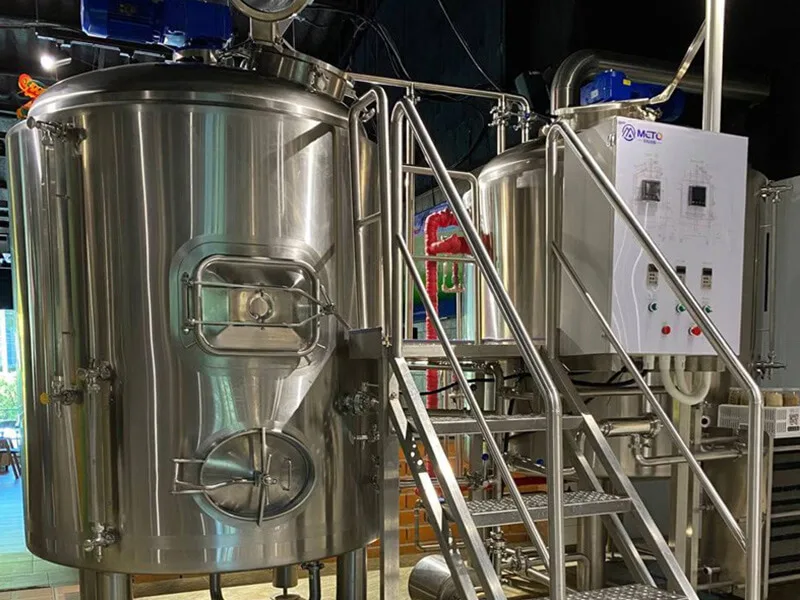
Fermentation Tank Design for Hot Climates
Fermentation tanks are particularly sensitive to ambient conditions.
A well-designed beer fermenter for Thailand should provide reliable temperature control while minimizing heat transfer from the surrounding environment.
Isolamento
Good insulation reduces heat gain from the surrounding air and helps the glycol system operate more efficiently.
The insulation thickness and material should be selected according to the tank design, operating temperature and local environment.
Insulation is especially important for:
- Fermenters
- Bright beer tanks
- Glycol pipelines
- Cold water tanks
- Chilled process lines
Poorly insulated piping can also increase the cooling load even when the chiller itself has sufficient capacity.
Jacket Design
Fermenter cooling jackets should provide effective heat transfer while maintaining stable temperature control.
The jacket configuration, cooling area and glycol flow should be considered together with the tank volume and fermentation requirements.
For larger breweries, independent temperature control for individual fermenters can also provide greater flexibility. Each tank can maintain its own fermentation temperature according to the beer style and production schedule.
Brewery Insulation Is More Important in Thailand
Insulation is sometimes treated as a secondary specification when purchasing brewery equipment.
In a hot climate, it should be considered part of the overall cooling strategy.
Heat can enter the system through:
- Tank surfaces
- Glycol pipelines
- Chilled water pipelines
- Valvole e raccordi
- Uninsulated process equipment
Reducing unnecessary heat gain means the refrigeration system does not have to work harder than necessary.
For international brewery projects, equipment specifications should therefore clearly define the insulation material, thickness and application.
Electrical and Control System Considerations
Thailand brewery projects also require attention to the local electrical environment.
The brewery equipment manufacturer should confirm the required:
- Tensione
- Frequency
- Phase
- Motor specifications
- Control cabinet configuration
- PLC requirements
- Sensor specifications
The electrical system should be designed according to the actual installation site rather than using a generic configuration.
For automated breweries, PLC controls can integrate temperature monitoring, pumps, valves, glycol cooling and alarm functions.
Remote monitoring can also be useful for fermentation management, particularly when multiple tanks operate simultaneously.
CIP and Sanitation in a Hot and Humid Environment
Cleaning and sanitation are critical in every brewery, but the brewery environment can make good process design even more important.
A suitable CIP system can help standardize cleaning of:
- Fermenters
- Brewhouse vessels
- Bright beer tanks
- Wort pipelines
- Beer pipelines
- Heat exchangers
The CIP system should be sized according to the number and volume of vessels being cleaned.
For a growing brewery, it can also be useful to consider whether the CIP system needs to support multiple cleaning circuits or simultaneous operations.
Efficient CIP design can reduce water, chemicals, labor and cleaning time. Commercial brewing equipment suppliers increasingly focus on reducing water and energy consumption through optimized cleaning sequences and process design.
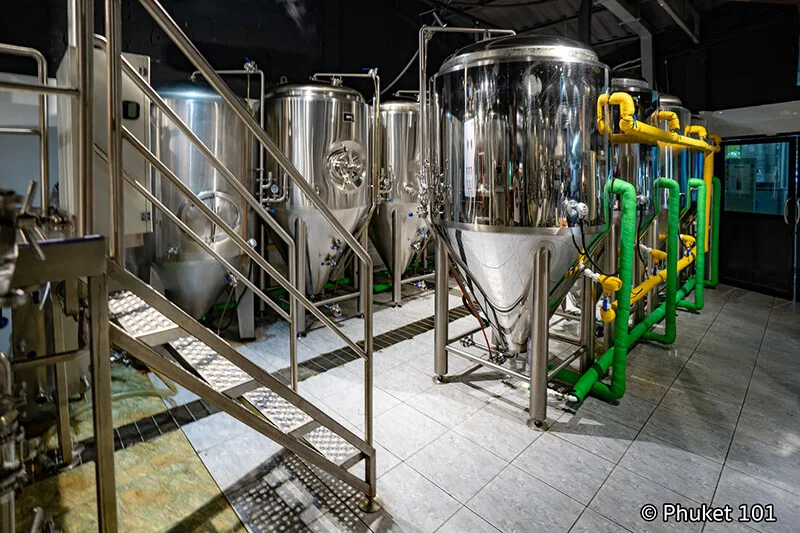
Brewery Layout and Ventilation in Thailand
The building environment should be considered before the equipment is manufactured.
A brewery layout in Thailand should provide sufficient space for:
- Brewhouse operation
- Fermentation tanks
- Glycol chiller
- Sistema CIP
- Pumps and piping
- Electrical cabinets
- Manutenzione
- Cleaning
- Raw material handling
- Finished beer handling
Ventilation is also important around the brewhouse and other heat-generating equipment.
The brewery should provide sufficient clearance around tanks and machinery for inspection, cleaning and maintenance.
For compact craft breweries, equipment layout becomes particularly important because the available floor area may be limited.
Choosing the Right Brewery Capacity for Thailand
The appropriate brewery size depends on the business model rather than climate alone.
Ad esempio:
300–500L
Suitable for:
- Brewpub
- Restaurants
- Pilot brewing
- Recipe development
- Small hospitality projects
1,000L
Suitable for:
- Growing craft breweries
- Hotels
- Restaurants
- Commercial craft beer production
A 1,000L brewhouse can also provide a practical foundation for future expansion through additional fermenters, bright beer tanks and cooling capacity.
2,000L and Above
Suitable for:
- Commercial breweries
- Regional craft beer production
- Higher-volume distribution
- Breweries planning multiple daily brews
For larger systems, fermentation capacity, cooling capacity and packaging can become more important production constraints than brewhouse volume alone.
How to Design a Brewery Equipment System for Thailand
A reliable brewery project should be designed as one integrated system.
Instead of selecting the brewhouse first and adding other equipment later, the manufacturer should evaluate:
Production target → Brewhouse → Fermentation → Cooling → CIP → Utilities → Packaging → Layout → Automation
For a Thai brewery, the cooling system should be calculated together with the fermentation cellar. Tank insulation, glycol piping and chiller capacity should be considered as one system.
The electrical configuration should be confirmed before production, while the factory layout should be reviewed before final equipment dimensions are approved.
Why Work with a Brewery Equipment Manufacturer?
For an international brewery project, equipment manufacturing is only one part of the process.
A qualified manufacturer should be able to support:
- Brewery system design
- Equipment selection
- Tank sizing
- Cooling calculation
- Piping design
- Electrical configuration
- PLC automation
- Factory testing
- Installation guidance
- Commissioning
- After-sales support
METO designs and manufactures brewery equipment for different production scales and international markets. Its brewery systems can be configured around brewhouse capacity, fermentation volume, cooling requirements, heating method, automation level and available site conditions.
For Thailand projects, the focus should not simply be on supplying a standard brewhouse. The goal is to create a complete brewing system that can maintain stable production under local climate and operating conditions.
FAQ
Is a standard brewery chiller suitable for Thailand?
Not necessarily. Chiller capacity should be calculated according to ambient conditions, fermentation volume, simultaneous cooling demand, wort cooling requirements, insulation and the planned production schedule.
Why is insulation important for a Thai brewery?
Higher ambient temperatures can increase heat gain. Proper insulation reduces unnecessary thermal load and helps the glycol system maintain stable temperatures more efficiently.
What brewery equipment needs the most cooling?
Fermenters generally represent a major continuous cooling load. Wort cooling and cold crashing can create additional peak demand, so the entire production process should be considered when sizing the cooling system.
Is 1000L a suitable brewery size for Thailand?
A 1000L system can be suitable for craft breweries, brewpubs, restaurants and hospitality projects. The final configuration should be based on target annual production, brews per day, fermentation capacity, available space and future expansion plans.
Can brewery equipment be customized for Thailand?
Yes. Brewery equipment can be customized according to production capacity, electrical requirements, heating method, cooling system, tank configuration, automation level, factory layout and other project requirements.
Conclusione
Thailand’s climate makes cooling and thermal management important considerations when selecting brewery equipment.
A successful brewery project should therefore look beyond the brewhouse itself. Glycol cooling, fermenter insulation, piping, CIP, electrical configuration, ventilation and future expansion should all be considered during the design stage.
For breweries in Thailand, the best equipment solution is not necessarily the largest or most automated system. It is a system correctly matched to the brewery’s production requirements, local operating conditions and long-term growth plan.
If you are planning a brewery project in Thailand, provide the target brewhouse capacity, number and size of fermenters, production target, available space and preferred heating method. A brewery equipment manufacturer can then develop the cooling, fermentation, CIP and control systems around the complete project rather than treating each piece of equipment separately.