Is Your Equipment List Really Ready?
When you move from a kitchen, garage, or basement into a real commercial brewery, the biggest shock is often not recipes or techniques—it’s equipment.
Many passionate home brewers discover that the tools they once mastered in a home brewery suddenly fall short at the commercial level. This is not a problem with skill, but a fundamental change in scale, compliance, and sustainability.
The shift is not just about “brewing good beer.”
It is about brewing good beer consistently, safely, legally, and profitably.
That requires a completely new way of thinking about equipment.
1. The Core Difference: Not Just Bigger, but Smarter
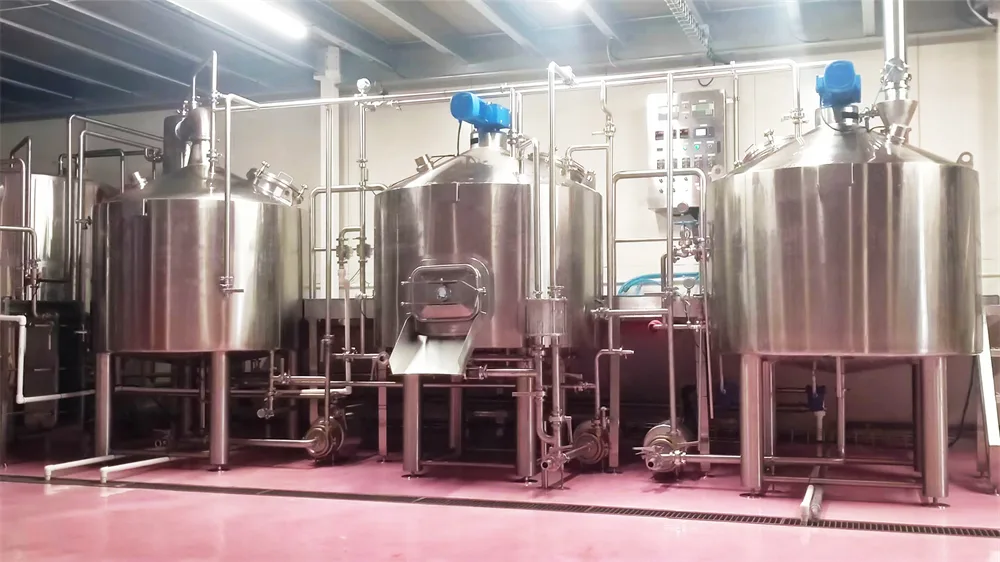
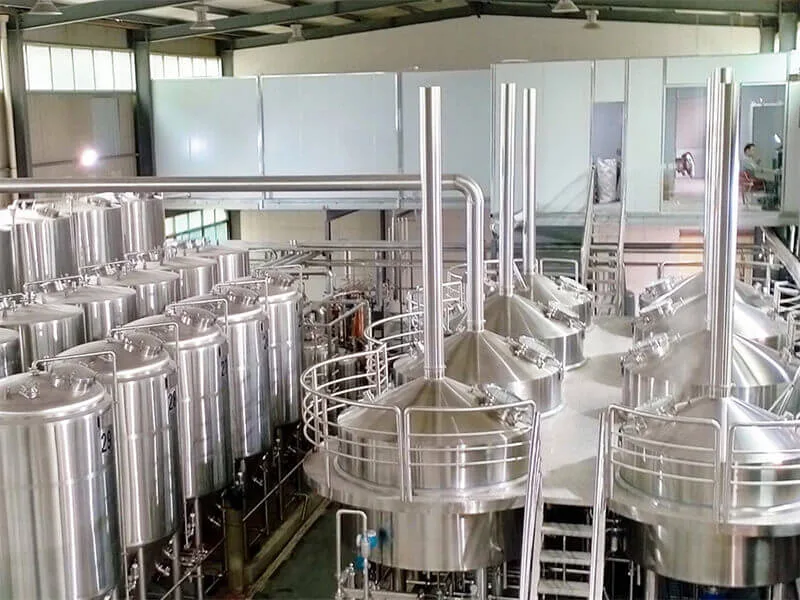
A commercial brewery system is not simply a scaled-up home brewery.
It is a professional production system designed for stability and efficiency.
| Key Aspect | Home Brewery | Commercial Brewery | What Really Changes |
|---|---|---|---|
| Main Goal | Fun & experimentation | Stable, efficient production | From “creating” to “manufacturing” |
| Capacité | Liters, fixed size | Hundreds or thousands of liters | Modular, expandable design |
| Materials | Food-grade is enough | Certified food-grade stainless steel | Material certificates & polishing standards |
| Process Control | Manual, experience-based | Automated & repeatable | PLC control, precise temperature & timing |
| Cleaning & Hygiene | Manual cleaning | Automatic CIP system | Prevent contamination |
| Efficacité énergétique | Minor concern | Major cost factor | Heat recovery & energy-saving design |
2. Three Key Factors When Entering Commercial Brewing
1) Capacity Planning: Think Beyond Year One
In a home brewery, flexibility is easy—you brew what you want, when you want.
In a commercial brewery, capacity planning becomes critical.
Key questions:
- What is your target production in Year 1, Year 3, and Year 5?
- What are your core beer styles?
- Do some products need dedicated fermentation tanks?
Equipment insight:
Avoid buying equipment that is “just enough.” Choose modular systems that allow future expansion.
For example, our brewing systems can start at 5 HL and expand to 20 HL or more by adding fermentation tanks or upgrading control systems—protecting your initial investment.
2) Compliance: Safety Is Not Optional
In a home brewery, safety depends on personal care.
In a commercial brewery, safety is defined by regulations and certifications.
Key requirements include:
- Materials:
All beer-contact parts must use 304 or 316L stainless steel, with material certificates. - Surface finish:
Inner surfaces should meet sanitary standards (Ra ≤ 0.8 μm) to avoid bacterial growth. - Pressure vessels:
Brew kettles and hot liquor tanks often require ASME or equivalent certification, which is essential for legal operation and insurance.
Equipment insight:
Always confirm compliance documents with your supplier.
We provide a complete compliance package—from material reports to pressure vessel certificates—to support licensing and inspections.
3) Automation: From Brewer to Production Manager
Home brewing is hands-on craftsmanship.
Commercial brewing is process control and management.
Common challenges:
- Long manual brewing hours
- Lots incohérents
- Rising labor costs
- Operator fatigue
Solution: Automated control systems
- Repeatability:
PLC systems store recipes and execute them precisely—your flagship IPA tastes the same every time. - Efficiency:
Automatic mash steps, temperature control, and timed boiling reduce manual work. - Data tracking:
Every batch is recorded, making troubleshooting fast and reliable.
Equipment insight:
Even entry-level commercial brewery systems should allow automation upgrades.
We offer solutions from manual valves to full touchscreen control—so you can upgrade step by step.
3. Hidden Equipment Costs Home Brewers Often Miss
Beyond the brewhouse itself, commercial brewing requires additional systems:
- Cooling system:
Industrial chillers and jacketed fermentation tanks replace household refrigerators. - Water treatment:
Stable water quality may require RO or deionization systems. - Wastewater considerations:
Commercial discharge is regulated and may need pretreatment. - Material handling:
Moving tons of malt efficiently may require grain conveyors or lifts.
4. A Smarter Path to Commercial Brewing
1. Build a business plan first, then choose equipment
Let your market goals and sales forecast define capacity.
2. Work with professional engineers
Brewery layout, utilities, and workflow are just as important as the equipment itself.
3. Invest in the core, upgrade later
Prioritize brewhouse, fermentation tanks, and CIP systems. Packaging lines can come later.
4. Choose a “coach-type” supplier
You need more than a seller—you need a long-term technical partner.
We support new commercial brewers with a Commercial Brewing Launch Program, covering installation guidance, training, and support through your first products.
Réflexions finales
Moving from a home brewery to a commercial brewery is exciting—but it is also a serious engineering project.
The right equipment turns passion into a sustainable business.
Ready to plan your future brewery?
We offer a free “Home Brewer to Commercial Brewery Equipment Checklist” and a 30-minute one-on-one consultation to help you avoid common mistakes and design a cost-effective starting system.
Contact our brewing consultants and take the first professional step toward your commercial brewing dream.