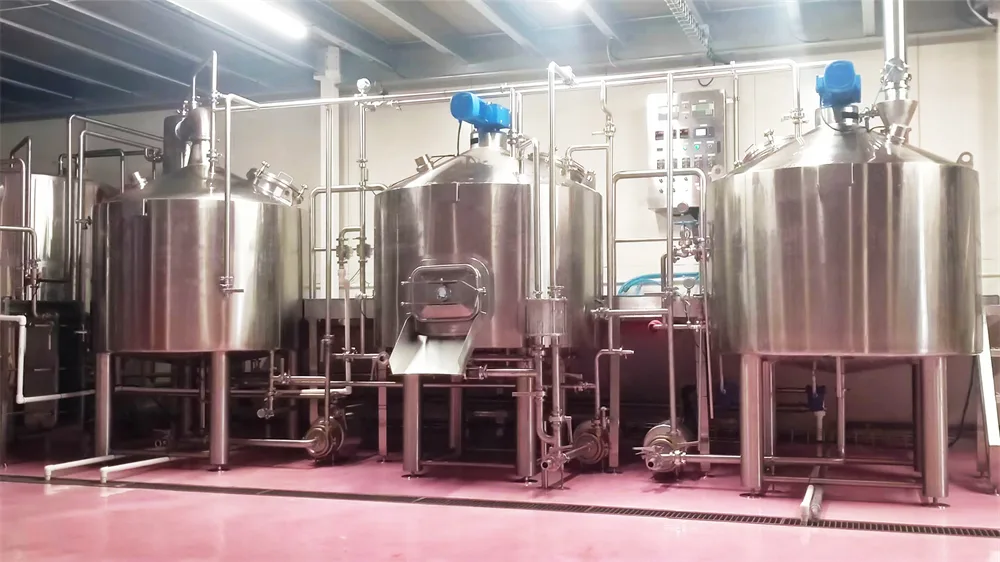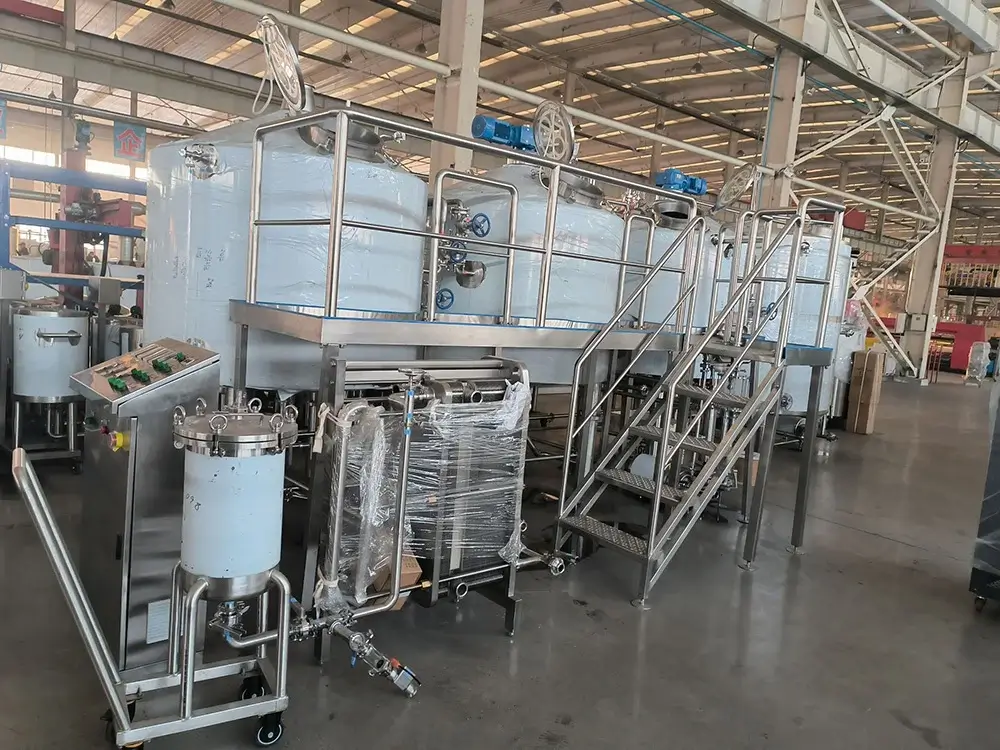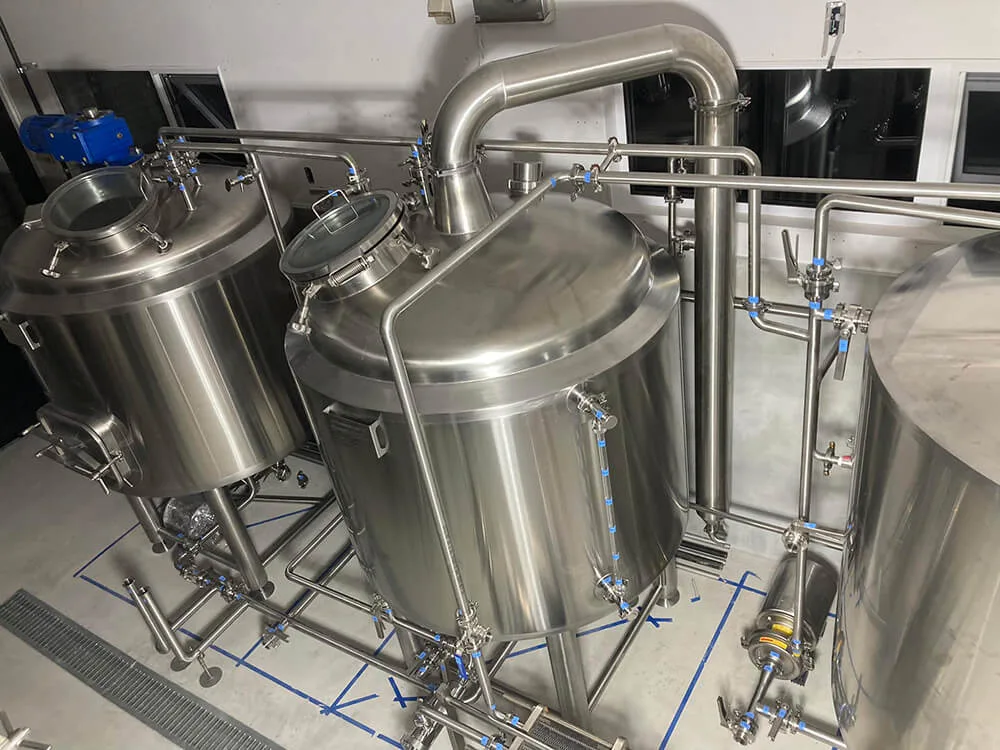
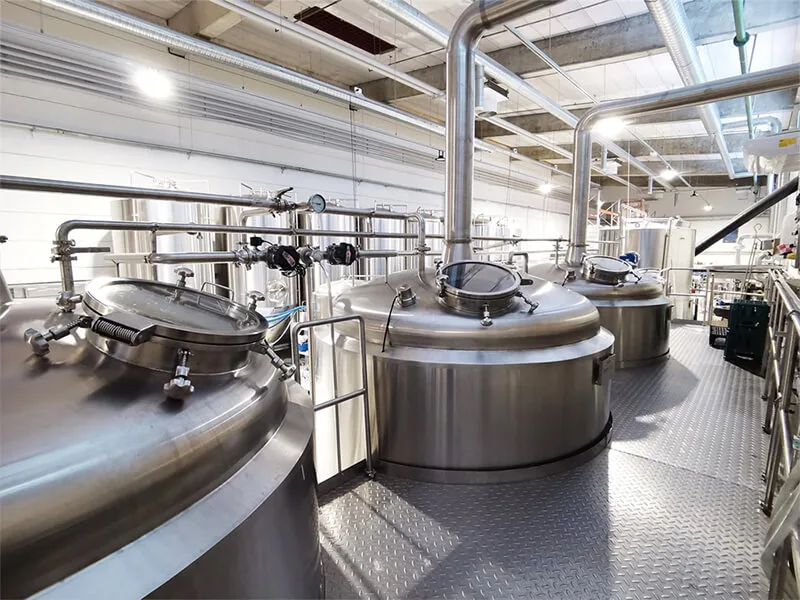
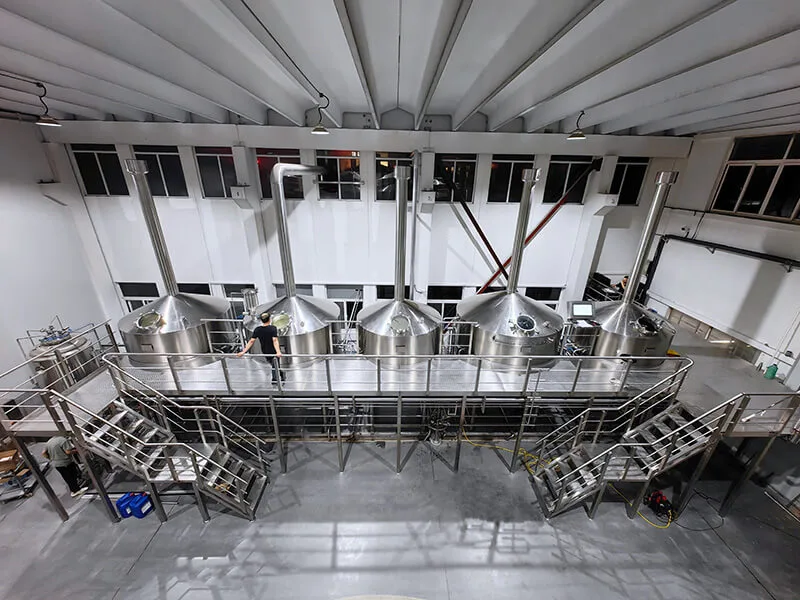
The brewhouse is the heart of beer production, determining wort quality, production efficiency and maximum capacity. For medium and large breweries with a daily output of over 2,000 liters, 4-vessel brewhouses and 5-vessel brewhouses are the mainstream industrial configurations. Both are designed for professional division of labor, precise temperature control and continuous production, but differ significantly in process logic, efficiency, energy consumption and applicable scenarios. This article analyzes both systems in detail from five dimensions: process principles, core configuration, operating efficiency, investment and operation, and application scenarios, providing a scientific basis for equipment selection for large-scale breweries worldwide.
1. Basic Process Principles of Brewhouse Systems
The core of beer saccharification is to convert starch from malt (and adjuncts) into fermentable sugars to produce clear wort, laying the foundation for fermentation. The standard process includes five key steps:
- Mashing Crushed malt is mixed with hot water. Through stepwise temperature control (protein rest 45–55°C, saccharification 60–70°C), enzymes convert starch into maltose and glucose.
- Lautering Separate wort from spent grain, sparge to recover residual sugar, and obtain clear wort.
- Boiling Wort is boiled vigorously for 60–90 minutes to sterilize, concentrate, extract hop flavors and precipitate hot break.
- Whirlpool Centrifugal force separates hop debris and protein flocs to obtain clear hot wort.
- Thermal Energy Management Hot water supply and waste heat recovery to support continuous production and energy saving.
Both 4-vessel and 5-vessel systems are designed around the above processes. The main differences lie in vessel function division, process parallelism and thermal energy buffering capacity.
2. 4-Vessel Brewhouse: A Stable and Balanced Industrial Standard
2.1 Core Configuration
A standard 4-vessel system consists of four independent functional tanks, matched with plate heat exchangers, cold/hot water tanks and a PLC automatic control system:
- Mash Tun: Enzymatic reaction vessel with precise temperature control and agitation for protein rest and saccharification.
- Lauter Tun: Equipped with screen plates and rakes for efficient separation of wort and spent grain.
- Brew Kettle / Boiling Kettle: Steam-jacketed heating for intense boiling, hop addition and wort concentration.
- Whirlpool Tank: Tangential inlet and conical bottom for efficient separation of hot break.
2.2 Operating Principle (Serial + Limited Parallel)
The 4-vessel system adopts a step-by-step, batch-relay mode:
- Malt is fed into the mash tun → mashing completed → mash transferred to lauter tun.
- Lauter tun separates wort → wort pumped to brew kettle.
- Brew kettle completes boiling → wort transferred to whirlpool.
- Whirlpool separation finished → wort cooled → transferred to fermentation.
Parallel advantage: While lautering is underway, the mash tun can start the next batch; during whirlpool, the brew kettle can prepare the next wort. Single-batch cycle is approximately 3.5–4.5 hours, with 4–6 batches per day.
2.3 Key Advantages
- Stable process: Clear division of labor, precise temperature control (±0.5°C), high consistency of wort quality.
- Cost-effective: 15–25% lower investment than 5-vessel systems, smaller footprint, easier maintenance.
- Wide adaptability: Suitable for all-malt brewing and low-adjunct beer production, compatible with most beer styles.
- Mature automation: Full PLC control, supporting 24-hour continuous production.
2.4 Limitations
- Efficiency bottleneck: Waiting gaps exist between processes (e.g., lautering waiting for boiling, whirlpool waiting for cooling).
- Limited adjunct capacity: No independent cereal cooker, restricting high-adjunct ratios (>30%).
- Moderate heat recovery: No dedicated buffer tank, resulting in relatively low waste heat recovery efficiency.
3. 5-Vessel Brewhouse: An Ultra-Efficient Capacity Engine
3.1 Core Configuration (Two Main Forms)
Based on the 4-vessel system, one additional specialized tank is added to form a fully parallel, high-buffering efficient system:
Scheme A (Mainstream High-Efficiency Type)
Mash Tun + Lauter Tun + Wort Holding Tank + Brew Kettle + Whirlpool Tank
- Wort holding tank: Caches filtered wort and eliminates waiting time for boiling.
Scheme B (Adjunct-Enhanced Type)
Cereal Cooker + Mash Tun + Lauter Tun + Brew Kettle + Whirlpool Tank
- Cereal cooker: Independently processes adjuncts such as rice and corn, suitable for high-adjunct ratio (30–50%) industrial beer.
General configuration: matched with large hot water tanks and high-efficiency heat recovery systems.
3.2 Operating Principle (Fully Parallel + Seamless Connection)
The core of the 5-vessel system is complete decoupling of processes and simultaneous multi-batch operation:
- Batch 1: Boiling in brew kettle → separation in whirlpool.
- Batch 2: Lautering in lauter tun → caching in wort holding tank.
- Batch 3: Mashing in mash tun → ready for lautering.
- Cereal cooker (optional): Processes adjuncts synchronously and links with mash tun.
Efficiency breakthrough: Almost eliminates batch waiting time. Single-batch cycle reduced to 3.0–4.0 hours, with 6–8 batches per day. Equipment utilization rate increases by 30–50% compared with 4-vessel systems.
3.3 Key Advantages
- Maximized capacity: Ultra-efficient continuous production, suitable for 10,000-ton annual output.
- Strong adjunct compatibility: Cereal cooker supports high-adjunct ratios, reducing raw material costs.
- Optimal thermal efficiency: Holding tank + hot water tank form thermal buffer, saving 60–80% energy via waste heat recovery.
- More stable quality: Independent optimization of each process, smaller deviation in wort turbidity and gravity.
- Flexible production: Supports rapid switching of multiple brands and recipes, ideal for large craft brewing groups.
3.4 Limitations
- Higher investment: Equipment, civil works and automation system increase by 20–35%.
- Larger footprint: More tanks require greater factory area and height.
- Complex operation and maintenance: More complex piping and automation systems require professional teams.
4. 4-Vessel vs 5-Vessel: In-Depth Comparison
4.1 Configuration and Process Comparison
| Comparison Item | 4-Vessel Brewhouse | 5-Vessel Brewhouse |
|---|---|---|
| Standard Vessels | Mash Tun, Lauter Tun, Brew Kettle, Whirlpool Tank | Mash/Cereal Cooker, Lauter Tun, Wort Holding Tank, Brew Kettle, Whirlpool Tank |
| Process Mode | Mainly serial, limited parallel | Fully parallel, seamless relay |
| Single Batch Cycle | 3.5–4.5 hours | 3.0–4.0 hours |
| Daily Batches | 4–6 batches | 6–8 batches (↑30–50%) |
| Adjunct Adaptability | Low ratio (<30%) | High ratio (0–50%) |
| Heat Recovery | Basic, 30–50% efficiency | High efficiency, 60–80% |
4.2 Investment and Operation Comparison
| Comparison Item | 4-Vessel Brewhouse | 5-Vessel Brewhouse |
|---|---|---|
| Equipment Cost | Baseline (100%) | 120–135% |
| Civil Engineering Cost | Relatively low (small footprint) | Relatively high (15–25% larger area) |
| Energy Cost | Relatively high (steam, water, power) | Relatively low (20–40% energy saving) |
| O&M Cost | Low (simple system) | High (spare parts, labor) |
| Payback Period | 3–5 years | 2–4 years (under high capacity) |
4.3 Application Scenarios
Best for 4-Vessel Brewhouse
- Medium and large craft breweries: 2,000–5,000L per batch, daily output ≤30,000L.
- All-malt or low-adjunct beers: German lager, British ale, craft specialty beers.
- Budget-controlled projects: Stable quality with balanced investment and efficiency.
- Limited factory space: Priority on compact layout.
Best for 5-Vessel Brewhouse
- Large industrial / group breweries: ≥5,000L per batch, daily output ≥30,000L.
- High-adjunct production: Industrial lager, high-volume mainstream beers.
- Ultimate efficiency demand: 24-hour full-load production for large market share.
- Large-scale multi-style craft breweries: Multiple brands, stable supply.
5. Selection Recommendations
5.1 Capacity-Oriented Selection
- Daily output <20,000L: 4-vessel system is sufficient with optimal cost performance.
- Daily output 20,000–50,000L: Prioritize 4-vessel; reserve space for future 5-vessel upgrade.
- Daily output >50,000L: Directly adopt 5-vessel system to ensure long-term capacity and efficiency.
5.2 Process-Oriented Selection
- All-malt / low-adjunct brewing: 4-vessel system fully meets requirements with stable quality and lower cost.
- High-adjunct ratio (>30%): Must choose 5-vessel (with cereal cooker) to ensure mashing efficiency.
- Multi-category flexible production: 5-vessel system is more suitable for quick switching and consistent quality.
5.3 Investment and Long-Term Operation
- Limited short-term investment: 4-vessel system, upgradable to 5-vessel later.
- Long-term cost priority: 5-vessel system significantly reduces energy and labor costs with shorter payback period.
Conclusion
Both 4-vessel and 5-vessel brewhouses are mature solutions for large breweries. There is no absolute superiority, only different applicable scenarios.
The 4-vessel system is an industrial standard of stability, efficiency and cost-effectiveness, suitable for medium and large-scale stable production.
The 5-vessel system is a top configuration of extreme capacity, high energy efficiency and strong process compatibility, designed for ultra-large-scale and complex production.
Breweries worldwide should select the most suitable brewhouse based on capacity planning, raw material recipes, factory conditions, investment budget and long-term strategy to achieve the optimal balance of quality, efficiency and profitability.
Contactez-nous dès aujourd'hui for a custom brewhouse system design tailored to your production goals, budget, and future expansion plans.