As the craft beer industry evolves from “small-batch artistry” to scalable precision brewing, the 2500L craft brewery system has emerged as a benchmark for balancing capacity, consistency, and automation.
Based on a real-world 2500L brewery project, this guide breaks down the equipment configuration, process engineering, and automation logic behind a modern large-scale craft brewery—helping brewers, investors, and brewery planners make informed decisions.
1. Why Choose a 2500L Craft Brewery?
The 2500L brewhouse system sits in the sweet spot between microbrew setups (300L–1000L) and industrial beer factories.
Key Advantages:
- Single batch output: 2.5 KL
- Daily capacity: 4–5 brews
- Annual production:
- Phase 1: ~1200 KL
- Phase 2: up to 3000 KL
- Suitable for:
- Regional craft beer brands
- Brewpub chains
- Supermarket distribution
- OEM / contract brewing
👉 It delivers industrial efficiency without sacrificing craft beer flavor integrity.
2. Core Brewery Systems Breakdown
2.1 Malt Milling System: Efficient Dry Milling for Higher Yield
A modern 2500L brewery replaces manual crushing with an integrated dry milling + conveying system.
Configuration :
- Malt elevator
- Dry mill
- Tubular chain conveyor
Capacité :
- 1500–2000 kg/hour
Technical Benefits:
- Improved mash efficiency
- Reduced dust and raw material loss
- Continuous feeding for large-batch production
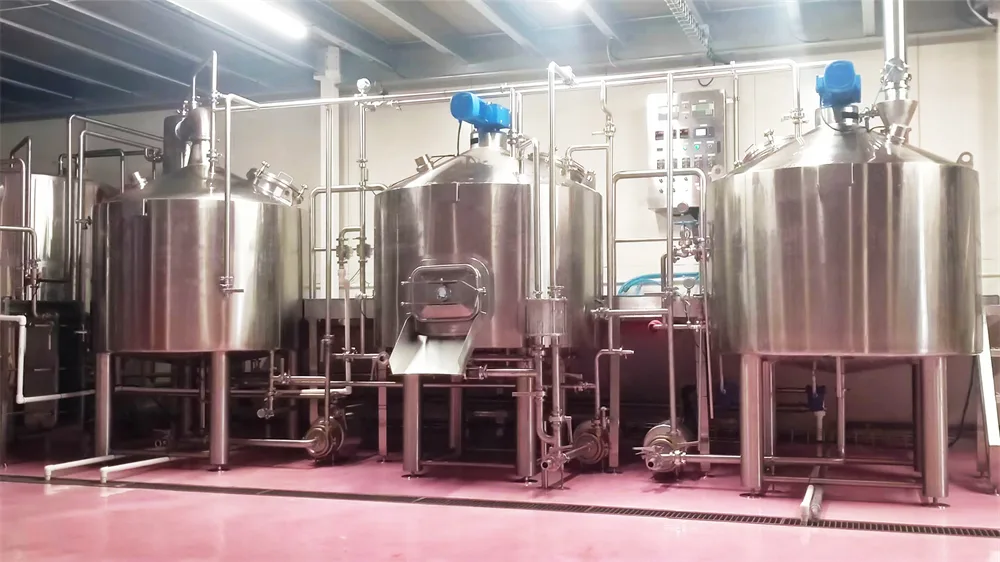
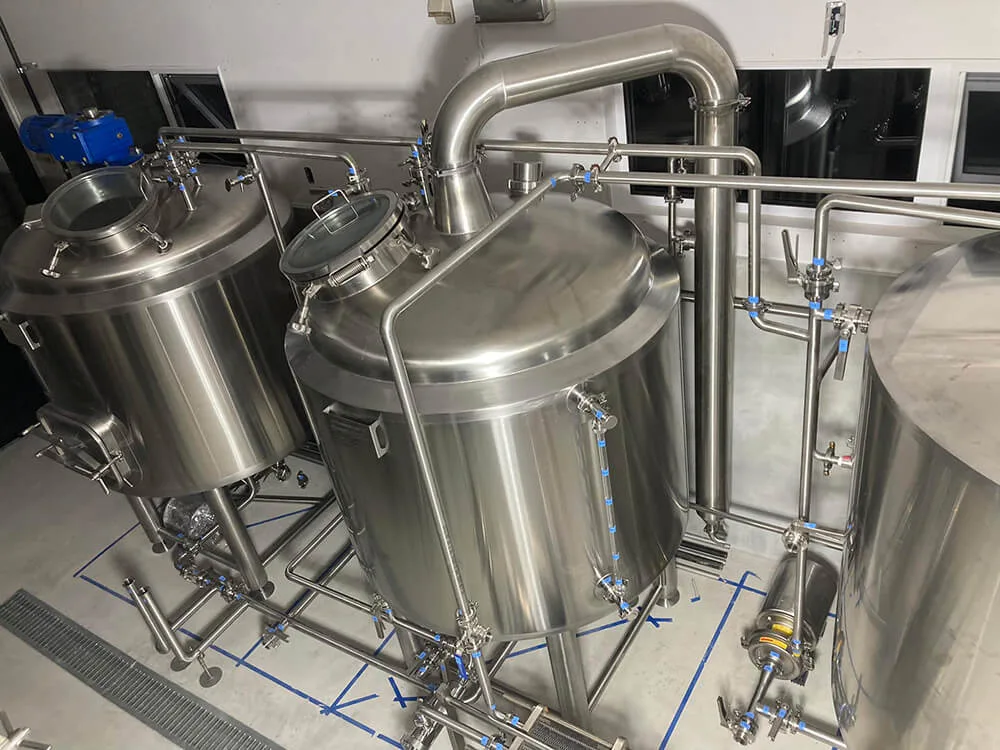
2.2 Four-Vessel Brewhouse: The Flavor Engine
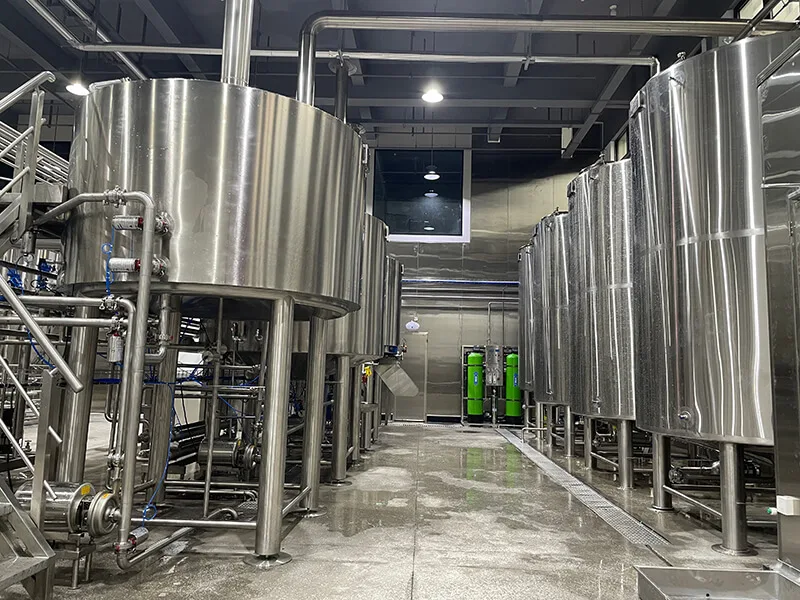
The four-vessel brewhouse system (Mash Tun, Lauter Tun, Kettle, Whirlpool) is standard for large-scale craft breweries.
Caractéristiques principales :
- Pneumatic spent grain discharge
- Automated control of temperature, time, and agitation
- High-efficiency wort separation
Why It Matters:
- Stable extract efficiency
- Clear wort through effective trub separation
- Flexibility for multiple beer styles
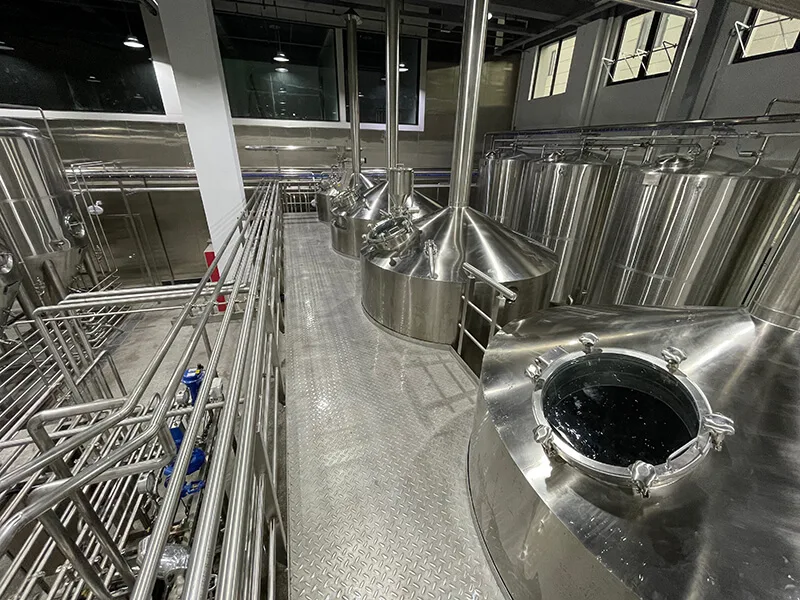
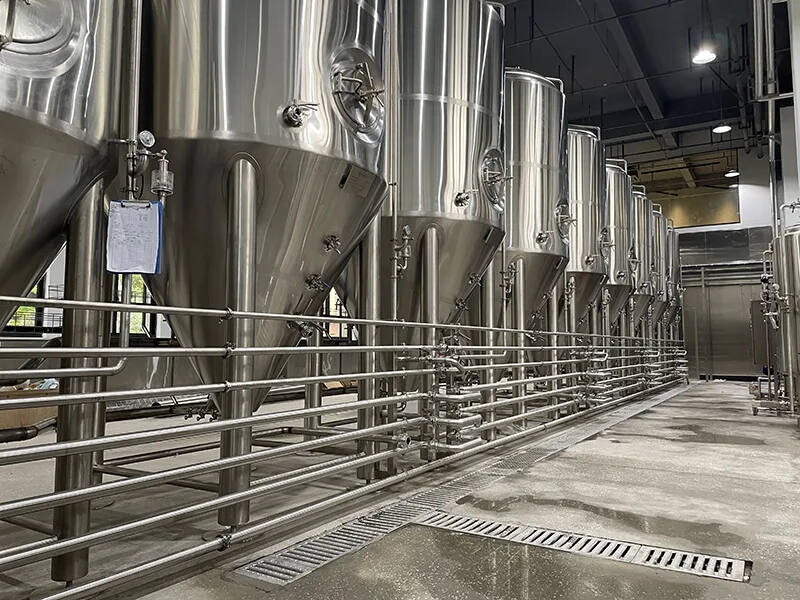
2.3 Fermentation System: Scaling Capacity Without Losing Flavor
Fermentation is where beer character is truly defined.
Modular Tank Strategy:
- Phase 1: 2.5T + 5T fermenters (~1200T/year)
- Phase 2: Add 10T tanks (~3000T/year)
Pipe Rack Design Includes:
- Wort lines
- Beer lines
- CIP pipelines
- CO₂ system
- Compressed air
- Drainage
Core Control Factors:
- Precise temperature control
- Pressure regulation
- Yeast activity optimization
👉 Ensures batch-to-batch flavor consistency at scale.
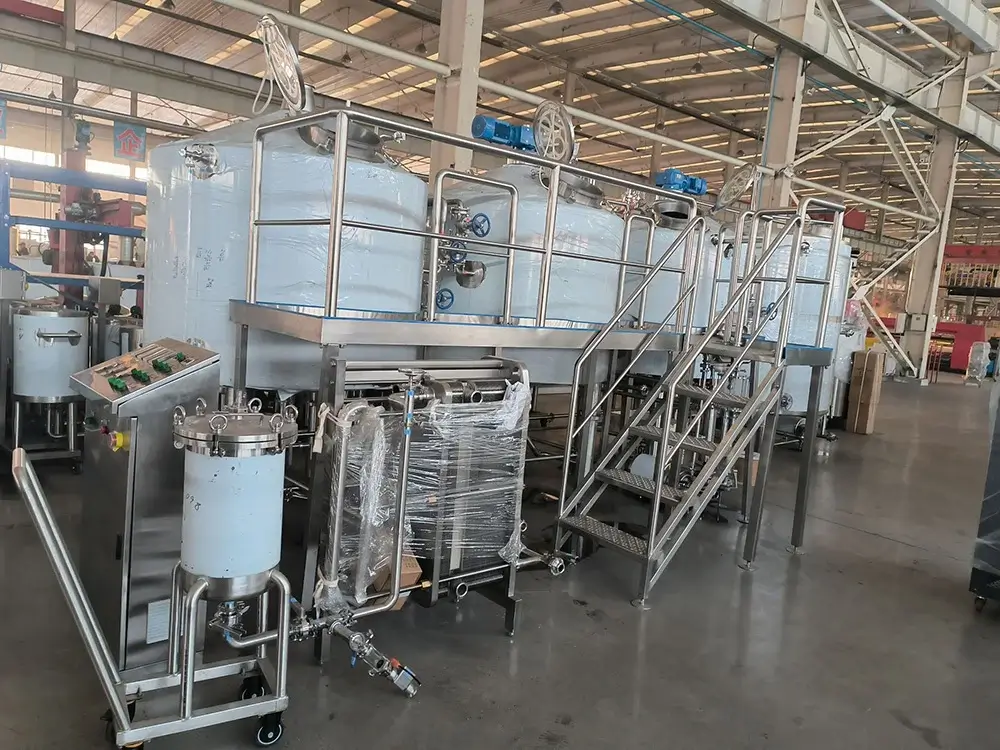
2.4 Utility & Glycol Cooling System: The Stability Backbone
Large breweries require independent and stable utility systems.
Service Water Tanks (4×8T):
- Ice water tank
- Purified water tank
- Hot water tank
- Cold water tank
Cooling System:
- 8T glycol tank
- 20HP chiller
Functions:
- Wort cooling
- Fermentation temperature control
- Cold storage stabilization
👉 Critical for flavor retention, yeast health, and shelf life.
2.5 CIP System: Automated Cleaning for Food-Grade Safety
Clean-In-Place (CIP) is non-negotiable in large-scale brewing.
Configuration :
- 1T alkali tank
- Acid tank
- Disinfection tank
- Hot water tank
- CIP pump system
Avantages :
- Fully automated cleaning without disassembly
- Eliminates contamination risks
- Meets food safety and export standards
2.6 Smart Control System: The Brain of the Brewery
Automation replaces manual guesswork.
Core Hardware:
- Siemens PLC
- MCGS touchscreen interface
Capabilities:
- Remote monitoring via WiFi
- Real-time process control
- Data logging & traceability
- Alarm and fault detection
👉 Enables consistent production, reduced labor, and smarter operations.
2.7 Pipeline System: The Hidden Infrastructure
A well-designed pipeline system ensures efficiency and hygiene.
Includes:
- Wort pipelines
- Beer pipelines
- Yeast lines
- CIP lines
- CO₂ and air systems
Design Principles:
- Dedicated pipelines (no cross-use)
- Minimized oxygen exposure
- Easy cleaning and maintenance
3. Key Advantages of a 2500L Brewery
✔ Scalable Production
- 4–5 batches/day
- Up to 3000 tons/year
✔ Consistent Beer Quality
- Automated brewhouse + controlled fermentation
- Minimal batch variation
✔ Full Automation
- Milling → Brewing → Fermentation → Cleaning
✔ Flexible Expansion
- Modular fermenters allow fast scaling
✔ Compliance Ready
- CIP + food-grade pipelines + automation
- Meets retail and export requirements
4. Brewery Equipment Selection Tips
For Regional Craft Brands
Choose:
- 2500L four-vessel brewhouse
- Modular fermentation tanks
For Quality & Compliance Focus
Must include:
- Automated CIP system
- Siemens PLC control
For Future Expansion
- Use phased fermentation strategy
- Reserve pipeline and control interfaces
For Energy & Labor Savings
- Integrated utilities (water + glycol)
- Centralized automation system
Conclusion
A 2500L craft brewery system represents a mature solution where engineering precision meets brewing artistry.
From malt milling to final packaging, every system plays a critical role in ensuring that large-scale production can still deliver consistent, high-quality craft beer.
If you’re planning to scale your brewery, enter OEM production, or build a regional craft beer brand, the 2500L system offers a proven, future-ready foundation.
👉 Contactez-nous dès aujourd'hui for a custom brewhouse system design tailored to your production goals, budget, and future expansion plans.