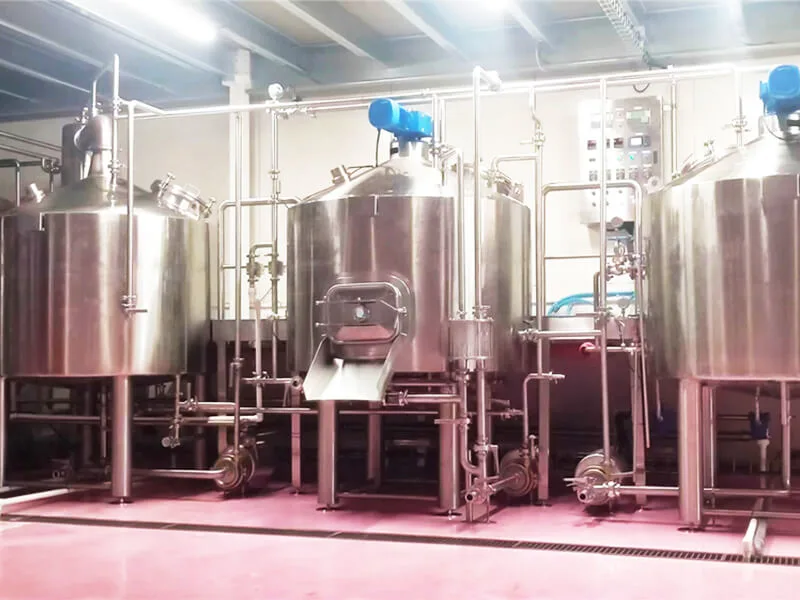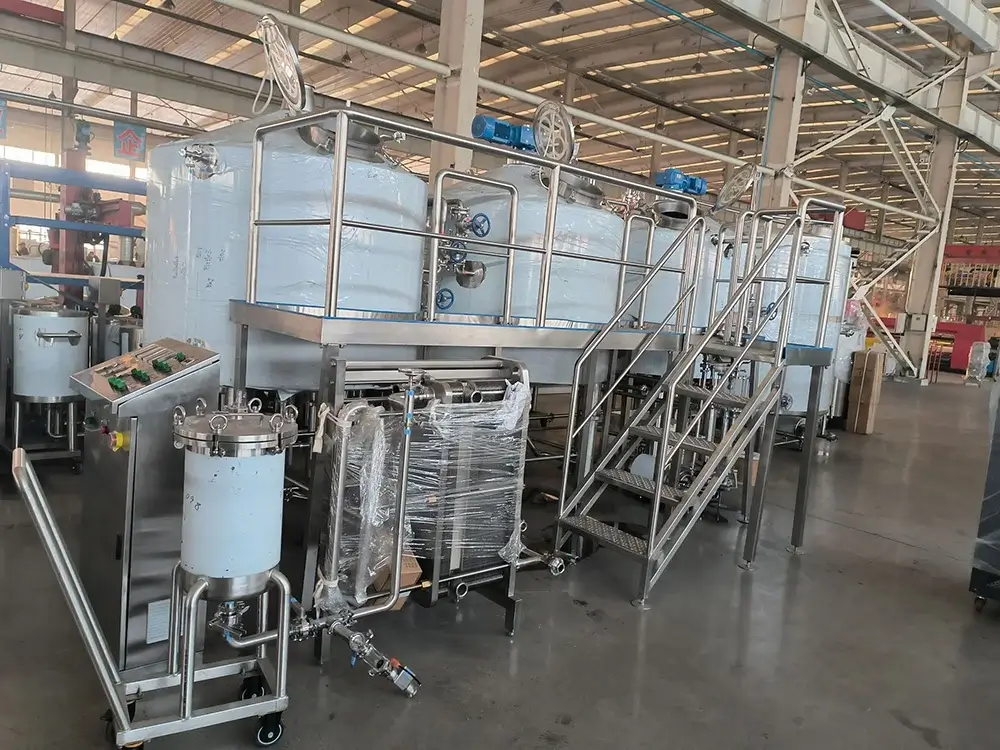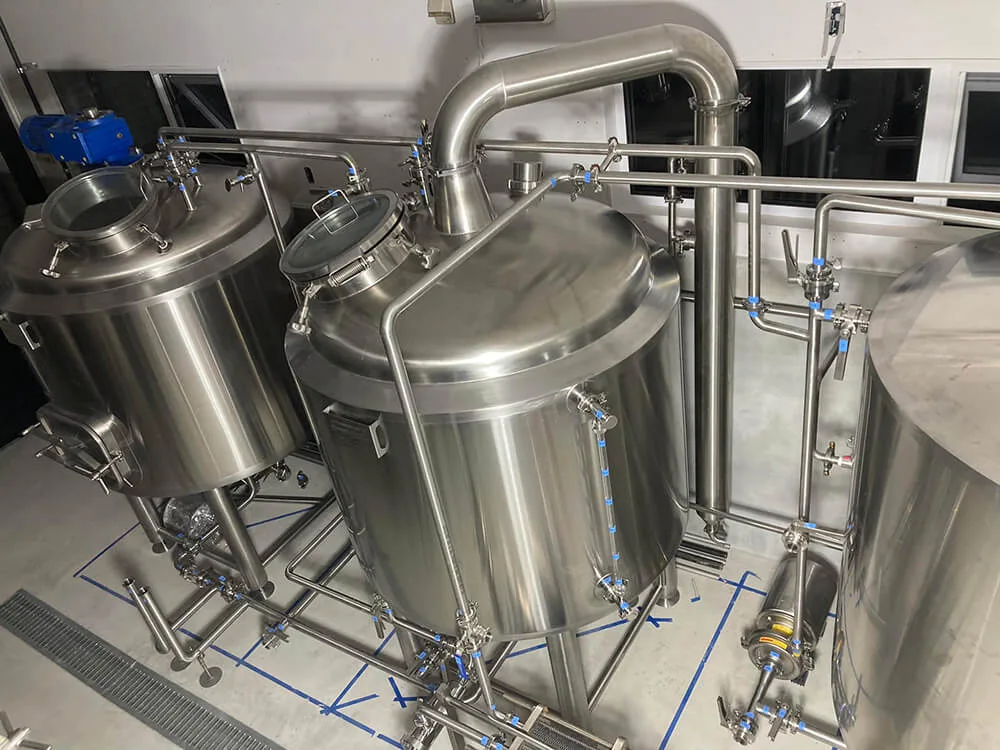
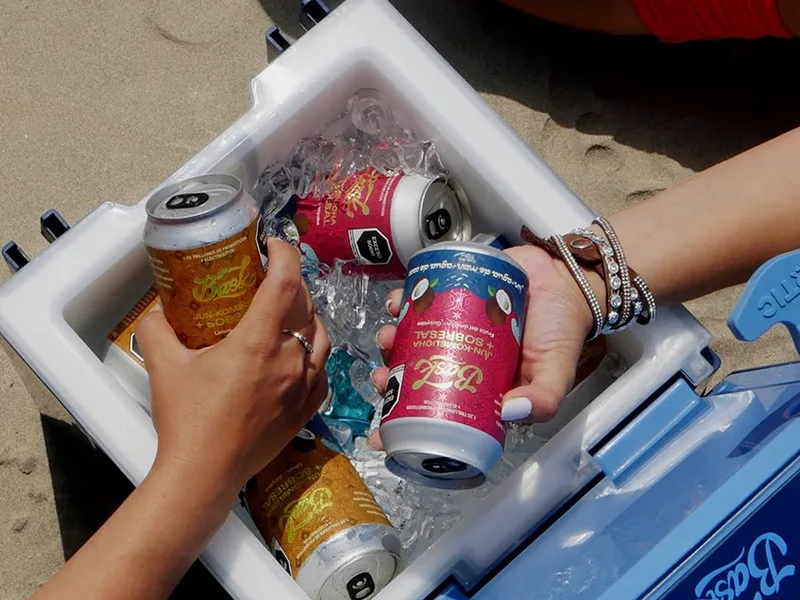
Kombucha production requires a coordinated system of beverage processing and fermentation equipment. As demand for fermented tea beverages expands into retail, food service, and international markets, commercial producers need equipment that supports consistent product quality, efficient production, and reliable sanitation.
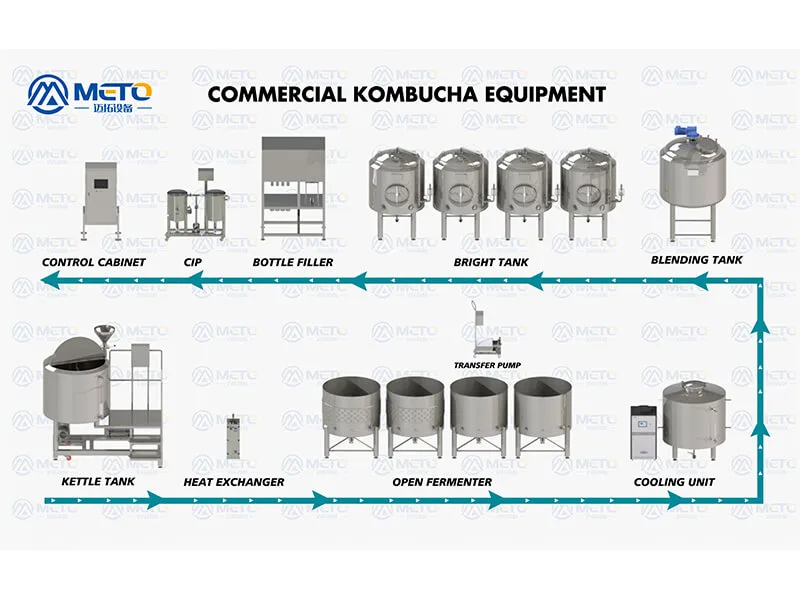
A commercial kombucha production line typically includes tea brewing tanks, sugar mixing tanks, fermentation tanks, cooling systems, blending vessels, cleaning systems, and filling equipment. Depending on the product formulation and packaging requirements, additional equipment such as carbonation systems, filtration units, and pasteurization or other stabilization systems may also be necessary.
For beverage manufacturers planning a new facility or upgrading an existing production process, selecting the right equipment starts with understanding how each stage of kombucha production works.
As a beverage and fermentation equipment manufacturer, METO helps customers evaluate equipment configurations based on production capacity, process requirements, and project objectives.
1. Understanding the Commercial Kombucha Production Process
Before selecting equipment, it is important to define the complete production workflow. Kombucha is generally made by fermenting sweetened tea with a suitable starter culture containing acetic acid bacteria and yeasts.
Although production methods vary by recipe and desired product characteristics, a commercial process commonly follows these stages:
- Tea brewing and ingredient preparation
- Sugar dissolution and mixing
- Cooling before inoculation
- Primary fermentation
- Flavor blending and optional secondary fermentation
- Filtration or product stabilization, when required
- Carbonation, if required
- Filling, sealing, and packaging
- Cleaning and quality control
Each stage has different equipment and process requirements. For example, the tea preparation stage requires effective heating and mixing, while fermentation requires appropriate temperature management and oxygen conditions. Packaging equipment must also match the product’s carbonation level and intended shelf life.
Planning the equipment around the complete workflow helps reduce unnecessary transfers, improve production scheduling, and make future capacity expansion easier.
2. Essential Equipment for a Commercial Kombucha Production Line
Tea Brewing and Extraction Tank
The tea brewing tank is used to extract tea compounds from tea leaves or prepare tea from other suitable ingredients. Depending on the production method, the tank may require a heating system, temperature monitoring, and an arrangement for handling or removing tea leaves.
For commercial applications, equipment selection should consider batch volume, heating requirements, brewing time, and the preferred method of ingredient handling.
A properly designed tea preparation system helps producers maintain repeatable brewing conditions and supply consistent tea base for subsequent fermentation.
Sugar Dissolving and Mixing Tank
Sugar is an essential ingredient in traditional kombucha production because it provides a substrate for fermentation. A dedicated mixing tank can be used to dissolve sugar and prepare a consistent sweetened tea base.
Depending on the process layout, sugar dissolution may take place in the brewing vessel or in a separate mixing tank.
When selecting this equipment, buyers should consider mixing performance, heating requirements, transfer connections, and cleaning access. The goal is to achieve consistent ingredient distribution while supporting an efficient transfer to the cooling and fermentation stages.
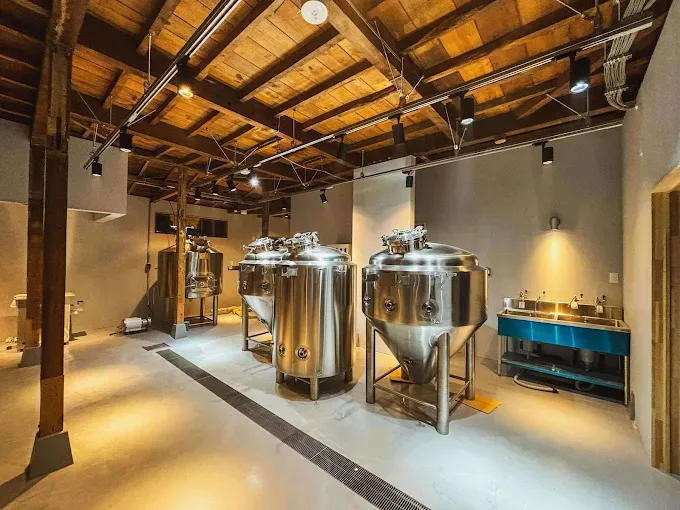
Kombucha Fermentation Tanks
Fermentation tanks are among the most important components of a commercial kombucha production line. They provide the controlled environment in which the sweetened tea and starter culture undergo fermentation.
Unlike conventional beer fermentation, kombucha fermentation often involves oxygen-dependent bacterial activity. Therefore, fermentation tank design must be selected according to the intended process rather than automatically copying a standard beer fermentation configuration.
Important considerations include:
- Tank capacity and the number of vessels required
- Food-contact material and surface finish
- Temperature monitoring and control
- Appropriate ventilation or oxygen-management arrangements
- Sanitary sampling, drainage, and transfer connections
- Compatibility with the intended cleaning procedure
Stainless steel is commonly used for commercial beverage processing because of its durability, cleanability, and suitability for many food-contact applications when properly specified and fabricated.
The required tank configuration depends on the recipe, fermentation method, production schedule, and desired product characteristics. Tank volume alone does not determine the production capacity of the entire plant.
Cooling and Temperature-Control Systems
Temperature management is important throughout kombucha production. After tea brewing, the liquid generally needs to be cooled to a suitable inoculation temperature before the starter culture is added.
Cooling may also be required after fermentation or during product conditioning, depending on the production method.
A commercial cooling system may include a heat exchanger, pumps, temperature sensors, and a suitable chilled-water or glycol system. The final arrangement should be based on the volume to be cooled, the required temperature change, and the available processing time.
For larger production facilities, cooling capacity should be coordinated with brewing and fermentation schedules. A cooling system that cannot keep pace with upstream production can create unnecessary delays even when sufficient tank capacity is available.
Blending and Flavoring Tank
Many commercial kombucha products include fruit juice, fruit preparations, botanical extracts, or other flavor ingredients. A blending tank provides a controlled environment for combining fermented kombucha with these ingredients.
The required configuration depends on the product formulation. Some applications need only a mixing vessel and sanitary transfer system, while others may require dosing equipment, temperature control, or additional filtration.
Buyers should also consider whether blending occurs before or after carbonation and how the selected sequence affects flavor consistency, dissolved carbon dioxide, and packaging performance.
Sistema de limpieza CIP
A clean-in-place (CIP) system supports the cleaning of compatible tanks, pipelines, and process equipment without requiring complete disassembly.
A typical CIP arrangement may include cleaning solution tanks, circulation pumps, valves, piping, and tank-cleaning devices. More advanced systems may provide automated cleaning sequences and monitoring.
The CIP design should reflect the equipment layout, product residues, cleaning chemistry, and required sanitation procedures.
For kombucha production, cleaning procedures must account for the acidic beverage, fermentation residues, and the need to control unwanted microorganisms between batches. Cleaning and sanitation should be validated for the actual process rather than assumed effective simply because a CIP system is installed.
Filling and Packaging Equipment
Packaging is the final major stage of the production line. Commercial kombucha may be packaged in glass bottles, PET bottles, cans, or kegs, depending on the target market and distribution strategy.
A packaging line may include:
- Bottle or can filling equipment
- Capping or can-seaming equipment
- Labeling and date-coding machines
- Conveyors and product handling systems
- Inspection and packaging equipment, as required
The filling method must be compatible with the product’s carbonation level and microbiological control strategy. Carbonated kombucha may require equipment designed to minimize foaming and manage dissolved carbon dioxide.
Packaging capacity should also match the output of the upstream processing system. A fast fermentation and blending process cannot achieve its intended throughput if the filling line becomes a bottleneck.
3. Optional Equipment for Different Kombucha Products
Not every commercial kombucha facility needs the same auxiliary equipment. The configuration depends on whether the product is sold as an unflavored fermented tea, a fruit-flavored beverage, a carbonated drink, or a product designed for ambient distribution.
Filtration System
Filtration may be used to remove tea particles, fruit solids, or other suspended material. The appropriate filtration method depends on the desired clarity and product formulation.
Filtration should not automatically be treated as a validated microbial stabilization step. Producers must determine whether their selected filtration process achieves the intended outcome.
Carbonation System and Brite Tank
For kombucha that requires controlled carbonation, a carbonation system and a suitably designed carbonation or conditioning vessel may be appropriate.
These systems help achieve the specified carbonation level before packaging. Equipment must be rated for the intended pressure, and pressure monitoring and protection devices must be selected accordingly.
Natural secondary fermentation is another possible production method, but it requires careful control of residual fermentable sugars, temperature, pressure, and package suitability. It should not be treated as equivalent to controlled carbonation without considering these variables.
Juice Dosing and Ingredient Handling Equipment
For fruit-flavored kombucha, dosing equipment can improve the repeatability of ingredient additions. Depending on the formulation, this may include metering pumps, ingredient preparation tanks, and sanitary transfer lines.
The equipment should be selected according to ingredient viscosity, solids content, dosing accuracy, and cleaning requirements.
Pasteurization or Other Stabilization Equipment
Some kombucha products are intended to retain live cultures, while others use a validated stabilization process to support their intended shelf life and distribution conditions.
Pasteurization or another stabilization technology may be considered when required by the product specification and food safety plan. The choice affects product characteristics, equipment requirements, and packaging decisions.
The correct approach depends on the formulation, target shelf life, storage conditions, and applicable regulations. Producers should validate the selected process rather than assume that filtration, refrigeration, or a single heat-treatment setting will be suitable for every product.
4. How to Choose the Right Kombucha Production Capacity
Production capacity is one of the most important decisions when investing in commercial kombucha brewing equipment. The plant should be sized according to expected demand and the complete production cycle, not simply the volume of one fermentation tank.
Before requesting an equipment quotation, buyers should define the following factors.
Batch volume: Determine how much sweetened tea will be prepared in each batch.
Fermentation duration: Estimate how long each batch occupies a fermentation vessel, including any required process holding time.
Production schedule: Establish the number of batches planned per day or week and whether production will operate in one or multiple shifts.
Tank quantity: Calculate how many batches need to be in fermentation simultaneously, allowing for cleaning, transfer, and downtime.
Finishing and packaging capacity: Confirm that blending, conditioning, and filling can handle the planned output.
Future expansion: Consider whether additional tanks, utilities, or packaging equipment may be needed as demand increases.
For example, a facility using 1,000-liter fermentation vessels may require several tanks to maintain a regular production schedule if each batch occupies a vessel for an extended fermentation period.
The actual output will depend on usable tank volume, the fermentation cycle, cleaning time, production losses, and downstream processing capacity. Therefore, a complete capacity calculation should be completed before the final equipment layout is approved.
5. Key Considerations When Selecting a Kombucha Equipment Manufacturer
Choosing a suitable equipment manufacturer is an important step in developing a reliable commercial beverage production facility.
Material and Sanitary Design
Confirm that product-contact materials, surface finishes, welds, valves, seals, and pipelines are appropriate for the intended beverage and cleaning process.
Material selection should consider product acidity, cleaning chemicals, operating temperatures, and other relevant process conditions.
Customized Tank Configuration
Tank capacity, geometry, connections, cooling arrangements, and cleaning methods should reflect the production process. Standard equipment may be suitable for some projects, while others require customized vessel dimensions or integrated process systems.
Process Integration
The equipment manufacturer should consider how brewing, cooling, fermentation, blending, cleaning, and packaging connect to one another.
Coordinated design can help reduce unnecessary transfers, simplify plant layout, and improve production scheduling.
Automation and Process Monitoring
Depending on the project’s scale, automation may range from basic temperature monitoring and manual valve operation to PLC-based control.
The appropriate level of automation depends on production volume, staffing, recipe consistency, and operational requirements. Automation should support the process rather than add unnecessary complexity.
Installation and Technical Support
International projects may require equipment layout drawings, utility requirements, installation guidance, commissioning support, and operating documentation.
Buyers should clarify the scope of supply and technical support before placing an order, particularly when equipment is sourced from multiple suppliers.
6. Why Work with a Manufacturer for a Commercial Kombucha Project?
Working directly with an equipment manufacturer can help buyers coordinate vessel design, equipment specifications, and production requirements from the beginning of a project.
METO manufactures beverage and fermentation equipment for different production applications. For commercial kombucha projects, the equipment scope can be evaluated according to the customer’s planned capacity, process workflow, tank configuration, cooling requirements, cleaning method, and packaging arrangement.
Rather than selecting equipment solely by individual tank volume, buyers should assess the complete process and identify the equipment needed for each production stage.
The final configuration should be based on confirmed technical requirements. Materials, pressure ratings, automation features, and other specifications should be established for the individual project instead of assumed to be identical across all production lines.
7. Frequently Asked Questions
What equipment is essential for a commercial kombucha production line?
The core equipment generally includes tea brewing and preparation vessels, sugar mixing equipment, fermentation tanks, cooling equipment, transfer pumps and piping, a cleaning system, and suitable packaging equipment. Additional systems depend on the product formulation and process requirements.
Can brewery equipment be used to produce kombucha?
Some brewery equipment can be adapted for kombucha production. However, fermentation vessels, oxygen management, temperature control, cleaning procedures, and pressure ratings must be suitable for the specific kombucha process. Conventional beer fermentation equipment should not be assumed to be directly interchangeable without reviewing its design.
How many fermentation tanks does a commercial kombucha plant need?
The number depends on batch volume, fermentation duration, production frequency, cleaning time, and downstream processing capacity. A production schedule should be prepared to determine how many vessels are required to maintain the target output.
Does kombucha production require a CIP system?
A CIP system is useful for cleaning compatible tanks and pipelines in commercial production. Its design and cleaning cycles should be selected according to the equipment configuration, product residues, and sanitation requirements.
Is carbonation equipment necessary?
No. Carbonation equipment is required only when the selected production method calls for controlled carbonation. Other kombucha products may use natural carbonation or be packaged without intentional carbonation, subject to the product specification and process controls.
Can a kombucha production line be customized?
Yes. A production line can be configured according to batch capacity, fermentation method, flavoring process, cleaning requirements, packaging format, and automation level. The final equipment list should be established after the production workflow and technical requirements are confirmed.
Conclusión
A commercial kombucha production line requires a coordinated combination of tea preparation, fermentation, cooling, blending, cleaning, and packaging equipment. Filtration, carbonation, ingredient dosing, and stabilization systems can be added according to the product’s specific requirements.
The most effective equipment configuration is one that balances production capacity, fermentation time, sanitary design, operating efficiency, and future expansion.
For beverage manufacturers planning a new kombucha facility, working with an experienced equipment manufacturer can help translate production targets into a practical equipment layout and a coordinated system.
Planning a commercial kombucha production line? Contactar con METO to discuss your target batch capacity, fermentation process, product type, and packaging requirements. Our team can help evaluate an equipment configuration tailored to your project.