Stainless steel tanks are widely used in breweries, wineries, distilleries, beverage production facilities and food processing plants. However, not every process requires the same tank configuration. One of the most important decisions is whether to choose a jacketed stainless steel tank or a non-jacketed design.
The main difference is temperature control. A jacketed tank can exchange heat with the product through an external jacket, while a non-jacketed tank does not have an integrated jacket for heating or cooling. The right choice depends on the product, processing temperature, production requirements and available utilities.
This guide explains how the two designs work, where each is used, and what to consider when selecting a stainless steel tank for your facility.
1. What Is a Jacketed Stainless Steel Tank?
A jacketed stainless steel tank is a vessel designed with an additional space or heat-transfer structure around part of its tank wall. A heating or cooling medium circulates through this structure to transfer heat between the medium and the product inside the tank.
Depending on the design, the jacket may cover the tank’s cylindrical shell, lower section or other specified areas.
Common jacket configurations include:
- Dimple jackets: Use a formed metal surface to create channels for heat-transfer media.
- Half-pipe jackets: Use welded pipe sections arranged around the vessel to carry the heating or cooling medium.
- Conventional jackets: Use an outer shell to form a heat-transfer space around the inner vessel.
The appropriate configuration depends on the tank’s size, operating conditions, heat-transfer requirements, manufacturing method and intended application.
A jacketed tank may be connected to a glycol cooling system, chilled water supply, hot water system or another suitable heating or cooling source. The selected medium must be compatible with the jacket design and its pressure and temperature ratings.
Jacketed tanks are commonly used for fermentation, beverage storage with temperature control, product cooling, mixing and other processes that require managed thermal conditions.
2. What Is a Non-Jacketed Stainless Steel Tank?
A non-jacketed stainless steel tank is a vessel without an integrated external heat-transfer jacket. It is generally used when the product can be processed or stored without active temperature control through the tank wall.
Its temperature may still change through ambient conditions, product transfer, internal mixing, or separate heating and cooling equipment. However, the tank itself does not provide the same integrated heat-transfer capability as a jacketed design.
Typical applications include:
- Storage of water and other suitable process liquids.
- Ingredient storage and batching.
- Intermediate holding between production stages.
- Mixing processes that do not require precise temperature regulation.
- General-purpose storage of beverages and food ingredients.
A non-jacketed tank can be a practical choice when the process does not require active temperature control and the surrounding environment is suitable for the product.
However, it should not automatically be assumed that every non-jacketed tank is suitable for every storage application. Product compatibility, cleaning requirements, hygienic design and any applicable pressure or regulatory requirements must still be evaluated.
3. Jacketed vs. Non-Jacketed Stainless Steel Tanks: Key Differences
The most suitable configuration depends on how the tank will be used rather than on the tank design alone.
| Comparison | Jacketed stainless steel tank | Non-jacketed stainless steel tank |
|---|---|---|
| Control de la temperatura | Supports heating or cooling through the jacket | No integrated jacket for heat transfer |
| Process suitability | Fermentation, cooling, heating and temperature-sensitive processes | General storage, holding and suitable mixing processes |
| System requirements | May require a chiller, heating source, piping and controls | Usually has fewer temperature-control connections |
| Inversión inicial | Generally higher for a comparable vessel when jacket and associated features are included | Generally lower for a comparable basic vessel |
| Installation | Requires consideration of jacket connections and heat-transfer utilities | Usually simpler when no external thermal system is required |
| Mantenimiento | Includes jacket, connections and associated thermal equipment where fitted | Primarily focuses on the vessel and its installed components |
| Process flexibility | Better suited to processes requiring controlled thermal conditions | Suitable for processes that do not need integrated heating or cooling |
These are general comparisons. Actual cost, maintenance and performance depend on tank specifications, materials, fabrication quality, auxiliary systems and the operating environment.
4. When Should You Choose a Jacketed Stainless Steel Tank?
A jacketed tank is worth considering when temperature directly affects product quality, processing time or production consistency.
Brewing and Beer Fermentation
Temperature management is an important part of beer fermentation. Yeast activity and fermentation performance vary with temperature, and different beer styles may require different fermentation conditions.
Jacketed fermentation tanks can connect to a glycol system to remove heat generated during fermentation and help maintain the required temperature profile.
For commercial breweries, tank selection should consider more than nominal tank volume. The number of fermentation tanks, production schedule, fermentation duration, cooling load and brewery expansion plans all affect the overall system design.
If temperature control is essential to the fermentation process, a non-jacketed tank may require a separate cooling arrangement that is less integrated than a purpose-designed jacketed vessel.
Wine and Fruit Wine Production
Wine and fruit wine production may involve fermentation, temperature management and storage requirements that vary by product and process stage.
A jacketed stainless steel tank can help manage temperature during selected processing stages when compatible with the production method.
For wineries, the decision should reflect the intended use of each tank. A fermentation tank may need temperature control, while a separate holding or transfer tank may not.
Kombucha and Other Fermented Beverages
Kombucha production involves fermentation conditions that influence acidity, flavor development and process consistency. Temperature requirements depend on the formulation, culture and production method.
Jacketed tanks may be appropriate where the production process requires controlled temperatures or where ambient conditions make temperature management difficult.
However, not every kombucha tank needs a jacket. The choice should be based on the actual fermentation process, production scale and required level of control.
Food Processing and Industrial Mixing
Some food and beverage processes require heating, cooling or maintaining a specific processing temperature during mixing.
Jacketed mixing tanks can support these requirements by transferring heat through the vessel wall. They may be used for suitable syrups, liquid ingredients, sauces and other process materials, depending on viscosity and heat-transfer needs.
For products that require more intensive heating, additional considerations such as agitator design, product circulation, heating-medium temperature and heat-transfer area may be important.
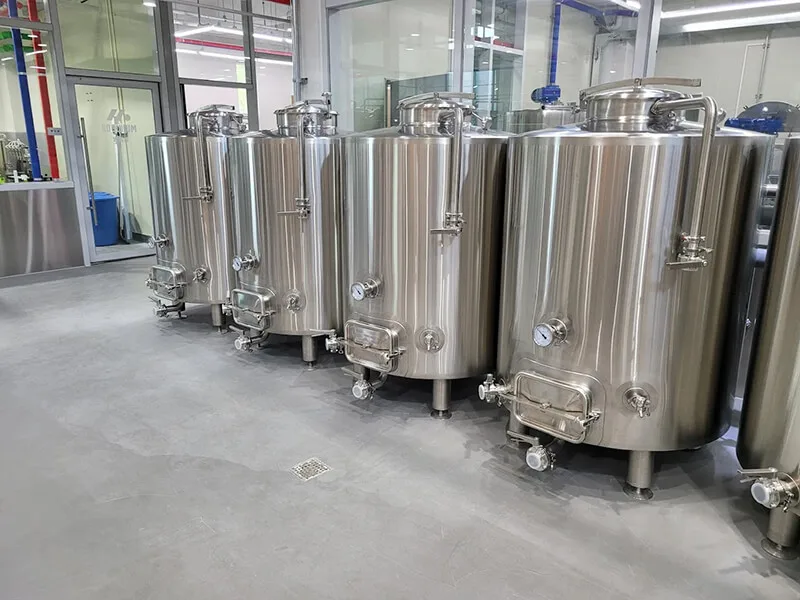
5. When Is a Non-Jacketed Stainless Steel Tank the Better Choice?
A non-jacketed tank may be the more economical and practical option when active temperature control is not part of the process.
General Liquid Storage
If a tank is used to store a liquid under suitable ambient conditions, an integrated heating or cooling jacket may not provide enough additional value to justify its cost.
Examples may include process water, certain ingredients and intermediate liquids that do not require active temperature regulation.
Buffer and Holding Tanks
Production lines often need tanks that temporarily hold liquids between processing stages. If the product remains stable during the intended holding period, a non-jacketed tank may be sufficient.
Before selecting this design, confirm the permitted holding temperature and duration, especially for products that are sensitive to microbial growth or quality changes.
Budget-Conscious Projects
For projects with multiple tanks, using a jacket only where needed can help control capital expenditure.
Instead of specifying jacketed construction for every vessel, divide the equipment list by function. Tanks that require active temperature control can be jacketed, while suitable storage or buffer tanks can use a simpler design.
This approach can reduce unnecessary equipment complexity without compromising the process requirements.
6. Jacketed vs. Non-Jacketed Tanks: What About Operating Costs?
The initial purchase price is only one part of the total cost of ownership.
A jacketed stainless steel tank generally involves additional fabrication and connections. Depending on the configuration, it may also require a chiller, heating equipment, circulation pumps, piping, valves, insulation or temperature-control instruments.
These additions can increase the initial project cost. They may also introduce additional energy consumption and maintenance requirements.
However, a jacketed tank can provide important process benefits when temperature control is necessary. Without appropriate temperature management, a production process may experience inconsistent results, longer processing times or product quality issues.
A non-jacketed tank typically has a simpler construction and fewer thermal-system components. If the process does not require active heating or cooling, this can reduce unnecessary capital and operating expenditure.
The key question is not which tank is always cheaper, but which design provides the required process performance at an appropriate total cost.
When comparing quotations, evaluate:
- Tank fabrication and material specifications.
- Jacket type and coverage, if applicable.
- Insulation requirements.
- Heating or cooling equipment included in the scope.
- Temperature sensors and control arrangements.
- Installation and utility requirements.
- Cleaning, inspection and long-term maintenance.
For larger projects, a process-based equipment schedule can help identify where jacketed construction is necessary and where a non-jacketed design is sufficient.
7. How to Choose the Right Stainless Steel Tank
Before selecting a tank, buyers should define the process requirements and then match the equipment configuration to those requirements.
Step 1: Identify the Tank’s Function
Determine whether the tank will be used for fermentation, heating, cooling, mixing, storage or temporary holding.
The tank’s primary function is the starting point for deciding whether a jacket is necessary.
Step 2: Define the Temperature Requirements
Establish the target operating temperature, permitted temperature range, expected temperature changes and required control accuracy.
Also consider the temperature of the incoming product, the surrounding environment and any heat generated during processing.
Step 3: Evaluate Heat-Transfer Requirements
If heating or cooling is required, the manufacturer may need to evaluate the product volume, properties, required heating or cooling time, available heat-transfer area and the characteristics of the selected thermal medium.
A jacket alone does not guarantee a specific cooling or heating performance. Actual results depend on the complete thermal design and operating conditions.
Step 4: Confirm Material and Hygienic Requirements
Stainless steel grade should be selected according to product compatibility, cleaning chemicals, operating conditions and applicable industry requirements.
Surface finish, weld quality, drainage, internal fittings and cleanability should also be considered for food and beverage applications.
Step 5: Review Utilities and Controls
For jacketed tanks, confirm the required heating or cooling source, connections, temperature sensors and control method.
For non-jacketed tanks, verify whether the process can maintain acceptable conditions without integrated thermal control.
Step 6: Plan for Future Production
A tank that meets today’s requirements may not be the most suitable option if production volumes or process needs are expected to change.
Consider future capacity, the possibility of adding a cooling system, available installation space and the need for additional tanks.
The final selection should balance current operating needs, future flexibility and the overall project budget.
8. Can a Stainless Steel Tank Be Customized With or Without a Jacket?
Yes. Industrial stainless steel tanks can be configured for different production requirements, subject to engineering feasibility and the intended operating conditions.
A manufacturer may work with buyers to define tank capacity, material grade, vessel geometry, jacket configuration, insulation, connections, manways, internal fittings and other features.
For jacketed tanks, the design should account for the heating or cooling medium, design pressure and temperature, heat-transfer requirements, and the applicable construction standards.
For non-jacketed tanks, the focus may instead be on storage capacity, product compatibility, cleaning access, drainage and integration with the surrounding process line.
Customization should be based on a clear technical specification rather than selecting features simply because they are available.
For overseas projects, buyers should also confirm the applicable documentation, electrical requirements for installed instruments, and any relevant local regulations before approving the final design.
9. Why Work With an Experienced Stainless Steel Tank Manufacturer?
Selecting the right tank requires an understanding of both vessel fabrication and the process in which the tank will operate.
An experienced manufacturer should be able to discuss the intended application, identify important design considerations and coordinate the tank with the wider production system.
METO manufactures stainless steel equipment for beverage production, fermentation and other industrial applications. Its equipment solutions can be planned according to project requirements, including the choice between jacketed and non-jacketed tank configurations.
When evaluating a stainless steel tank manufacturer, consider its ability to support:
- Technical communication and equipment specification.
- Tank design and fabrication planning.
- Appropriate material and surface-finish selection.
- Jacket configuration and thermal-system integration, where required.
- Inspection and quality-control procedures.
- Equipment documentation and after-sales technical support.
The right manufacturing partner should help ensure that the selected vessel fits the process rather than simply supplying a tank with the requested volume.
Preguntas frecuentes
Is a jacketed stainless steel tank better than a non-jacketed tank?
Neither design is universally better. A jacketed tank is generally more suitable when the process requires integrated heating or cooling. A non-jacketed tank is often a better choice for suitable storage and holding applications that do not require active temperature control.
Does a jacketed stainless steel tank always need a chiller?
No. A jacketed tank may use a cooling source, a heating source or another suitable thermal medium, depending on its intended application. A chiller is required only when the process and system design call for one.
Can a non-jacketed tank be used for fermentation?
It depends on the product and process. Some fermentation processes can operate in non-jacketed vessels under suitable environmental conditions. However, when active temperature control is required, a jacketed tank or another appropriately engineered temperature-control solution may be necessary.
Are jacketed tanks more expensive to maintain?
They can involve additional maintenance because of the jacket, thermal-medium connections and associated equipment. Actual maintenance costs depend on the design, operating conditions, cleaning procedures and maintenance practices.
Which stainless steel grade should I choose for a jacketed tank?
The choice depends on product compatibility, cleaning chemicals, operating conditions and applicable requirements. Common options in beverage and industrial applications include 304 and 316L stainless steel, but the appropriate grade should be determined from the actual process conditions rather than assumed in advance.
Can I use jacketed and non-jacketed tanks in the same production line?
Yes. Many production systems use different tank configurations for different process stages. For example, fermentation tanks may require temperature control, while suitable ingredient storage or buffer tanks may not. The complete process flow should determine the configuration of each vessel.
Conclusión
Choosing between a jacketed stainless steel tank and a non-jacketed tank starts with understanding the process. If temperature control is essential for fermentation, heating, cooling or mixing, a jacketed design may be the appropriate solution. If the tank is intended for suitable storage or holding without active thermal management, a non-jacketed vessel may provide the required functionality with less complexity.
The most cost-effective solution is often a combination of both designs, selected according to the role of each tank in the production line.
Looking for a stainless steel tank for your project? Contactar con METO to discuss your application, capacity, material requirements and temperature-control needs. Our team can help you evaluate a suitable tank configuration for your beverage or industrial production system.