There comes a moment in every serious brewer’s journey when the pilot system—that trusty setup that helped you win local awards and build a loyal following—simply cannot keep up anymore. You find yourself turning away wholesale accounts, running multiple batches just to keep your tanks full, and spending more time cleaning than actually brewing. The business case for scaling up is clear. But the path forward is fraught with risk.
The commercial brewing equipment market is vast and often bewildering to first-time buyers. Price tags can vary by a factor of two or three for systems that look almost identical to the untrained eye. So how do you separate genuine quality from clever marketing?
This decision will shape your business for the next decade. Get it right, and you have a solid foundation for growth. Get it wrong, and you’ll be fighting bottlenecks, quality inconsistencies, and crushing utility bills for years. This guide provides a practical framework for making an informed investment.
Understanding the Brewing Process at Commercial Scale
Before diving into equipment specifications, it’s worth understanding how the brewing process translates from brewpub scale to commercial production. The fundamental steps remain the same—milling, mashing, lautering, boiling, fermenting, and conditioning—but the equipment executing those steps must be engineered quite differently when you’re dealing with five, ten, or fifty hectolitres per batch.
Fresado at commercial level requires a mill that can process hundreds of kilograms per hour with consistent results. The goal is to crack the malt kernel to expose starch while leaving the husk intact to form a natural filter bed. A mill with precise gap adjustment and hardened rollers is essential—sacrificing efficiency means leaving money in the spent grain.
Mashing and lautering demand uniform temperature distribution across hundreds of kilograms of grist. Temperature precision is paramount; a variation of even one degree Celsius can significantly impact enzyme activity. The lauter tun should have a proper false bottom, effective rake system, and efficient sparge arms. Faster runoff means more batches per week, and better efficiency means more beer from the same grain bill.
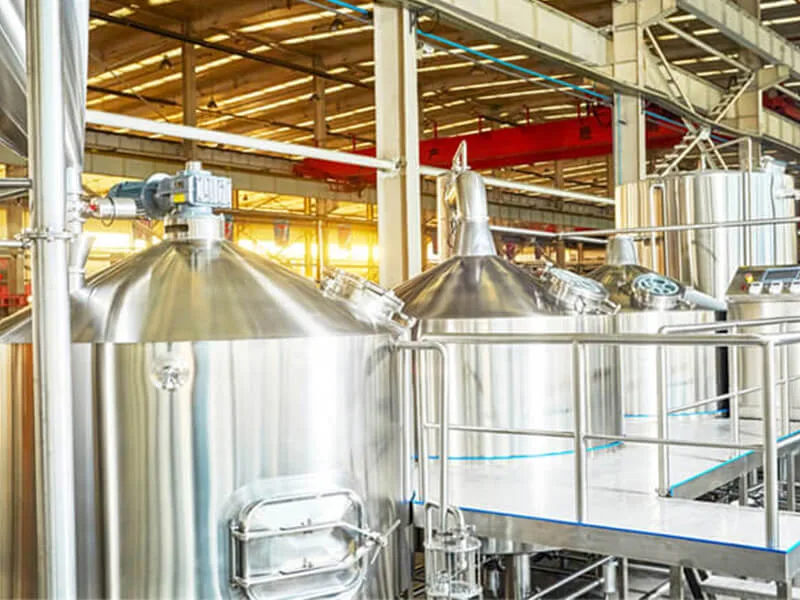
Wort boiling requires a vigorous, rolling boil to drive off undesirable volatile compounds and isomerise hop alpha acids. Heating method matters—steam-jacketed kettles offer more even heating than direct-fired systems. Evaporation rate must be consistent, typically five to ten percent of volume per batch.
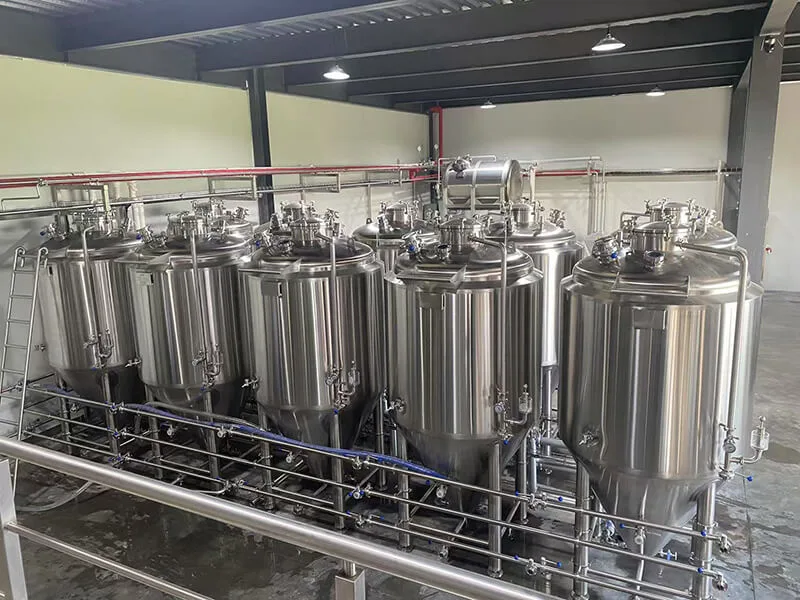
Fermentación requires precise temperature control, as even a few degrees shift can produce unwanted flavour profiles. Most commercial fermenters are jacketed for glycol cooling. Pressure management matters too—some styles benefit from fermentation under modest pressure. Tank geometry affects yeast collection and convection currents within the fermenter.
Conditioning typically happens in bright beer tanks for maturation, carbonation, and clarification. These tanks need the same temperature and pressure control capabilities as fermenters.
Seven Critical Criteria for Equipment Evaluation
With the brewing process in mind, let’s examine seven factors that truly matter when evaluating commercial equipment.
1. Production Capacity and Throughput
This is the most fundamental question: can the equipment meet your production targets? Start with your business plan. If you’re targeting 2,000 hectolitres annually, work backwards to determine required batch size and frequency.
Consider brewhouse utilisation—seventy to eighty percent is typical, allowing time for maintenance, cleaning, and recipe development. The brewhouse and cellar must be balanced. A 30-hectolitre brewhouse producing four batches weekly yields 120 hectolitres of wort, but if your fermenter farm only holds 200 hectolitres, you’ll be constrained.
Think about growth. Will this system support your volume targets for three to five years? Some manufacturers offer modular systems with upgrade paths; others require complete replacement when you outgrow them.
2. Automation and Control Systems
Consistency is the foundation of brand loyalty, and consistency at scale requires automation. Modern commercial breweries typically use PLC systems to manage the brewing process, allowing recipe programming, real-time monitoring, and batch documentation.
Automation exists on a spectrum. A 10-hectolitre brewpub might find moderately automated systems ideal—enough control to ensure consistency without complexity that becomes a maintenance burden. A 50-hectolitre production brewery needs substantial automation to maintain quality and efficiency.
Look for intuitive HMIs, remote monitoring capabilities, and robust data logging. Batch records are essential for troubleshooting and regulatory compliance.
3. Materials and Manufacturing Quality
Commercial brewing equipment should be constructed from 304 or 316 stainless steel, with 316L preferred for enhanced corrosion resistance. But the grade of steel is just the starting point.
Weld quality matters enormously—smooth, continuous, fully penetrated welds prevent bacterial harbourage. Interior surface finish should be polished (180-grit or finer) to resist bacterial adhesion and clean effectively. Electropolishing enhances corrosion resistance and cleanability.
Examine fittings and components. Are valves, pumps, and instrumentation from reputable brands with available spare parts? Cutting costs here is false economy—when a cheap sensor fails during a brew, lost production far exceeds initial savings.
4. Energy Efficiency and Operating Costs
The purchase price is a one-time capital expense. Energy consumption is a recurring cost that impacts profitability for as long as you own the equipment.
Heating is typically the largest energy consumer. Steam systems are generally more efficient than direct-fired for larger operations. Heat recovery can capture waste heat from the kettle or wort cooler for reuse—well-designed systems can recover fifty percent or more of energy input.
Cooling is the second major load. Glycol chillers vary considerably in efficiency. Consider whether your facility can use free cooling during colder months.
Wort cooling efficiency depends on heat exchanger design and cold water availability. Insulation is often overlooked but reduces thermal losses significantly.
Ask suppliers for energy consumption data per hectolitre. The differences may surprise you.
5. Future-Proofing and Scalability
Can you add more fermenters without changing the brewhouse? Is the control system designed to manage expanded capacity? Can the brewhouse itself be upgraded?
Pipework and utility connections should be designed with expansion in mind. Plan your layout with future growth in mind, even if additional tanks won’t be installed for years.
Technology evolves too. Is the automation platform compatible with software updates? Can it interface with brewery management software? Open architecture systems are generally more future-proof.
6. Technical Support and Aftersales Service
This is where the relationship with your supplier truly matters. Before purchasing, investigate support infrastructure. Do they have local service engineers? How quickly can they respond? What’s the lead time for spare parts?
Installation and commissioning are critical. A rushed installation can lead to ongoing problems. Training is essential—your team needs comprehensive instruction on operation, cleaning, and maintenance.
Check references. Speak with brewers who have purchased from the same supplier. Would they buy again?
7. Regulatory Compliance and Food Safety
Equipment must meet food contact material requirements. Hygienic engineering principles mean no dead legs in pipework, self-draining runs, and accessible cleaning points.
Pressure vessel certification provides assurance that fermenters and bright tanks are safe. Documentation—material certificates, welding logs—is valuable for both regulatory purposes and quality assurance.
Beyond the Equipment: The Broader Commercial Picture
Equipment is only one element of success. Location affects market access and raw material costs. Proximity to customers determines distribution costs. Access to quality water is essential.
Licensing can be a lengthy process. Factor timeline into planning—many brewers have been surprised by approval delays leading to idle equipment and carrying costs.
Reliable utilities are the lifeblood of a brewery. Power requirements can be substantial, particularly for electric heating. Conduct a thorough utility assessment before signing a lease.
Safety is paramount. A commercial brewery has inherent hazards—high temperatures, pressurised vessels, chemicals, heavy loads. Equipment should incorporate appropriate safety features, but your team needs comprehensive training, PPE, and clear SOPs. Develop a safety culture from day one.
Conclusión
Choosing commercial brewing equipment is one of the most consequential decisions you’ll make as a brewery owner. It’s a decision that demands thorough research, careful analysis, and a clear understanding of both current needs and future aspirations.
Use the framework we’ve outlined: understand the brewing process at commercial scale, evaluate equipment against seven critical criteria, and consider the broader factors that influence success.
Take your time. Visit other breweries, attend trade shows, read reviews, and talk to experts. Get multiple quotes and compare thoughtfully. The lowest price is rarely the best value when you consider total cost of ownership over a decade.
Build a strong relationship with your equipment supplier. The best suppliers are partners in your success, bringing expertise and genuine interest in helping you brew great beer.
The craft beer market is competitive, but with the right equipment and approach, you can produce exceptional beer that builds a loyal following and supports a thriving enterprise. The investment is significant, but the rewards are well worth the effort.