Introducción
Choosing the right gin distillery equipment is an important step when establishing a craft distillery or expanding an existing spirits business. The still, botanical basket, condenser, heating system, and supporting vessels all influence how the production process operates and how consistently a distillery can reproduce its desired gin profile.
However, there is no single still configuration that suits every gin producer. Some distilleries focus on traditional, juniper-forward gin, while others develop botanical-forward recipes featuring citrus peel, herbs, flowers, and spices. Production capacity, base spirit, distillation method, and future expansion plans also affect equipment selection.
For distillery owners and project planners, the objective is to select a system that matches the intended production process rather than simply choosing the largest still or the most complex configuration.
This guide explains how to choose gin distillery equipment, compare different still designs, evaluate botanical baskets, and plan a practical commercial distillation system.
What Equipment Is Needed for Gin Production?
A commercial gin distillery may require several types of process equipment, depending on whether the producer purchases neutral alcohol or produces its own base spirit.
The main equipment components typically include a distillation still, a condenser, a heating system, botanical infusion equipment where required, and vessels for blending and spirit handling.
Gin Still
The still is the central component of the distillation system. It heats the prepared spirit and allows alcohol vapour to travel through the selected distillation path before being condensed back into liquid.
Still design affects vapour movement, reflux, copper contact where applicable, and the degree of separation achieved during distillation. These factors influence the spirit’s characteristics and the producer’s ability to control the process.
Botanical Basket
A botanical basket is used for vapour infusion. Instead of soaking all the botanicals directly in the liquid spirit, the producer places selected plant materials inside a basket positioned in the vapour path before the condenser.
As vapour passes through the botanicals, it carries aromatic compounds into the resulting distillate. The effect depends on the ingredients, loading method, operating conditions, and basket design.
Not every gin distillery needs a botanical basket. Producers who use only liquid-phase maceration may prefer a different configuration.
Condenser and Supporting Equipment
The condenser converts alcohol vapour back into liquid. Its capacity must be compatible with the still’s operating conditions and expected vapour load.
Depending on the project, supporting equipment may include spirit receiving tanks, blending tanks, transfer pumps, process piping, instrumentation, cleaning connections, and control systems.
If the distillery produces its own neutral spirit, additional fermentation and distillation equipment may be necessary. Purchasing neutral spirit instead can simplify the initial production setup, although the business must still evaluate supply quality, cost, and local regulations.
How to Choose the Right Gin Still
Three common configurations to evaluate are the pot still, the column still, and the hybrid still. Their suitability depends on the production process, target spirit profile, and level of operational flexibility required.
Pot Still for Traditional and Craft Gin
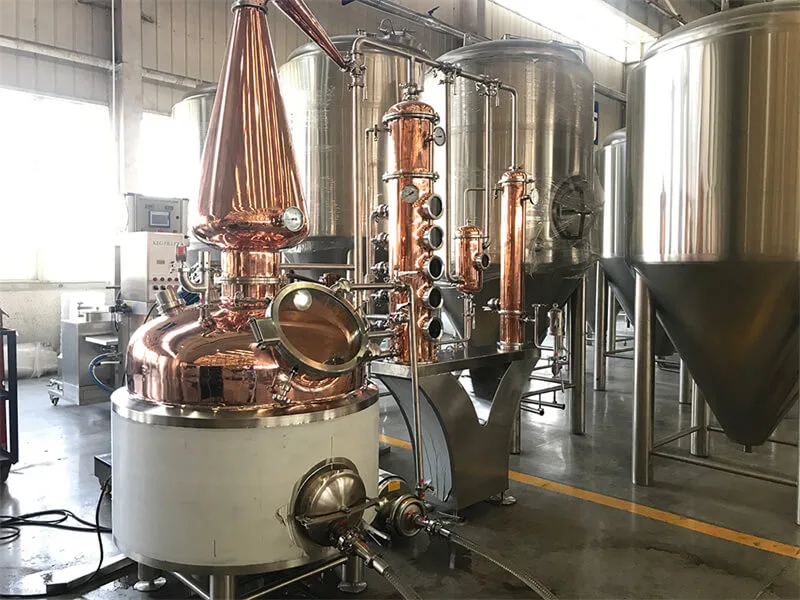
A pot still is a batch distillation vessel that heats the liquid charge and directs the resulting vapour toward the condenser. Its relatively straightforward design makes it suitable for distilleries that prefer batch-based production and hands-on process control.
When used to redistil neutral spirit with botanicals, a pot still can support traditional maceration-based gin production. Depending on its configuration, it may also be connected to a botanical basket for vapour infusion.
A pot still is worth considering when:
- The distillery focuses on small-batch or craft gin.
- The production team wants flexibility when developing recipes.
- Batch operation fits the planned production schedule.
- The equipment needs to accommodate different botanical formulations.
The final flavour is not determined by the still alone. Botanical ratios, maceration time, heating conditions, and distillation management remain important.
Column Still for Greater Separation Control
A column still uses a vertical column or rectification section to increase separation between components in the vapour-liquid system. Its configuration can provide greater control over rectification than a basic pot still.
Column systems are commonly considered when a distillery needs to produce neutral spirit or requires a specific degree of separation during distillation. However, a column used to produce neutral spirit is not necessarily configured in the same way as a system designed to redistil botanicals into gin.
For a gin project, clarify whether the column is intended for base spirit production, gin redistillation, or both. The required column design, reflux control, and botanical infusion arrangement should follow the actual process requirements.
A column-based system may be suitable for producers who prioritise repeatability, defined spirit characteristics, and a more controlled separation process.
Hybrid Still for Production Flexibility
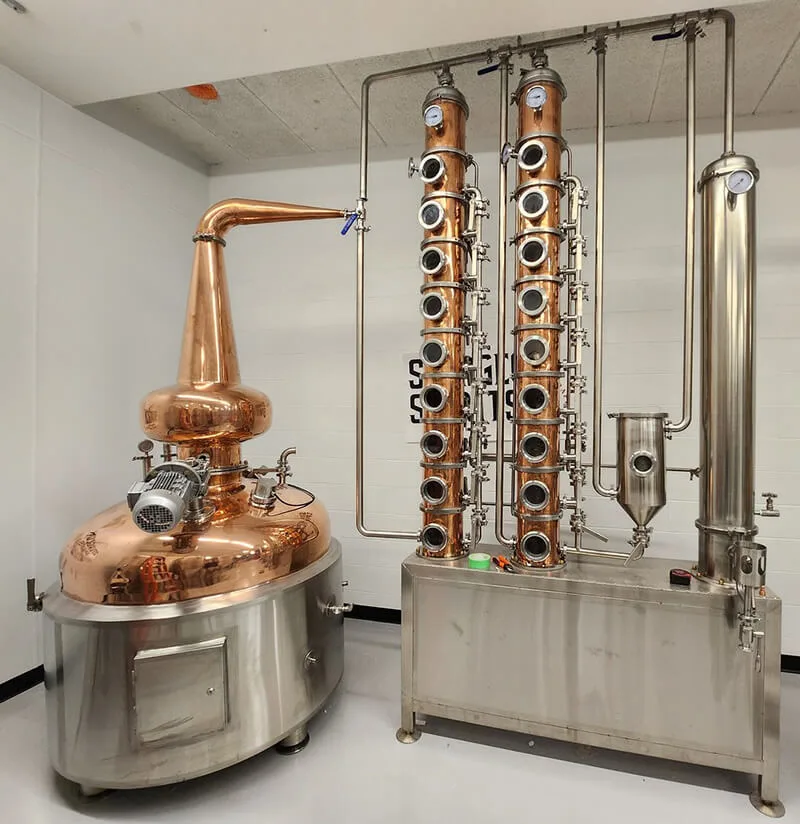
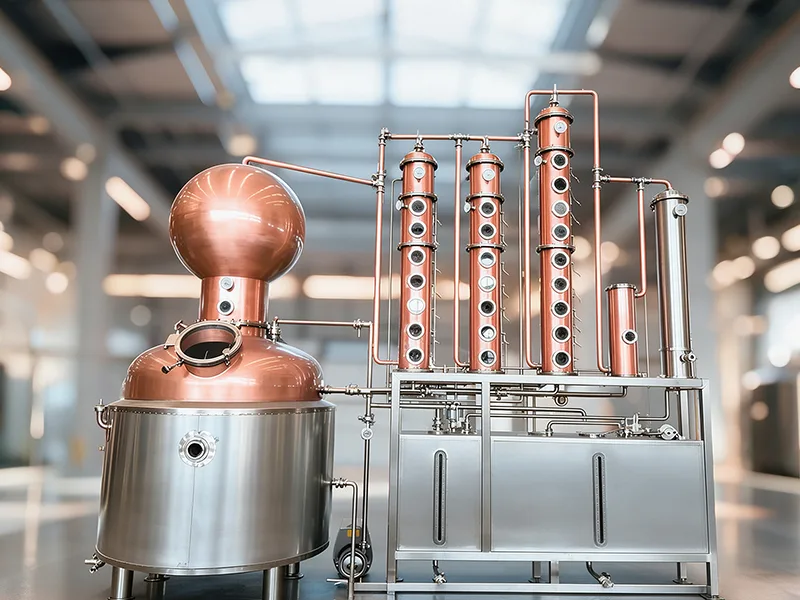
A hybrid still combines a pot-style boiler with a column or rectification section. Depending on its design, the system can support different operating configurations.
For example, a distillery may use a pot-style configuration for one product and incorporate rectification for another. A compatible botanical basket can provide an additional option for vapour infusion.
A hybrid still may be worth considering when a producer plans to develop several spirit styles or wants flexibility without installing completely separate distillation systems.
Before selecting one, confirm which operating modes are genuinely supported by the proposed design. The presence of a column does not automatically mean that every possible distillation method can be performed effectively.
What Is a Botanical Basket and How Does It Work?
A botanical basket, also called a gin basket, is an accessory installed in the vapour path of a distillation system. It is designed to expose botanical ingredients to alcohol vapour before the vapour enters the condenser.
This method is known as vapour infusion.
During operation, the vapour passes through the basket and extracts aromatic compounds from the botanical ingredients. The resulting spirit profile depends on the botanical recipe, ingredient preparation, vapour contact, operating conditions, and equipment arrangement.
Common gin botanicals include juniper berries, coriander seeds, citrus peel, angelica root, cardamom, and selected herbs or flowers. Not every ingredient performs equally well under vapour infusion, so recipe development and testing remain essential.
Botanical Basket vs. Maceration
Maceration and vapour infusion are two different approaches to botanical extraction.
With maceration, the botanicals are soaked in the spirit before distillation. The prepared mixture is then distilled according to the producer’s process.
With vapour infusion, the botanicals are held in a basket through which the vapour passes. This reduces direct contact between the ingredients and the liquid charge during the infusion stage.
The two methods can produce different aromatic results, but neither is universally superior. Some producers prefer maceration for their core recipe, while others use vapour infusion for selected ingredients or develop systems that support both methods.
The correct choice depends on the intended flavour profile and the producer’s process design.
How to Choose the Right Botanical Basket
Selecting a botanical basket requires more than checking whether it fits the still. Its capacity, internal arrangement, connections, and cleaning requirements should match the planned production process.
Basket Capacity and Botanical Loading
The basket must accommodate the intended botanical charge while allowing vapour to pass through the ingredient bed.
A basket that is too small may restrict recipe development or require frequent loading changes. A basket that is too large is not automatically better, because ingredient distribution and vapour flow still need to be considered.
Ask the equipment manufacturer to evaluate the expected botanical load, ingredient form, and intended batch size together.
Vapour Flow and Basket Design
Vapour needs a suitable path through the basket. The internal arrangement should support effective contact with the botanical ingredients without creating excessive flow resistance.
The design should also consider the placement of the basket relative to the boiler, column, and condenser. Different configurations can produce different results, so the basket should be designed as part of the complete distillation system rather than treated as an isolated accessory.
For larger commercial systems, the manufacturer should assess the expected vapour load and the basket’s mechanical and process requirements.
Material Selection and Fabrication
Stainless steel and copper may both be used in distillation equipment, depending on the component and process design.
Stainless steel offers practical advantages in fabrication, cleaning, and integration with other process vessels. Copper may be selected for particular vapour-contact components where its properties are appropriate for the intended process.
Material selection should consider product contact, cleaning procedures, operating conditions, and applicable requirements. The correct choice should be confirmed with the equipment manufacturer rather than based on appearance alone.
Cleaning and Maintenance
Botanical ingredients can leave oils, particles, and residues inside the basket. A design that allows convenient access, removal of spent botanicals, drainage, and cleaning can simplify routine operation.
When comparing equipment, ask about the basket’s loading access, connection arrangement, cleaning procedure, and compatibility with the distillery’s sanitation practices.
These practical details can make a meaningful difference during repeated production runs.
How to Match Gin Distillery Equipment to Production Capacity
The correct equipment capacity depends on the intended production output and the complete production schedule, not simply the nominal volume of the still.
Before selecting a system, estimate the required annual output, expected batch size, available operating days, and number of production runs per day. Also consider the time required for preparation, heating, distillation, cleaning, and recipe changes.
A smaller still may suit a distillery that prioritises product development and limited production runs. A larger system may be appropriate when sales demand and production planning justify the additional capacity.
However, a larger still does not automatically deliver a lower production cost. Equipment investment, energy consumption, labour, cleaning time, and utilisation all influence the economics of the project.
Questions to Answer Before Ordering
Before requesting a quotation for gin distillery equipment, define the following:
- Production target: What annual or monthly volume does the business plan to produce?
- Base spirit: Will the distillery purchase neutral alcohol or produce its own?
- Distillation method: Will the process use maceration, vapour infusion, or a combination?
- Product range: Will the system produce one gin recipe or several botanical profiles?
- Heating method: Which heating arrangement is appropriate for the facility and process?
- Installation conditions: What space, utilities, drainage, and local compliance requirements must be considered?
- Future expansion: Should the initial system allow for additional vessels or process equipment later?
Providing this information helps the manufacturer recommend a configuration based on the actual project instead of a generic equipment package.
What Should a Commercial Gin Distillation System Include?
A commercial system should be planned around the entire production process, including equipment connections and day-to-day operation.
Depending on the production method, the proposed configuration may include a pot still or hybrid still, a compatible botanical basket, a condenser, heating and control components, spirit receiving vessels, and transfer piping.
Additional tanks may be needed for blending, dilution, or temporary storage. If the facility produces neutral spirit from fermented raw materials, the upstream process will require a separate assessment.
The equipment layout should allow operators to access valves and instruments, load and unload botanicals, clean product-contact surfaces, and carry out maintenance safely.
For systems handling flammable alcohol vapour, the design must also address appropriate ventilation, electrical equipment selection, pressure and vacuum protection, and other applicable fire and process safety requirements. Installation and operation should comply with the relevant local regulations.
A coordinated system design helps avoid compatibility problems between the still, basket, condenser, and supporting equipment.
Why Choose METO as Your Gin Distillery Equipment Manufacturer?
Selecting a manufacturer involves more than comparing the price of a still. The supplier should understand the intended production process and be able to translate the requirements into a practical equipment configuration.
METO is a beverage and alcohol equipment manufacturer offering equipment design, fabrication, production, and project support. For gin distillery projects, the equipment configuration can be discussed according to the intended production capacity, distillation method, botanical infusion requirements, and facility conditions.
As a manufacturer, METO can work with buyers to evaluate key design considerations, including:
- Process configuration: Selecting a suitable pot, column, or hybrid arrangement for the intended production method.
- Botanical infusion: Evaluating whether a botanical basket is required and how it should integrate with the still and condenser.
- Material and fabrication: Discussing appropriate product-contact materials, fabrication requirements, and surface finishes.
- Equipment integration: Planning connections between the distillation unit and supporting tanks or process equipment.
- Project-specific requirements: Reviewing capacity, heating, control, installation, and applicable compliance requirements before finalising the specification.
The final equipment design should be based on confirmed technical requirements. Material grades, working capacities, operating pressures, heating specifications, and certifications should be stated in the project quotation and technical documentation as applicable.
For buyers planning a new gin distillery or upgrading an existing facility, working directly with a manufacturer can help align equipment design with the production process from the beginning.
Frequently Asked Questions About Gin Distillery Equipment
Do I need a botanical basket to make gin?
No. A botanical basket is required only when the selected process uses vapour infusion. Gin can also be produced by macerating botanicals in spirit before redistillation. The choice depends on the intended flavour profile and production method.
Is a pot still or column still better for gin?
Neither is universally better. A pot still suits batch-based production and traditional distillation approaches. A column can provide greater rectification and separation control. A hybrid still may offer flexibility, depending on its configuration and intended use.
Can one still produce different types of gin?
Yes, if the equipment configuration and operating procedure support the required recipes. However, botanical carryover, cleaning time, and changes in operating conditions should be considered when switching between products.
Should I choose a copper or stainless steel gin still?
The decision depends on the process, desired copper contact, cleaning requirements, and overall equipment design. Some systems combine stainless steel vessels with selected copper components. Discuss the intended application and material requirements with the manufacturer.
What information is needed for a gin distillery equipment quotation?
Provide the target production capacity, intended spirit styles, base spirit source, preferred distillation method, botanical basket requirements, heating preference, installation location, and any applicable local compliance requirements. These details help the manufacturer prepare a more relevant equipment proposal.
Conclusión
Choosing the right gin distillery equipment starts with understanding the production process. The still determines the basic distillation configuration, while the botanical basket provides an additional option for producers who want to use vapour infusion.
A pot still, column still, or hybrid still may be appropriate depending on the target spirit profile, batch size, production schedule, and required process flexibility. Basket capacity, vapour flow, material selection, cleaning access, and equipment integration should also be evaluated before making a final decision.
For commercial gin producers, the best solution is a properly matched system that supports consistent operation and future business development.
Planning a gin distillery project? Contactar con METO to discuss your production targets, preferred distillation method, and botanical infusion requirements. Our team can help evaluate a suitable distillation equipment configuration based on your project needs.