Starting a craft brewery, opening a brewpub, or adding fresh beer production to a restaurant requires more than just a brewhouse. You need a properly configured brewing system that fits your available space, production targets, operating model, and future business plans.
A 500L craft beer equipment system is a practical choice for small and medium-sized brewing businesses. It provides sufficient batch capacity for local beer production while keeping equipment size, investment, and daily operation manageable.
METO designs and manufactures 500L craft beer brewing systems for craft brewpubs, hotel restaurants, small microbreweries, and educational brewing facilities. The complete solution integrates a brewhouse, fermentation tanks, milling equipment, CIP cleaning, steam generation, cooling, and control systems.
This article introduces the configuration, technical features, installation requirements, and expansion possibilities of METO’s 500L craft beer equipment.
1. Who Is 500L Craft Beer Equipment Suitable For?
A 500L brewing system is designed for businesses that need their own fresh beer production without investing in a large industrial brewery.
Depending on the number of brewing batches, fermentation capacity, and operating schedule, it can support several business models.
Craft Brewpubs
For craft brewpubs, producing beer on-site helps create a distinctive drinking experience. Customers can enjoy freshly brewed beer while seeing the brewing equipment as part of the venue’s atmosphere.
A 500L brewhouse provides flexibility for developing different beer styles, including pale ale, IPA, lager, wheat beer, and seasonal specialties.
Hotel Restaurants
Hotels and restaurants can use an in-house brewing system to develop signature beers and strengthen their food and beverage offerings.
A compact brewing configuration can be integrated into a suitable back-of-house production area or an open brewing space, depending on the building layout.
Small Microbreweries
For entrepreneurs entering the craft beer market, a 500L system offers a manageable starting point.
It supports local beer production, taproom sales, and small-scale distribution. Additional fermentation tanks can also be installed when production demand increases.
Educational and Research Facilities
Brewing schools, universities, and technical research centers can use a 500L system for practical brewing training, recipe development, process testing, and fermentation research.
The equipment configuration can be adjusted according to teaching requirements and experimental processes.
2. 500L Two-Vessel, Three-Function Brewhouse
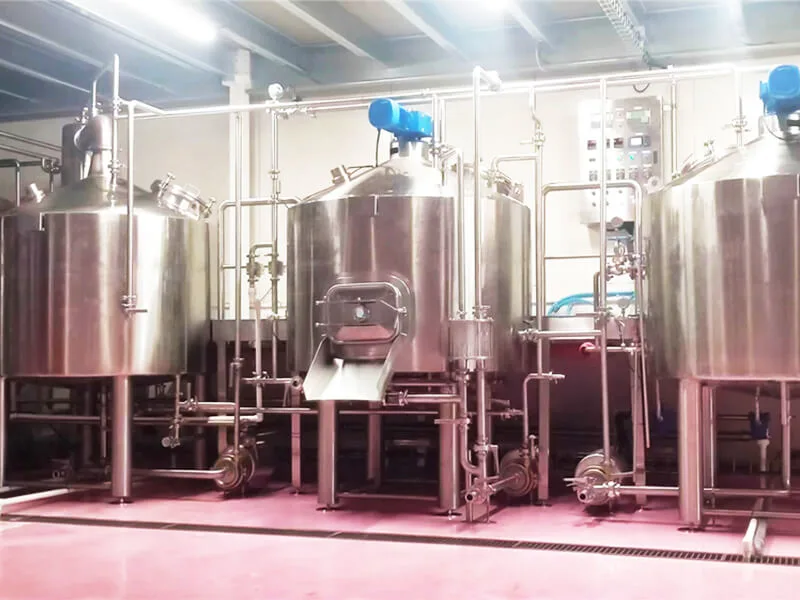
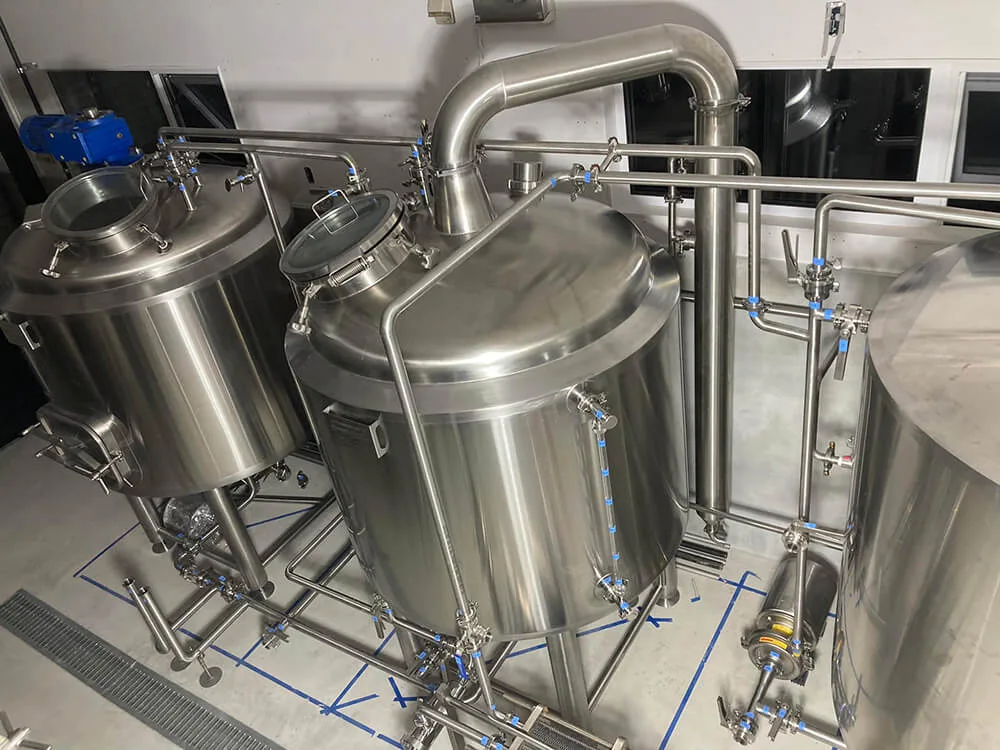
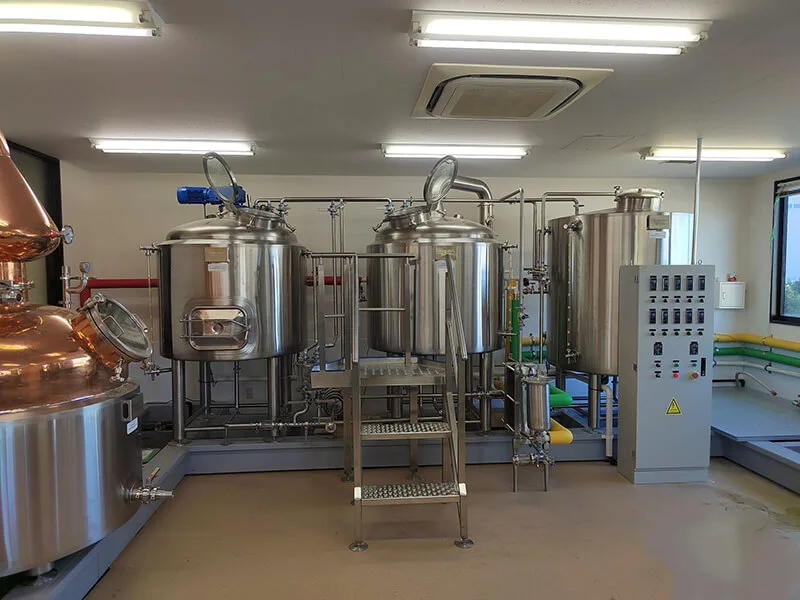
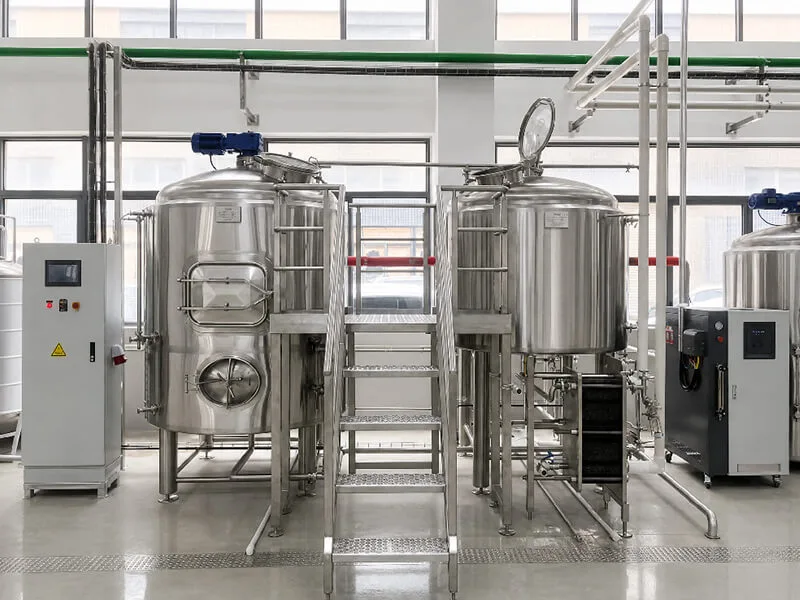
The core of the system is a 500L two-vessel, three-function brewhouse.
It consists of three main vessels:
- Mash-Lauter Tun
- Kettle-Whirlpool
- Depósito de agua caliente
The system is designed for a single-batch capacity of 500L, with temperature control to support consistent brewing operations.
Mash-Lauter Tun
The mash-lauter tun combines mashing and lautering functions in one vessel.
During mashing, crushed malt is mixed with hot water to convert starch into fermentable sugars. After the mashing process, the wort is separated from the grain bed through the lauter system.
A properly designed lautering system helps maintain efficient wort separation and supports stable extract recovery.
Kettle-Whirlpool
The kettle-whirlpool vessel performs wort boiling and whirlpool separation.
Boiling allows hop additions at different stages of the brewing process, while whirlpool separation helps remove hop particles and hot trub before wort cooling.
Combining these functions in one vessel helps reduce the overall equipment footprint.
Depósito de agua caliente
The hot water tank stores process water for mashing and sparging.
Its capacity and heating configuration can be matched to the brewing schedule and the requirements of the complete brewhouse.
Installation Requirements
The standard 500L brewhouse configuration is designed around the following installation conditions:
| Item | Reference Specification |
|---|---|
| Batch capacity | 500L |
| Brewhouse configuration | Two vessels, three functions |
| Recommended footprint | Approximately 35 m² |
| Recommended ceiling height | 2.8 m |
| Total installed power | Approximately 45 kW |
| Transportation | Suitable for a 9.6 m truck |
These figures are reference values for the described configuration. Actual installation space, electrical requirements, and transportation arrangements should be confirmed against the final equipment drawings and local site conditions.
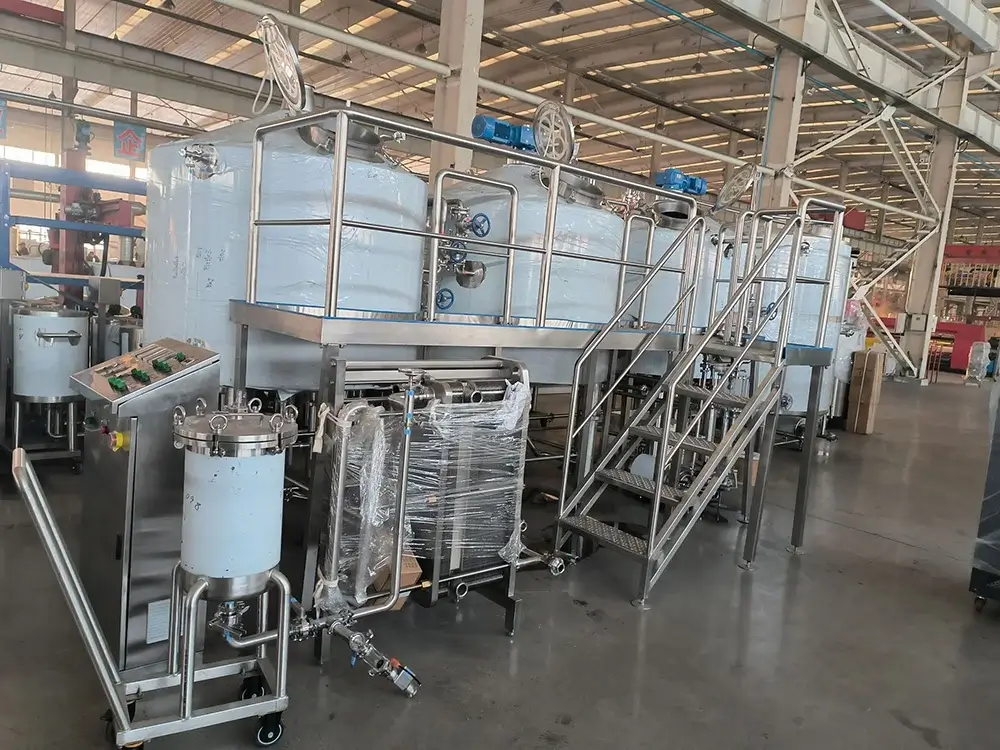
3. Six 500L Fermentation Tanks for Flexible Beer Production
Fermentation capacity directly affects the production potential of a brewery.
The standard configuration includes six 500L side-manway fermentation tanks, providing a nominal combined fermentation capacity of 3,000L.
This configuration is designed to support a daily beer output target of more than 200L under suitable brewing schedules and fermentation conditions.
For brewpubs and restaurants with an area of less than approximately 300 m², this setup provides a practical balance between production capacity and available space.
Why Side-Manway Fermenters?
Side-manway fermentation tanks provide convenient access for internal inspection and cleaning verification.
This design is particularly useful for craft breweries that frequently produce hop-intensive beer styles, where hop residues and fermentation deposits can accumulate inside the vessel.
For tanks containing heavy krausen, high hop loads, or sticky residues, operators can perform an initial manual rinse with a pressure washer before CIP cleaning, where the vessel design and cleaning procedures permit.
The CIP process then provides systematic internal cleaning and helps maintain brewery hygiene.
Temperature-Controlled Fermentation
Fermentation is where wort is transformed into beer.
Temperature management and fermentation time influence yeast activity, flavor development, aroma, and beer body.
METO’s fermentation system can be integrated with the glycol cooling system to provide controlled fermentation conditions for different beer styles.
Room for Future Expansion
The standard configuration includes six fermentation tanks, while the cooling and refrigeration system is designed with additional capacity allowance.
Depending on the final heat-load calculation and operating schedule, the system can be expanded to accommodate up to 12 fermentation tanks.
This provides an opportunity for brewery owners to increase fermentation capacity as sales demand grows.
4. Supporting Equipment for a Complete 500L Brewery
A reliable brewery requires more than a brewhouse and fermentation tanks. Supporting systems are essential for raw material preparation, cleaning, heating, and temperature management.
METO integrates the following auxiliary equipment into the 500L brewing solution.
Malt Milling System
The milling system uses a dry roller mill to crack malt kernels while keeping the husks relatively intact.
This is important for lautering efficiency. Excessively crushed husks can contribute to a compact grain bed and slow wort filtration.
The target is to break the malt kernels while avoiding unnecessary pulverization, helping maintain smooth wort separation and good extract recovery.
The reference milling capacity is 150 kg/h.
50L Mobile CIP Cleaning System
The mobile CIP system consists of:
- 50L cleaning trolley
- Alkali solution tank
- Disinfection tank
- Cleaning pump
The mobile design allows operators to move the cleaning unit between suitable cleaning points.
It is particularly practical for brewpubs and restaurants where floor space is limited.
Proper cleaning procedures help remove organic residues and reduce contamination risks between brewing batches.
50 kg/h Electric Steam Generator
The system can be equipped with an electric steam generator with a rated evaporation capacity of 50 kg/h.
It provides steam for brewhouse heating and is designed to meet the heating requirements of the 500L brewing system under the specified operating conditions.
The electric configuration avoids on-site fuel combustion and can be suitable for food service environments where the relevant electrical supply and local regulations permit.
The steam generator’s pressure classification, installation requirements, and applicable approvals should be confirmed according to the selected model and destination market.
Sistema de refrigeración por glicol
The standard cooling configuration includes:
- 1,200L glycol water tank
- 5 HP refrigeration unit
- Cooling pipelines and accessories
The cooling system supports several important brewing stages, including wort cooling, fermentation temperature control, and cold storage.
A properly sized glycol system helps maintain stable operating temperatures and supports consistent beer quality.
Final refrigeration capacity should be checked against the actual fermentation schedule, ambient temperature, tank quantity, and cooling demand.
5. Intelligent Control System: Siemens PLC or Independent Digital Control
Brewing consistency depends on accurate temperature management, stable equipment operation, and repeatable process settings.
METO offers two control configurations for the 500L craft beer equipment system.
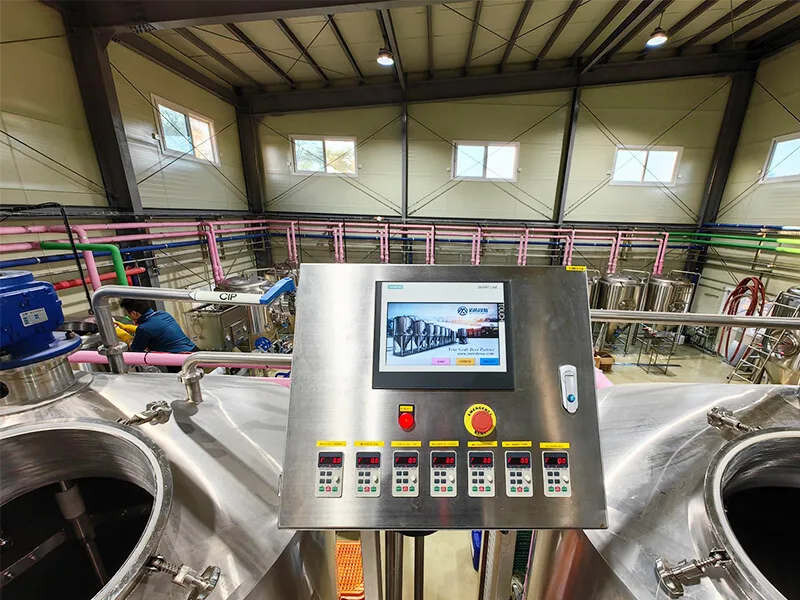
Option A: Siemens PLC with MCGS Touchscreen
For breweries looking for a higher level of automation, the system can be equipped with a Siemens PLC and MCGS touchscreen.
Main functions include:
- Centralized control of brewing processes
- Real-time monitoring of equipment operation
- Temperature and process parameter management
- Wi-Fi-based connectivity with compatible mobile devices and tablets
- Process data recording and traceability
This configuration is suitable for breweries that prioritize standardized production and centralized operation.
Remote connectivity depends on the selected configuration, network availability, and system integration.
Option B: Independent Digital Controllers
For smaller breweries that prefer straightforward operation and lower maintenance complexity, METO also offers independent digital control.
Each vessel can be controlled separately, allowing operators to manage individual equipment without relying on a centralized PLC system.
Its advantages include:
- Simple operation
- Independent vessel control
- Convenient maintenance
- Lower control-system complexity
- Practical replacement and servicing
The final control solution can be selected according to the brewery’s automation requirements, operating budget, and technical capabilities.
6. Why Choose METO for Your 500L Craft Beer Equipment?
Choosing a brewery equipment supplier is not simply about comparing vessel prices. Manufacturing capability, engineering design, system integration, and after-sales support all influence the long-term performance of a brewery.
METO is a brewery and beverage equipment manufacturer integrating engineering design, manufacturing, sales, installation, commissioning, and after-sales service.
Our manufacturing capabilities include:
- Brewery equipment manufacturing and complete system integration
- Stainless steel vessel fabrication
- Laser cutting and precision processing
- Automatic plasma welding, laser welding, and manual argon arc welding
- Surface polishing and finishing
- Equipment inspection and quality control
- Project installation and commissioning support
With experience in supplying brewing equipment to international markets, METO works with customers to configure systems according to production capacity, beer styles, available space, utilities, and local operating requirements.
We do not simply supply individual tanks. We help customers develop a complete brewing equipment solution from initial design to production.
7. Customize Your 500L Brewery Equipment
The configuration described in this article provides a reference solution. Every brewery project has different requirements.
Before preparing a quotation, METO’s engineering team can evaluate the following factors:
Production target: How much beer do you plan to produce daily, weekly, or annually?
Beer styles: Will you mainly produce lager, IPA, stout, wheat beer, or multiple styles?
Fermentation capacity: How many fermentation tanks are required, and what fermentation cycle do you expect?
Available space: What are the building dimensions, ceiling height, and equipment access conditions?
Heating method: Do you prefer electric heating, steam heating, or another suitable configuration?
Automation level: Do you need Siemens PLC control, independent digital controllers, or a customized solution?
Future expansion: Do you plan to increase fermentation capacity or brewing output in the future?
Based on these details, METO can prepare an equipment configuration and layout proposal for your project.
Preguntas frecuentes
1. How much beer can a 500L brewing system produce per day?
A 500L brewhouse produces up to 500L of nominal wort per batch. Actual packaged beer output depends on brewing frequency, wort losses, fermentation performance, filtration requirements, and packaging losses.
The reference configuration is designed to support a daily output target of more than 200L, subject to the production schedule and available fermentation capacity.
2. How many fermentation tanks are included in the 500L brewery system?
The standard configuration includes six 500L fermentation tanks, providing 3,000L of nominal fermentation capacity.
Additional tanks can be considered depending on the cooling system capacity, installation space, and production requirements. The reference design allows expansion to up to 12 tanks after engineering verification.
3. How much space is required for a 500L brewery?
The reference brewhouse installation footprint is approximately 35 m², with a recommended ceiling height of 2.8 m.
However, the complete brewery also requires space for fermentation tanks, cooling equipment, CIP cleaning, raw materials, and packaging operations.
A site layout should be prepared before installation.
4. Can the 500L system be used in a restaurant or hotel?
Yes. A 500L brewing system can be configured for craft brewpubs, hotel restaurants, and other food and beverage businesses.
The final design should consider available floor space, electrical supply, drainage, ventilation, steam requirements, and local food safety and building regulations.
5. Can METO customize the 500L brewing system?
Yes. METO can customize vessel configurations, fermentation tank quantities, heating methods, cooling systems, control systems, and auxiliary equipment according to project requirements.
6. Can I expand production after purchasing the 500L system?
Yes. The brewery can be planned with future expansion in mind.
For example, additional fermentation tanks can increase production flexibility without necessarily replacing the original brewhouse. The feasibility of expansion depends on the existing cooling capacity, utility supply, floor space, and process requirements.
Start Your Craft Brewery Project with METO
A successful craft brewery starts with the right equipment configuration.
Whether you are opening a craft brewpub, adding an on-site brewery to a restaurant, establishing a microbrewery, or building a brewing training facility, METO can help you develop a suitable 500L craft beer equipment solution.
As a brewery equipment manufacturer, we provide engineering design, equipment fabrication, system integration, and project support.
Contactar con METO to discuss your brewery project.
Send us your expected production capacity, available installation space, preferred beer styles, and project location. Our team can help you evaluate the equipment configuration and prepare a solution based on your actual requirements.