For brewers worldwide, whether operating a large-scale brewery or a craft brewing workshop, fermenter temperature control is the foundation of consistent beer quality. While many focus on malt and hops, improper temperature control in a fermentation system can directly cause cloudy beer, off-flavors, and even batch loss.
This guide shares practical, field-tested temperature control strategies to help you avoid common mistakes and produce beer that is clear in appearance and clean in taste.
Why Fermentation Temperature Is the “Lifeline” of Beer Quality
Beer fermentation is essentially the metabolic process of yeast. Temperature acts as the “master switch” that controls yeast activity:
- Too high → excessive fusel alcohols (harsh, dizzying effect) and esters (overly fruity or solvent-like flavors)
- Too low → sluggish fermentation, under-attenuation, and flat taste
More importantly, temperature fluctuations can destroy beer stability:
- Protein–polyphenol complexes → permanent haze
- Yeast stress → off-flavors (sour, metallic, or “stale rice” notes)
For international brewers, this is one of the most common yet overlooked causes of inconsistent beer quality.
Stage-by-Stage Fermenter Temperature Control (Practical Method)
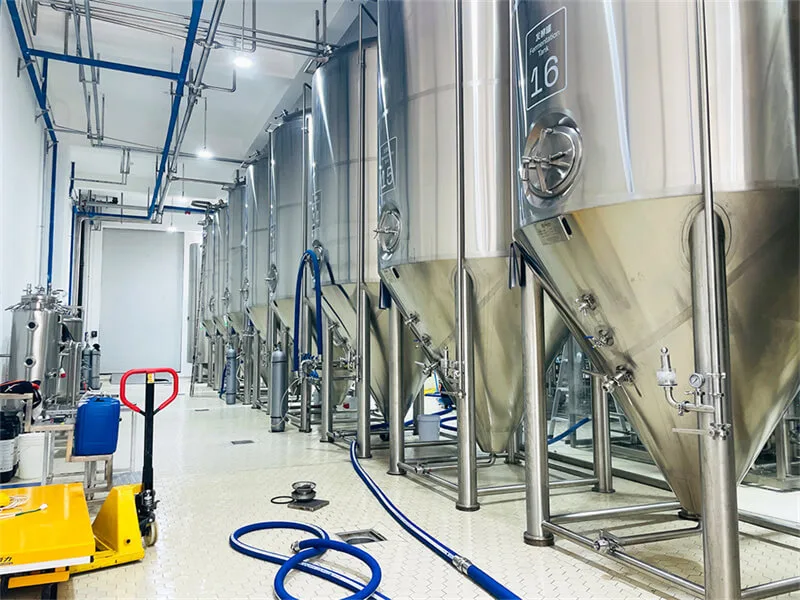
Modern breweries widely use conical fermenters (brewery tanks). The following staged control method works for most beer styles and is easy to implement.
1. Pitching Stage: Activate Yeast Properly
Before pitching, adjust wort temperature to match yeast requirements:
- Ale fermentation: 18–22°C
- Lager fermentation: 8–10°C
Pro tip:
In colder environments, you may start slightly higher (up to ~30°C for yeast activation), then gradually cool down to the target range.
Maintain stable temperature for 12–24 hours to ensure proper yeast adaptation and distribution.
2. Primary Fermentation: Control Heat & Prevent Off-Flavors
This is the most active stage, where yeast generates significant heat.
Early phase (Day 0–3):
- Keep temperature at or slightly above pitching level
- Ale: 20–22°C
- Lager: 9–11°C
Late phase (Day 4–7):
- Gradually reduce temperature
- Ale: 16–18°C
- Lager: 5–6°C
This step is critical to:
- Reduce ester overproduction
- Improve flavor balance
- Avoid “overly fruity” or harsh profiles
3. Diacetyl Rest: Remove Off-Flavors
Diacetyl creates an undesirable buttery or “stale” flavor.
To eliminate it:
- Ale: raise to 20–22°C for 2–3 days
- Lager: raise to 12–14°C for 3–5 days
Increase temperature slowly (≤1°C per hour) to avoid yeast stress.
4. Conditioning (Cold Maturation): Achieve Clarity
This stage determines beer clarity and stability.
- Lower temperature gradually to 0–2°C
- Hold for 7–14 days
Vorteile:
- Protein and polyphenol precipitation
- Yeast sedimentation
- Cleaner, more stable flavor
Cold crash technique:
Rapid cooling at the end further improves clarity, especially for lagers.
Common Temperature Control Mistakes (And How to Avoid Them)
Mistake 1: Constant Temperature Fermentation
Different fermentation stages require different temperatures. A fixed setting leads to:
- Incomplete fermentation
- Excess esters or diacetyl
Mistake 2: Large Temperature Fluctuations
Variations above ±1°C can stress yeast and cause haze or instability.
Solution:
- Use precise temperature control systems
- Maintain deviation within ±0.5°C
Mistake 3: Ignoring Heating in Cold Conditions
In winter or cold regions:
- Low temperature can stall fermentation
- Yeast becomes inactive
Solution:
- Use heating belts or low-density heating elements
- Combine heating + cooling for full control
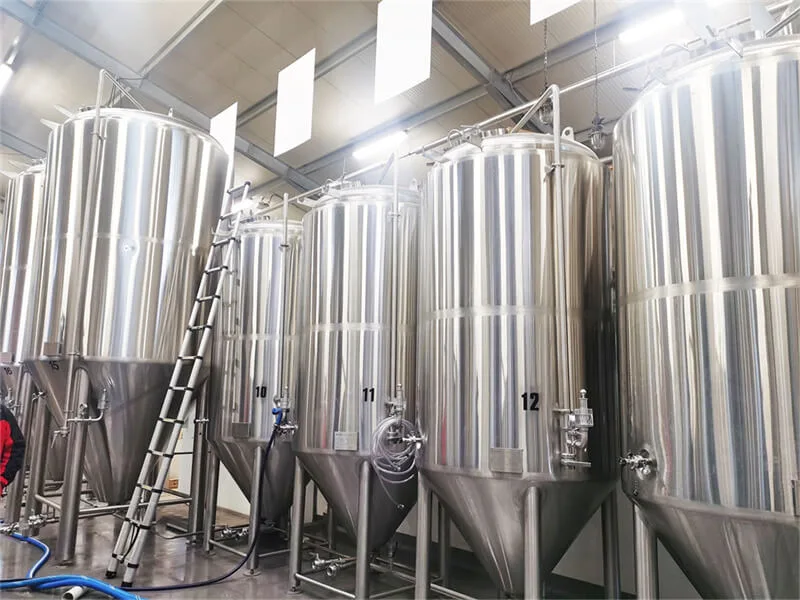
Equipment That Improves Temperature Control Precision
Reliable equipment is essential for stable fermentation:
- Conical fermenters (brewery tanks)
With cooling jackets and insulation for precise control and better yeast sedimentation - Digital temperature controllers
(e.g., widely used controllers in craft breweries) for automated monitoring - Glycol cooling systems
Provide uniform cooling and prevent temperature stratification - Multiple temperature probes
Monitor top, middle, and bottom zones inside the fermenter
Key Takeaway: Dynamic Temperature Control, Not Fixed Settings
The core principle of fermentation temperature control is dynamic adjustment, not constant temperature.
Brewers should:
- Adapt temperature to yeast strain and beer style
- Control each fermentation stage precisely
- Maintain stability and avoid fluctuations
Mastering this approach allows you to:
- Prevent cloudy beer
- Eliminate off-flavors
- Achieve consistent, high-quality production
Abschließende Überlegungen
Temperature control may seem simple, but it directly defines the upper limit of your beer quality. With proper staged control, reliable fermentation systems, and avoidance of common mistakes, every batch can achieve excellent clarity, stability, and flavor balance.
If you need help with fermenter selection, brewery tank configuration, or yeast-specific temperature profiles, feel free to reach out — optimizing your brewing system is the fastest way to improve product consistency and competitiveness.
👉 Kontaktieren Sie uns heute for a custom brewhouse system design tailored to your production goals, budget, and future expansion plans.